From Surf Wiki (app.surf) — the open knowledge base
Theotokos
Title of Mary in Eastern Christianity
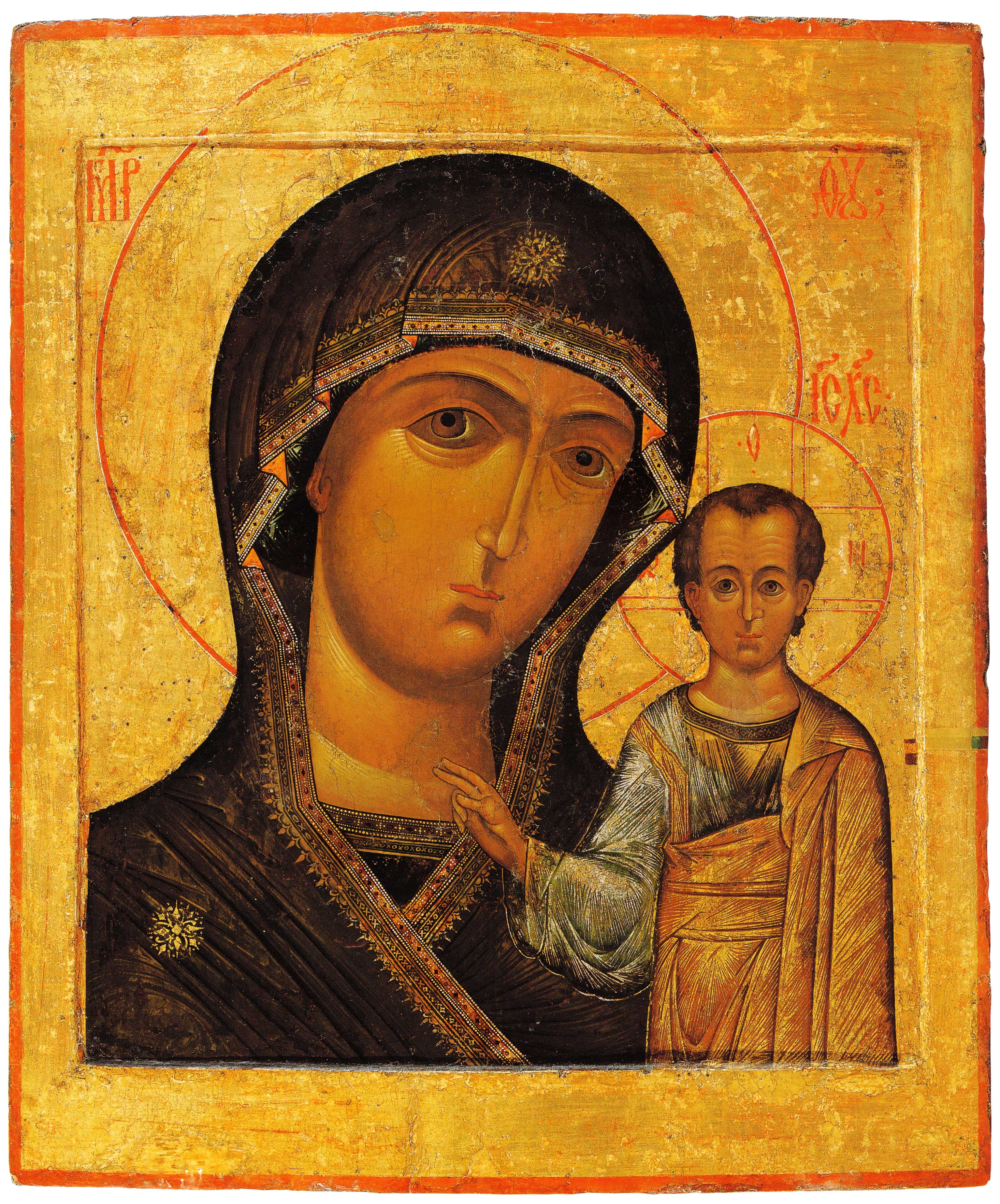
Title of Mary in Eastern Christianity
Theotokos () is a title of Mary, mother of Jesus, used especially in Eastern Christianity. The usual Latin translations are Dei Genitrix or Deipara (approximately "parent [] of God"). Common English translations are "Mother of God" or "God-bearer" – but these both have different literal equivalents in , and Θεοφόρος respectively.
The title has been in use since the 3rd century, and in the Liturgy of Saint James (4th century). The Council of Ephesus in AD 431 decreed that Mary is the Theotokos because her son Jesus is both God and man: one divine person from two natures (divine and human) intimately and hypostatically united.
The title of Mother of God () or Mother of Incarnate God, abbreviated ΜΡ ΘΥ (the first and last letter of main two words in Greek), is most often used in English, largely due to the lack of a satisfactory equivalent of the Greek τόκος. For the same reason, the title is often left untranslated, as , in Eastern liturgical usage of other languages.
Theotokos is also used as the term for an Eastern icon, or type of icon, of the Mother with Child (typically called a Madonna in the Western tradition), as in "the Theotokos of Vladimir" both for the original 12th-century icon and for icons that are copies or imitate its composition.
Etymology
Etymology Main article: Titles of Mary

Theotokos is an adjectival compound of two Greek words Θεός "God" and τόκος "childbirth, parturition; offspring". A close paraphrase would be "[she] whose offspring is God" or "[she] who gave birth to one who was God". The usual English translation is "Mother of God"; Latin uses Deipara or Dei Genitrix.
The Church Slavonic translation is Bogoroditsa (Russian/Serbian/Bulgarian Богородица). The full title of Mary in Slavic Orthodox tradition is Прест҃а́ѧ влⷣчица на́ша бцⷣа и҆ прⷭ҇нод҃ва мр҃і́а (), from Greek Ὑπεραγία δέσποινα ἡμῶν Θεοτόκος καὶ ἀειπάρθενος Μαρία "Our Most Holy Lady Theotokos and Ever-Virgin Mary". German has the translation Gottesgebärerin (). In Arabic, there are two main terms which are widely used at the general level, first one is: Walidatu-liilahi ( ) and Ùmmu-'llahi () or Ùmmu-l'iilahi, (), ).
"Mother of God" is the literal translation of a distinct title in Greek, Μήτηρ τοῦ Θεοῦ (), a term which has an established usage of its own in traditional Orthodox and Catholic theological writing, hymnography, and iconography. The Second Vatican Council stated: "Clearly from earliest times the Blessed Virgin is honoured under the title of Mother of God." Pope Paul VI, Lumen gentium, 66 In an abbreviated form, ΜΡ ΘΥ (), it often is found on Eastern icons, where it is used to identify Mary. The Russian term is Матерь Божия (also Богома́терь).
Variant forms are the compounds
The theological dispute over the term concerned the term Θεός "God" versus Χριστός "Christ", and not τόκος (genitrix, "bearer") versus μήτηρ (mater, "mother"), and the two terms have been used as synonyms throughout Christian tradition. Both terms are known to have existed alongside one another since the Early Church, but it has been argued, including in modern times, that the term "Mother of God" is unduly suggestive of Godhead having its origin in Mary, imparting to Mary the role of a Mother Goddess. But this is an exact reiteration of the objection by Nestorius, resolved in the 5th century, to the effect that the term "Mother" expresses exactly the relation of Mary to the incarnate Son ascribed to Mary in Christian theology.
Theology
Theologically, the terms "Mother of God", "Mother of Incarnate God" (and its variants) does not mean that Mary is the source of the divine nature of Jesus, who Christians believe existed with the Father from all eternity.
Within the Orthodox and Catholic tradition, Mother of God has not been understood, nor been intended to be understood, as referring to Mary as Mother of God from eternity — that is, as Mother of God the Father — but only with reference to the birth of Jesus, that is, the Incarnation. To make it explicit, it is sometimes translated Mother of God Incarnate.
The Niceno-Constantinopolitan Creed of 381 affirmed the Christian faith on "one Lord Jesus Christ, the only-begotten Son of God, begotten of the Father before all worlds (æons)", that "came down from heaven, and was incarnate by the Holy Ghost and of the Virgin Mary, and was made man". Hence, the term affirms Jesus Christ's full divinity as God by referencing Mary as the "Mother of [that] God". In the Syriac tradition, the creed contains an addition of Theotokos after mentioning the incarnation, where it reads "...was incarnate by the Holy Spirit and of the Virgin Mary, Mother of God ."
The status of Mary as Theotokos was a topic of theological dispute in the 4th and 5th centuries and was the subject of the decree of the Council of Ephesus of 431 to the effect that, in opposition to those who denied Mary the title Theotokos ("the one who gives birth to God") but called her Christotokos ("the one who gives birth to Christ"), Mary is Theotokos because her son Jesus is one person who is both God and man, divine and human. This decree created the Nestorian Schism. Cyril of Alexandria wrote, "I am amazed that there are some who are entirely in doubt as to whether the holy Virgin should be called Theotokos or not. For if our Lord Jesus Christ is God, how is the holy Virgin who gave [Him] birth, not [Theotokos]?" (Epistle 1, to the monks of Egypt; PG 77:13B). But the argument of Nestorius was that divine and human natures of Christ were distinct, and while Mary is evidently the Christotokos (bearer of Christ), it could be misleading to describe her solely as the "bearer of God" without referencing the humanity. At issue is the interpretation of the Incarnation, and the nature of the hypostatic union of Christ's human and divine natures between Christ's conception and birth.
Within the Orthodox doctrinal teaching on the economy of salvation, Mary's identity, role, and status as Theotokos is acknowledged as indispensable. For this reason, it is formally defined as official dogma. The only other Mariological teaching so defined is that of her virginity. Both of these teachings have a bearing on the identity of Jesus Christ. By contrast, certain other Marian beliefs which do not bear directly on the doctrine concerning the person of Jesus (for example, her sinlessness, the circumstances surrounding her conception and birth, her Presentation in the Temple, her continuing virginity following the birth of Jesus, and her death), which are taught and believed by the Orthodox Church (being expressed in the Church's liturgy and patristic writings), are not formally defined by the Church.
History of use
Early Church
The term and similar titles were certainly in use before the 4th century. Ephrem the Syrian used it in 318, Alexander I of Alexandria in 321,Athanasius of Alexandria in 330, Gregory the Theologian in 370, John Chrysostom in 400, and Augustine all used Theotokos.
Origen (d. 254) is often cited as the earliest author to use Theotokos for Mary (Socrates, Ecclesiastical History 7.32 (PG 67, 812 B) citing Origen's Commentary on Romans), but the surviving texts do not contain it. It is also claimed that the term was used c. 250 by Dionysius of Alexandria, in an epistle to Paul of Samosata, but the epistle is a forgery of the 6th century.
The oldest preserved extant hymn dedicated to the Virgin Mary, Ὑπὸ τὴν σὴν εὐσπλαγχνίαν (English: Beneath thy Compassion, ,) has been continually prayed and sung for at least sixteen centuries, in the original Koine Greek vocative, as ΘΕΟΤΟΚΕ. The oldest record of this hymn is a papyrus found in Egypt, mostly dated to after 450, but according to a suggestion by Henri de Villiers possibly older, dating to the mid-3rd century.
John Cassian (360–435) stated:
Basil of Caesarea (330–378) stated:
Augustine of Hippo (354–430) stated:
Third Ecumenical Council
.jpg)
The use of Theotokos was formally affirmed at the Third Ecumenical Council held at Ephesus in 431. It proclaimed that Mary truly became the Mother of God by the human conception of the Son of God in her womb:
The competing view, advocated by Patriarch Nestorius of Constantinople, was that Mary should be called Christotokos, meaning "Birth-giver of Christ," to restrict her role to the mother of Christ's humanity only and not his divine nature.
Nestorius' opponents, led by Cyril of Alexandria, alleged that this view, in conjunction with Nestorius's two-nature Christology, leads to two persons in Christ, which results in an incomplete incarnation and, by extension, incomplete salvation for mankind. The council accepted Cyril's reasoning and his one-nature Christology, affirmed the title Theotokos for Mary, and anathematized Nestorianism as heresy.
In letters to Nestorius which were afterwards included among the council documents, Cyril explained his doctrine. He noted that "the holy fathers... have ventured to call the holy Virgin Theotokos, not as though the nature of the Word or his divinity received the beginning of their existence from the holy Virgin, but because from her was born his holy body, rationally endowed with a soul, with which the Word was united according to the hypostasis, and is said to have been begotten according to the flesh" (Cyril's second letter to Nestorius).
Explaining his rejection of Nestorius' preferred title for Mary (Christotokos), Cyril wrote:
Nestorian schism
Main article: Nestorian schism
Following the decision of the Council of Ephesus to anathematize the two-nature formula and its adherents such as Ibas of Edessa, the followers of Nestorius (but not Nestorius himself) moved eastwards within the borders of the Sassanid Empire. There they spread their ideology, and eventually, their later student, Barsauma of Nisibis, is often credited with the official establishment of the Church of the East in 424. Other influential figures include Narsai, Babai the Great, and Babai of Seleucia-Ctesiphon. The Church accepts the teachings of Nestorius's mentor, Theodore of Mopsuestia, as official doctrine. Whether the Church of the East is truly "Nestorian" is a subject of debate, and modern research suggests that the Church of the East in China did not teach a doctrine of two distinct natures of Christ.
Reformation
Lutheran tradition retained the title of "Mother of God" (, Gottesmutter), a term already embraced by Martin Luther; and officially confessed in the Formula of Concord (1577), accepted by the Lutheran World Federation.
Whilst Calvin believed that Mary was theologically speaking rightly qualified as "the mother of God", he rejected common use of this as a title, saying, "I cannot think such language either right, or becoming, or suitable. ... To call the Virgin Mary the mother of God can only serve to confirm the ignorant in their superstitions."
20th century
In 1994, Pope John Paul II and Patriarch of the Assyrian Church of the East Mar Dinkha IV signed an ecumenical declaration, mutually recognizing the legitimacy of the titles "Mother of God" and "Mother of Christ." The declaration reiterates the Christological formulations of the Council of Chalcedon as a theological expression of the faith shared by both Churches, at the same time respecting the preference of each Church in using these titles in their liturgical life and piety.
Liturgy
Theotokos is often used in hymns to Mary in the Eastern Orthodox, Eastern Catholic and Oriental Orthodox Churches. The most common is Axion Estin (It is truly meet), which is used in nearly every service.
Other examples include Sub tuum praesidium, the Hail Mary in its Eastern form, and All creation rejoices, which replaces Axion Estin at the Divine Liturgy on the Sundays of Great Lent. Bogurodzica is a medieval Polish hymn, possibly composed by Adalbert of Prague (d. 997).
The Solemnity of Mary, Mother of God is a Roman Catholic feast day introduced in 1969, based on older traditions associating 1 January with the motherhood of Mary.
Iconography
Main article: Madonna (art)
One of the two earliest known depictions of the Virgin Mary is found in the Catacomb of Priscilla (3rd century) showing the adoration of the Magi. Recent conservation work at the Catacombs of Priscilla revealed that what had been identified for decades as the earliest image of the Virgin and Child was actually a traditional funerary image of a Roman matron; the pointing figure with her, formerly identified as a prophet, was shown to have had its arm position adjusted and the star he was supposedly pointing to was painted in at a later date. The putative Annunciation scene at Priscilla is also now recognized as a Roman matron with accompanying figure and not the Virgin Mary. Recently another third-century image of the Virgin Mary was identified at the eastern Syrian site of Dura Europos in the baptistry room of the earliest known Christian Church. The scene shows the Annunciation to the Virgin.
The tradition of Marian veneration was greatly expanded only with the affirmation of her status as Theotokos in 431. The mosaics in Santa Maria Maggiore in Rome, dating from 432 to 40, just after the council, does not yet show her with a halo. The iconographic tradition of the Theotokos or Madonna (Our Lady), showing the Virgin enthroned carrying the infant Christ, is established by the following century, as attested by a very small number of surviving icons, including one at Saint Catherine's Monastery in Sinai, and Salus Populi Romani, a 5th or 6th-century Byzantine icon preserved in Rome. This type of depiction, with subtly changing differences of emphasis, has remained the mainstay of depictions of Mary to the present day. The roughly half-dozen varied icons of the Virgin and Child in Rome from the 6th to 8th centuries form the majority of the representations surviving from this period, as most early Byzantine icons were destroyed in the Byzantine Iconoclasm of the 8th and 9th century, notable exceptions being the 7th-century Blachernitissa and Agiosoritissa.
The iconographic tradition is well developed by the early medieval period. The tradition of Luke the Evangelist being the first to have painted Mary is established by the 8th century.
An early icon of the Virgin as queen is in the church of Santa Maria in Trastevere in Rome, datable to 705–707 by the kneeling figure of Pope John VII, a notable promoter of the cult of the Virgin, to whom the infant Christ reaches his hand.
The earliest surviving image in a Western illuminated manuscript of the Madonna and Child comes from the Book of Kells of about 800 (there is a similar carved image on the lid of St Cuthbert's coffin of 698). The oldest Russian icons were imports from Byzantium, beginning in the 11th century.
Gallery
File:Icon of the blessed Virgin Mary by Luke the Evangelist.jpg|Icon of Virgin Mary in Monastery of Saint Mark, traditionally attributed to Luke the Evangelist File:Virgin salus populi romani.jpg|Salus Populi Romani, Rome (5th or 6th century) File:Encaustic Virgin.jpg|Theotokos icon of Saint Catherine's Monastery, Sinai (6th century) File:Vlahernskaya.jpg|Blachernae Icon of the Theotokos (7th century) File:Byzantinischer Mosaizist des 12. Jahrhunderts 002.jpg|Mother of God, mosaic icon, Hagia Sophia (12th century) File:VergineTricherusa.jpg|Trojeručica, (c. 8th century), Serbia File:Gelati Theotokos.jpg|Mosaic (ca 1130), Gelati Monastery, Georgia (12th century) File:The Mother of God Trenousa (17-18. century).jpg|Theotokos icon (17–18. century), National Museum of Serbia
Russian icons Image:Theotokos Iverskaya.jpg|The Iveron Theotokos (Iverskaya), an 11th-century Russian icon based on the 10th-century Hodegetria type, Iviron Monastery, Mount Athos. Image:Svenskaya.jpg|Theotokos Panachranta from Svensky Monastery, by St. Alypios of Kiev (11th century) Image:Panachranta.jpg|Panachranta Theotokos, mid-11th-century Kievan illumination from the Gertrude Psalter. Image:Vladimirskaya.jpg|Theotokos of Vladimir (c. 1100) File:Fedorovskaya3.jpg|Theotokos of St. Theodore (12th century) Image:Our Lady Derzhavnaya.jpg|Our Lady Derzhavnaya (18th century) File:Neuvyadaemii cvet 18th century icon.jpg| Bogomater of the "Unfading Flower" (Неувядаемый Цвет) type (18th century, Tretyakov Gallery)
Notes
References
References
- {{Cite OED. Theotokos
- {{MerriamWebsterDictionary. Theotokos
- {{Dictionary.com. Theotokos
- Ph. Schaff, H Wace ''Nicene and Ante-Nicene Fathers'', II.XIV ({{usurped
- J.F. Bethune-Baker, ''Nestorius and His Teachings: A Fresh Examination of the Evidence'' (1998), [https://books.google.com/books?id=WHFKAwAAQBAJ&pg=PA58 p. 58]
- "CHURCH FATHERS: Divine Liturgy of St. James". Newadvent.org.
- (2005-06-01). "NPNF2-14. The Seven Ecumenical Councils - Christian Classics Ethereal Library". Ccel.org.
- Pelikan, Jaroslav. (1998). "Mary Through the Centuries". Yale University Press.
- [https://ru.wikisource.org/wiki/ЭСБЕ/Богоматерь-Богородица Богоматерь-Богородица] [[Brockhaus and Efron Encyclopedic Dictionary. Энциклопедический словарь Брокгауза и Ефрона]] : в 86 т. (82 т. и 4 доп.). — СПб., 1890—1907.
- Saint Methodius of Patara. (1865). "S. Methodii Opera Et S. Methodius Platonizans". Halis Saxonum, C.E.M. Pfeffer.
- Pyrros, Dionysios. (1852). "Panthektē: hiera ekklēsiastikē periechousa to Pentēkostarion".
- Ph. Schaff, H Wace (eds.), ''Early Church Fathers'', ''Nicene and Ante-Nicene Fathers'', Ser. II, Vol. XIV, {{usurped
- Father William Saunders. (December 22, 1994). "Mary, Mother of God". The Arlington Catholic Herald (retrieved from EWTN).
- (August 10, 2004). "Mary: Mother of God". Catholic Answers.
- "We recognize the Blessed Virgin Mary as the {{lang. el. Theotókos, the mother of God incarnate, and so observe her festivals and accord her honour among the saints." ''Mary: Grace and Hope in Christ'' by the Anglican-Roman Catholic International Commission (ARCIC II)
- (2004). "Mary, Mother of God". William B. Eerdmans Publishing Company.
- E. A. Wallis Budge, M.A.. "E.A.Wallis Budge, On a Fragment of a Coptic Version of Saint Ephraim's Discourse on the Transfiguration of our Lord, Proceedings of the Society of Biblical Archaeology, vol. 9".
- "Alexander of Alexandria: Epistles on the Arian Heresy".
- "CHURCH FATHERS: Discourse III Against the Arians (Athanasius)". (Buffalo, NY: Christian Literature Publishing Co., 1892.).
- (2012-06-24). "The rejection of the term Theotokos by Nestorius Constantinople and the refutation of his teaching by Cyril of Alexandria". Egolpion.com.
- de Villiers, Henri. (2011-02-03). "The Sub Tuum Praesidium". New Liturgical Movement.
- Wolfgang A. Bienert, "Dionysius von Alexandrien: zur Frage d. Origenismus im 3. Jh", de Gruyter (1978), pp.47-49.
- "The Oldest Hymn To the Theotokos".
- G. Vannucci, ''Marianum'', 1941 (3), pp. 97-101, "La piu antica preghiera alla Madre de Dio". [http://www.trismegistos.org/text/64320 P. Ryl. Gr. 3 470] (Roberts, Colin Henderson) = Le Muséon 52 (1939), p. 229-233 (Mercenier, P. F. ) = [[Zeitschrift für katholische Theologie]] 74 (1952), p. 76-82 (Stegmüller, Otto). "Date: AD 450 - 799".
- "CHURCH FATHERS: On the Incarnation, Book VI (John Cassian)".
- "CHURCH FATHERS: On the Incarnation, Book II (John Cassian)".
- "CHURCH FATHERS: Letter 360 (St. Basil)".
- "CHURCH FATHERS: On the Trinity, Book II (Hilary of Poitiers)".
- "Catechism of the Catholic Church - Paragraph # 466".
- (2003-12-08). "The Church of the East: A Concise History". Routledge.
- Hofrichter, Peter L.. (2006). "Jingjiao: the Church of the East in China and Central Asia". Steyler Verlagsbuchhandlung GmbH.
- (2005). "Festival Sermons of Martin Luther". Mark V Publiscations.
- Tappert, Theodore G.. "The Book of Concord: The Confessions of the Evangelical Lutheran Church". Fortress Press.
- (10 July 1993). "7th Plenary in Sandbjerg, Denmark". The Lutheran World Federation.
- Calvin, John. (February 1, 2007). "Letters of John Calvin". Wipf and Stock Publishers.
- "Common Christological Declaration between the Catholic Church and the Assyrian Church of the East".
- ''Universal Norms on the Liturgical Year and the Calendar'', 35 f.
- "Marialis Cultus (February 2, 1974) | Paul VI".
- Geri Parlby, "The Origins of Marian Art in the Catacombs and the Problems of Identification," in Chris Maunder, ed., Origins of the Cult of the Virgin Mary (London: Bloomsbury Academic, 2008) 41-56.
- Michael Peppard, The World’s Oldest Church: Bible, Art and Ritual at Dura Europos, Syria (New Haven: Yale, 2015)
- Nees, Lawrence. (2002). "Early medieval art". Oxford University Press.
- Michele Bacci, ''Il pennello dell'Evangelista. Storia delle immagini sacre attribuite a san Luca'' (Pisa: Gisem, 1998).
This article was imported from Wikipedia and is available under the Creative Commons Attribution-ShareAlike 4.0 License. Content has been adapted to SurfDoc format. Original contributors can be found on the article history page.
Ask Mako anything about Theotokos — get instant answers, deeper analysis, and related topics.
Research with MakoFree with your Surf account
Create a free account to save articles, ask Mako questions, and organize your research.
Sign up freeThis content may have been generated or modified by AI. CloudSurf Software LLC is not responsible for the accuracy, completeness, or reliability of AI-generated content. Always verify important information from primary sources.
Report