From Surf Wiki (app.surf) — the open knowledge base
Theodosius Cistern
Ancient cistern in Istanbul, Turkey
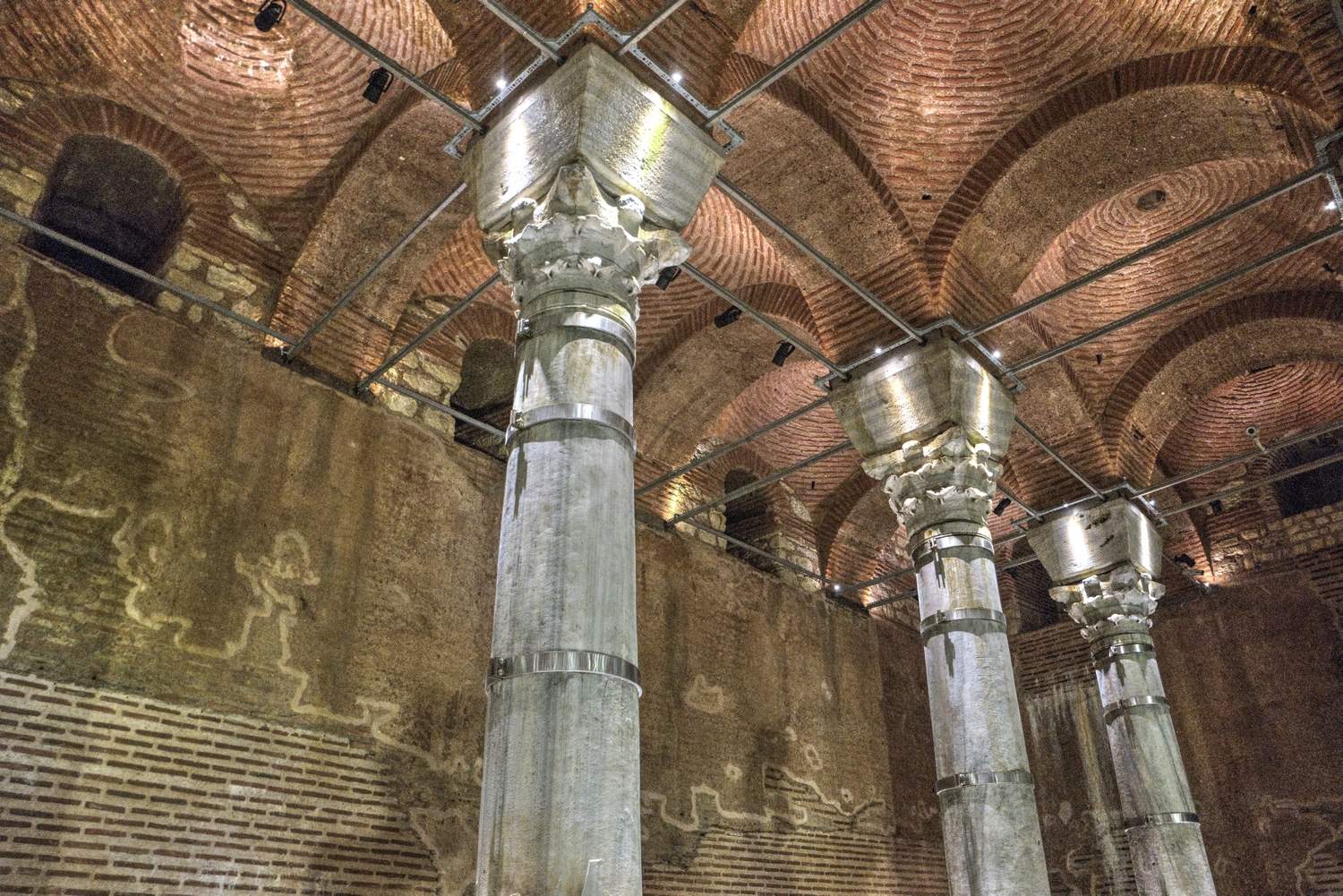
Ancient cistern in Istanbul, Turkey
| Field | Value |
|---|---|
| name | Theodosius Cistern |
| image | Theodosius_cistern_08.jpg |
| caption | Theodosius Cistern |
| map_type | Istanbul Fatih#Turkey |
| map_caption | Position of the cistern |
| altitude_m | |
| relief | 1 |
| coordinates | |
| location | Fatih, Istanbul |
| type | Cistern |
| length | 40 m |
| width | 20 m |
| height | 11 m |
| built | 428–443 |
| abandoned | 15th century |
| epochs | |
| website |
The Theodosius Cistern (, ) is one of many ancient cisterns of Constantinople that lie beneath the city of Istanbul, Turkey. The modern entrance is in Piyer Loti Caddesi, Fatih.
Background
Constantinople had insufficient water resources. Since the Lycus river running through the historic Peninsula of Constinople was not an efficient water supplier, water had to be brought from outside of the city. Storing water was needed also due to population density and the sieges suffered. During centuries, the city built and used a great number of open-air and roofed cisterns.
History
The cistern was built by Roman Emperor Theodosius II () between 428 and 443 to store water supplied by the Valens Aqueduct. Water from the Aqueduct of Valens was redistributed by the Theodosius Cistern from its original supply to the Nymphaeum, the Baths of Zeuxippus and the Great Palace of Constantinople.
Architecture
The cistern area is about 20 by, and the roof with 45 sail vaults is supported by 32 marble columns about 11 m high. All column capitals are of Corinthian order with stylized acanthus leaves bearing impost blocks above. The marble of the columns was brought from Marmara Island. The interior walls of the cistern are covered with waterproof plaster, and its corners are curved to withstand water pressure. The wall thickness is around 2.5 m.
Ottoman Empire era
During the Ottoman Empire era, cisterns were not in use because still water was considered as unhealthy.
Yet sometime around the late 18th or early 19th century, its existence was completely forgotten after a large private estate was built on the site, which was used by the municipality services from 1912 on, and it lay hidden for many years.
Today
In 2010, the cistern was rediscovered under the building when Istanbul Metropolitan Municipality demolished the annex building. Locally, it is named Şerefiye Cistern after the neighborhood it is situated.
Like the Basilica Cistern and the Binbirdirek Cistern, it is once again open to the public, having been under restoration for eight years as of April 2018.
The 360-degree projection mapping system integrated in the cistern structure offers the visitors an extraordinary museum experience.
References
References
- Morrow Lisa. "The extraordinary and ancient secret places hidden under Turkey". [[CNN]].
- (27 April 2018). "Theodosius Cistern, a witness to Istanbul's long history". [[Daily Sabah]].
- (6 December 2023). "Şerefiye Sarnıcı". Kultur İstanbul.
- Kerm, Ali. (11 July 2018). "İstanbul'un Eski Su Kaynakları; Sarnıçlar".
This article was imported from Wikipedia and is available under the Creative Commons Attribution-ShareAlike 4.0 License. Content has been adapted to SurfDoc format. Original contributors can be found on the article history page.
Ask Mako anything about Theodosius Cistern — get instant answers, deeper analysis, and related topics.
Research with MakoFree with your Surf account
Create a free account to save articles, ask Mako questions, and organize your research.
Sign up freeThis content may have been generated or modified by AI. CloudSurf Software LLC is not responsible for the accuracy, completeness, or reliability of AI-generated content. Always verify important information from primary sources.
Report