From Surf Wiki (app.surf) — the open knowledge base
The War of the Worlds
1898 science fiction novel by H. G. Wells
1898 science fiction novel by H. G. Wells
| Field | Value |
|---|---|
| name | The War of the Worlds |
| author | H. G. Wells |
| illustrator | Warwick Goble |
| image | The War of the Worlds first edition.jpg |
| caption | 1898 UK first edition |
| country | England |
| language | English |
| genre | Science fiction |
| publisher | William Heinemann (UK) |
| Harper & Bros (US) | |
| release_date | 1898 |
| pages | 319 |
| isbn | |
| wikisource | The War of the Worlds |
Harper & Bros (US)
The War of the Worlds is a science fiction novel by English author H. G. Wells about an attempted invasion of Earth by beings from the planet Mars with much greater intelligence and more advanced weapons than humans. The Martians intend to eliminate mankind and conquer Earth because their own older and smaller world has reached the "last stage of exhaustion". It was written between 1895 and 1897, and serialised in Pearson's Magazine in the UK and Cosmopolitan magazine in the US in 1897. The full novel was first published in hardcover in 1898 by William Heinemann. The War of the Worlds is one of the earliest stories to detail a conflict between humankind and an extraterrestrial race. The novel is the first-person narrative of an unnamed protagonist in Surrey and his younger brother who escapes to Tillingham in Essex as London and Southern England are invaded by Martians. It is one of the most commented-on works in the science fiction canon.
The plot is similar to other works of invasion literature from the same period and has been variously interpreted as a commentary on the theory of evolution, imperialism, and Victorian era fears, superstitions and prejudices. Wells later noted that inspiration for the plot was the catastrophic effect of European colonisation on the Aboriginal Tasmanians. Some historians have argued that Wells wrote the book to encourage his readership to question the morality of imperialism. In the preface to his collected works in 1933, Wells explained: "My early, profound and lifelong admiration for [Jonathan] Swift...is particularly evident in a predisposition to make the stories reflect upon contemporary political and social discussions", adding "The War of the Worlds like The Time Machine was another assault on human self-satisfaction", both being "consciously grim, under the influence of Swift's tradition".
The War of the Worlds has never been out of print: it spawned numerous feature films, radio dramas, a record album, comic book adaptations, television series, and sequels or parallel stories by other authors. It was dramatised in a 1938 radio programme, directed and narrated by Orson Welles, that reportedly caused panic among listeners who did not know that the events were fictional.
Plot
The Coming of the Martians

In the mid-1890s, aliens on Mars plot an invasion of Earth because their world is becoming uninhabitable. In the early 20th century, in the summer, an object thought to be a meteor lands on Horsell Common, near the narrator's home. It turns out to be an artificial cylinder launched towards Earth months earlier, as Earth and Mars approached opposition. Several Martians emerge and struggle with Earth's gravity and atmosphere. The alien beings do not resemble humans and have an enormously enlarged head and brain, two large eyes, and a beak mouth, on an octopus-like body with long, whip-shaped tentacles for grasping and locomotion. When humans approach the cylinder waving a white flag, the Martians incinerate them using a heat ray. The crowd flees. That evening a large military force surrounds the cylinder.
The next night, the narrator sees a three-legged Martian "fighting-machine" (tripod), armed with a heat-ray and a chemical weapon. Tripods have wiped out the human soldiers around the cylinder and destroyed most of Woking. The narrator approaches his own house and finds the landlord dead. He offers shelter to an artilleryman whose battery was wiped out attacking the cylinder. The narrator and the artilleryman try to escape but are separated during a Martian attack. As refugees try to cross the River Wey, the army destroys a tripod with artillery fire, and the Martians retreat. The narrator travels to Walton, where he meets a curate.

The Martians attack again, and people begin to flee London, trying to escape the deadly black chemical vapor spread by the invaders. The narrator's brother reaches the coast and buys passage to Europe on a refugee ship. Tripods attack, but a torpedo ram, HMS Thunder Child, destroys two before being destroyed itself, and the evacuation fleet escapes. Soon, resistance collapses, and Martians roam the shattered landscape unhindered.
The Earth under the Martians
In Book Two, the narrator and the curate witness a Martian machine seizing people and tossing them into a metal carrier. The narrator realises that the Martian invaders have plans for their victims. When a fifth Martian cylinder lands, both men are trapped beneath the ruins of a manor house. Hidden in the wreckage, the narrator observes the Martians in the impact pit and learns that they feed on blood, taken now from humans, and that they appear to communicate with some type of telepathy. The curate falls into despair. When he tries to eat their remaining food, the narrator knocks him unconscious. A mechanical tentacle probes the smashed house and removes the curate's body, but the narrator is able to escape and hide.
The Martians abandon the cylinder's crater, and the narrator heads for West London. En route, he finds Martian red weed everywhere, prickly vegetation spreading wherever there is water, but notices that it is slowly dying. On Putney Hill, he encounters the artilleryman, who is planning tactics for how humans can continue fighting the Martians after they control the world. The next day the narrator heads into the deserted ruins of London and hears a strange howling sound coming from immobile Martian fighting machines. On an insane impulse, he resolves to die and end his hopeless situation. He approaches a stationary fighting machine on Primrose Hill, expecting to be killed. To his joy and relief, he discovers that all the Martians are dead, killed by earthly pathogens, to which they had no immunity.
The narrator suffers a nervous breakdown. Returning to Woking, he finds his wife. In the following days, humankind gradually recovers and makes scientific progress from studying the Martian corpses and machines. However, there is still the humbling realization of Earth's vulnerability and the possibility of another invasion.
Background
Inspiration
Wells explained that he was exposed to the scenario of an empty and depopulated London almost simultaneously by a friend during a conversation and through the novel A Sensational Trance, by Forbes Dawson. Being attracted to the idea about writing a similar story himself, he tried to come up with a reason for why London was empty, and concluded the one that made the most sense was a mass exodus. When thinking about what could have caused the flight, he suddenly remembered his brother's idea about superior beings from another planet suddenly dropping from the sky. Wells's son Anthony West claimed another seed for the novel can be found in The Time Machine, where the narrator speculates about the possible future evolution of humanity, thinking it could have "developed into something inhuman, unsympathetic, and overwhelmingly powerful". Next, the picture came to him that the aliens would arrive in interplanetary cylinders, an idea he borrowed from Jules Verne's stories about spaceflight. When deciding from what planet, he picked Mars, both because it was the one most similar to Earth, and because scientists of the time wrongly assumed Mars was older than Earth, and therefore the Martians would have a longer evolutionary history than humans, having evolved into much more advanced creatures.
Wells was trained as a science teacher during the latter half of the 1880s. One of his teachers was Thomas Henry Huxley, a major advocate of Darwinism. Wells later taught science, and his first book was a biology textbook. Much of his work makes contemporary ideas of science and technology easily understandable.
Scientific setting

The War of the Worlds presents itself as a factual account of the Martian invasion. The scientific fascinations of the novel are established in the opening chapter. The narrator views Mars through a telescope, and Wells offers the image of the superior Martians having observed human affairs as though watching tiny organisms through a microscope. In August 1894, a French astronomer reported sightings of a "strange light" on Mars. Wells used this observation to open the novel, imagining these lights to be the launching of the Martian cylinders toward Earth.
Italian astronomer Giovanni Schiaparelli described apparent linear features on Mars in 1877, wrongly supposing these were canali (Italian for "channels"). In 1895, American astronomer Percival Lowell speculated in his book Mars that these might be irrigation channels, constructed by a sentient life form to support existence on an arid, dying world. The novel also explores ideas related to Charles Darwin's theory of natural selection.
In 1896, Wells published an essay on 'Intelligence on Mars' in the Saturday Review, setting out ideas about life on Mars. Wells speculates on the nature of Martian inhabitants and how their evolutionary progress might compare to humans.
Physical location
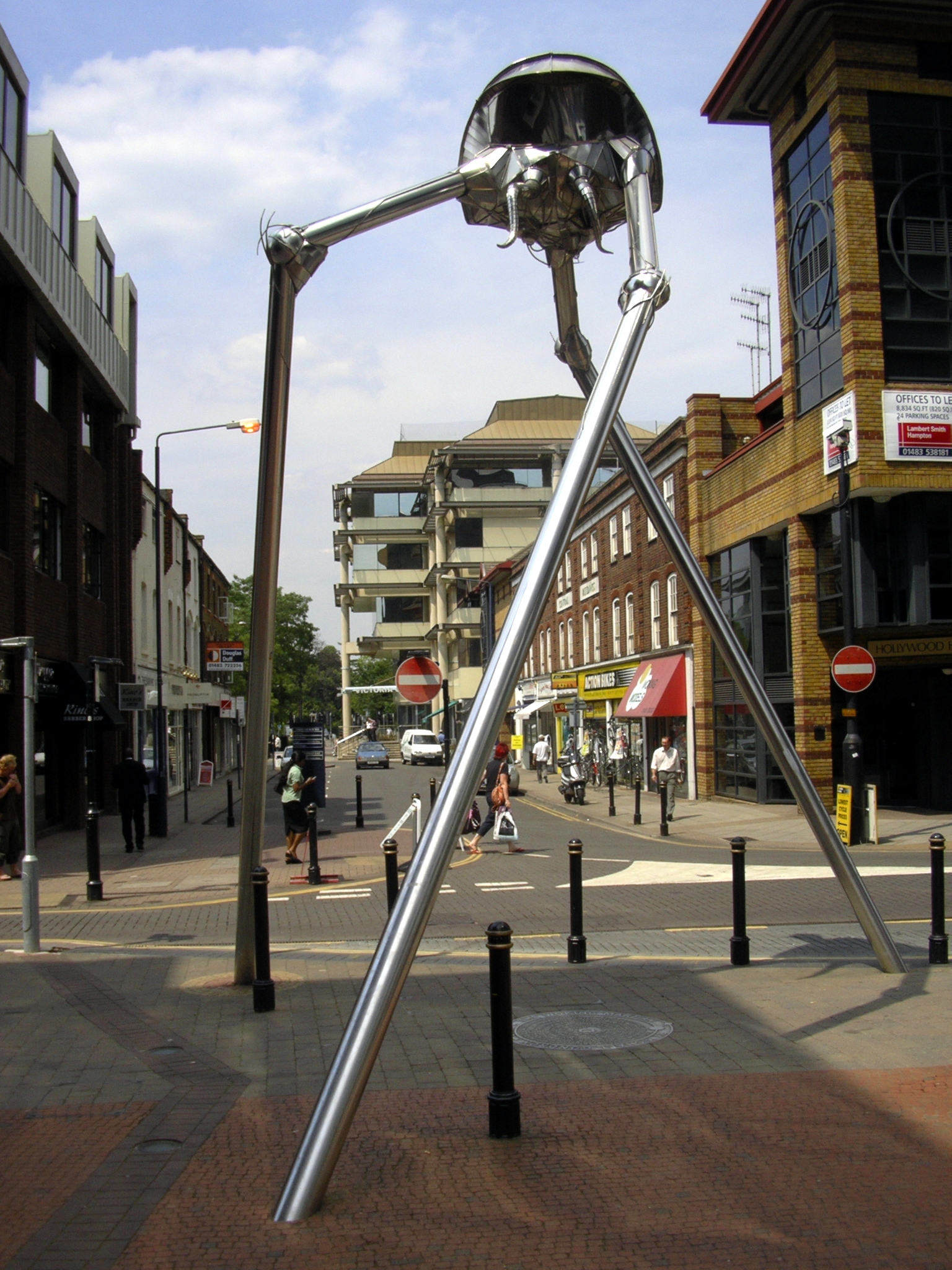
In 1895, Wells married Catherine Robbins, and moved with her to Woking in Surrey. There, he spent his mornings walking or cycling in the countryside, and his afternoons writing. He used these bicycle tours to find places he would refer to in his novel. He wrote in his autobiography that he “wheeled about the district marking down suitable places and people for destruction by my Martians”. A 23 ft high sculpture of a tripod fighting machine, entitled The Woking Martian, based on descriptions in the novel, stands in Crown Passage close to the local railway station in Woking, designed and constructed in 1998 by artist Michael Condron. Fifty meters further up the pedestrianised street is a concrete and brick representation of a Martian cylinder.
Cultural setting
Wells's depiction of late Victorian suburban culture in the novel was an accurate representation of his experiences. In the late 19th century, the British Empire was the predominant colonial power on the globe, making its domestic heart a poignant and terrifying starting point for an invasion by Martians with their own imperialist agenda.
Publication
In the late 1890s it was common for novels to be serialised in magazines or newspapers before publication in full, with each part of the serialisation ending on a cliffhanger to entice audiences to buy the next issue. This practice was familiar from Charles Dickens's novels earlier in the 19th century. The War of the Worlds was first serialised in the United Kingdom in Pearson's Magazine from April to December 1897. Wells was paid £200 and Pearsons demanded to know the ending of the piece before committing to publish it. The complete volume was first published by Heinemann in 1898 and has been in print ever since, although several editions exist. The 1924 Atlantic edition is considered the definitive text used for reprints. In addition, a revised version for schools was first published by Heinemann in 1951.
Two unauthorised serialisations of the novel were published in the United States prior to publication of the novel. The first was in the New York Evening Journal where the story was published as Fighters from Mars or the War of the Worlds, located in a New York setting, between December 1897 and January 1898. The second version had the Martians landing near and around Boston, and was published by The Boston Post as Fighters from Mars, or the War of the Worlds in and near Boston in 1898. Hughes and Geduld suggest that Wells may inadvertently have agreed to the serialisation in the New York Evening Journal.
File:Fighters from Mars 2.jpg|Fighters from Mars or the War of the Worlds in and near Boston, unauthorized adaptation of the novel in the Boston Post in 1898 File:The War of the Worlds - poster by Henrique Alvim Corrêa, original graphic.jpg|Advertisement for deluxe edition of The War of the Worlds (La Guerre des Mondes) in French, published in Belgium in 1906 with illustrations by Henrique Alvim Corrêa File:Amazing stories 192708.jpg|Cover of Amazing Stories August 1927 issue, for a reprint of The War of the Worlds, artwork by Frank R. Paul File:War of the Worlds original cover bw.jpg|Title page, 1927 Amazing Stories reprint, illustration by Frank R. Paul File:Famous fantastic mysteries 195107.jpg|A reprint of The War of the Worlds was cover-featured on the July 1951 issue of Famous Fantastic Mysteries.
Reception
Contemporary
The War of the Worlds was received favourably by both readers and critics. The Illustrated London News wrote that the serialisation in Pearson's magazine had "a very distinct success". The story did even better as a book, and reviewers rated it as "the very best work he has yet produced", and highlighting the story's originality in showing Mars in a new light through the concept of an alien invasion of Earth. Writing for Harper's Weekly, Sidney Brooks admired Wells's writing style: "he has complete check over his imagination, and makes it effective by turning his most horrible of fancies into the language of the simplest, least startling denomination". Praising Wells's "power of vivid realization", The Daily News reviewer wrote, "the imagination, the extraordinary power of presentation, the moral significance of the book cannot be contested". There was, however, some criticism of the brutal nature of the events in the narrative.
Later
Interpretations
Natural selection
In the novel, the conflict between humankind and the Martians is portrayed as a survival of the fittest, with the Martians whose longer period of successful evolution on the older Mars has led to their developing a superior intelligence, able to create weapons far in advance of humans on the younger planet Earth, who have not had the opportunity to develop sufficient intelligence to construct similar weapons.
Human evolution
The narrator refers to an 1893 publication suggesting that the evolution of the human brain might outstrip the development of the body. Organs such as the stomach, nose, teeth, and hair would wither. Humans would be left as thinking machines, needing mechanical devices much like the Tripod fighting machines, to be able to interact with their environment. This publication is probably Wells's own "The Man of the Year Million", first published in The Pall Mall Gazette on 6 November 1893, which suggests similar ideas. In his vision for the future of humanity, Wells imagined them as having huge hands and large heads with soulful eyes. The rest of the body had shriveled into nothing. Instead of a digestive system, they absorb liquid nutrients from a pool through the surface of their body, while machinery does all the work their muscles can no longer accomplish, and their emotions have been replaced by an intellect that have turned society into a "paragon of order and calm" through co-operation.
Colonialism and imperialism
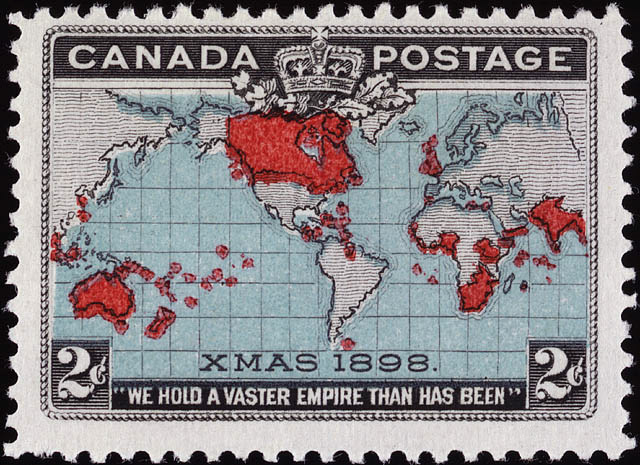
While invasion literature had provided an imaginative foundation for the idea of the heart of the British Empire being conquered by foreign forces, it was not until The War of the Worlds that the British public was presented with an adversary that was completely superior to themselves. A significant motivating force behind the success of the British Empire was its use of sophisticated technology; the Martians, also attempting to establish an empire on Earth, have technology superior to their British adversaries. In The War of the Worlds, Wells depicted an imperial power as the victim of imperial aggression, and thus perhaps encouraging the reader to consider the morality of imperialism itself.
Social Darwinism
Social Darwinism was a theory in Wells's time that argued that the success of different ethnic groups in world affairs, and social classes in a society, were the result of evolutionary struggle in which the group or class more fit to succeed did so. The novel dramatises these ideas, as the more advanced Martians exercise their "rights" as a superior race over humans.
Antecedents
Terrestrial

Between 1871 and 1914 more than 60 works of fiction for adult readers describing invasions of Great Britain were published. The original work was The Battle of Dorking (1871) by George Tomkyns Chesney, which portrays a surprise German attack and landing on the south coast of England, made possible by the distraction of the Royal Navy in colonial patrols and the army in an Irish insurrection. The German army makes short work of English militia and rapidly marches to London. This story was published in Blackwood's Magazine in May 1871 and was so popular that it was reprinted a month later as a pamphlet which sold 80,000 copies. There are clear plot similarities between Wells's book and The Battle of Dorking, with the destruction of the Home Counties of Southern England by the invader. However, The War of the Worlds is a far more imaginative story. The invasion literature genre provided a familiar base from which to support the success of The War of the Worlds. It may also have proved an important foundation for Wells's ideas, as he had never seen or fought in a war.
Extraterrestrial
Wells is credited with establishing several extraterrestrial themes which were later greatly expanded by science fiction writers in the 20th century, including first contact and war between planets and their differing species. There were, however, stories of aliens and alien invasion prior to the publication of The War of the Worlds.
Voltaire's Micromégas (1752) includes two beings from Saturn and Sirius who, though human in appearance, are of immense size and visit the Earth out of curiosity. At first the difference in scale between them and the peoples of Earth makes them think that the planet is uninhabited. When they discover the haughty Earth-centric views of Earth philosophers, they are greatly amused by how important Earth beings think they are compared to greater beings in the universe such as themselves.
In 1892 Robert Potter, an Australian clergyman, published The Germ Growers in London. It describes a covert invasion by aliens who take on the appearance of human beings and attempt to develop a virulent disease to assist in their plans for global conquest. It was not widely read, and consequently Wells's vastly more successful novel is generally credited as the seminal alien invasion story.
The first science fiction to be set primarily on Mars may be Across the Zodiac: The Story of a Wrecked Record (1880) by Percy Greg. It concerned a civil war on Mars. Another Mars novel, this time dealing with benevolent Martians coming to Earth to give humankind the benefit of their advanced knowledge, was published in 1897 by Kurd Lasswitz – Two Planets (Auf Zwei Planeten). It was not translated until 1971, and thus may not have influenced Wells, although it did depict a Mars influenced by the ideas of Percival Lowell.
Other examples are Hugh MacColl's Mr. Stranger's Sealed Packet (1889), which took place on Mars, Gustavus W. Pope's Journey to Mars (1894), and Pharaoh's Broker by Elmer Dwiggins, writing under the name of Ellsworth Douglass, in which the protagonist encounters an Egyptian civilisation on Mars which, while parallel to that of Earth, has evolved somehow independently.
_by_Frank_Rudolph_Paul.png)
The work's influence

The publication and reception of The War of the Worlds brought the term "Martians" into popular usage for hostile aliens of all kinds.
Six weeks after the publication of the novel, The Boston Post newspaper published another alien invasion story, an unauthorised sequel to The War of the Worlds, which turned the tables on the invaders. Edison's Conquest of Mars was written by Garrett P. Serviss, a now little-remembered writer, who described the inventor Thomas Edison leading a counterattack against the invaders on their home soil. Though this is actually a sequel to Fighters from Mars, a revised and unauthorised reprint of The War of the Worlds, they both were first printed in the Boston Post in 1898. Lazar Lagin published Major Well Andyou in the U.S.S.R. in 1962, an alternative view of events in The War of the Worlds from the viewpoint of a traitor.
Adaptations
As of 2025, The War of the Worlds has inspired eight films, as well as various radio dramas, comics, video games, television series, and sequels or parallel stories by other authors. Most are set in different locations or eras to the original novel. Among the adaptations is the 1938 radio broadcast narrated and directed by Orson Welles, set in contemporary America and presented as a live news story happening in New Jersey.
_trailer_-_Martian_machine.jpg)
In 1978, Jeff Wayne produced a musical album of the story, with the voices of Richard Burton and David Essex. Wayne has also toured two live concert musical versions. That same year a stage adaptation by Albert Reyes was mounted at the Nat Horne Theatre in New York.
An immersive experience of The War of the Worlds set to Jeff Wayne's score opened in London in 2019. The show uses a blend of virtual reality, volumetric holograms and live theatre.
Gallery of early illustrations
File:The War of the Worlds by Henrique Alvim Corrêa, orginal graphic 03.jpg|Martian cylinder appears as a falling star (Henrique Alvim Corrêa 1906) File:The War of the Worlds by Henrique Alvim Corrêa, orginal graphic 04.jpg|The mysterious "thing" that has landed in the sand-pits (Henrique Alvim Corrêa 1906) File:The War of the Worlds by Henrique Alvim Corrêa, orginal graphic 07.jpg|The Martian heat ray incinerates the humans who approached the pit where the cylinder landed (Henrique Alvim Corrêa 1906) File:The War of the Worlds by Henrique Alvim Corrêa, orginal graphic 06.jpg|The Martians turn the heat ray on the crowds gathered near the pit, bringing "flaming death" (Henrique Alvim Corrêa 1906) File:The War of the Worlds by Henrique Alvim Corrêa, orginal graphic 12.jpg|Martian fighting machines in action (Henrique Alvim Corrêa 1906) File:The War of the Worlds by Henrique Alvim Corrêa, orginal graphic 14.jpg|Martian fighting machine struck by a shell (Henrique Alvim Corrêa 1906) File:The War of the Worlds by Henrique Alvim Corrêa, orginal graphic 16.jpg|Martian fighting machine fires the black smoke (Henrique Alvim Corrêa 1906) File:The War of the Worlds by Henrique Alvim Corrêa, orginal graphic 13.jpg|A Flying Machine approaches HMS Thunder Child. (Henrique Alvim Corrêa 1906) File:Correa-Martians vs. Thunder Child.jpg|The warship HMS Thunder Child confronts a Martian fighting machine (Henrique Alvim Corrêa 1906) File:The War of the Worlds by Henrique Alvim Corrêa, orginal graphic 19.jpg|The Thunder Child downs a Tripod, only to get destroyed by them soon after. File:The War of the Worlds by Henrique Alvim Corrêa, orginal graphic 20.jpg|Martian cylinder strikes the house where the narrator and the curate took refuge (Henrique Alvim Corrêa 1906) File:War of the worlds Henrique Alvim Correa.jpg|A Martian handling machine used for construction and assembly tasks (Henrique Alvim Corrêa 1906) File:War of the worlds Henrique Alvim correa.jpg|Martians grab the curate with a mechanical tentacle (Henrique Alvim Corrêa 1906) File:The War of the Worlds by Henrique Alvim Corrêa, orginal graphic 24.jpg|Spreading Martian red weed (Henrique Alvim Corrêa 1906) File:The War of the Worlds by Henrique Alvim Corrêa, orginal graphic 25.jpg|Martian viewing a Drunken Crowd. (Henrique Alvim Corrêa 1906) File:The War of the Worlds by Henrique Alvim Corrêa, orginal graphic 26.jpg|London in ruins after the Martian attack (Henrique Alvim Corrêa 1906) File:The War of the Worlds by Henrique Alvim Corrêa, orginal graphic 27.jpg|An abandoned Handling Machine, plundered by Crows. (Henrique Alvim Corrêa 1906) File:The War of the Worlds by Warwick Goble 42.jpg|Narrator discovers the Martians are dead and expresses relief and gratitude (Warwick Goble 1898) File:H G Wells La guerre des mondes 1906 (page 233 crop).jpg|The fighting machines stand immobile in London as birds scavenge dead Martians (Henrique Alvim Corrêa 1906) File:The War of the Worlds by Henrique Alvim Corrêa, orginal graphic 31.jpg|Humans examine the advanced war machines left after the death of the Martians (Henrique Alvim Corrêa 1906)
References
Sources
- Coren, Michael (1993) The Invisible Man: The Life and Liberties of H.G. Wells's. Publisher: Random House of Canada.
- Gosling, John. Waging the War of the Worlds. Jefferson, North Carolina, McFarland, 2009. Paperback, .
-
- Roth, Christopher F. (2005) "Ufology as Anthropology: Race, Extraterrestrials, and the Occult." In E.T. Culture: Anthropology in Outerspaces, ed. by Debbora Battaglia. Durham, N.C.: Duke University Press.
- Yeffeth, Glenn (Editor) (2005) The War of the Worlds: Fresh Perspectives on the H. G. Wells Classic. Publisher: Benbella Books.
References
- Wells, H. G.. (1898). "The War of the Worlds". William Heinemann.
- (1993). "A Critical Edition of The War of the Worlds: H.G. Wells's Scientific Romance". Indiana University Press.
- Flynn, John L.. (2005). "War of the Worlds: From Wells to Spielberg". Galactic Books.
- Ball, Philip. (18 July 2018). "What the War of the Worlds means now". New Statesman.
- Wills, Matthew. (2018-12-03). "What The War of the Worlds Had to Do with Tasmania".
- Wells, H. G.. (1933). "The Scientific Romances of H.G. Wells". V. Gollancz, Ltd.
- Schwartz, A. Brad. "The Infamous "War of the Worlds" Radio Broadcast Was a Magnificent Fluke".
- [https://books.google.no/books?id=R2UdDAAAQBAJ&pg=PA128&dq=%22The+inspiration+for+The+War+of+the+Worlds%22&hl=no&newbks=1&newbks_redir=0&sa=X&ved=2ahUKEwir77XJw9iLAxXhLBAIHa_tAhwQ6AF6BAgNEAM#v=onepage&q=%22The%20inspiration%20for%20The%20War%20of%20the%20Worlds%22&f=false The War of the Worlds: From H. G. Wells to Orson Welles, Jeff Wayne, Steven Spielberg and Beyond]
- Parrinder, Patrick. (1981). "The Science Fiction of H.G. Wells". Oxford University Press.
- Haynes, Rosylnn D.. (1980). "H.G. Wells Discover of the Future". Macmillan.
- (1894). "A Strange Light on Mars". Nature.
- (2024). "Mars".
- Stableford, Brian. (2006). "[[Science Fact and Science Fiction: An Encyclopedia]]". Taylor & Francis.
- Baxter, Stephen. (2005). "H.G. Wells's Enduring Mythos of Mars". BenBalla.
- Wagar, W. Warren. (1989). "H. G. Wells and the scientific imagination". The Virginia Quarterly Review.
- Wells, H. G.. (1896). "Intelligence on Mars". The Saturday Review.
- Martin, Christopher. (1988). "H.G. Wells". Wayland.
- McKie, Robin. (28 February 2016). "Woking pays homage to HG Wells, the man who brought the Martians to town". The Guardian.
- Pearson, Lynn F.. (2006). "Public Art Since 1950". Osprey Publishing.
- Lackey, Mercedes. (2005). "In Woking's Image". BenBalla.
- Franklin, H. Bruce. (2008). "War Stars". [[University of Massachusetts Press]].
- Gerrold, David. (2005). "War of the Worlds". BenBalla.
- "The War of the Worlds". Encyclopaedia Britannica.
- [https://books.google.no/books?id=R2UdDAAAQBAJ&pg=PA140&dq=Harpers+1924+Atlantic+edition+1951+Heinemann&hl=no&newbks=1&newbks_redir=0&sa=X&ved=2ahUKEwjZrp3WmeqLAxVeJxAIHdpiKmsQ6AF6BAgMEAM#v=onepage&q=Harpers%201924%20Atlantic%20edition%201951%20Heinemann&f=false The War of the Worlds: From H. G. Wells to Orson Welles, Jeff Wayne, Steven Spielberg & Beyond]
- Urbanski, Heather. (2007). "Plagues, Apocalypses and Bug-Eyed Monsters". McFarland.
- (2016). "The War of the Worlds: From H. G. Wells to Orson Welles, Jeff Wayne, Steven Spielberg and Beyond". Bloomsbury Publishing.
- (1986). "Trillion Year Spree: the History of Science Fiction". Victor Gollancz.
- Williamson, Jack. (2005). "The Evolution of the Martians". BenBella.
- Draper, Michael. (1987). "H.G. Wells". Macmillan.
- [https://books.google.no/books?id=8h-jEAAAQBAJ&pg=PA247&dq=The+Man+of+the+Year+Million+dangling+pools+liquid+machinery&hl=no&newbks=1&newbks_redir=0&sa=X&ved=2ahUKEwjP9KO5o9qLAxXTKxAIHT5DEXgQ6AF6BAgFEAM#v=onepage&q=The%20Man%20of%20the%20Year%20Million%20dangling%20pools%20liquid%20machinery&f=false The Myth and Mystery of UFOs]
- Zebrowski, George. (2005). "The Fear of the Worlds". BenBalla.
- Roberts, Adam. (2006). "The History of Science Fiction". Palgrave Macmillan.
- (2006). "Science and Technology in World History". JHU Press.
- Eby, Cecil D.. (1988). "The Road to Armageddon: The Martial Spirit in English Popular Literature, 1870–1914". Duke University Press.
- McConnell, Frank. (1981). "The Science Fiction of H.G. Wells". Oxford University Press.
- Hotakainen, Markus. (2008). "Mars: A Myth Turned to Landscape". Springer.
- Westfahl. Gary. "Space and Beyond". Greenwood Publishing Groups. (2000)
- Wells, H. G.. (1897). "The Crystal Egg". The New Review.
- Silverberg, Robert. (2005). "Introduction". BenBalla.
- ''Edison's Conquest of Mars'', "Foreword" by Robert Godwin, Apogee Books 2005
- (2021). "After Memory: World War II in Contemporary Eastern European Literatures". Walter de Gruyter.
- Brinkley, Alan. (2010). "The Unfinished Nation". McGraw-Hill Education.
- (29 October 2013). "The Myth of the 'War of the Worlds' Panic". Slate.
- (30 October 2018). "When historians traffic in fake news. Unraveling the myth of "War of the Worlds."". Washington Post.
- [https://web.archive.org/web/20141013192412/http://bbfc.co.uk/releases/war-worlds-1970-0 "'The War of the Worlds'."] ''[[British Board of Film Classification]]'', 9 March 1953. Retrieved 3 August 2022.
- "War of the Worlds". [[Metacritic]].
- "War of the Worlds". [[Rotten Tomatoes]].
- Burrows, Alex. (26 September 2020). "The story behind Jeff Wayne's The War Of The Worlds".
- Jones, Josh. (30 March 2017). "Hear the Prog-Rock Adaptation of H.G. Wells's War of the Worlds: The 1978 Rock Opera That Sold 15 Million Copies Worldwide".
- (1978). "The Best Plays of 1977-1978". [[Dodd, Mead & Co.]].
- "Dotdotdot | the world premier of Jeff Wayne's the War of the Worlds: The Immersive Experience".
This article was imported from Wikipedia and is available under the Creative Commons Attribution-ShareAlike 4.0 License. Content has been adapted to SurfDoc format. Original contributors can be found on the article history page.
Ask Mako anything about The War of the Worlds — get instant answers, deeper analysis, and related topics.
Research with MakoFree with your Surf account
Create a free account to save articles, ask Mako questions, and organize your research.
Sign up freeThis content may have been generated or modified by AI. CloudSurf Software LLC is not responsible for the accuracy, completeness, or reliability of AI-generated content. Always verify important information from primary sources.
Report