From Surf Wiki (app.surf) — the open knowledge base
The Truman Show
1998 film by Peter Weir

1998 film by Peter Weir
| Field | Value | |
|---|---|---|
| name | The Truman Show | |
| image | Trumanshow.jpg | |
| alt | Film poster. On the side of the building is a large screen, showing a man laying his head on a pillow, eyes closed and smiling. Digital text above and below the screen state "LIVE" and "DAY 10,909", with the film's title right below it. Text at the top of the image includes the sole starring credit and text at the bottom includes the film's tagline and credits. | |
| caption | Theatrical release poster | |
| director | Peter Weir | |
| writer | Andrew Niccol | |
| producer | {{Plainlist | |
| starring | {{Plainlist | |
| cinematography | Peter Biziou | |
| editing | {{Plainlist | |
| music | {{Plainlist | |
| studio | Scott Rudin Productions | |
| distributor | Paramount Pictures | |
| released | ||
| runtime | 103 minutes | |
| country | United States | |
| language | English | |
| budget | $60 million | |
| gross | $264 million |
- Scott Rudin
- Andrew Niccol
- Edward S. Feldman
- Adam Schroeder
- Jim Carrey
- Laura Linney
- Noah Emmerich
- Natascha McElhone
- Holland Taylor
- Ed Harris
- William Anderson
- Lee Smith
- Burkhard Dallwitz
- Philip Glass
- Wojciech Kilar The Truman Show is a 1998 American comedy-drama film written and co-produced by Andrew Niccol, and directed by Peter Weir. The film depicts the story of Truman Burbank (played by Jim Carrey), a man who is unaware that he is living his entire life on a colossal soundstage, and that it is being filmed and broadcast as a reality television show that has a huge international following. All of his friends, family, and members of his community are paid actors whose job is to sustain the illusion and keep Truman unaware that the world he inhabits is scripted and fake. The film's supporting cast includes Laura Linney, Ed Harris, Noah Emmerich, Natascha McElhone, Holland Taylor and Paul Giamatti.
Niccol's original spec script was more of a science-fiction thriller, with the story set in New York City. Producer Scott Rudin purchased the script and set up production at Paramount Pictures. Brian De Palma was to direct before Weir signed on as director, making the film for $60 million—$20 million less than the original estimate. Niccol rewrote the script while the crew was waiting for Carrey to sign. The majority of filming took place at Seaside, Florida, a master-planned community located in the Florida Panhandle.
The Truman Show held its world premiere in Los Angeles on June 1, 1998, and was released in North America on June 5. The film was a financial success, grossing $264 million worldwide, debuting to critical acclaim, and earned numerous nominations at the 71st Academy Awards, 56th Golden Globe Awards, 52nd British Academy Film Awards, and 25th Saturn Awards. The Truman Show has been analyzed as an exploration of simulated reality, existentialism, surveillance, metaphilosophy, privacy, and reality television, and described as a genre-blending work that features elements of dystopian fiction, meta fiction, psychological drama, romantic comedy, satire, and social science fiction.
In 2025, it was selected for preservation in the United States National Film Registry by the Library of Congress as being "culturally, historically or aesthetically significant."
Plot
Selected at birth and legally adopted by a television studio following an unwanted pregnancy, Truman Burbank is the unsuspecting star of The Truman Show, a reality television program filmed and broadcast worldwide, 24/7, through hidden cameras. Truman's hometown, Seahaven Island, is set inside an enormous soundstage in Los Angeles, which allows Christof, the show's creator and executive producer, to control nearly all aspects of Truman's life. Truman's world is populated by actors and crew members who serve as his community while keeping him from discovering the truth. To prevent Truman from escaping, Christof has orchestrated various scenarios such as the "death" of Truman's father in a boating accident to instill thalassophobia, and has the cast reinforce Truman's anxieties with messages about the dangers of traveling and the virtues of staying home.
Though the producers intend for Truman to fall in love with and marry a woman named Meryl, he develops feelings for an extra named Sylvia. Sympathetic to Truman's plight, Sylvia tries to tell him the truth, but is promptly fired and removed from the set. Truman marries Meryl, but their relationship is stilted and passionless, and he continues to dream of traveling to Fiji, where he was told Sylvia had moved, and living a happy life with her. In the real world, Sylvia joins "Free Truman", an activist group that calls for Truman's liberation from the show.
As the show approaches its thirtieth anniversary, Truman notices unusual occurrences such as a stage light falling from the sky; an isolated patch of rain that falls only over him; a radio transmission describing his movements; and the reappearance of his father, who is rushed away by crew members before Truman can confront him. Inferring that the city somehow revolves around him, Truman questions his life and asks his closest confidants to help him solve the mystery.
Truman's suspicions culminate in an attempt to escape the island, but increasingly implausible occurrences block his path. Eventually, he is caught and returned home under a flimsy pretext. There, he confronts Meryl and challenges the sincerity of their marriage. As he holds her at knifepoint, Meryl breaks character to call for help and is removed from the show.
Hoping to bring Truman back to a controllable state, Christof reintroduces his father to the show under the guise of him having developed amnesia following the accident. The show regains its ratings, and Truman seems to return to his routines. One night, however, Christof discovers that Truman has begun sleeping in his basement. Disturbed by this change in behavior, Christof sends Truman's best friend Marlon to visit and discovers that Truman has disappeared through a makeshift tunnel. Christof suspends the broadcast for the first time in its history, leading to record viewing numbers.
Truman is found sailing away from Seahaven, having conquered his fear of water. Christof resumes the transmission and, unable to fetch Truman by rescue boat, creates a violent storm in an attempt to capsize Truman's boat, ignoring the protests of the executive producers and his assistants. Truman nearly drowns but continues to sail until his boat strikes the wall of the soundstage. He finds a staircase leading to an exit door. As he contemplates leaving, Christof speaks to Truman, revealing the truth about the show and encouraging him to stay by claiming that there is no more truth in the real world than in his artificial one. Truman utters his catchphrase—"In case I don't see ya, good afternoon, good evening, and good night"—before bowing to the audience and exiting. Viewers around the world celebrate Truman's escape, and Sylvia races to greet him. The executive producers end the program with a shot of the open exit door, leaving Christof devastated, and the broadcast is ended.
Cast
- Jim Carrey as Truman Burbank
- Blair Slater as young Truman
- Ed Harris as Christof, the creator and director of the in-universe show in which Truman lives
- Laura Linney as Hannah Gill, who plays Meryl, Truman's wife
- Noah Emmerich as Louis Coltrane, who plays Marlon, Truman's best friend
- Natascha McElhone as Lauren/Sylvia; Sylvia met Truman while playing Lauren, Truman's college schoolmate, who was originally just a background character, but whom Truman fell for
- Holland Taylor as Truman's mother, as portrayed by an in-universe actress
- Brian Delate as Truman's father, as portrayed by an in-universe actor
- Paul Giamatti as Simeon, a control room director
- Una Damon as Chloe, Christof's control room assistant
- Philip Baker Hall and John Pleshette as a network executive
- Peter Krause as Truman's boss, as portrayed by an in-universe actor
- Heidi Schanz as Vivien, a woman positioned to be Truman's next love interest after Meryl, as portrayed by an in-universe actress
- Harry Shearer as Mike Michaelson, a TV talk show host
Production
Development
Andrew Niccol completed a one-page film treatment titled The Malcolm Show in May 1991. The original draft was more in tone of a science fiction thriller, with the story set in New York City. Niccol stated, "I think everyone questions the authenticity of their lives at certain points. It's like when kids ask if they're adopted." In the fall of 1993, producer Scott Rudin purchased the script for slightly over $1 million. Paramount Pictures agreed to distribute. Part of the deal called for Niccol to make his directing debut, though Paramount executives felt the estimated $80 million budget would be too high for him. In addition, Paramount wanted to go with an A-list director, paying Niccol extra money "to step aside". Brian De Palma was under negotiations to direct before he left United Talent Agency (UTA) in March 1994. Directors who were considered after De Palma's departure included Tim Burton, Sam Raimi, Terry Gilliam, David Cronenberg, Barry Sonnenfeld and Steven Spielberg before Peter Weir signed on in early 1995, following a recommendation of Niccol. Bryan Singer wanted to direct but Paramount decided to go with the more experienced Weir.
Weir wanted the film to be funnier, feeling that Niccol's script was too dark, and declaring, "where [Niccol] had it depressing, I could make it light. It could convince audiences they could watch a show in this scope 24/7." Niccol wrote sixteen drafts of the script before Weir considered the script ready for filming. Later in 1995, Jim Carrey signed to star, but because of commitments with The Cable Guy and Liar Liar, he would not be ready to start filming for at least another year. Weir felt Carrey was perfect for the role and opted to wait for another year rather than recast the role. Niccol rewrote the script twelve times, while Weir created a fictionalized book about the show's history. He envisioned backstories for the characters and encouraged actors to do the same.
Weir scouted locations in Eastern Florida but was dissatisfied with the landscapes. Sound stages at Universal Studios were reserved for the story's setting of Seahaven before Weir's wife Wendy Stites introduced him to Seaside, Florida, a "master-planned community" located in the Florida Panhandle. Pre-production offices were immediately opened in Seaside, where the majority of filming took place. The scenes of Truman's house were filmed at a residence owned by the Gaetz family, which included Florida State Senator Don Gaetz and U.S. representative Matt Gaetz. The scene at the Seahaven Nuclear Power Station was filmed outside the front entrance of the Lansing Smith Generating Plant at Lynn Haven, operated at the time by Gulf Power. Other scenes were shot at Paramount Studios in Los Angeles, California. Norman Rockwell paintings and 1960s postcards were used as inspiration for the film's design. Weir, Peter Biziou and Dennis Gassner researched surveillance techniques for certain shots.
Casting
Though Robin Williams was considered for the role of Truman, Weir cast Carrey after seeing him in Ace Ventura: Pet Detective, citing that Carrey's performance reminded him of Charlie Chaplin. Gary Oldman did test footage for the role. Carrey took the role so he would be known as a multifaceted actor, rather than being typecast in comedic roles. Carrey, who was then normally paid $20 million per film, agreed to do The Truman Show for $12 million. Carrey also said it was the fastest that he ever accepted a role. Carrey brought his own innovations to the role, including the idea for the scene in which Truman declares "this planet Trumania of the Burbank galaxy" to the bathroom mirror.
The film started production with Dennis Hopper in the role of Christof, but he left in April 1997 soon after filming began due to "creative differences". Hopper later stated that he was fired after two days because Weir and producer Scott Rudin had made a deal that if they did not both approve of Hopper's performance, they would replace him. A number of other actors turned down the role after Hopper's departure, until Ed Harris agreed to step in after meeting them in Malibu. Harris later stated that he pitched the notion of making Christof a hunchback, but Weir did not like the idea.
After Laura Linney was hired to play the actress pretending to be Meryl, Truman's wife, she studied Sears catalogs from the 1950s to develop her character's poses.
Filming
Filming took place from December 9, 1996, to April 21, 1997. Its overall look was influenced by television images, particularly commercials: Many shots have characters leaning into the lens with their eyes wide open, and the interior scenes are heavily lit because Weir wanted to remind viewers that "in this world, everything was for sale". Those involved in visual effects work found the film somewhat difficult to make because 1997 was the year many visual effects companies were trying to convert to computer-generated imagery (CGI). CGI was used to create the upper halves of some of the larger buildings in the film's downtown set. Craig Barron, one of the effects supervisors, said that these digital models did not have to look as detailed and weathered as they normally would in a film because of the artificial look of the entire town, although they did imitate slight blemishes found in the physical buildings.
Soundtrack
Also featured are Frédéric Chopin's second movement (Romanze-Larghetto) from his First Piano Concerto, performed by the New Symphony Orchestra of London under the direction of Stanisław Skrowaczewski with pianist Artur Rubinstein; Wojciech Kilar's Father Kolbe's Preaching performed by the Warsaw National Philharmonic Orchestra; as well as the song "20th Century Boy" performed by rockabilly band The Big Six.
Although not included on the soundtrack CD, Wolfgang Amadeus Mozart's Rondo alla turca from his Piano Sonata No. 11 in A Major, performed by Wilhelm Kempff, and his Horn Concerto No. 1, performed by the Philharmonia Baroque Orchestra; plus "Love Is Just Around the Corner" by Jackie Davis were also featured in the film.
Themes
Media
Ronald Bishop's paper in the Journal of Communication Inquiry suggested The Truman Show showcased the power of the media. Truman's life inspires audiences around the world, meaning their lives are controlled by his. Bishop commented, "In the end, the power of the media is affirmed rather than challenged. In the spirit of Antonio Gramsci's concept of hegemony, these films and television programs co-opt our enchantment (and disenchantment) with the media and sell it back to us."
Journalist Erik Sofge surmised that the film's story reflects the falseness of reality television. "Truman simply lives, and the show's popularity is its straightforward voyeurism. And, like Big Brother, Survivor, and every other reality show on the air, none of his environment is actually real." Weir declared, "There has always been this question: Is the audience getting dumber? Or are we filmmakers patronizing them? Is this what they want? Or is this what we're giving them? But the public went to my film in large numbers. And that has to be encouraging."
In her essay "Reading The Truman Show inside out", Simone Knox argues that the film itself tries to blur the objective perspective and the show-within-the-film. Knox also draws a floor plan of the camera angles of the first scene.
Psychoanalytic interpretation
An essay published in the International Journal of Psychoanalysis analyzed Truman as
The website of the 2022 Cannes Film Festival says that "Peter Weir and Andrew Niccol's The Truman Show (1998) is a modern reflection of Plato's cave, and the decisive [final] scene urges viewers to not only experience the border between reality and its representation but to ponder the power of fiction, between manipulation and catharsis."
Similarity to ''Utopia''
Parallels can be drawn from Thomas More's 1516 book Utopia, in which More describes an island with only one entrance and only one exit. Only those who belonged to this island knew how to navigate their way through the treacherous openings safely and unharmed. This situation is similar to The Truman Show because there are limited entryways into the world that Truman knows. Truman does not belong to this utopia into which he has been implanted, and childhood trauma rendered him frightened of the prospect of ever leaving this small community. Utopian models of the past tended to be full of like-minded individuals who shared much in common, comparable to More's Utopia and real-life groups such as the Shakers and the Oneida Community. It is clear that the people in Truman's world are like-minded in their common effort to keep him oblivious to reality. The suburban "picket fence" appearance of the show's set is reminiscent of the "American Dream" of the 1950s. The "American Dream" concept in Truman's world serves as an attempt to keep him happy and ignorant.
Gnosticism
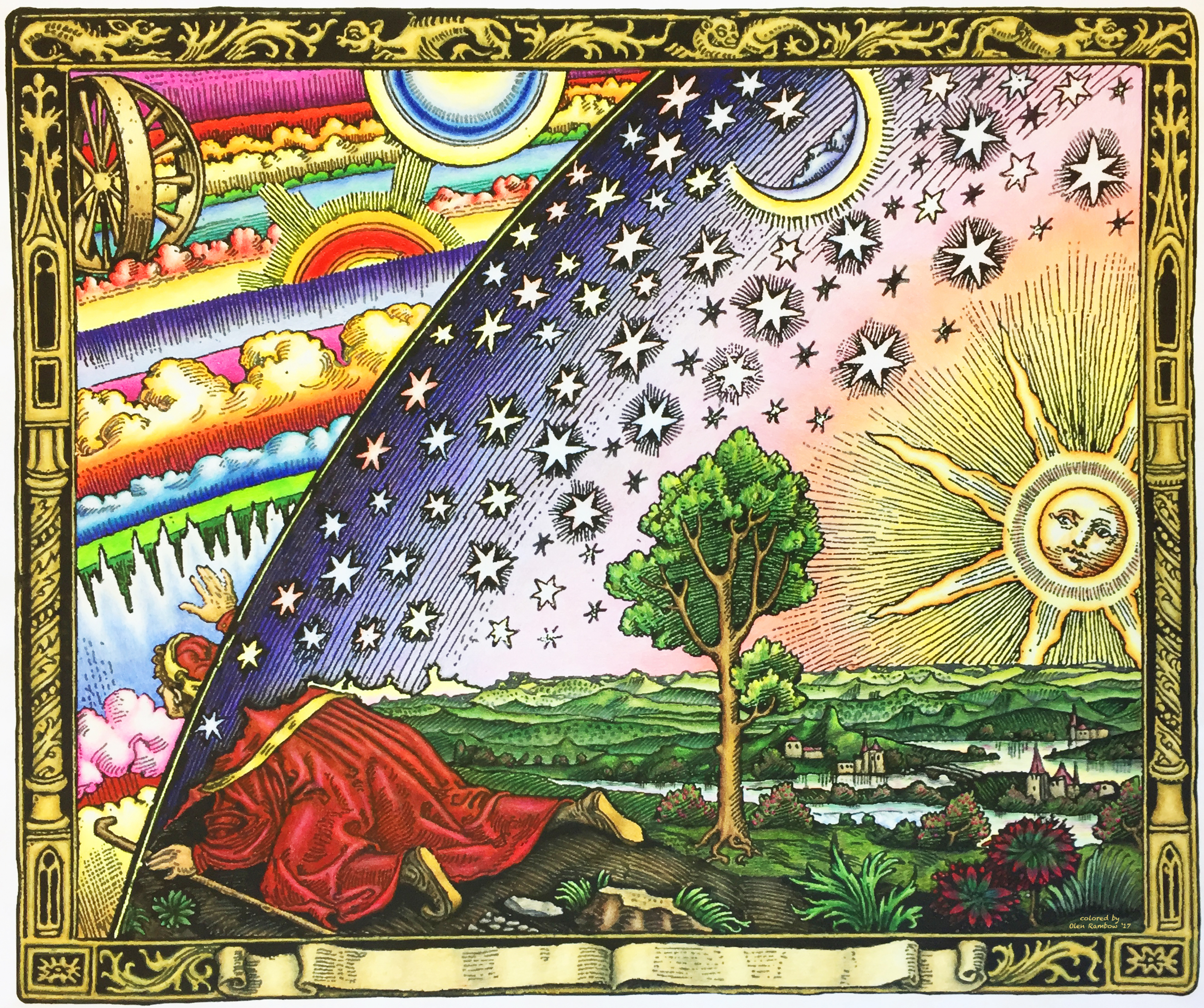
The Truman Show has themes that can be perceived as being gnostic, with its symbolism and Truman exiting the world clearly showing in the woodcut Flammarion engraving, exiting the world. Per screenwriter Chris Greenhalgh: "Slowly, Truman realises the truth and he, like the figure in the Flammarion Engraving, explores the artificial seam between the sky and the sea, wondering what might lie beyond the torn canvas."
Release
Originally set for August 8, 1997, the film's theatrical release was pushed back initially to November 14, 1997, and then to the summer of 1998. NBC purchased broadcast rights in December 1997, roughly eight months before the film's release. In March 2000, Turner Broadcasting System purchased the rights, and now airs the film on TBS.
Home media
Paramount Home Entertainment released the film on VHS on January 12, 1999, followed by DVD on January 26 that same year, and a "Special Edition" re-release on August 23, 2005. It was later released on Blu-ray on December 30, 2008. An Ultra HD Blu-ray was released on July 4, 2023, in celebration of the film's 25th anniversary.
Reception
Box office
The Truman Show grossed $125.6million domestically (United States and Canada) and $138.5million in other territories, for a worldwide total of $264.1million, against a budget of $60million. It spent its first two weeks as No.1 at the domestic box office, and its first seven weeks in the Top10.
Critical response
The Truman Show received widespread critical acclaim. Audiences polled by CinemaScore gave the film an average grade of "B" on an A+ to F scale.
Giving the film a perfect four star score, Roger Ebert compared it to Forrest Gump, claiming that the film had the right balance of comedy and drama. He was also impressed with Jim Carrey's dramatic performance. Kenneth Turan of the Los Angeles Times wrote, "The Truman Show is emotionally involving without losing the ability to raise sharp satiric questions as well as get numerous laughs. The rare film that is disturbing despite working beautifully within standard industry norms." He named it the best movie of 1998. In June 2010, Entertainment Weekly named Truman one of the 100 Greatest Characters of the Last 20 Years.
James Berardinelli liked the film's approach of "not being the casual summer blockbuster with special effects", and he likened Carrey's "[charismatic], understated and effective" performance to those of Tom Hanks and James Stewart. Jonathan Rosenbaum of the Chicago Reader wrote, "Undeniably provocative and reasonably entertaining, The Truman Show is one of those high-concept movies whose concept is both clever and dumb." Tom Meek of Film Threat said the film was not funny enough but still found "something rewarding in its quirky demeanor".
Accolades
| Award | Category | Nominee(s) | Result |
|---|---|---|---|
| Academy Awards | Best Director | Peter Weir | |
| Best Supporting Actor | Ed Harris | ||
| Best Screenplay – Written Directly for the Screen | Andrew Niccol | ||
| American Comedy Awards | Funniest Actor in a Motion Picture (Leading Role) | Jim Carrey | |
| ASCAP Film and Television Music Awards | Top Box Office Films | Burkhard Dallwitz and Philip Glass | |
| Australasian Performing Right Association Awards | Best Film Score | Burkhard Dallwitz | |
| Australian Film Institute Awards | Best Foreign Film | Peter Weir and Scott Rudin | |
| Blockbuster Entertainment Awards | Best Actor – Drama | Jim Carrey | |
| Best Supporting Actor – Drama | Ed Harris | ||
| Best Supporting Actress – Drama | Laura Linney | ||
| British Academy Film Awards | Best Film | Scott Rudin, Andrew Niccol, Edward S. Feldman, and Adam Schroeder | |
| Best Direction | Peter Weir | ||
| Best Actor in a Supporting Role | Ed Harris | ||
| Best Original Screenplay | Andrew Niccol | ||
| Best Cinematography | Peter Biziou | ||
| Best Production Design | Dennis Gassner | ||
| Best Special Effects | Michael J. McAlister, Brad Kuehn, Craig Barron, and Peter Chesney | ||
| British Society of Cinematographers Awards | Best Cinematography in a Theatrical Feature Film | Peter Biziou | |
| Chicago Film Critics Association Awards | Best Film | ||
| Best Director | Peter Weir | ||
| Best Actor | Jim Carrey | ||
| Best Screenplay | Andrew Niccol | ||
| Best Original Score | Burkhard Dallwitz | ||
| Chlotrudis Awards | Best Screenplay | Andrew Niccol | |
| Costume Designers Guild Awards | Excellence in Costume Design for Film | Marilyn Matthews | |
| Critics' Choice Movie Awards | Best Picture | ||
| Dallas–Fort Worth Film Critics Association Awards | Best Picture | ||
| Best Actor | Jim Carrey | ||
| Directors Guild of America Awards | Outstanding Directorial Achievement in Motion Pictures | Peter Weir | |
| Empire Awards | Best Film | ||
| European Film Awards | Best Non-European Film | Peter Weir | |
| Film Critics Circle of Australia Awards | Best Foreign Film | ||
| Florida Film Critics Circle Awards | Best Director | Peter Weir | |
| Fotogramas de Plata | Best Foreign Film | ||
| Golden Globe Awards | Best Motion Picture – Drama | ||
| Best Actor in a Motion Picture – Drama | Jim Carrey | ||
| Best Supporting Actor – Motion Picture | Ed Harris | ||
| Best Director | Peter Weir | ||
| Best Screenplay | Andrew Niccol | ||
| Best Original Score | Burkhard Dallwitz and Philip Glass | ||
| Golden Reel Awards | Best Sound Editing – Foreign Feature | Lee Smith, Karin Whittington, Rick Lisle, Peter Townend, Tim Jordan, | |
| Andrew Plain, Nicholas Breslin, and Maureen Rodbard-Bean | |||
| Hugo Awards | Best Dramatic Presentation | Peter Weir and Andrew Niccol | |
| Kids' Choice Awards | Favorite Movie Actor | Jim Carrey | |
| London Film Critics Circle Awards | Film of the Year | ||
| Director of the Year | Peter Weir | ||
| Screenwriter of the Year | Andrew Niccol | ||
| Los Angeles Film Critics Association Awards | Best Production Design | Dennis Gassner | |
| Movieguide Awards | Grace Award | Jim Carrey | |
| MTV Movie Awards | Best Movie | ||
| Best Male Performance | Jim Carrey | ||
| Nastro d'Argento | Best Foreign Director | Peter Weir | |
| Best Male Dubbing | Roberto Pedicini (for the dubbing of Jim Carrey) | ||
| National Board of Review Awards | Best Supporting Actor | Ed Harris | |
| Online Film & Television Association Awards | Best Picture | Scott Rudin, Andrew Niccol, Edward S. Feldman, and Adam Schroeder | |
| Best Drama Picture | |||
| Best Director | Peter Weir | ||
| Best Actor | Jim Carrey | ||
| Best Drama Actor | |||
| Best Supporting Actor | Ed Harris | ||
| Best Original Screenplay | Andrew Niccol | ||
| Best Cinematography | Peter Biziou | ||
| Best Film Editing | William M. Anderson and Lee Smith | ||
| Best Production Design | Dennis Gassner and Nancy Haigh | ||
| Best Drama Score | Burkhard Dallwitz and Philip Glass | ||
| Best Sound | |||
| Best Ensemble | |||
| Best Drama Ensemble | |||
| Best Titles Sequence | |||
| Best Cinematic Moment | "Truman Decides His Fate After Talking to Christof" | ||
| Film Hall of Fame: Productions | |||
| Online Film Critics Society Awards | Best Film | ||
| Best Director | Peter Weir | ||
| Best Supporting Actor | Ed Harris | ||
| Best Screenplay | Andrew Niccol | ||
| Best Editing | William M. Anderson and Lee Smith | ||
| Robert Awards | Best American Film | Peter Weir | |
| Satellite Awards | Best Art Direction | Dennis Gassner | |
| Saturn Awards | Best Fantasy Film | ||
| Best Actor | Jim Carrey | ||
| Best Supporting Actor | Ed Harris | ||
| Best Director | Peter Weir | ||
| Best Writing | Andrew Niccol | ||
| Southeastern Film Critics Association Awards | Best Picture | ||
| Best Director | Peter Weir | ||
| Best Supporting Actor | Ed Harris | ||
| Turkish Film Critics Association Awards | Best Foreign Film | ||
| Valladolid International Film Festival | Golden Spike | Peter Weir | |
| Writers Guild of America Awards | Best Screenplay – Written Directly for the Screen | Andrew Niccol | |
| Young Artist Awards | Best Family Feature Film – Drama |
Legacy
In the decades since its release, the film's exploration of surveillance and manufactured reality has been described as "prescient". In 2008, Popular Mechanics named The Truman Show as one of the 10 most prophetic science fiction films. In 2023, ACMI chronicled the modern societal developments that were predicted in The Truman Show, with writer Anthony Frajman noting "it foretold the rise of reality TV, mass surveillance, social media, influencer marketing and our increasing obsession with celebrity," along with "the 24-hour news cycle, product placement, parasocial relationships, the merging of entertainment and news." Journalist Erik Sofje deemed it an eerie coincidence that Big Brother made its debut a year after the film's release, and he also compared the film to the 2003 program The Joe Schmo Show: "Unlike Truman, Matt Gould could see the cameras, but all of the other contestants were paid actors, playing the part of various reality-show stereotypes. While Matt eventually got all of the prizes in the rigged contest, the show's central running joke was in the same existential ballpark as The Truman Show."
The official poster and website of the 2022 Cannes Film Festival pay homage to the film.
The film's set design and setting of Seahaven served as inspiration for future films with similar themes. Director Greta Gerwig consulted Weir for the inspiration for Barbie Land in the 2023 film Barbie, with the idea of creating it as an "interior soundstage world" reminiscent of Seahaven in The Truman Show. Director Jon M. Chu cited how The Truman Show and its setting influenced the thematic portrayal of the Land of Oz in the 2024 film Wicked, saying, "It helps create this idea of the rebelliousness that this new younger generation are discovering ... You start to see the truth about things that maybe you were taught differently." Comparisons have been drawn between The Truman Show and Free Guy (2021). In 2025, it was selected for preservation in the United States National Film Registry by the Library of Congress as being "culturally, historically or aesthetically significant."
''The Truman Show'' delusion
Main article: Truman Show delusion
Joel Gold, a psychiatrist at the Bellevue Hospital Center, revealed that by 2008, he had met five patients with schizophrenia (and had heard of another twelve) who believed their lives were reality television shows. Gold named the syndrome "The Truman Show delusion" after the film and attributed the delusion to a world that had become hungry for publicity. Gold stated that some patients were rendered happy by their disease, while "others were tormented". One traveled to New York to check whether the World Trade Center had actually fallen—believing the 9/11 attacks to be an elaborate plot twist in his personal storyline. Another came to climb the Statue of Liberty, believing that he would be reunited with his high school girlfriend at the top and finally be released from the show. In August 2008, the British Journal of Psychiatry reported similar cases in the United Kingdom. The delusion has informally been referred to as "Truman syndrome", according to an Associated Press story from 2008. After hearing about the condition, Andrew Niccol said: "You know you've made it when you have a disease named after you."
Possible sequel show
Screenwriter Andrew Niccol had pitched a sequel show to The Truman Show. This was his pitch:
References
References
- "The Truman Show". [[British Board of Film Classification]].
- "The Truman Show (1998) – Peter Weir {{!}} Synopsis, Characteristics, Moods, Themes and Related".
- Carver, Benedict. (June 22, 1998). "'Truman' suit retort".
- (2005). "How's It Going to End? The Making of The Truman Show, Part 1". Paramount Pictures.
- Davids, Brian. (July 4, 2023). "'The Truman Show' Writer Andrew Niccol on the Original Script's Darker Tone and Connection to 'Gattaca'".
- Fleming, Michael. (February 18, 1994). "TriStar acquires female bounty hunter project".
- Blackwelder, Rob. (August 12, 2002). "''S1MONE's'' Sire".
- Fleming, Michael. (March 10, 1994). "''SNL's'' Farley crashes filmdom".
- Clark, John. (April 22, 1999). "The Complexity of Cronenberg". [[Los Angeles Times]].
- Bernard, Weinraub. (July 9, 2000). "An Unusual Choice for the Role of Studio Superhero". [[The New York Times]].
- Niccol, Andrew. (2012). "The Truman Show: The Shooting Script". Newmarket.
- Zak, Dan. (February 20, 2018). "Rep. Matt Gaetz wants you to know who he is, and his plan is working". [[The Washington Post]].
- (2005). "How's It Going to End? The Making of The Truman Show, Part 2". Paramount Pictures.
- Svetkey, Benjamin. (June 5, 1998). "Jim Carrey's serious turn in The Truman Show".
- Miller, Julie. (June 5, 2018). "Twenty Years Later, Everything is the Truman Show".
- Weinraub, Bernard. (May 21, 1998). "Director Tries a Fantasy As He Questions Reality". [[The New York Times]].
- Busch, Anita M.. (April 7, 1997). "New ''Truman'' villain: Harris".
- Jones, Mike. (April 4, 2022). "The Truman Show is the Fastest Jim Carrey Ever Said Yes to a Role".
- (April 9, 1997). "Is Jim Carrey Flying in the Face of Success, Again?".
- Godfrey, Alex. "Farewell then Dennis Hopper".
- (August 13, 2021). "'The Truman Show' Star ed Harris Looks Back on His "Pretty Twisted" Character".
- "The Truman Show". [[Turner Classic Movies]].
- "Photos: Historic Florida town of Seaside during the filming of the Truman Show in 1998". [[The Florida Times-Union]].
- Rudolph, Eric. (June 1998). "This is Your Life: The Truman Show".
- (2005). "Faux Finishing, the Visual Effects of The Truman Show". Paramount Pictures.
- Rickitt, Richard. (2000). "Special Effects: The History and Technique". [[Billboard Books]].
- Walker, Rob. (1999). "Burkhard Dallwitz".
- "The Truman Show".
- Bijan, Stephen. (June 5, 2024). "Pieces of the Self".
- McKim, Neil. (March 19, 2024). "Six of the best classical musician cameos in films".
- (2019). "Music, Narrative and the Moving Image: Varieties of Plurimedial Interrelations". [[Brill Rodopi]].
- Nicholson, Tom. (June 6, 2023). "The Truman Show Remains A 20th Century Masterpiece, 25 Years Later".
- Bishop, Ronald. (2000). "Good Afternoon, Good Evening, and Good Night: The Truman Show as Media Criticism". [[Journal of Communication Inquiry]].
- Jones, Alan. "The Truman Show (1998)".
- Sofge, Erik. (March 28, 2008). "The 10 Most Prophetic Sci-Fi Movies Ever".
- Johnston, Sheila. (September 20, 1998). "Interview: The clevering-up of America". [[The Independent]].
- Knox, Simone. (2010). "Reading 'The Truman Show' inside out". Film Criticism.
- (2008). "The Truman Show: How's it going to end?". The International Journal of Psychoanalysis.
- (April 19, 2022). "The Official Poster of the 75th Festival de Cannes - Festival de Cannes".
- Beuka, Robert. (2004). "SuburbiaNation: Reading Suburban Landscape in Twentieth Century American Fiction and Film". [[Palgrave Macmillan]].
- Verarde, Randall. (2000-06-01). "Suspicion, the Seed of Awakening: The Truman Show as Gnostic Fairy Tale". The San Francisco Jung Institute Library Journal.
- "The Edge of the World, the Truman Show, and Widening Horizons".
- Hindes, Andrew. (April 10, 1997). "''Speed 2'' shifted in sked scramble".
- "It's 'Show' Time".
- Hontz, Jenny. (December 18, 1997). "Peacock buys Par pic pack".
- (March 6, 2000). "Turner Broadcasting Acquires ''Runaway Bride'', ''Deep Impact'', ''The Truman Show'', ''Forrest Gump'' and Others in Film Deal With Paramount". [[Business Wire]].
- "VHS - The Truman Show - Paramount - USA".
- "DVD - The Truman Show - Paramount - USA".
- "DVD Talk".
- "DVD Savant Blu-Ray Review: The Truman Show".
- Gonzales, Dillon. (April 30, 2023). "Jim Carrey's Classic 'The Truman Show' Celebrates Its 25th Anniversary With A 4K UHD Blu-Ray This July".
- "The Truman Show - 4K Ultra HD Blu-ray Ultra HD Review {{!}} High Def Digest".
- (April 26, 2023). "'The Truman Show' 25th Anniversary; Arrives On 4K Ultra HD July 4, 2023 From Paramount {{!}} Screen-Connections".
- Prange, Stephanie. (April 26, 2023). "'The Truman Show' Headed to 4K Ultra HD July 4 for 25th".
- O'Brien, Becky. (April 26, 2023). "The Truman Show Comes to 4K UHD this Summer for its 25th Anniversary".
- {{Cite Box Office Mojo
- {{Cite The Numbers
- "Cinemascore".
- Ebert, Roger. (June 5, 1998). "The Truman Show". RogerEbert.com.
- Turna, Kenneth. (June 5, 1998). "The Truman Show". Los Angeles Times.
- Turan, Kenneth. (December 27, 1998). "'Truman Show' Was Definitely the One to Watch". Los Angeles Times.
- Adam B. Vary. (June 1, 2010). "The 100 Greatest Characters of the Last 20 Years: Here's our full list!".
- Berardinelli, James. (June 5, 1998). "The Truman Show". ReelViews.
- Rosenbaum, Jonathan. "The Audience Is Us". Chicago Reader.
- Meek, Tom. "The Truman Show". Film Threat.
- "The 71st Academy Awards (1999) Nominees and Winners". [[Academy of Motion Picture Arts and Sciences]].
- "BAFTA Awards: Film in 1999". [[British Academy Film Awards]].
- "Best Cinematography in Feature Film". [[British Society of Cinematographers]].
- "Chicago Film Critics Awards - 1998–07". [[Chicago Film Critics Association]].
- "5th Annual Chlotrudis Awards". [[Chlotrudis Society for Independent Films]].
- "1st CDGA (1999)". [[Costume Designers Guild]].
- Clinton, Paul. (January 26, 1999). "Broadcast Film critics name 'Saving Private Ryan' best film". [[CNN]].
- "The 51st Annual DGA Awards". [[Directors Guild of America Awards]].
- (1999). "1999 Empire Awards". [[Empireonline.co.uk]].
- "1998 FFCC AWARD WINNERS". [[Florida Film Critics Circle]].
- "The Truman Show". [[Golden Globe Awards]].
- (September 6, 1999). "1999 Hugo Awards". [[Hugo Award]]s.
- "The 24th Annual Los Angeles Film Critics Association Awards". [[Los Angeles Film Critics Association]].
- "1998 Award Winners". [[National Board of Review]].
- "3rd Annual Film Awards (1998)". Online Film & Television Association.
- "Film Hall of Fame Productions". Online Film & Television Association.
- (January 3, 2012). "1998 Awards (2nd Annual)". [[Online Film Critics Society]].
- "International Press Academy website – 1999 3rd Annual SATELLITE Awards". [[International Press Academy]].
- "Past Saturn Awards". [[Saturn Awards]].
- "1998 SEFA Awards". Southeastern Film Critics Association.
- (1999). "WGA Awards: Previous Nominees and Winners". [[Writers Guild of America Awards]].
- "The 20th Annual Youth in Film Awards". [[Young Artist Award]]s.
- Frajman, Anthony. (September 13, 2023). "How The Truman Show predicted our digital reality". [[ACMI (museum).
- Miller, Julie. (June 5, 2018). "Twenty Years Later, Everything Is The Truman Show".
- Bahr, Lindsey. (July 20, 2023). "'Barbie' filmmaker Greta Gerwig wants to embrace the mess". [[Associated Press]].
- (September 23, 2024). "How Fantasy Epic Wicked Unexpectedly Channels... The Truman Show and Pleasantville?!".
- (2019-11-26). "Free Guy composer says Ryan Reynolds comedy will be Grand Theft Auto meets The Truman Show".
- (January 29, 2026). "The 2025 National Film Registry: "The Thing," "Inception," "Clueless" and More!".
- Jesse, Ellison. (August 2, 2008). "When Life Is Like a TV Show". Newsweek.
- (2008). "'Truman' signs and vulnerability to psychosis". The British Journal of Psychiatry.
- Kershaw, Sarah. (August 27, 2008). "Look Closely, Doctor: See the Camera?". [[The New York Times]].
- (March 20, 2013). "NZ filmmaker adds to medical lexicon". 3 News NZ.
- (June 26, 2023). "The Truman Show Writer Pitches A TV Show Version Of The Classic Jim Carrey Movie".
- (June 28, 2023). "The Truman Show Writer Pitches a TV Adaptation as a Potential Sequel".
This article was imported from Wikipedia and is available under the Creative Commons Attribution-ShareAlike 4.0 License. Content has been adapted to SurfDoc format. Original contributors can be found on the article history page.
Ask Mako anything about The Truman Show — get instant answers, deeper analysis, and related topics.
Research with MakoFree with your Surf account
Create a free account to save articles, ask Mako questions, and organize your research.
Sign up freeThis content may have been generated or modified by AI. CloudSurf Software LLC is not responsible for the accuracy, completeness, or reliability of AI-generated content. Always verify important information from primary sources.
Report