From Surf Wiki (app.surf) — the open knowledge base
The Remains of the Day (film)
1993 drama film directed by James Ivory
1993 drama film directed by James Ivory
| Field | Value | |
|---|---|---|
| name | The Remains of the Day | |
| image | Remains_of_the_day.jpg | |
| caption | Theatrical-release poster | |
| director | James Ivory | |
| producer | ||
| screenplay | ||
| based_on | ||
| starring | {{Plain list | |
| music | Richard Robbins | |
| color_process | Technicolor | |
| cinematography | Tony Pierce-Roberts | |
| editing | Andrew Marcus | |
| studio | Merchant Ivory Productions | |
| distributor | Columbia Pictures | |
| released | ||
| runtime | 134 minutes | |
| country | {{Plainlist | |
| * United Kingdom<ref name | "BFI" | |
| * United States<ref name | "BFI"/ | |
| language | English | |
| budget | $15 million | |
| gross | $63.9 million |
- Anthony Hopkins
- Emma Thompson
- James Fox
- Christopher Reeve
- Peter Vaughan
- Hugh Grant
- Michael Lonsdale
- Tim Pigott-Smith
- United Kingdom
- United States
The Remains of the Day is a 1993 drama film adapted from the Booker Prize–winning 1989 novel by Kazuo Ishiguro. The film was directed by James Ivory, produced by Ismail Merchant, Mike Nichols, and John Calley and adapted by Ruth Prawer Jhabvala. It stars Anthony Hopkins as James Stevens and Emma Thompson as Miss Kenton, with James Fox, Christopher Reeve, Hugh Grant, Ben Chaplin, and Lena Headey in supporting roles.
The film was a critical and box office success and it was nominated for eight Academy Awards, including Best Picture, Best Actor (Hopkins), Best Actress (Thompson) and Best Adapted Screenplay (Jhabvala). In 1999, the British Film Institute ranked The Remains of the Day the 64th-greatest British film of the 20th century.
Plot
In 1958 postwar Britain, Stevens, the butler of Darlington Hall, receives a letter from the former housekeeper, Miss Kenton, now Mrs. Benn. Their past employer, the Earl of Darlington, has died a broken man, his reputation destroyed by his pre–Second World War support of Nazi Germany, and his stately country house has been sold to retired US Congressman Jack Lewis. Allowed to borrow the Daimler, Stevens sets off for the West Country to see Miss Kenton for the first time in decades.
In the 1930s, Kenton arrives at Darlington Hall, where the ever-efficient but deeply repressed Stevens derives his entire identity from his profession. He butts heads with the warmer, strong-willed Kenton, particularly when he refuses to acknowledge that his father, now an under-butler, is no longer able to perform his duties.
Displaying total professionalism, Stevens carries on as his father lies dying during Darlington's conference of like-minded fascist-sympathising British and European aristocrats. Also in attendance is U.S. Congressman Lewis, who admonishes the "gentleman politicians" as meddling amateurs, advising that "Europe has become the arena of Realpolitik" and warning of impending disaster.
Exposed to Nazi racial laws, Darlington gets Stevens to dismiss two newly hired refugee German-Jewish maids. Kenton threatens to resign but has nowhere to go, and a regretful Darlington is later unable to rehire the maids. At another conference, Stevens is unable to answer an aristocratic guest's questions on global trade and politics, which the aristocrat claims demonstrates the lower classes' ignorance and inability to govern themselves.
Relations thaw between Stevens and Kenton, and she clearly shows her feelings for him. But the outwardly detached Stevens remains dedicated solely to his role as butler. She catches him reading a romance novel, which he explains is to improve his vocabulary, asking her not to invade his privacy again.
Lord Darlington's godson, journalist Reginald Cardinal, arrives on the day of a secret meeting at Darlington Hall between the British Prime Minister, Neville Chamberlain, and the German ambassador, Joachim von Ribbentrop. Appalled by his godfather's role in seeking appeasement for Nazi Germany, Cardinal tells Stevens that Darlington is being used by the Nazis, but Stevens feels it is not his place to judge his employer.
Kenton forms a relationship with former co-worker Tom Benn and accepts his proposal of marriage. She informs Stevens as an ultimatum, but he will not admit his feelings and only offers his congratulations. Finding her crying, his only response is to call her attention to a neglected domestic task, and she leaves Darlington Hall before the start of the Second World War.
En route to meeting Kenton in 1958, Stevens is mistaken for a gentleman at a pub. Doctor Carlisle, a local GP, helps him refuel the Daimler, deduces that he is actually a manservant, and asks his thoughts about Lord Darlington's actions. Initially denying having even met him, Stevens later admits to having served and respected him, noting that Darlington later confessed that his Nazi sympathies had been misguided and naive. Stevens tells Carlisle that, although Lord Darlington was unable to correct his error, he is attempting to correct his own.
Stevens meets Kenton, who has separated from her husband and is staying at a boarding house on the coast. She and Stevens discuss how Lord Darlington died from a broken heart after suing a newspaper for libel, losing the suit and his reputation. Stevens mentions that Cardinal was killed in the war. Kenton declines to resume her position at Darlington Hall, wishing to remain near her pregnant daughter and, despite years of unhappiness, thinking about going back to her husband. Stevens supposes they may never meet again, and they part fondly but are both quietly upset, with Kenton visibly tearful as her bus pulls away.
Stevens returns to Darlington Hall, where Lewis asks if he remembers what he had said at the conference in the 30s. Stevens replies that he was too busy serving to listen to the speeches. A pigeon flies into the fireplace from the chimney, and Lewis catches and sets it free. Stevens watches the bird as it flies away, leaving Darlington Hall far behind.
Cast
- Anthony Hopkins as Mr James Stevens
- Emma Thompson as Miss Sarah "Sally" Kenton (later Mrs Benn)
- James Fox as the Earl of Darlington (Lord Darlington)
- Christopher Reeve as Congressman Jack Lewis
- Peter Vaughan as Mr William Stevens ("Mr Stevens, Sr")
- Hugh Grant as Reginald Cardinal (Lord Darlington's godson)
- Tim Pigott-Smith as Mr Tom Benn
- John Haycraft as Auctioneer
- Michael Lonsdale as Dupont d'Ivry
- Brigitte Kahn as Baroness
- Jeffry Wickham as Viscount Bigge
- Paula Jacobs as Mrs Mortimer
- Ben Chaplin as Charlie
- Rupert Vansittart as Sir Geoffrey Wren
- Patrick Godfrey as Spencer
- Peter Halliday as Canon Tufnell
- Peter Cellier as Sir Leonard Bax
- Pip Torrens as Doctor Carlisle
- Frank Shelley as Prime Minister Neville Chamberlain
- Peter Eyre as the 3rd Viscount Halifax (Lord Halifax)
- Wolf Kahler as Joachim von Ribbentrop
- Lena Headey as Lizzie
- John Savident as Doctor Meredith}}
Production
A film adaptation of the novel was originally planned at Columbia to be directed by Mike Nichols from a script by Harold Pinter with a projected budget of $26 million. Meryl Streep’s then-agent, Sam Cohn, and the director sold her on the plum role of Miss Kenton. Both Streep and Jeremy Irons read for Nichols, but the filmmaker opted not to cast them in roles later filled by Emma Thompson (ten years Meryl's junior) and Anthony Hopkins (twenty years Emma's senior). Cohn, who was also Nichols's agent, didn’t make it clear to Meryl that she was no longer a candidate for Miss Kenton; she learned only later, after reading about Thompson's casting. Shortly thereafter Streep made headlines after she fired her long time, east coast agent, signing with rival agent Bryan Lourd at the powerful Creative Artists Agency. James Ivory had taken an interest in the book and with his producing partner Ismail Merchant, they planned to make the film for $11.5 million. Some of Pinter's script was used in the film, but, while Pinter was paid for his work, he asked to have his name removed from the credits, in keeping with his contract.{{efn|group=notes|name=Gale| "In November 1994, Pinter wrote, "I've just heard that they are bringing another writer into the "Lolita" film. It doesn't surprise me.' ... Pinter's contract contained a clause to the effect that the film company could bring in another writer, but that in such a case he could withdraw his name (which is exactly the case with [the film] The Remains of the Day—he had insisted on this clause since the bad experience with revisions made to his Handmaid's Tale script); he has never been given any reason as to why another writer was brought in" (Gale 352). Hudgins adds: "We did not see Pinter's name up in lights when Lyne's Lolita finally made its appearance in 1998. Pinter goes on in the March 13 [1995] letter [to Hudgins] to state that 'I have never been given any reason at all as to why the film company brought in another writer,' again quite similar to the equally ungracious treatment that he received in the Remains of the Day situation" (125).}}{{efn|group=notes|name=Jones|Cf. the essay on the film The Remains of the Day published in Gale's collection by Edward T. Jones: "Pinter gave me a copy of his typescript for his screenplay, which he revised 24 January 1991, during an interview that I conducted with him in London about his screenplay in May 1992, part of which appeared in 'Harold Pinter: A Conversation' in Literature/Film Quarterly, XXI (1993): 2–9. In that interview, Pinter mentioned that Ishiguro liked the screenplay that he had scripted for a proposed film version of the novel. All references to Pinter's screenplay in the text [of Jones's essay] are to this unpublished manuscript" (107n1). In his 2008 essay published in The Pinter Review, Hudgins discusses further details about why "Pinter elected not to publish three of his completed film scripts, The Handmaid's Tale, The Remains of the Day and Lolita," all of which Hudgins considers "masterful film scripts" of "demonstrable superiority to the shooting scripts that were eventually used to make the films"; fortunately ("We can thank our various lucky stars"), he says, "these Pinter film scripts are now available not only in private collections but also in the Pinter Archive at the British Library"; in this essay, which he first presented as a paper at the 10th Europe Theatre Prize symposium, Pinter: Passion, Poetry, Politics, held in Turin, Italy, in March 2006, Hudgins "examin[es] all three unpublished film scripts in conjunction with one another" and "provides several interesting insights about Pinter's adaptation process" (132).
The music was recorded at Windmill Lane Studios in Dublin.
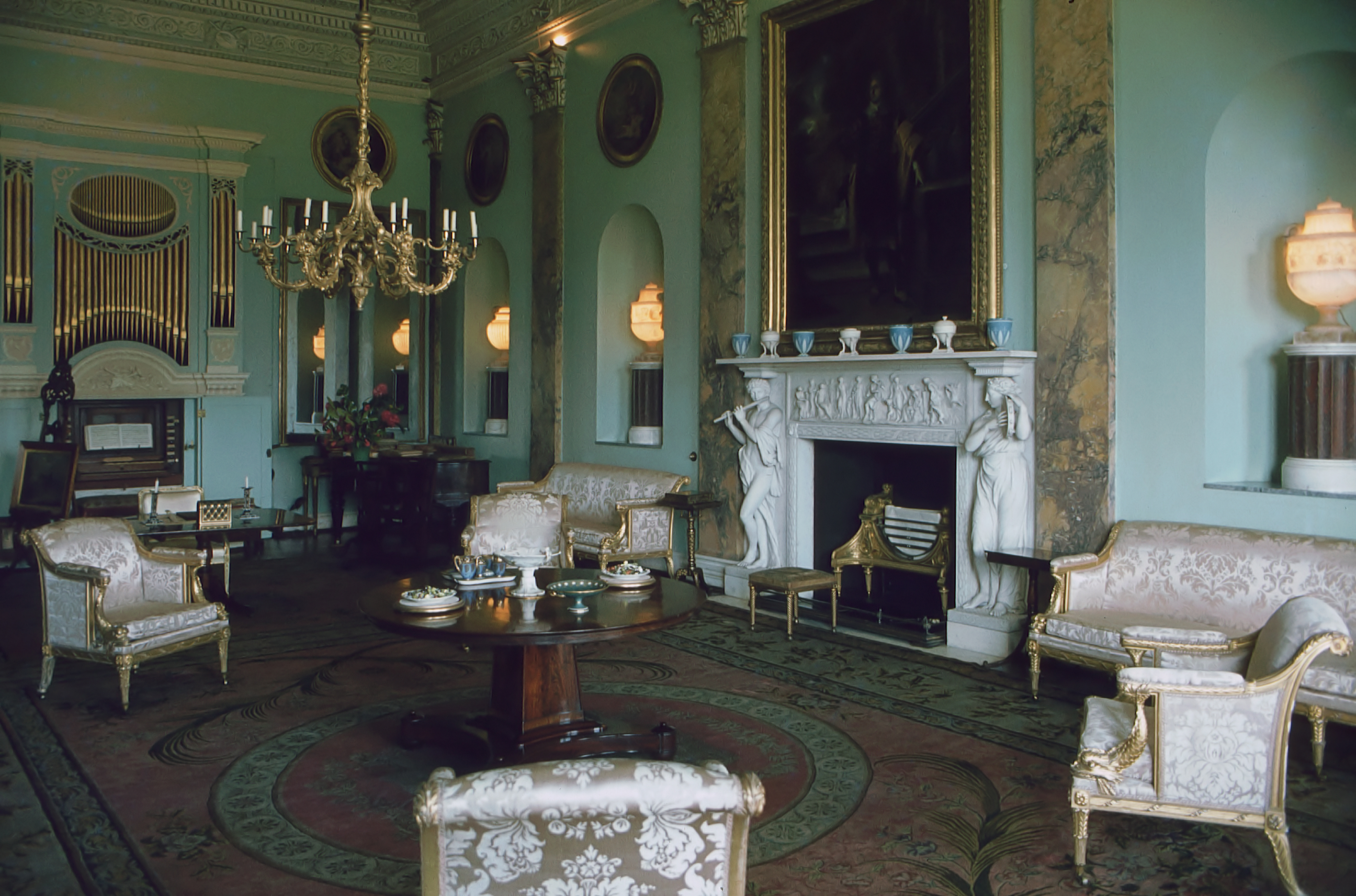
Settings
Characters
The character of Sir Geoffrey Wren is based loosely on that of Sir Oswald Mosley, a British fascist active in the 1930s. Wren is depicted as a strict vegetarian, like Hitler. The 3rd Viscount Halifax (later created the 1st Earl of Halifax) also appears in the film. Lord Darlington tells Stevens that Halifax approved of the polish on the silver, and Lord Halifax himself later appears when Darlington meets secretly with the German Ambassador and his aides at night. Halifax was the chief architect of the British policy of appeasement from 1937 to 1939. Coincidentally, Halifax was born at Powderham Castle (above). The character of Congressman Jack Lewis in the film is a composite of two separate American characters in Kazuo Ishiguro's novel: Senator Lewis (who attends the pre-WW2 conference in Darlington Hall), and Mr Farraday, who succeeds Lord Darlington as master of Darlington Hall.
Release
The film had its premiere on 25 October 1993 at the Academy of Motion Picture Arts and Sciences in Los Angeles.
It was the opening night film at the London Film Festival on 4 November 1993 and opened in 94 theatres in the United States on 5 November.
Reception
Box office
The film grossed $23 million in the United States and Canada. In the United Kingdom, it grossed £4.5 million. Worldwide, it grossed a total of $63.9 million.
Critical reception
On Rotten Tomatoes the film has a 96% rating based on 49 reviews, with an average rating of 8.6/10. The consensus states: "Smart, elegant, and blessed with impeccable performances from Anthony Hopkins and Emma Thompson, The Remains of the Day is a Merchant–Ivory classic." On Metacritic, it has a weighted average score of 86 based on 12 reviews. Audiences polled by CinemaScore gave the film an average grade of "A−" on an A+ to F scale.
Roger Ebert particularly praised the film, calling it "a subtle, thoughtful movie." In his favorable review for The Washington Post, Desson Howe wrote, "Put Anthony Hopkins, Emma Thompson and James Fox together and you can expect sterling performances." Vincent Canby of The New York Times said, in another favorable review, "Here's a film for adults. It's also about time to recognize that Mr. Ivory is one of our finest directors, something that critics tend to overlook because most of his films have been literary adaptations."
The film was named one of the best films of 1993 by over 50 critics, making it the fifth-most-acclaimed film of 1993.
Accolades
| Award | Category | Recipient(s) | Result |
|---|---|---|---|
| 20/20 Awards | Best Actor | Anthony Hopkins | |
| Best Actress | Emma Thompson | ||
| Best Adapted Screenplay | Ruth Prawer Jhabvala | ||
| Best Costume Design | Jenny Beavan and John Bright | ||
| Best Original Score | Richard Robbins | ||
| Academy Awards | Best Picture | John Calley, Mike Nichols and Ismail Merchant | |
| Best Director | James Ivory | ||
| Best Actor | Anthony Hopkins | ||
| Best Actress | Emma Thompson | ||
| Best Screenplay – Based on Material Previously Produced or Published | Ruth Prawer Jhabvala | ||
| Best Art Direction | Art Direction: Luciana Arrighi; | ||
| Set Decoration: Ian Whittaker | |||
| Best Costume Design | Jenny Beavan and John Bright | ||
| Best Original Score | Richard Robbins | ||
| Awards Circuit Community Awards | Best Actress in a Leading Role | Emma Thompson | |
| Best Costume Design | Jenny Beavan and John Bright | ||
| Best Production Design | Luciana Arrighi and Ian Whittaker | ||
| British Academy Film Awards | Best Film | Ismail Merchant, Mike Nichols, John Calley, and James Ivory | |
| Best Direction | James Ivory | ||
| Best Actor in a Leading Role | Anthony Hopkins | ||
| Best Actress in a Leading Role | Emma Thompson | ||
| Best Adapted Screenplay | Ruth Prawer Jhabvala | ||
| Best Cinematography | Tony Pierce-Roberts | ||
| Chicago Film Critics Association Awards | Best Actor | Anthony Hopkins | |
| Best Actress | Emma Thompson | ||
| Best Screenplay | Ruth Prawer Jhabvala | ||
| Dallas–Fort Worth Film Critics Association Awards | Best Film | ||
| Best Actor | Anthony Hopkins | ||
| David di Donatello Awards | Best Foreign Film | James Ivory | |
| Best Foreign Actor | Anthony Hopkins | ||
| Best Foreign Actress | Emma Thompson | ||
| Directors Guild of America Awards | Outstanding Directorial Achievement in Motion Pictures | James Ivory | |
| Evening Standard British Film Awards | Best Actress | Emma Thompson (Also for Much Ado About Nothing) | |
| Golden Globe Awards | Best Motion Picture – Drama | ||
| Best Actor in a Motion Picture – Drama | Anthony Hopkins | ||
| Best Actress in a Motion Picture – Drama | Emma Thompson | ||
| Best Director – Motion Picture | James Ivory | ||
| Best Screenplay – Motion Picture | Ruth Prawer Jhabvala | ||
| Goya Awards | Best European Film | James Ivory | |
| Kansas City Film Critics Circle Awards | Best Actor | Anthony Hopkins | |
| Best Actress | Emma Thompson | ||
| London Film Critics Circle Awards | British Film of the Year | ||
| Director of the Year | James Ivory | ||
| Actor of the Year | Anthony Hopkins | ||
| Los Angeles Film Critics Association Awards | Best Actor | Anthony Hopkins (Also for Shadowlands) | |
| Movieguide Awards | Best Movie for Mature Audiences | ||
| Nastro d'Argento | Best Foreign Director | James Ivory | |
| National Board of Review Awards | Top Ten Films | ||
| Best Actor | Anthony Hopkins (Also for Shadowlands) | ||
| National Society of Film Critics Awards | Best Actor | ||
| New York Film Critics Circle Awards | Best Actor | ||
| Best Actress | Emma Thompson (Also for Much Ado About Nothing) | ||
| Producers Guild of America Awards | Outstanding Producer of Theatrical Motion Pictures | Mike Nichols, John Calley, and Ismail Merchant | |
| Robert Awards | Best Foreign Film | James Ivory | |
| Southeastern Film Critics Association Awards | Top Ten Films | ||
| Best Actor | Anthony Hopkins (Also for Shadowlands) | ||
| Turkish Film Critics Association Awards | Best Foreign Film | ||
| USC Scripter Awards | Ruth Prawer Jhabvala (screenwriter); Kazuo Ishiguro (author) | ||
| Writers Guild of America Awards | Best Screenplay – Based on Material Previously Produced or Published | Ruth Prawer Jhabvala |
- The film is #64 at the British Film Institute's "Top 100 British films".
- The film was also nominated for the American Film Institute's "100 Years...100 Passions" list.
Soundtrack
The original score was composed by Richard Robbins. It was nominated for the Academy Award for Best Original Score, but lost to Schindler's List.
;Track listing
- Opening Titles, Darlington Hall – 7:27
- The Keyhole and the Chinaman – 4:14
- Tradition and Order – 1:51
- The Conference Begins – 1:33
- Sei Mir Gegrüsst (Schubert) – 4:13
- The Cooks in the Kitchen – 1:34
- Sir Geoffrey Wren and Stevens Sr. – 2:41
- You Mean a Great Deal to This House – 2:21
- Loss and Separation – 6:19
- Blue Moon – 4:57
- Sentimental Love Story/Appeasement/In the Rain – 5:22
- A Portrait Returns/Darlington Hall/End Credits – 6:54
Notes
References
Bibliography
- Gale, Steven H. Sharp Cut: Harold Pinter's Screenplays and the Artistic Process. Lexington, Ky.: The University Press of Kentucky, 2003.
- Gale, Steven H., ed. The Films of Harold Pinter. Albany: SUNY Press, 2001.
- Hudgins, Christopher C. "Harold Pinter's Lolita: 'My Sin, My Soul'." In The Films of Harold Pinter. Steven H. Gale, ed. Albany, N.Y.: SUNY Press, 2001.
- Hudgins, Christopher C. "Three Unpublished Harold Pinter Filmscripts: The Handmaid's Tale, The Remains of the Day, Lolita." The Pinter Review: Nobel Prize / Europe Theatre Prize Volume: 2005 – 2008. Francis Gillen with Steven H. Gale, eds. Tampa, Fla.: University of Tampa Press, 2008.
References
- "The Remains of the Day".
- "The Remains of the Day".
- [http://www.cinemarealm.com/best-of-cinema/top-100-british-films/ "British Film Institute – Top 100 British Films'] (1999). Retrieved 27 August 2016
- (24 January 1993). "FILM; Merchant-Ivory and Friends: On the Job Again (Published 1993)".
- Carlson, Erin. (24 September 2019). "Queen Meryl: The Iconic Roles, Heroic Deeds, and Legendary Life of Meryl Streep". Hachette Books.
- (26 November 2012). "Four Weddings actor visits Creebridge". Galloway Gazette.
- Giblin, James Cross. (2002). "The Life and Death of Adolf Hitler". Clarion Books.
- Lee, David. (2010). "Stanley Melbourne Bruce: Australian Internationalist". Continuum.
- {{AFI film. 59638
- Brown, Geoff. (3 November 1993). "Now, heaven knows, anything goes". [[The Times]].
- {{Mojo title. remainsoftheday
- (22 November 1996). "Top Period Dramas in the UK".
- "The Remains of the Day".
- "The Remains of the Day Reviews". [[Metacritic]].
- "Home". [[CinemaScore]].
- Ebert, Roger. (5 November 1993). "The Remains Of The Day Movie Review (1993) |". [[Chicago Sun-Times]].
- (5 November 1993). "The Remains of the Day". Washingtonpost.com.
- Canby, Vincent. (5 November 1993). "Movie Review – The Remains of the Day – Review/Film: Remains of the Day; Blind Dignity: A Butler's Story". [[The New York Times]].
- (9 January 1994). "86 THUMBS UP! FOR ONCE, THE NATION'S CRITICS AGREE ON THE YEAR'S BEST MOVIES". [[The Washington Post]].
- "The 66th Academy Awards". [[Academy of Motion Picture Arts and Sciences]].
- "Film in 1994". [[British Academy of Film and Television Arts]].
- (January 2013). "1988–2013 Award Winner Archives".
- "46th DGA Awards".
- "The Remains of the Day – Golden Globes".
- (14 December 2013). "KCFCC Award Winners – 1990–99".
- (4 December 2010). "Critics' Circle Film of the Year: 1980–2010". [[London Film Critics' Circle]].
- "London Film Critics Circle Awards 1994".
- "The 19th Annual Los Angeles Film Critics Association Awards".
- "1993 Award Winners".
- (19 December 2009). "Past Awards". [[National Society of Film Critics]].
- "1993 New York Film Critics Circle Awards".
- (19 January 1994). "Laurel noms announced". Variety.
- "1993 SEFA Awards".
- "Past Scripter Awards".
- Fox, David J.. (14 March 1994). "'Schindler's' Adds a Pair to the List : Awards: Spielberg epic takes more honors—for screenwriting and editing. Jane Campion's 'The Piano' also wins.". [[The Los Angeles Times]].
- "AFI's 100 Years...100 Passions Nominees".
- (December 24, 1993). "Sister Act 2: Back in the Habit;Schindler's List;The Piano;Remains of the Day;Addams Family Values;Wayne's World 2;A Perfect World".
This article was imported from Wikipedia and is available under the Creative Commons Attribution-ShareAlike 4.0 License. Content has been adapted to SurfDoc format. Original contributors can be found on the article history page.
Ask Mako anything about The Remains of the Day (film) — get instant answers, deeper analysis, and related topics.
Research with MakoFree with your Surf account
Create a free account to save articles, ask Mako questions, and organize your research.
Sign up freeThis content may have been generated or modified by AI. CloudSurf Software LLC is not responsible for the accuracy, completeness, or reliability of AI-generated content. Always verify important information from primary sources.
Report