From Surf Wiki (app.surf) — the open knowledge base
The Mosquito
Anti-loitering sonic device
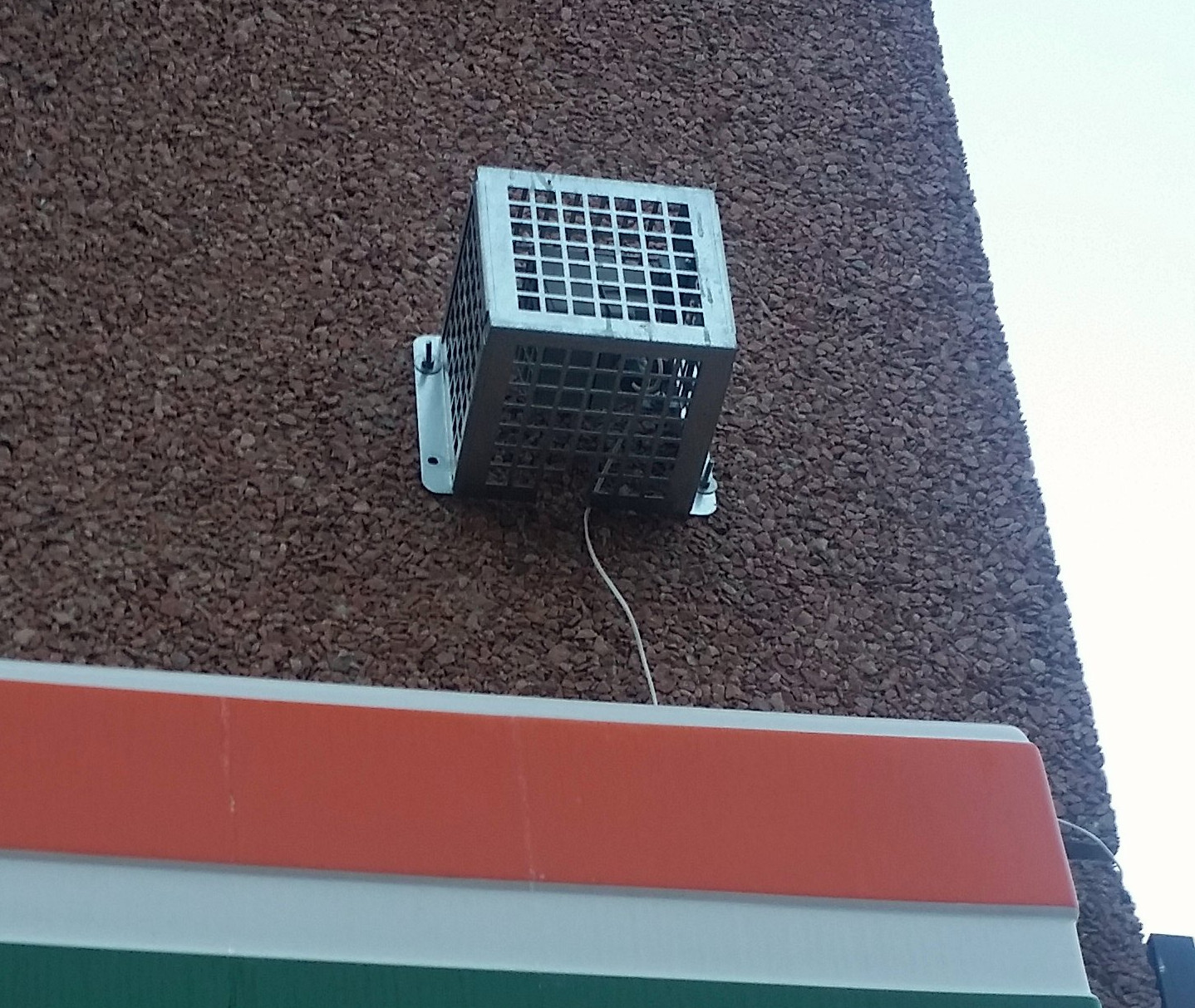
Anti-loitering sonic device
The Mosquito or Mosquito alarm is a machine used to deter loitering by emitting sound at high frequency. In some versions, it is intentionally tuned to be heard primarily by younger people. Nicknamed "Mosquito" for the buzzing sound it plays, the device is marketed as a safety and security tool for preventing youths from congregating in specific areas.
The latest version of the device, launched late in 2008, has two frequency settings, one of approximately 17.4 kHz that can generally be heard only by young people, and another at 8 kHz that can be heard by most people. The maximum potential output sound pressure level is stated by the manufacturer to be 108 decibels (dB) (comparable in loudness to a live rock concert) and the manufacturer's product specification furthermore states that the sound can typically be heard by people below 25 years of age. The ability to hear high frequencies deteriorates in most humans with age (a condition known as presbycusis), typically observable by the age of 18.
History
The Mosquito machine was invented and patented by Howard Stapleton in 2005, and was originally tested in Barry, Wales, where it was successful in reducing teenagers loitering near a grocery store. The idea was born after he was irritated by a factory noise when he was a child. The push to create the product was when Stapleton's 17-year-old daughter went to the store to buy milk and was harassed by a group of 12- to 15-year-olds. Using his children as test subjects, he determined the frequency of "The Mosquito".
The Mosquito was released to the mainstream market in 2005, through Stapleton's company Compound Security Solutions. The current device has two settings: the high frequency sound targeted at youth, and another that can be heard by everyone. The range of the sound is 140 ft with the sound baffle, and 200 ft without. It requires a 24-volt DC or 15-volt AC power supply.
A device installed in a Spar shop in Caerleon Road in Newport, South Wales was banned after three months by the Newport Community Safety Partnership, a partnership set up to meet the requirements of the Crime and Disorder Act 1998, with members including Newport City Council, Gwent Police, Newport Local Health Board, South Wales Fire Service, representatives of Customs and Excise, and the Welsh Assembly Government. Despite the ban, another Spar shop in Newport installed the device. A Newport Community Safety Partnership spokesman said: "Any view expressed by the Partnership does not stop any business or private company from purchasing these devices. They must ensure these systems comply with the law."
In February 2008, in response to a national campaign launched by the Children’s Commissioner for England, Liberty, and the National Youth Agency, the government issued a statement insisting that "'Mosquito alarms are not banned and the government has no plans to ban them".
Teen Buzz ringtone
The sound was made into a mobile phone ringtone, which could not be heard by teachers if the phone rang during a class.{{cite web
Awards
The Mosquito won the satirical Ig Nobel for "peace" in 2006. The Ig Nobels celebrate the quirkier side of serious scientific endeavour, honouring "achievements that first make people laugh, and then make them think".
Health effects
The German Federal Institute for Occupational Safety and Health stated in a report on The Mosquito, entitled Use of ultrasonic noise channels not entirely safe:
The results of the examination are now available. The auditors were not able to certify this device as completely safe.
The risk to the target group of teenagers and young adults is relatively low. They can leave the area when they hear the sound. On the other hand small children and infants are especially at risk, due to lengthy exposure to the sound, because the adults themselves do not perceive the noise. Moreover, the ultrasound affects not only hearing. Disruption of the equilibrium senses, as well as other extra-aural effects are well known. With the sound levels that can be reached by the device, the onset of dizziness, headache, nausea and impairment is to be expected. This is not the limit of the total risks to safety and health.}}
In a United Kingdom survey of the relevant studies of adults exposed to high frequency sound in an occupational context for the Health and Safety Executive (HSE) in 2001, it was concluded that the studies were inadequate to establish guidelines for safe exposure. The Mosquito's manufacturer relies on these inconclusive adult studies to justify the safety of the device.
The National Autistic Society said in 2008 that it was "extremely concerned" about possible harmful effects of the devices upon autistic people. Since autism can cause auditory hypersensitivity, autistic individuals with can have more intense reactions to this sound, especially if they are also under 25. Since autism can also affect communication skills, some individuals may not be able to communicate their discomfort to caregivers. A supermarket in Longridge, England, removed a mosquito device in 2008 after a campaign by a 19-year-old Paul Brookfield, who is autistic. Brookfield stated that the device was causing him pain due to his hypersensitivity.
Other disabilities and conditions may be exacerbated by the device. In March 2009, a child who had recently undergone ear surgery reported that the device set off her tinnitus, causing significant pain.
Reception
Support
The Mosquito has received support and endorsements from municipalities, school districts, property management companies, convenience stores and other organisations. Rochdale Safer Communities Partnership said the borough was committed to the continued use of the Mosquito:
"We feel totally justified in deploying Mosquito devices in the borough of Rochdale to give the community respite in cases of acute anti-social behaviour and youth nuisance," she said. "We use the devices when there are large groups of young people making life a problem for residents and businesses, as we are very keen not to let problems of anti-social behaviour escalate."
The Association of Convenience Stores (ACS) also supports the usage of the device, and so does British Retail Consortium (BRC), stating that "Not all young people are involved in violence, but given that some retail staff are facing a level of insolence [from teenagers] they have to have the option of doing what they can to protect themselves. They are entitled to discourage threatening groups from hanging around or in their shops."
At the Maple Ridge, Pitt Meadows and Vancouver west side school districts in British Columbia, Canada, the device has been credited with lowering exterior vandalism at one school by about 40%.
Opposition
Opposition categorises it as an indiscriminate sonic weapon which succeeds only in demonising children and young people and may breach their human rights.
A UK campaign called "Buzz off" is calling for The Mosquito to be banned.
The device was singled out for criticism in a joint report by children's commissioners for all parts of the UK, which formed part of a United Nations review of standards in the UK.
In January 2011, the device was banned on all Council and Partnership buildings in Sheffield following a successful campaign led by the then Member of UK Youth Parliament for Sheffield, Harrison Carter. Sheffield is the largest city in the country with such a ban in place. It was recognised by the UK Government in their Positive For Youth document, published by the Department for Education in January 2012. This strategy paper acts to set out a new-approach to cross government policy for young people aged 13–19. Although mentioned in the document, a national ban of the mosquito device was not in the Coalition Agreement, and is not part of current Government policy.
In July 2014, a new campaign was started in order to get a mosquito device removed from the public library in Milford Haven, Pembrokeshire. However, the campaign was unsuccessful.
In 2016, a shopping centre in Queensland, Australia removed the device after two years of campaigning by a local lawyer, due to it discriminating against young people. It had been installed in the centre for 10 years.
Legal status
Campaigners and authorities in many countries have stated that they believe the device breaches human rights Liberty has expressed concern that the device may violate articles 8 and 14 of the European Convention on Human Rights, and the United Kingdom's Human Rights Act 1998.
The Committee on Culture, Science and Education of the Parliamentary Assembly of the Council of Europe prepared a report stating that this device violates many articles of both the European Convention on Human Rights and the United Nations Convention on the Rights of the Child, and should be banned in Europe, because it is often "painful" and causes "degrading and discriminatory consequences for young people". In September 2008, Baroness Sarah Ludford MEP moved a motion to the European Parliament to ban the use of the Mosquito. It failed to get enough signatures from MEPs to proceed to a full debate.
In Belgium, a resolution was passed by the House in June 2008 asking the government to take all necessary measures to prohibit the use of devices like the Mosquito on Belgian territory. The legality of the device has also been tested in the French courts, where the Tribunal de Grande Instance de Saint-Brieuc prohibited the use of the Mosquito within its municipality, and ordered a private individual to pay €2,000 compensation after operating the device outside their house.
Under Ireland's Non-Fatal Offences Against the Person Act, 1997, anyone who "directly or indirectly applies force to or causes an impact on the body of another... without the consent of the other" (force including "application of ... noise or any other form of energy"), is guilty of committing assault. This issue has been raised in relation to the Mosquito device by Ireland's Ombudsman for Children following legal advice provided by Youth Work Ireland, but has yet to be tested in the Irish courts.
In the United Kingdom, the manufacturers claim that the tones are broadcast at 75 dB, meaning that the product falls within the government's auditory-safety limits, although the German news source Heise reported the device emits 85 dB, The English county of Kent has chosen not to allow the usage of the Mosquito on council-owned buildings.
References
References
- (21 February 2008). "The Mosquito MK4 Anti-Loitering device – Key specifications". Compoundsecurity.co.uk.
- "MP3 sample of the 17.4 kHz tone".
- Education.com. (23 May 2013). "Sonic Science: The High-Frequency Hearing Test". [[Scientific American]].
- "Sound-Emitting Device".
- (8 November 2005). "Noise machine deters shop gangs". BBC.
- Discovery's Science Channel "Weird Connections" Episode 8
- Williamson, David. (11 November 2005). "Life's a buzz for Mosquito inventor". Wales Online.
- (24 March 2006). "Anti-gang noise box switched off". BBC News.
- "'Mosquito' returns to zap the rowdies". South Wales Argus.
- (12 February 2008). "3,500 ultra-sonic dispersal devises told to Buzz Off". Office of the Children's Commissioner.
- Steffan Rhys. (11 February 2008). "News – Wales News – Mosquito device inventor tells campaign to buzz off". WalesOnline.
- Doctorow, Cary. (24 May 2006). "Kids turn "teen repellent" sound into teacher-proof ringtone". [[Boing Boing]].
- (24 May 2006). "Pupils perform 'alarming' feat". Metro.co.uk.
- Jha, Alok. (6 October 2006). "Electronic teenager repellant and scraping fingernails, the sounds of Ig Nobel success | UK news". The Guardian.
- (14 December 2007). "Einsatz von Ultraschall-Störgeräusch-Sendern nicht ganz unbedenklich". German Federal Institute for Occupational Safety and Health.
- [[Health and Safety Executive]]. Institute of Sound and Vibration Research. [http://www.hse.gov.uk/research/crr_pdf/2001/crr01343.pdf ''Damage to human hearing by airborne sound of very high frequency or ultrasonic frequency''] {{Webarchive. link. (28 May 2009 . Retrieved 23 May 2009.)
- compoundsecurity.co.uk. [http://www.compoundsecurity.co.uk/sites/default/files/Mosquito%20MK4.pdf ''Mosquito Anti-vandal System: MK4 Mosquito with multi-age function'']{{Dead link. (June 2018)
- [https://www.theguardian.com/business/2008/may/04/supermarkets.retail1 ''Store drops anti-yob device''] {{Webarchive. link. (5 March 2016 . Retrieved 16 November 2015.)
- [http://www.childrensrights.ie/sites/default/files/submissions_reports/files/BriefingNoteMosquitoMarch09_0.pdf ''Children’s Rights Alliance Briefing Note on the Mosquito Device''] {{Webarchive. link. (17 November 2015 . Retrieved 16 November 2015.)
- "Testimonials From Our Clients". Compound Security Systems.
- Ottewell, David. (13 February 2008). "'Mosquito device' defended". Manchester Evening News.
- Peacock, Louisa. (14 February 2008). "Anti-yob 'mosquito' device backed by British Retail Consortium". Personnel Today.
- (12 February 2008). "Calls to ban 'anti-teen' device". BBC News.
- (22 June 2011). "Hastings Debates Pitching Out Teen Vandals". StarTribune.
- (4 October 2010). "Gallery Place "Mosquito" Swatted Down". NBC 4 Washington.
- (9 June 2008). "UK society 'demonising' children". BBC News.
- (28 June 2010). "Calls to ban Mosquito 'teen repellent' device ruled out". BBC News.
- "Local teen wins campaign to ban controversial device".
- (2011). "Positive for Youth: A new approach to cross-government policy for young people aged 13 to 19". [[Department for Education]].
- "Remove Mosquito Device/Audio Weapon from Milford Haven Library!".
- (9 July 2014). "'Mosquito' alarm campaign grows wings". Milford Mercury.
- "Stop The Mosquito Device/Anti-Teen Weapon at Milford Haven Library". Facebook.
- (9 October 2014). "Sting in the tail for anti-Mosquito campaign". Milford Mercury.
- Robertson, Joshua. (30 June 2016). "National ban sought on sonic anti-loitering device aimed at young people". [[The Guardian]].
- (30 May 2007). "Using mosquito devices on children could constitute assault, says ombudsman". Irish Examiner.
- Florian Rötzer. (20 March 2007). "TP: Akustische Waffe oder harmlose Teenagerabwehr?". Heise.de.
- "The Mosquito Device". [[Liberty (advocacy group).
- Wach, Piotr. (25 June 2010). "Recommendation 1930 (2010): Prohibiting the marketing and use of the "Mosquito" youth dispersal device". [[Parliamentary Assembly of the Council of Europe]].
- (14 September 2008). "EU rejects bid to ban Mosquito". Thisisplymouth.co.uk.
- (26 June 2008). "Le Mosquito proche d'être interdit en Belgique?".
- (30 April 2008). "Le Figaro – Actualités : La justice interdit le boîtier anti-jeunes". [[Le Figaro]].
- (September 2009}} selling the Mosquito claim it can go up to 95 dB with a special chip, which in reality allows the Mosquito to reach 104 dB. The government of the United Kingdom issued a statement in 2008 stating that "'Mosquito alarms are not banned and the government has no plans to ban them".{{cite news). "No plan to ban 'anti-teen' device". BBC News.
- (13 June 2008). "Kent bans high-pitch Mosquito which targets youths". The Guardian.
This article was imported from Wikipedia and is available under the Creative Commons Attribution-ShareAlike 4.0 License. Content has been adapted to SurfDoc format. Original contributors can be found on the article history page.
Ask Mako anything about The Mosquito — get instant answers, deeper analysis, and related topics.
Research with MakoFree with your Surf account
Create a free account to save articles, ask Mako questions, and organize your research.
Sign up freeThis content may have been generated or modified by AI. CloudSurf Software LLC is not responsible for the accuracy, completeness, or reliability of AI-generated content. Always verify important information from primary sources.
Report