From Surf Wiki (app.surf) — the open knowledge base
The Fate of Fenella
Experiment in consecutive novel writing
Experiment in consecutive novel writing
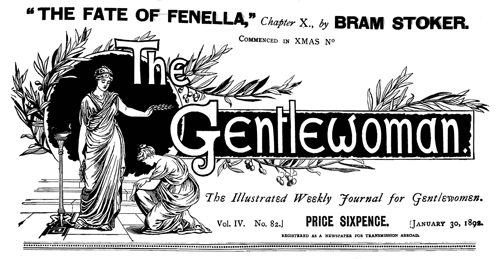
The Fate of Fenella was an experiment in consecutive novel writing inspired by J. S. Wood and published in his magazine The Gentlewoman in twenty-four parts between 1891 and 1892. When first published in book form its title was The Fate of Fenella: by Twenty-four Authors. Authors included Bram Stoker, Frances Eleanor Trollope and Sir Arthur Conan Doyle.
Description
The novel first appeared as a twenty-four part serial in J. S. Wood's weekly magazine, The Gentlewoman, in 1891 and 1892. Each of the authors wrote one chapter and passed the novel on to the next person in line. The odd-numbered chapters were written by women, and the even-numbered chapters by men, thus alternating in developing the narrative – although one of the men in the list, "Frank Danby", was in fact a woman. The completed work was republished as a three-volume novel by Hutchinson & Co. of London in May 1892, with a review noting the absence of a controlling mind.
Contemporary review
The following appeared in The Spectator in May 1892.
The result has been a fairly readable novel, that tells an extremely silly story. The plot is ridiculous; the characters waver and change from chapter to chapter; but there are occasionally strong situations, and scraps of fairly good dialogue. On the whole, however, the book is an amusing one; more amusing still when the reader remembers the conditions under which it has been written, and the difficulties with which the separate authors had to contend.
The chapters
The quotation marks in some chapter titles are as shown in the book (from the "cheap" edition of August 1892 by J. S. Wood)
- Helen Mathers, "Fenella"
- Justin McCarthy, Kismet
- Frances Eleanor Trollope, How it strikes a contemporary
- Arthur Conan Doyle, "Between two fires"
- May Crommelin, Complications
- F. C. Phillips, A woman's view of the matter
- “Rita”, So near — so far away
- Joseph Hatton, The tragedy
- Mrs. Lovett Cameron, Free once again
- Bram Stoker, Lord Castleton explains
- Florence Marryat, Madame de Vigny's revenge
- Frank Danby, To live or die?
- Mrs. Edward Kennard, "The scars remained"
- Richard Dowling, Derelict
- Mrs. Hungerford, Another rift
- Arthur A'Beckett, In New York
- Jean Middlemass, Confined in a madhouse
- Clement Scott, "Within sight of home"
- Clo. Graves, A vision from the sea
- H. W. Lucy, Through fire and water
- Adeline Sergeant, "Alive or dead?"
- George Manville Fenn, Retribution
- "Tasma", Sick unto death
- F. Anstey, "Whom the gods hate die hard"
References
References
- [http://archive.spectator.co.uk/article/28th-may-1892/23/the-fate-of-fenella ''Fate of Fenella'', The Spectator, May 1892, retrieved 21 February 2014]
- [http://bramstoker.org/stories/04other/fenella.html ''Fate of Fenella'', bramstoker.org, retrieved 21 February 2012]
- [[Richard Lancelyn Green]] and John Michael Gibson, ''A Bibliography of A. Conan Doyle'', revised edition, Boston London and New York, Hudson House, 2000, pp. 345–6
- "Lord Castleton Explains", in ''The Gentlewoman'' dated 30 January 1892, Chapter 10 of ''The Fate of Fenella''
- "Papers of Patricia Clarke".
This article was imported from Wikipedia and is available under the Creative Commons Attribution-ShareAlike 4.0 License. Content has been adapted to SurfDoc format. Original contributors can be found on the article history page.
Ask Mako anything about The Fate of Fenella — get instant answers, deeper analysis, and related topics.
Research with MakoFree with your Surf account
Create a free account to save articles, ask Mako questions, and organize your research.
Sign up freeThis content may have been generated or modified by AI. CloudSurf Software LLC is not responsible for the accuracy, completeness, or reliability of AI-generated content. Always verify important information from primary sources.
Report