From Surf Wiki (app.surf) — the open knowledge base
The Day After Trinity
1980 American documentary film
1980 American documentary film
| Field | Value |
|---|---|
| name | The Day After Trinity |
| image | Day-After-Trinity.jpg |
| caption | DVD cover, 2002, with photograph by Philippe Halsman, 1958 |
| director | Jon H. Else |
| producer | Jon H. Else |
| Peter Baker | |
| (executive producer) | |
| writer | David Peoples |
| Janet Peoples | |
| Jon Else | |
| narrator | Paul Frees |
| starring | Hans Bethe |
| Robert Serber | |
| Robert Wilson | |
| Frank Oppenheimer | |
| I.I. Rabi | |
| Freeman Dyson | |
| Stanislaw Ulam | |
| J. Robert Oppenheimer (archive footage) | |
| music | Martin Bresnick |
| cinematography | Tom McDonough |
| David Espar | |
| Stephen Lighthill | |
| editing | David Peoples |
| Ralph Wikke | |
| studio | KTEH |
| distributor | Pyramid Films (non-theatrical) |
| PBS (television) | |
| released | |
| runtime | 88 minutes |
| country | United States |
| language | English |
Peter Baker (executive producer) Janet Peoples Jon Else Robert Serber Robert Wilson Frank Oppenheimer I.I. Rabi Freeman Dyson Stanislaw Ulam J. Robert Oppenheimer (archive footage) David Espar Stephen Lighthill Ralph Wikke PBS (television)
The Day After Trinity (or The Day After Trinity: J. Robert Oppenheimer and the Atomic Bomb) is a 1981 documentary film directed and produced by Jon H. Else in association with KTEH public television in San Jose, California.
Synopsis
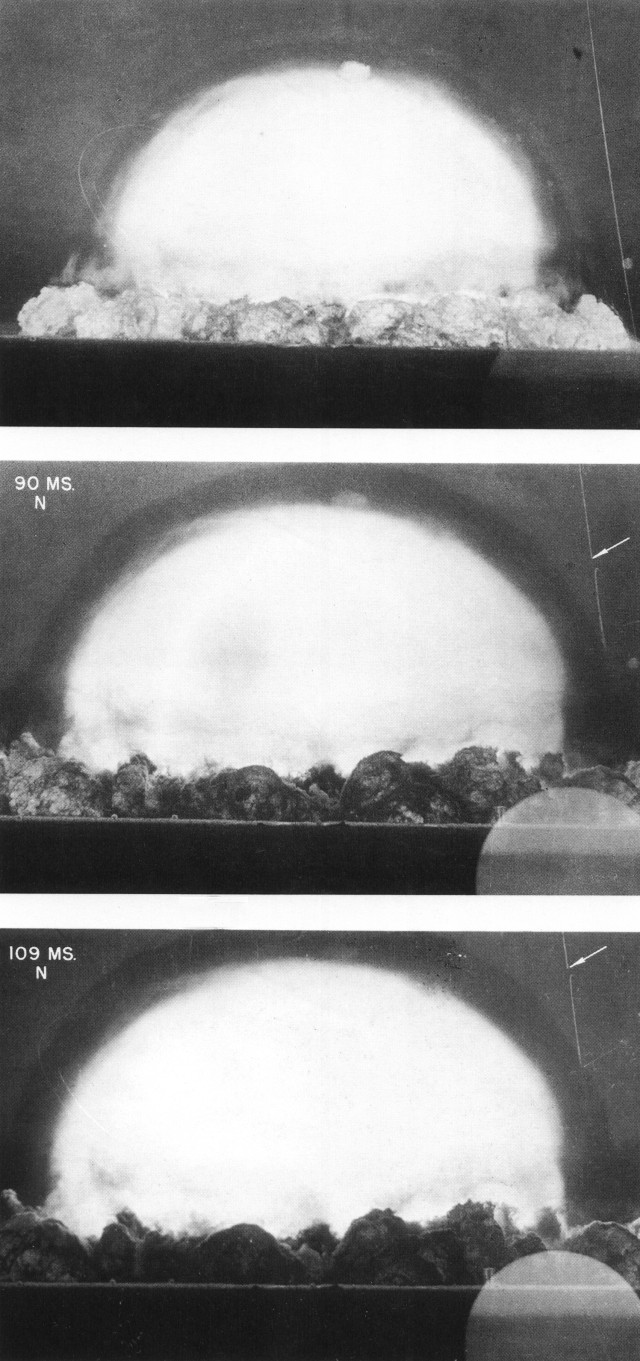
The film tells the story of J. Robert Oppenheimer (1904–1967), the theoretical physicist who led the effort to build the first atomic bomb, tested in July 1945 at Trinity site in New Mexico. It features interviews with several Manhattan Project scientists, as well as newly declassified archival footage.
The film's title comes from an interview seen near the conclusion of the documentary. Robert Oppenheimer is asked for his thoughts on Sen. Robert F. Kennedy's efforts to urge President Lyndon Johnson to initiate talks to stop the spread of nuclear weapons. "It's 20 years too late," Oppenheimer replies. After a pause, he states, "It should have been done the day after Trinity."
Interviewees
:In order of first appearance
- Haakon Chevalier – writer, friend of J. Robert Oppenheimer
- Hans Bethe – Los Alamos physicist, Nobel laureate in physics
- Francis Fergusson – writer, friend of J. Robert Oppenheimer
- Robert Serber – physicist, Los Alamos
- Robert Wilson – physicist, Los Alamos
- Frank Oppenheimer – physicist, Los Alamos, brother of Robert Oppenheimer
- I.I. Rabi – Manhattan Project physicist, Nobel laureate
- Freeman Dyson – physicist, Institute for Advanced Study
- Stirling Colgate – physicist, Los Alamos
- Stan Ulam – mathematician, Los Alamos
- Robert Porton – G.I., at Los Alamos during World War II
- Françoise Ulam – writer, wife of Stanislaw Ulam
- Dorothy McKibbin – former head, Manhattan Project office, Santa Fe, New Mexico
- Robert Krohn – physicist, Los Alamos
- Jane Wilson – writer, wife of Robert Wilson
- Jon Else – filmmaker, interviewer
- Holm Bursom – rancher, Socorro, New Mexico
- Dave MacDonald – rancher, Socorro, New Mexico
- Susan Evans – resident, New Mexico
- Elizabeth Ingram – merchant, San Antonio, New Mexico
Interviewees in archival film
- J. Robert Oppenheimer
- General Leslie Groves
- President Harry Truman
- Senator Joseph McCarthy
Home media
The Day After Trinity was released on VHS cassette by Pyramid Home Video, and on Region 1 DVD by Image Entertainment. A CD-ROM that was released in 1995 included interviews, transcripts, annotations, biographies, and other information.
In July 2023, after the release of Christopher Nolan's Oppenheimer, the Criterion Channel streamed The Day After Trinity for free; it was one of the service's most-streamed films during that time. It is also available for free viewing and download at the Internet Archive.
Reviews
Awards
The Day After Trinity was nominated for an Academy Award for Best Documentary Feature of 1980, and received a Peabody Award in 1981. The film also won a CINE Golden Eagle Award.
References
References
- [https://www.youtube.com/watch?v=tUg1J1owor8 Documentary Winners: 1981 Oscars]
- (27 July 2023). "'Oppenheimer' Fans Are Rediscovering a 40-Year-Old Documentary". [[The New York Times]].
- (July 18, 2023). "The Real History Behind Christopher Nolan's 'Oppenheimer'". Smithsonian Magazine.
- "The Day after Trinity: J. Robert Oppenheimer and the Atomic Bomb; Part 2".
- Annotations from transcript of ''The Day After Trinity'' produced by PTV Publications, associated with the documentary's national broadcast on PBS April 29, 1981
- Nichols, Peter M. [https://www.nytimes.com/1995/08/18/arts/home-video-728195.html?scp=3&sq=The Home Video], ''The New York Times'', August 18, 1995
- (24 July 2023). "How to stream Oppenheimer documentary The Day After Trinity for free right now".
- {{Internet Archive film. thedayaftertrinity
- [https://movies.nytimes.com/movie/review?res=980DE7DF1E38F933A15752C0A967948260 "The Day After Trinity: Oppenheimer & the Atomic Bomb (1980)"], ''[[The New York Times]]'', [[Vincent Canby]], January 20, 1981
- "The 53rd Academy Awards (1981) Nominees and Winners". oscars.org.
- (April 19, 1982). "Peabody Awards announced". UPI.
- "The Day After Trinity: J. Robert Oppenheimer and the Atomic Bomb".
- Davis, Clare Gartrell. "C.I.N.E. Annual Awards". Film News.
This article was imported from Wikipedia and is available under the Creative Commons Attribution-ShareAlike 4.0 License. Content has been adapted to SurfDoc format. Original contributors can be found on the article history page.
Ask Mako anything about The Day After Trinity — get instant answers, deeper analysis, and related topics.
Research with MakoFree with your Surf account
Create a free account to save articles, ask Mako questions, and organize your research.
Sign up freeThis content may have been generated or modified by AI. CloudSurf Software LLC is not responsible for the accuracy, completeness, or reliability of AI-generated content. Always verify important information from primary sources.
Report