From Surf Wiki (app.surf) — the open knowledge base
Tharbis
Cushite princess
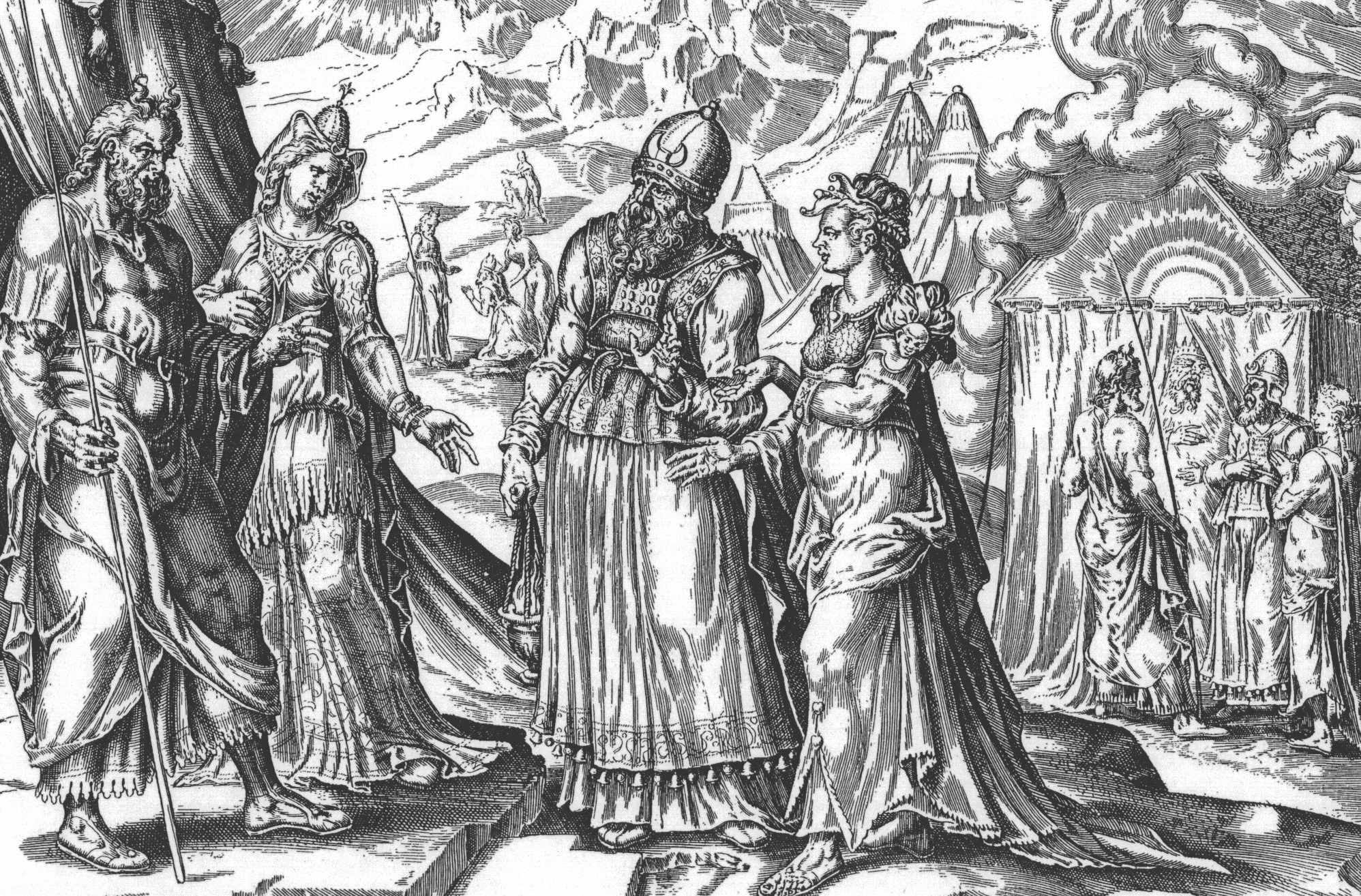
Cushite princess
| Field | Value |
|---|---|
| name | Tharbis |
| image | File:Ms. 33 (88.MP.70) Moses Leaves Tabris, cropping.jpg |
| alt | Moses and his family |
| caption | Moses leaves Tharbis, early 15th century depiction |
| birth_place | Kingdom of Kush |
| spouse | Kikianus |
| Moses |
Moses Tharbis (alternatively Adoniah), according to Josephus, was a Cushite princess of the Kingdom of Kush, who married Moses prior to his marriage to Zipporah as told in the Book of Exodus.
Purported family
According to the first-century Romano-Jewish scholar Josephus, Tharbis was the daughter of an unnamed king of "Saba", which he claimed was in Ethiopia, who lived before the Exodus. In the medieval rabbinic version found in the Sefer HaYashar, she is instead the king's wife, not his daughter, and the king is named Kikianus.
Marriage
Per Josephus' account, in Moses' early adult life, he led the Egyptians in a campaign against invading Ethiopians and defeated them. While Moses besieged the city of Meroë, Tharbis watched him lead the Egyptian army from within the city walls, and fell in love with him. He agreed to marry her if she would procure the deliverance of the city into his power. She did so immediately and Moses promptly married her. The account of this expedition is also mentioned by Irenaeus.
After the war, when Moses sought to return to Egypt – Tharbis is said to have resisted and insisted that he remain in Ethiopia as her husband. He then, being "most skilful in astronomy", cast two rings; one which caused the wearer to become forgetful, and the other to cause the wearer to remember all. He gave the first ring to Tharbis, and wore the second himself, and waited for her oblivious nature to lose interest in retaining him as a husband – and when she had forgotten her love for him, he returned to Egypt alone. Some have suggested this period may have started when Moses was 27, and that he remained with Tharbis for forty years; although this number contradicts the traditional sources which suggest that Moses killed an Egyptian overseer when he was approximately 40 years old himself.
Theories
Some have suggested that this story is an invention, arising from the "enigmatic" verse in Numbers 12:1 that states "Miriam and Aaron spoke against Moses because of the Cushite woman whom he had married". Miriam is punished for her rebuke of her brother by being afflicted with leprosy. Moses is depicted with an African wife in a 17th-century painting by Jacob Jordaens.
It is also suggested that Artapanus of Alexandria may have concocted the story "to impress his pagan audience" with "such a love story".
In fiction
Tharbis is a character in "Tarbis of the Lake", a 1934 supernatural story by E. Hoffmann Price. In 1937, Amy Redpath Roddick published an 80-page "poetic drama" telling an account of the life of Tharbis.
Tharbis is portrayed by Esther Brown in Cecil B. DeMille's 1956 biblical epic The Ten Commandments. In the film, she appears briefly and is not Moses's wife.
References
References
- ''Book of Jasher'', 23.5-25.5
- Dewey M. Beegle, "Moses", The Anchor Bible Dictionary, 6 vols. (New York: Doubleday, 1992), vol. 4, p. 917.
- [[Flavius Josephus]], [http://sacred-texts.com/jud/josephus/ant-2.htm Jewish Antiquities, Book II, Chapter 10]
- "Antiquities of the Jews page 61".
- "''Fragments from the Lost Writings of Irenaeus'', XXXII".
- [[Walter Raleigh. Raleigh, Sir Walter]], ''The History of the World: Section IV 'Of Moses' flying out of Egypt'', 1829 edition
- Yashar Shemot, [[Midrash]] to the [[Pentateuch]], 11th century
- Exodus 2:11-21
- Inglis, James. "The Witness", 1871. pp. 30
- Bostwick, Henry. "Lectures Upon Portions of History", 1838. p. 29
- Hays, J. Daniel. [http://fontes.lstc.edu/~rklein/Documents/did_moses_marry_a_cushite.htm Did Moses Marry a Cushite?] {{Webarchive. link. (2019-09-05)
- [[Book of Numbers]], [[s:Bible, King James, Numbers#Chapter 12. Chapter 12]]. v. 1-10
- Feldman, Louis H. "Jew and Gentile in the Ancient World", 1996. p. 547
- (2008). "The Essential Guide to Mummy Literature". [[Scarecrow Press]].
- (February 1934). "Tarbis of the Lake". [[Weird Tales]].
- Roddick, Amy Redpath. "Tharbis", 1937 {{OCLC. 13114790
- (17 April 2018). "University of Toronto Quarterly". University of Toronto Press.
- Meyer, Stephen C.. (27 November 2014). "Epic Sound: Music in Postwar Hollywood Biblical Films". Indiana University Press.
This article was imported from Wikipedia and is available under the Creative Commons Attribution-ShareAlike 4.0 License. Content has been adapted to SurfDoc format. Original contributors can be found on the article history page.
Ask Mako anything about Tharbis — get instant answers, deeper analysis, and related topics.
Research with MakoFree with your Surf account
Create a free account to save articles, ask Mako questions, and organize your research.
Sign up freeThis content may have been generated or modified by AI. CloudSurf Software LLC is not responsible for the accuracy, completeness, or reliability of AI-generated content. Always verify important information from primary sources.
Report