From Surf Wiki (app.surf) — the open knowledge base
Thai lunar calendar
Religious calendar in Thailand
_(CBL_Thi_1302).jpg)
Religious calendar in Thailand
The Thai lunar calendar (, , , literally, Specific days according to lunar norms), or Tai calendar, is a lunisolar Buddhist calendar. It is used for calculating lunar-regulated holy days. Based on the SuriyaYatra, with likely influence from the traditional Hindu Surya Siddhanta, it has its own unique structure that does not require the Surya Siddhanta to calculate. Lunisolar calendars combine lunar and solar calendars for a nominal year of 12 months. An extra day or an extra 30-day month is intercalated at irregular intervals.
Legal versus religious calendar
The Thai solar calendar (, , ), Thailand's version of the Gregorian calendar, replaced the patithin chanthrakhati in AD 1888 / 2431 BE for legal and commercial purposes. In both calendars, the four principal lunar phases determine Buddhist Uposathas, obligatory holy days for observant Buddhists. Significant days also include feast days.
Note that the Thai and the Chinese lunar calendars do not directly correspond. Thai Chinese likewise observe their Uposatha and traditional Chinese holidays according to solar terms, two of which correspond to one lunar phase. These also move with respect to the solar calendar, and so it is common for Thai calendars to incorporate both Thai and Chinese lunar calendar-based events.
Mundane astrology also figures prominently in Thai culture, so modern Thai birth certificates include lunar calendar dates and the appropriate Thai Zodiacal animal year-name for Thai Hora (, ). The Thai Zodiac is similar to the Chinese, though the Dragon is replaced by the Naga (งูใหญ่), and in Northern Thailand the Pig is occasionally replaced with an Elephant.

Years
To keep the years in sync with the seasons, Thai lunar years may add a day to the 7th month or repeat the 8th month. Therefore, years may have one of three lengths – 354, 355 or 384 days – yet retain a nominal length of twelve months.
- The 354-day-long years consist of 12 "normal months", and such a year is called a "normal-month year" (, , ).
- The 355-day-long years add an extra day to the normally 29-day-long 7th month; such a year is called an "extra-day year" (, , ).

- The 384-day-long years repeat the 30-day-long 8th month, thus keeping the month count at 12. Nevertheless, a year of 384 days is called an "extra-month year" (, , ).
New year
The Thai lunar calendar does not mark the beginning of a new year when it starts a new 1-to-12 count, which occurs most frequently in December.
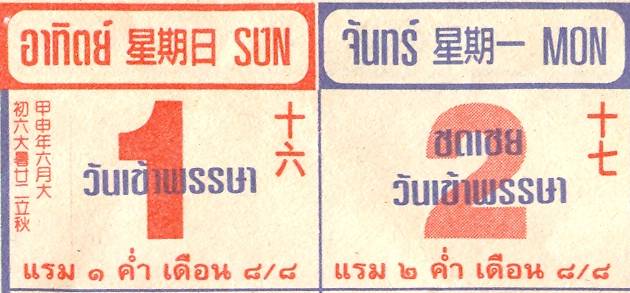
The Thai solar calendar determines a person's legal age and the dates of secular holidays, including the civil new year and the three days of the traditional Thai New Year, which begin the next Twelve-year animal cycle. Should the holidays fall on a weekend, it also accommodates these as well as some of the principal lunar festivals with a compensatory day off (, ).
Twelve-year animal cycle
13 April of the solar calendar occasions the beginning of the traditional Thai New Year (Songkran) and is the day that a year assumes the name of the next animal in the twelve-year animal cycle; Thai Chinese communities may observe the name-change earlier in accordance with the Chinese New Year.
The Thai names of the months were borrowed from Khmer, which were in turn borrowed from Archaic Vietnamese.
| Gregorian year | Thai zodiac | Animal | Khmer name | Vietnamese root |
|---|---|---|---|---|
| 2025 | Maseng (มะเส็ง) | 蛇 Snake | Msáñ | Rắn |
| 2026 | Mamia (มะเมีย) | 馬 Horse | Mâmi | Mã? |
| 2027 | Mamae (มะแม) | 羊 Goat | Mâmê | Mùi? |
| 2028 | Wok (วอก) | 猴 Monkey | Vok | Vọc |
| 2029 | Raka (ระกา) | 雞 Rooster | Râka | Gà (Kê) |
| 2030 | Cho (จอ) | 狗 Dog | Câ | Chó |
| 2031 | Kun (กุน) | 豬 Pig | Kŏr | Cúi |
| 2032 | Chuat (ชวด) | 鼠 Rat | Jut | Chuột |
| 2033 | Chalu (ฉลู) | 牛 Ox | Chlov | Trâu |
| 2034 | Khan (ขาล) | 虎 Tiger | Khal | Cọp (Khái) |
| 2035 | Tho (เถาะ) | 兔 Rabbit | Thaôh | Thỏ |
| 2036 | Marong (มะโรง) | 龍 Dragon | Roŭng | Rồng |
Months
In the modern Thai calendar, months (, , , meaning "month" or "Lunation") are defined by lunar cycles. Successive months (or lunations) are numbered from 1 to 12 within the Thai year. As in other Buddhist calendars, these months have names that derive from Sanskrit, but for the most part are only known by Thai astrologers.{{cite web
Two successive lunations take slightly more than 59 days. The Thai lunar calendar approximates this interval with "normal-month" pairs (ปกติมาส, ) that are alternately 29 and 30 days long. 29-day "hollow months" (เดือนขาด, , ) are odd-numbered (เดือนคี่, , ); 30-day "full months" (เดือนถ้วน, , ) are even-numbered (เดือนคู่, , ).
To keep the beginning of the month in sync with the new moon, from time to time either the normally "hollow" Month 7 takes an extra day, or an extra "full" Month 8 follows a normal "full" Month 8.
Months 1 and 2 are named in archaic alternate numbers, with the remainder being named in modern numbers.{{cite web |url= http://dspace.anu.edu.au/bitstream/1885/41890/3/thai_time.html |archive-url=https://web.archive.org/web/20020110010101/http://dspace.anu.edu.au/bitstream/1885/41890/3/thai_time.html|title= Thai Time |access-date= 2008-05-08 |last= Diller |first= Anthony |author2=Preecha Juntanamalaga |year= 2000 |publisher= Faculty of Asian Studies Australian National University |page= 25 |archive-date= 2002-01-10 |url-status= dead |quote= (5.1) ...the common Thai practice is simply to refer to lunar months by number, e.g. [du’an s:am], ‘third lunar month’. For the first and second lunar months, the older Thai counting forms [a:y] and [yi:] are used. Thus the first lunar month is commonly [du’an a:y], equivalent in more obscure astrological parlance to [maru’khasira-ma:t].}}
Months 1 – 6
Month 1, "duean ai" (เดือนอ้าย, ), begins the cycle of counting the months anew, most frequently in December, but does not signify the beginning of a new year.{{cite web |archive-url= https://web.archive.org/web/20020110010101/http://dspace.anu.edu.au/bitstream/1885/41890/3/thai_time.html |access-date= 2008-05-08 |archive-date= 2002-01-10 |url-status= dead An odd-numbered hollow month, it is 29 days long.
Month 2, "duean yi", (เดือนยี่, , from archaic ญี่ meaning 2) is an even-numbered full month.
Months 3–6, "duean 3–6", use the modern reading of Thai numerals, as do all remaining months. Months 3–6, alternate between 29-day hollow months and 30-day full months.
Month 7 and athikawan
Month 7, "duean 7", a hollow month is normally 29 days long in years of 354 days, but adds an extra day (อธิกวาร ) when required for 355-day-long years (ปีอธิกวาร, ).
Month 8
The eighth month, "duean 8", is a 30-day full month.
Month 8/8 "athikamat"


Athikamat (อธิกมาส, )) is the extra month needed for a 384-day-long pi athikamat (extra-month year; ปีอธิกมาส, ). Month 8 repeats as เดือน ๘/๘ or Month 8/8, variously read as "duean paet thab paet" (เดือนแปดทับแปด) or "duean paet lang" (เดือนแปดหลัง)
Months 9 – 12
Months 9–12, "duean 9–12", complete the lunar cycle.
Month divisions
Months divide into two periods designated by whether they are waxing or waning:
- Waxing : khang khuen (ข้างขึ้น), the period from new moon to full moon, is always 15 days long.
- Waning : khang raem (ข้างแรม), the period from full moon to new moon, which is 14 days long in hollow months, except when Month 7 adds an extra day, and 15 days long in full months.
Weeks
วันเสาร์, ระยะ ๗ วัน เช่น สัปดาห์แห่งการส่งเสริมพระพุทธศาสนา. สัปดาห์แห่งการเขียนจดหมาย. (ส. สปฺตาห). สัปดาห์, สัปดาหะ ดู สัปด. สัปด [สับดะ] ว. เจ็ด. (ส. สปฺต; ป. สตฺต). ORID -- A week is called Sapda/Sappada (, ). The term is defined by the Royal Institute Dictionary (RID) as a 7-day period beginning on Sunday and ending Saturday. When referring to lunations, however, it is the 7-, 8- or (rarely) 9-day interval between quartile lunar phases; that is, from one wan phra (วันพระ) to the next.
Days
While solar-calendar weekdays have names, lunar-calendar days number sequentially from 1 to 14 or 15 in two segments depending on whether the moon is waxing or waning. For example, "raem 15 kham duean 12 แรม ๑๕ ค่ำ เดือน ๑๒" means "Waning of the 15th Night of the 12th Lunar Month".
*Kham ค่ำ *, evening, is considered to be the evening of the common day that begins and ends at midnight, rather than of a day that begins and ends at dusk. Past practice may have been different.
Named lunar days
- Wan Phra วันพระ, Buddhist holy days
- Wan Thamma Sawana วันธรรมสวนะ Buddhist Uposatha regularly fall on:
- Khuen 8 ขึ้น ๘ first-quarter moon
- Khuen 15 ขึ้น ๑๕ full moon; also called wan phen วันเพ็ญ day [of] full [moon]. However, Wan Deuan Phen วันเดือนเพ็ญ, the actual day of the full moon and khuen 15 kham do not always fall on the same day.
- Raem 8 แรม ๘ third-quarter moon
- Raem 14 (15) แรม ๑๔ (๑๕) the last day of the lunar month; also called wan dap วันดับ day [moon is] quenched, [or goes] out.
- Wan Thamma Sawana วันธรรมสวนะ Buddhist Uposatha regularly fall on:
- Wan wai phra chan วันไหว้พระจันทร์, called "Day [of] Respect [for] the Holy Moon", is the actual day the Harvest moon becomes full. It occurs on khuen 14 (15) kham duean 10 ขึ้น ๑๔ (๑๕) ค่ำ เดือน ๑๐ (Waxing 14 (15) Evening, Month 10.)
Holidays regulated by the moon
Main article: Public holidays in Thailand
Uposatha, colloquially called วันพระ, are the New, First-quarter, Full, and Third-quarter Moon-days. These are not normally days off (วันหยุด), except for butcher, barber, and beautician shops that observe the Eight Precepts. Annual holidays and seasonal festivals collectively are called วันนักขัตฤกษ์.
Festivals or fairs are called เทศกาล; these may be further styled as ประเพณี "traditional" and as , "rite" or "ceremony". The table shows the principal ones governed by the moon in yellow.
Work holidays prescribed by the government are called ; those regulated by the moon are red.
Weekends are normally days off; if a holiday normally observed by a day off falls on a weekend, the following Monday is a compensatory day off .
| Work holidays | and | festivals | regulated by the moon: x = waxing moon; n = waning |
|---|
| Mo. | Day | Event | ไทย | Comment |
|---|---|---|---|---|
| 3† | 1x | Chinese New Year | ตรุษจีน | Most shops owned by Chinese-Thai close |
| 3 | 15x | Magha Puja | วันมาฆบูชา | Makha Bucha |
| 6 | 15x | Vesak | วิสาขบูชา | Wisakha Bucha |
| 8‡ | 15x | Asalha Puja | อาสาฬหบูชา | Asanha Bucha |
| 8‡ | 1n | Wan Khao Phansa | วันเข้าพรรษา | Begin Rains Retreat, or "Buddhist Lent" |
| 10 | 15n | Thetsakan Sat | เทศกาลสารท | The Vegetarian Festival (เทศกาลวันสารท) now appears on calendars as thetsakan kin che kao wan (เทศกาลกินเจเก้าวัน), (begin) Nine-day Vegetarian Festival. Kin Jae means (to vow) in the manner of Vietnamese or Chinese Buddhists to eat a strict vegetarian diet. (เทศกาลกินเจ) |
| 11 | 15x | Wan Ok Phansa | วันออกพรรษา | End Rains Retreat, or "Buddhist Lent" |
| 11 | 1n | Thot Kathin | ทอดกฐิน | Presentation of Monk's Robes after Rains Retreat |
| 12 | 15x | Loi Krathong | ลอยกระทง | Note that Loi Krathong dates are based on the Lanna (Northern Thailand) Lunar Calendar which is two months later than the Thai Lunar Calendar. Loy Krathong is actually on the second month of the Lanna calendar which is the 12th month of the central Thai calendar. |
Notes: : † The Chinese New Year uses different methods of determining intercalary months, so this festival sometimes occurs a month earlier or later. : ‡ Month 8/8 in years with the extra month.
Thai year vocabulary
Thai orthography spells most native words phonetically, though there is no definitive system for transcription into Roman letters. Here, native Thai words are immediately followed by a vocabulary entry in this pattern: :Phonetic Thai (Thai phonetic respelling, if different) [Comment] definition; variant definitions. Example: :Thai ไทย (ไท) [Archaic] free, frank; Thai race, language, alphabet; citizen of Thailand.
Sanskrit loan words follow different rules [the way English grammatical rules vary for words of Greek and Latin origin ('ph-' in 'phonetic' being pronounced /f/, for example.)] Entered below in order of first appearance, these vocabulary entries are in this pattern: ;Sanskrit สันสกฤต (สันสะกฺริด /san-sa-krit/) : Literally means "well done", "polished","cultured" or "perfected" in a modern usage (which implies the language of cultured persons); Sanskrit alphabet, language, writing; [presumed] compound of
- san สัน (-/son/) derived from the prefix "saṃ" meaning "together, with, completely"
- skrit สกฤต (สะกฺริต /sa-krit/) derived from the root "kr" meaning "do or make". ; Chanthrakhati จันทรคติ (จันทฺระคะติ) : "Lunar norms", Lunar Calendar; compound of
- Chanthra- จันทร- (จันทฺระ) : Chan จันทร์ (จัน) moon, lunar +
- Kati คติ (คะติ) : ways, principles, norms ; Patithin ปฏิทิน (ปะติทิน) : Calendar; compound of
- Pati- ปฏิ- (ปะติ-) : anti-, re-, for, specific +
- -thin (-ทิน) : [from Sanskrit dina] : day.
- patithin means for days, specific days or fixed days ; Patitin Chanthakhati ปฏิทินจันทรคติ (ปะติทินจันทระคะติ) : "Specific days according to lunar norms", Lunar Calendar ; Suriyakhati สุริยคติ (สุริยะคะติ) : Solar norms, Solar Calendar; compound of
- Suriya สุริย or สุริยะ : Athit อาทิตย์, the sun, Sol +
- Khati คติ (คะติ) : ways, principles, norms ; Prokkatimat ปรกติมาส (ปฺรกกะติมาด) : normal month; compound of
- Prokkati ปรกติ (ปฺรกกะติ) : pakati ปกติ (ปะกะติ) ordinary, usual, normal +
- Mat มาส (มาด) : duean (เดือน) month. ; Athikamat อธิกมาส (อะทิกะมาด) : month added in leap-month lunar years ; Athikawan อธิกวาร (อะทิกะวาน) : day added in leap-day lunar years; compound of
- Athika (Sanskrit: adhika) : additional +
- -wan วาร (Sanskrit: vāra) : wan วัน day. ;Athikasurathin อธิกสุรทิน (อะทิกะสุระทิน) : day added to February in a solar leap year.
References
References
- J.C. Eade. (1995). "The calendrical systems of mainland southeast asia". E.J. Brill, Leiden.
- Michel Ferlus. [https://hal.archives-ouvertes.fr/halshs-00922842/document The sexagesimal cycle, from China to Southeast Asia]. 23rd Annual Conference of the Southeast Asian Linguistics Society, May 2013, Bangkok, Thailand.
- [http://rirs3.royin.go.th/dictionary.asp RID on-line] {{webarchive. link. (2009-03-03)
- [http://rirs3.royin.go.th/dictionary.asp สารท ๑] {{webarchive. link. (2009-03-03)
- [http://rirs3.royin.go.th/dictionary.asp กินเจ] {{webarchive. link. (2009-03-03)
This article was imported from Wikipedia and is available under the Creative Commons Attribution-ShareAlike 4.0 License. Content has been adapted to SurfDoc format. Original contributors can be found on the article history page.
Ask Mako anything about Thai lunar calendar — get instant answers, deeper analysis, and related topics.
Research with MakoFree with your Surf account
Create a free account to save articles, ask Mako questions, and organize your research.
Sign up freeThis content may have been generated or modified by AI. CloudSurf Software LLC is not responsible for the accuracy, completeness, or reliability of AI-generated content. Always verify important information from primary sources.
Report