From Surf Wiki (app.surf) — the open knowledge base
Textile arts of the Indigenous peoples of the Americas
none

none
_bag_-_South_American_objects_in_the_American_Museum_of_Natural_History_-_DSC06043.JPG)
The textile arts of the Indigenous peoples of the Americas are decorative, utilitarian, ceremonial, or conceptual artworks made from plant, animal, or synthetic fibers by Indigenous peoples of the Americas.
Textile arts and fiber arts include fabric that is flexible woven material, as well as felt, bark cloth, knitting, embroidery, featherwork, skin-sewing, beadwork, and similar media. Textile arts are one of the earliest known industries.
While humans have created textiles since the dawn of culture, many are fragile and disintegrate rapidly. Ancient textiles are preserved only by special environmental conditions. The oldest known textiles in the Americas are some early fiberwork found in Guitarrero Cave, Peru dating back to 10,100 to 9,080 BCE.
The oldest known textiles in North America are twine and plain weave fabrics preserved in a peat pond at the Windover Archaeological Site in Florida, the earliest dating to 6,000 BCE.
Cultural regions
Andes
Main article: Andean textiles

As previously mentioned, fragments of rope and textiles dating back between 12,100 and 11,080 years ago have been unearthed from Guitarrero Cave in Peru. Cotton and wool from alpaca, llamas, and vicuñas have been woven into elaborate textiles for thousands of years in the Andes and are still important parts of Quechua and Aymara culture today. Coroma in Antonio Quijarro Province, Bolivia is a major center for ceremonial textile production. An Aymara elder from Coroma said, "In our sacred weavings are expressions of our philosophy, and the basis for our social organization... The sacred weavings are also important in differentiating one community, or ethnic group, from a neighboring group..." Aguayos are clothes woven from camelid fibers with geometric designs that Andean women wear and use for carrying babies or goods.
; Inca textiles Awasaka was the most common grade of weaving produced by the Incas of all the ancient Peruvian textiles, this was the grade most commonly used in the production of Inca clothing. Awaska was made from llama or alpaca wool and had a high thread count (approximately 120 threads per inch). Thick garments made from awaska were worn as standard amongst the lower classes of the Andean highlands, while lighter cotton clothing was produced on the warmer coastal lowlands. Peruvian Pima cotton, as used by the Incas, is still regarded as one of the finest cottons available on today’s market.
The finest Inca textiles were reserved for the nobility and royalty, including the emperor himself. This cloth, known as qompi, was of exceptionally high quality and required a specialized and state-run body of dedicated workers. Qompi was made from the finest materials available, alpaca, particularly baby alpaca, and vicuña wool were used to create elaborate and richly decorated items. As a result of their smoothness, Inca textiles made of vicuña fiber are described as "silk" by the first Spanish explorers. The finest Inca cloth had a thread count of more than 600 threads per inch, higher than that found in contemporaneous European textiles and not excelled anywhere in the world until the industrial revolution in the 19th century.
Circum-Caribbean
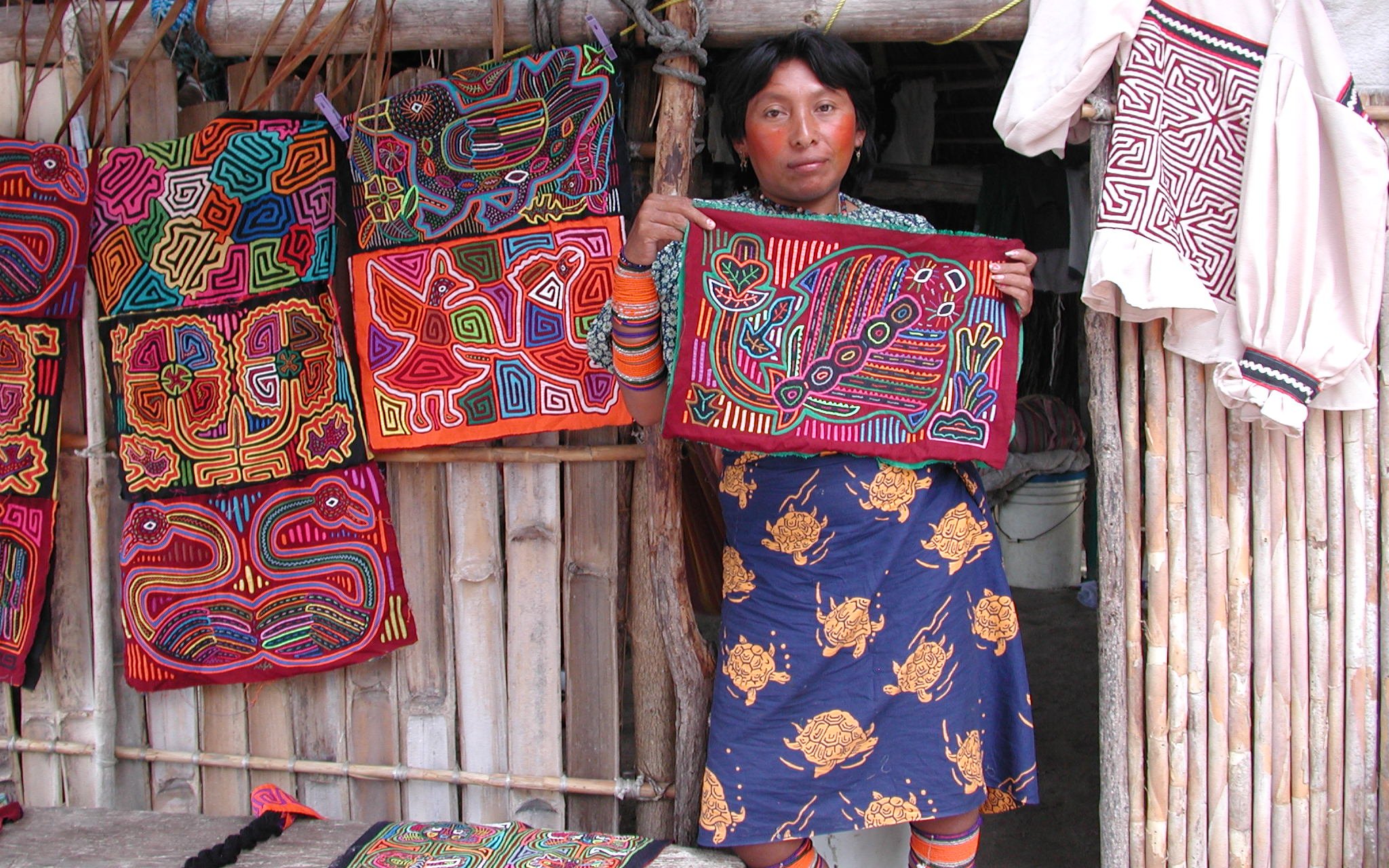
Guna tribal members of Panama and Colombia are famous for their molas, cotton panels with elaborate geometric designs created by a reverse appliqué technique. Designs originated from traditional body art designs but today exhibit a wide range of influences, including pop culture. Two mola panels form the bodice of a blouse. When a Guna woman is tired of a blouse, she can disassemble it and sell the molas to art collectors.
Mesoamerica
Maya women have woven cotton with backstrap looms for centuries, creating items such as huipils or traditional blouses. Elaborate Maya textiles featured representations of animals, plants, and figures from oral history. In modern times, weaving serves as both an art form and a source of income. Organizing into weaving collectives have helped Maya women earn better money for their work and greatly expand the reach of Maya textiles in the world.
Oasisamerica
Pueblo men weave with cotton on upright looms. Their mantas and sashes are typically made for ceremonial use for the community, not always for outside collectors.
Navajo rugs are woven by Navajo women today from Navajo-Churro sheep, other breeds of sheep, or commercial wool. Designs can be pictorial or abstract, based on historic Navajo, Spanish, Asian, or Persian designs. 20th century Navajo weavers include Clara Sherman and Hosteen Klah, who co-founded the Wheelwright Museum of the American Indian.
Valencia, Joseph and Ramona Sakiestewa (Hopi) and Melissa Cody (Navajo) explore non-representational abstraction and use experimental materials in their weaving.
Northwest Coast

Traditional textiles of Northwest Coast tribes are enjoying a dramatic revival. Chilkat weaving and Ravenstail weaving are regarded as some of the most difficult weaving techniques in the world. A single Chilkat blanket can take an entire year to weave. In both techniques, dog, mountain goat, or sheep wool and shredded cedar bark are combined to create textiles featuring curvilinear formline designs. Tlingit weaver Jennie Thlunaut (1892–1986) was instrumental in this revival.
Button blankets are wool blankets embellished with mother-of-pearl buttons worn on significant occasions, such as potlatches.
Northeastern Woodlands
Great Lakes and Prairie tribes are known for their ribbonwork, found on clothing and blankets. Strips of silk ribbons are cut and appliquéd in layers, creating designs defined by negative space. The colors and designs might reflect the clan or gender of the wearer. Powwow and other dance regalia from these tribes often feature ribbonwork. These tribes are also known for their fingerwoven sashes.
Southeastern Woodlands

Pieces of 7,000- to 8,000-year-old fabric have been found with human burials at the Windover Archaeological Site in Florida. The burials were in a peat pond. The fabric had turned into peat, but was still identifiable. Many bodies at the site had been wrapped in fabric before burial. Eighty-seven pieces of fabric were found associated with 37 burials. Researchers have identified seven different weaves in the fabric. One kind of fabric had 26 strands per inch (10 strands per centimeter). There were also weaves using two-strand and three-strand wefts. A round bag made from twine was found, as well as matting. The yarn was probably made from palm leaves. Cabbage palm, saw palmetto and scrub palmetto are all common in the area, and would have been so 8,000 years ago.
Seminole seamstresses, upon gaining access to sewing machines in the late 19th century and early 20th centuries, invented an elaborate appliqué patchwork tradition. Seminole patchwork, for which the tribe is known today, came into full flower in the 1920s.
Southern Cone

Mapuche women engaged in the practice of weaving textiles and ponchos by using the wool of llamas and alpacas before replacing them with sheep after the Spanish colonists introduced them.
Notes
References
- Gibbs, Charlotte Mitchell. Household Textiles. Boston: Whitcomb & Barrows, 1912.
- Siegal, William (1991). Aymara-Bolivianische Textilien. Krefeld: Deutsches Textilmuseum. .
- Stone-Miller, Rebecca. Art of the Andes: from Chavín to Inca. London: Thames and Hudson, 2002. .
References
- Gibbs 1
- [[Basketry]] is associated with textile arts.Gibbs 6
- Stacey, Kevin. [http://www.eurekalert.org/pub_releases/2011-04/uocp-cdi041311.php "Carbon dating identifies South America's oldest textiles."] {{Webarchive. link. (2021-04-10 ''University of Chicago Press Journals.'' 13 April 2013.)
- Spike, Tamara. (July 2003). "Review of Doran, Glen H., ed., Windover: Multidisciplinary Investigations of an Early Archaic Florida Cemetery.". Humanities and Social Sciences Online.
- Because of the extremely dry conditions of the desert sands, twined textiles from the [[Norte Chico civilization]] in Peru have survived, dating back to 2500-1800 BCE.Stone-Miller 18-19
- Siegal 15
- Siegal 15-16
- INCA: Textiles and Ornaments of the Andes. e L. Bjerregaard, S.Desrosiers, B.Devia, [[Penelope Dransart. P.Dransart]], E. Dufour, P. Eeckhout, C. Giuntini, N. Goepfert. A.H. Peters, E. Phipps, A.P. Rowe (2019), {{ISBN. 9493039021, {{ISBN. 9789493039025
- [http://www.panart.com/molainfo.htm About Molas.] ''Indigenous Art from Panamá.'' (retrieved 28 March 2009)
- Geise, Paula. [https://www.mythinglinks.org/Geise~MayanWeaving.html Clothing, Regalia, Textiles from the Chiapas Highlands of Mexico.] ''Mything Links.'' 22 December 1999 (retrieved 28 March 2009)
- (1999). "Culture, History, Biology, and Body: Native and Non-Native Acquisition of Technological Skill". Ethos.
- Indyke, Dottie. [http://www.southwestart.com/in_swa/native_arts/1478 Ramona Sakiestewa.] ''Southwest Art.'' (retrieved 28 March 2009)
- Brown, Robin C.. (1994). "Florida's First People: 12,000 Years of Human History". Pineapple Press.
- Milanich, Jerald T.. (1994). "Archaeology of Precolumbian Florida". University Press of Florida.
- Blackard, David M. and Patsy West. [http://www.seminoletribe.com/culture/clothing.shtml Seminole Clothing: Colorful Patchwork.] {{Webarchive. link. (2008-03-16 ''Seminole Tribe of Florida.'' (retrieved 11 April 2009))
This article was imported from Wikipedia and is available under the Creative Commons Attribution-ShareAlike 4.0 License. Content has been adapted to SurfDoc format. Original contributors can be found on the article history page.
Ask Mako anything about Textile arts of the Indigenous peoples of the Americas — get instant answers, deeper analysis, and related topics.
Research with MakoFree with your Surf account
Create a free account to save articles, ask Mako questions, and organize your research.
Sign up freeThis content may have been generated or modified by AI. CloudSurf Software LLC is not responsible for the accuracy, completeness, or reliability of AI-generated content. Always verify important information from primary sources.
Report