From Surf Wiki (app.surf) — the open knowledge base
Text-based game
Video game that uses text characters

Video game that uses text characters
A text game or text-based game is an electronic game that uses a text-based user interface, that is, the user interface employs a set of encodable characters, such as ASCII, instead of bitmap or vector graphics.
Text-based games have been well documented since at least the 1960s, when teleprinters were interlaced with mainframe computers as a form of input, where the output was printed on paper. With that, notable titles were developed for those computers using the sprinter in the 1960s and 1970s and more numerous game titles have been developed for other video terminals since at least the mid-1970s, having reached their peak popularity in that decade and the 1980s, and continued as early online games into the mid-1990s.
Although generally replaced in favor of video games that use non-textual graphics, text-based games continue to be written by independent developers. They have been the basis of instigating genres of video gaming, especially adventure and role-playing video games.
Overview
Strictly speaking, text-based means employing an encoding system of characters designed to be printable as text data. As most computers only read binary code, encoding formats are typically written in such, where a bit is the smallest unit of data that has two possible values and each combination of bits represents a byte. That said, a text-based game is any electronic game whereby information is conveyed as encoded text in the user interface.
Although technically graphical when displayed on a computer monitor, text data is sometimes contrasted with graphics as the former is text-only; data representation conveyed via an output device is restricted to a given set of encodable characters and the total number thereof, as well as graphical capabilities. For example, ASCII uses 96 printable characters in its set of 128, whereas ANSI uses both ASCII and 128 additional characters from extended ASCII and allows the text to be variously colored, allowing for further possibilities. as well as significantly reducing production costs compared to graphical data.
History
Text-based games trace as far back as teleprinters in the 1960s, when they were installed on early mainframe computers as an input-and-output form. At that time, video terminals were expensive and being experimented as "glass teletypes", and the user would submit commands via the teleprinter interfaced with the mainframe, the output being printed on paper. Notable early mainframe games include The Sumerian Game, Lunar Lander, The Oregon Trail, and Star Trek.
In the mid-1970s, when video terminals became the cheapest means for multiple users to interact with mainframes, As with other games, they often lacked functionalities such as saving. Proposed reasons for the absence of the ability to save included the fact that early computer games were often simple and gaming sessions were brief, as well as hardware limitations and costs. This may partly explain why earlier computer games were developed instead under the episodic structure, but such computer games whose source code could be accessed by anyone could be modified, and as designers wrote larger game worlds, gaming sessions lengthened, and the need to resume where left off became inevitable. This started in 1977 with Don Woods' revision of the 1976 text-based adventure game Colossal Cave Adventure (later renamed to Adventure), which saw expanded gameplay and story and, notably, the ability to save.
Text-based games were also early forerunners to online gaming. From the late-1970s Without a graphical program for clients, most online computer games could only run using textual graphics,
However, terminal emulators are still in use today, and people continue playing MUDs (multi-user dungeon) and exploring interactive fiction. The Interactive Fiction Competition was established in 1995 to encourage development of and explore independent interactive fiction titles, and has since held annual competitions for who can develop the best such game.
Genres
Although text-based games are not limited to any specific genre, several notable genres started as and were popularized by text-based games.
Text adventure
Main article: Interactive fiction
Text adventures (sometimes synonymously referred to as interactive fiction) are text-based games wherein worlds are described in the narrative and the player submits typically simple commands to interact with the worlds. Colossal Cave Adventure is considered to be the first adventure game, and indeed the name of the genre adventure game is derived from the title. As text-based adventure games reached their peak in popularity in the late 1970s and 1980s, notable text-based adventure titles were released by various developers, including Zork and The Hitchhiker's Guide to the Galaxy by Infocom.
MUD
Main article: Multi-user dungeon
An MUD (originally Multi-user dungeon, with later variants Multi-User Dimension and Multi-User Domain),{{cite book| last = Bartle | first = Richard | author-link = Richard Bartle| title = Designing Virtual Worlds| publisher = New Riders| year = 2003| isbn = 0-13-101816-7| pages = 9–10, 741| quote = [pp. 9-10] TinyMUD was deliberately intended to be distanced from the prevailing hack-and-slay AberMUD style, and the "D" in its name was said to stand for "Dimension" (or, occasionally, "Domain") rather than "Dungeon;" this is the ultimate cause of the MUD/MU* distinction that was to arise some years later. [pp. 741] The "D" in MUD stands for "Dungeon" [...] because the version of ZORK Roy played was a Fortran port called DUNGEN.
Roguelike
Main article: Roguelike
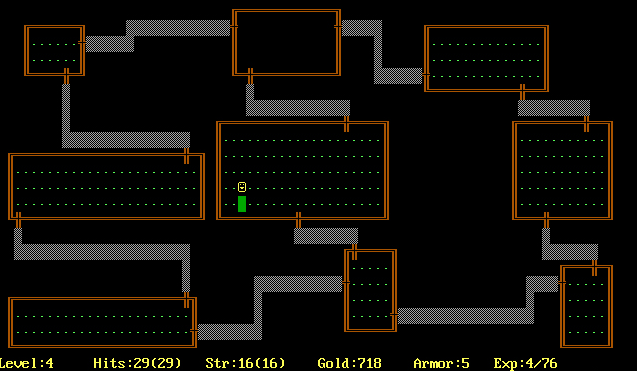
The roguelike is a subgenre of role-playing video games, characterized by randomization for replayability, permanent death, and turn-based movement. Many early roguelikes featured ASCII graphics. Games are typically dungeon crawls, with many monsters, items, and environmental features. Computer roguelikes usually employ the majority of the keyboard to facilitate interaction with items and the environment. The name of the genre comes from the 1980 game Rogue.
References
References
- (April 16, 2014). "Understanding Computers: Today and Tomorrow, Introductory". [[Cengage]].
- Bangia, Ramesh. (2010). "Dictionary of Information Technology". Firewall Media.
- Wolf, Mark J.P.. (2012). "Encyclopedia of Video Games: A-L". [[ABC-CLIO]].
- Edwards, Benj. (October 13, 2016). "The Forgotten World of Dumb Terminals". [[Ziff Davis]].
- Edwards, Benj. (April 4, 2017). "The Forgotten World of Teletype Computer Games". [[Ziff Davis]].
- Cobbett, Richard. (May 19, 2017). "The history of RPGs". [[Future US]].
- Bollmer, Grant D.. (September 3, 2018). "Theorizing Digital Cultures". [[SAGE Publishing]].
- Hanson, Christopher. (March 8, 2018). "Game Time: Understanding Temporality in Video Games". [[Indiana University Press]].
- Edwards, Benj. (November 4, 2016). "The Lost Civilization of Dial-Up Bulletin Board Systems". [[Atlantic Media]].
- Edwards, Benj. (January 14, 2016). "The Forgotten World of BBS Door Games". [[Ziff Davis]].
- Alexander, Leigh. (October 22, 2014). "The joy of text – the fall and rise of interactive fiction". [[The Guardian]].
- Edwards, Benj. (March 10, 2016). "7 Classic PC Games With ASCII Graphics". [[Ziff Davis]].
- (September 10, 2012). "Interactive Storytelling for Video Games". [[Focal Press]].
- (June 3, 2016). "Debugging Game History: A Critical Lexicon". [[The MIT Press]].
- Hahn, Harley. (1996). "The Internet Complete Reference". Osborne McGraw-Hill.
- (January 15, 2015). "Teaching Programming Concepts Through Play". [[Rosen Publishing]].
This article was imported from Wikipedia and is available under the Creative Commons Attribution-ShareAlike 4.0 License. Content has been adapted to SurfDoc format. Original contributors can be found on the article history page.
Ask Mako anything about Text-based game — get instant answers, deeper analysis, and related topics.
Research with MakoFree with your Surf account
Create a free account to save articles, ask Mako questions, and organize your research.
Sign up freeThis content may have been generated or modified by AI. CloudSurf Software LLC is not responsible for the accuracy, completeness, or reliability of AI-generated content. Always verify important information from primary sources.
Report