From Surf Wiki (app.surf) — the open knowledge base
Texas State University
Public university in San Marcos, Texas, US

Public university in San Marcos, Texas, US
| Field | Value | |
|---|---|---|
| name | Texas State University | |
| image | Texas State University seal.svg | |
| image_upright | 0.6 | |
| former_name | {{collapsible list | |
| accreditation | SACS | |
| titlestyle | background:transparent;text-align:left;padding-left:0.5em;font-size:100%; | |
| liststyle | text-align:left;white-space:nowrap; | |
| title | Southwest Texas State Normal School (1899–1918) | |
| Southwest Texas State Normal College (1918–1923) | ||
| Southwest Texas State Teachers College (1923–1959) | ||
| Southwest Texas State College (1959–1969) | ||
| Southwest Texas State University (1969–2003) | ||
| Texas State University-San Marcos (2003–2013)}} | ||
| motto | Auctoritas Gravitas Humanitas Veritas (Latin) | |
| mottoeng | "Prestige, Seriousness, Humanity, Truth" | |
| established | ||
| type | Public research university | |
| president | Kelly Damphousse | |
| provost | Pranesh Aswath | |
| city | San Marcos, Texas | |
| country | United States | |
| coor | ||
| endowment | $1.6 billion (FY2025) | |
| budget | $1.01 billion (FY2026) | |
| enrollment | 44,630 (fall 2025) | |
| undergrad | 39,415 (fall 2025) | |
| postgrad | 5,215 (fall 2025) | |
| campus | Small city | |
| campus_size | 517 acre | |
| free_label | Other campuses | |
| free | Round Rock, Texas | |
| Querétaro, Mexico | ||
| free_label2 | Newspaper | |
| free2 | University Star | |
| sporting_affiliations | NCAA Division I FBS – Sun Belt | |
| sports_nickname | Bobcats | |
| mascot | Boko the Bobcat | |
| colors | ||
| parent | Texas State University System | |
| academic_affiliations | {{hlist | |
| website | ||
| logo | [[File:Texas State University logo.svg | 200px]] |
Southwest Texas State Normal College (1918–1923) Southwest Texas State Teachers College (1923–1959) Southwest Texas State College (1959–1969) Southwest Texas State University (1969–2003) Texas State University-San Marcos (2003–2013)}} Querétaro, Mexico |CUMU |CONAHEC |Space grant
Texas State University (TXST) is a public research university that was established in 1899. Its main campus is in San Marcos, Texas, United States, and another campus is in Round Rock. The university has grown to be the seventh-largest university in Texas. Texas State University reached a record enrollment of 40,678 students in the 2024 fall semester, continuing a trend of enrollment growth over several years.
Texas State University offers over 200 bachelor's, master's, and doctoral degree programs from its nine colleges. The university is accredited by the Southern Association of Colleges and Schools (SACS) and designated as a Hispanic-Serving Institution (HSI) by the U.S. Department of Education. Texas State is classified among "R2: Doctoral Universities – High research activity" and an Emerging Research University (ERU) by the State of Texas. It spent more than $160 million in research expenditures during fiscal year 2024.
Texas State's main campus consists of 259 buildings on 517 acre of hilly land along the San Marcos River. It also has a 101 acre satellite campus at its Round Rock Campus (RRC) in the greater north Austin area. The university operates the 70 acre Science, Technology and Advanced Research (STAR) Park, a technology commercialization and applied research facility. Texas State has 4522 acre additional acres of recreational, instructional, farm, and ranch land. The Forensic Anthropology Center at Texas State is the largest forensics research facility in the world.
Texas State University's intercollegiate sports teams, the Bobcats, compete in National Collegiate Athletic Association (NCAA) Division I and the Sun Belt Conference.
History
Texas State University was first proposed in a March 3, 1899 bill by state representative Fred Cocke with the name of Southwest Texas State Normal School. Cocke represented the citizens of Hays and surrounding counties where the school was to be located. While there was opposition to the bill, with the support of state senator J.B. Dibrell, it was finally passed and signed into law on May 10, 1899, by Governor Joseph D. Sayers. The school's purpose was to train the future teachers of Texas. Any students earning a diploma and teaching certificate from the school would be authorized to teach in the state's public schools. In October 1899, the San Marcos City Council voted to donate 11 acre of land at what was known as Chautauqua Hill for the school to be built on. It was not until 1901 that the Texas legislature accepted this donation and approved $25,000 to be used for construction of buildings on the site. The building now known as Old Main was completed and the school opened its doors to its first enrollment of 303 students in September 1903.
The San Marcos School Board began a partnership with the school in 1912 in order to allow Southwest Texas State Normal School students to instruct local school children as part of their training to become teachers. The San Marcos East End Ward School, comprising the first eight grades of the school district, was moved onto the Southwest Texas State campus in 1917. In 1935, a formal contract between Southwest Texas State Teachers College, as it was known then, and the San Marcos school district for the "Public Schools [to become] the laboratory school for said Teachers College." The school would be under the control and supervision of the city of San Marcos but Southwest Texas State was responsible for providing and maintaining buildings and equipment for the city's elementary and junior high schools.
The college enrolled its first African-American students in 1963, following a federal lawsuit brought by Dana Smith, who became one of the first five African Americans at the institution when a district court judge ruled that they could not be denied admission based on race.
The school's most famous alumnus, United States president Lyndon B. Johnson, returned to his alma mater on November 8 of 1965 in order to sign the Higher Education Act of 1965, a part of the Great Society programs. The president gave a speech in the old Strahan Gymnasium on the school's campus (now the Music Building), before signing the bill. He recounted his own difficulties affording to go to college: having to shower and shave in the school's gymnasium, living above a faculty member's garage, and working multiple jobs.
Ten students were suspended from Texas State for protesting the Vietnam War on November 13 in 1969. They became known as the "San Marcos 10." They appealed their expulsion through the normal school channels, and then they filed a lawsuit against the president of the university, the dean of students and the Texas State University system Board of Regents. They were reinstated via an injunction and attended classes while their case moved through the courts. When their appeals were rejected, they submitted their case to the U.S. Supreme Court, but only Justice William Douglas voted to hear their argument so the decisions of the lower courts stood. The San Marcos 10 subsequently lost all of the credits for the semesters they completed while their lawsuit moved through the court system.
Expansion
The campus has grown substantially from its original 11 acres in 1899. During the first 40 years of the school's history, the campus was expanded to accommodate 18 buildings around the original Main Building. These buildings included academic buildings, a library, buildings to house the San Marcos school students, dormitories, a dining hall, and men's and women's gymnasiums. In 1926, 90 acres of land adjacent to the San Marcos River was purchased by A. B. Rogers to build a hotel, glass-bottom boat rides and other water-based attractions to become the Aquarena Springs theme park. The university bought the property in 1994 intending to use the land as a research and education center. In 2002, this piece of land became known as the International Institute for Sustainable Water Resources and offered educational tours including a wetlands boardwalk and continued to offer glass-bottom boat rides.
In 1996, the school began offering courses in Round Rock, Texas, on the campus of Westwood High School. It originally offered night classes that allowed students to earn graduate degrees in business administration and education. As enrollment in these programs increased and with a gift of 101 acre, the Texas State University Round Rock Campus was constructed and opened in 2005.
Name changes
The school's name has changed several times over the course of its history. The first change occurred in 1918 when Southwest Texas State Normal School became Southwest Texas State Normal College, after the Board of Regents, two years earlier, had authorized the school to begin granting degrees as a senior college. In 1921, a statewide effort was launched to improve academic standards in Texas normal schools to meet more closely the requirements of the University of Texas. These improvements prompted a second name change in 1923, when the Texas Legislature renamed the school Southwest Texas State Teachers College. Another change occurred in 1959, with the school becoming Southwest Texas State College. Ten years later, the legislature renamed the school Southwest Texas State University.
In 2003, members of the school's Associated Student Government (ASG), approached state senator Jeff Wentworth asking that the school be renamed Texas State University at San Marcos. The ASG had unanimously approved a resolution supporting the change, arguing that the current name reflected a regionalism that was not aligned with the university's effort to reach top-tier status. The ASG further said that donations from the school's alumni would pay for implementing the name change so that state tax dollars would not be required. Some students and alumni protested the change, pointing out that no vote had been taken on the matter. A bill, sponsored by Senator Wentworth, was passed and on September 1, 2003, the school became known as Texas State University–San Marcos. The city was originally included in the name to differentiate it from other schools in the Texas State University System, which were, at the time, expected to change their names to Texas State University (e.g. Texas State University–Beaumont). Those changes did not occur, however, and after Texas State continued to expand its campus in Round Rock, the university requested that the name of the city be removed from the school's name. In 2013, under the McDaniel-Sibley ASG Administration, Associated Student Government senator Quentin De La Garza continued the efforts to have the name changed. A bill to accomplish that change was passed by the Eighty-third Texas Legislature and signed by the governor. The name was officially changed on September 1, 2013, for the sixth time in the school's history.
2019 sexual assault controversies
In the fall of 2019, the US Department of Education opened a formal review into Texas State University's compliance with a federal crime-reporting statute meant to provide information about campus safety. Texas State University officials acknowledged in September 2019 that it seriously under-reported the number of rapes and other crimes on campus in recent years. A former university police chief and his top deputy were also accused of hiring unqualified officers to patrol the San Marcos campus, including one who allegedly slept with a sexual assault victim while investigating her case.
Campus
Texas State University comprises over 8 million gross square feet in facilities and its campuses are located on over 500 acres with an additional 4,000 acres of agriculture, research, and recreational areas. The Texas State University main campus is located in San Marcos, Texas, midway between Austin and San Antonio along Interstate 35. It spans 517 acre, including the original land donated by the city of San Marcos consisting of Chautauqua Hill on which Old Main still sits. The university also operates a 101 acre Round Rock Campus and a 70 acre Science, Technology, and Advanced Research (STAR) Park; other parts of the Texas State property including farm and ranch land, residential, recreational areas and commercial incubators cover more than 4522 acre of additional land.
The Quad is the heart of campus because it is surrounded by a majority of the academic buildings and is near the bus loop where most of the university bus routes stop on campus. Since many students pass through the quad, it is the primary gathering place for student organizations, which often set up booths and tables promoting fundraisers and events. The west end of the Quad has a 17-foot high aluminum sculpture of two horses, called The Fighting Stallions. This area was designated as the university's free speech zone and was subject to one of the first court challenges to the creation of such zones after the suspension of ten students protesting the Vietnam War. The east end of the Quad rises to the top of the highest hill on campus where the university's oldest building, Old Main, sits.
The main campus in San Marcos served as the location of the fictional school TMU (Texas Methodist University) in the NBC TV series Friday Night Lights.
Old Main

Main article: Old Main (Texas State University)
Built in 1903 and originally called the Main Building, Old Main was the first building on the campus. The design was closely patterned on the Old Main Building of 1889 at Sam Houston State University, designed by Alfred Muller of Galveston. Fourteen years later, E. Northcraft, the engineer for the building at Sam Houston, oversaw construction of the Texas State University Main Building, a Victorian Gothic structure. It was added to the National Register of Historic Places in 1983. In more than a century of use, and through many renovations, the building has served varied purposes, from being the university's administration building to an auditorium and chapel to now housing the offices for the School of Journalism and Mass Communication as well as the offices of the College of Fine Arts and Communication.
Alkek Library
Main article: Alkek Library

The university's library was named in 1991 for an alumnus, Albert B. Alkek, who became an oilman, rancher, and philanthropist. The Albert B. Alkek Library serves as the main academic library supporting the university community. It is a "select depository" for United States and Texas government documents, receiving a large number of government publications from the state and 60% of all federal publications. The library also encompasses special collections and papers, including the Wittliff collections, which is the largest US repository of contemporary Mexican photography, as well as home of the King of the Hill archives and major collections of works by Cormac McCarthy, Sam Shepard, and Sandra Cisneros, and the Lonesome Dove miniseries collection.
Sewell Park

Sewell Park, located on the Texas State University campus on the banks of the San Marcos River in San Marcos, Texas, borders City Park, the San Marcos Mill Tract and Strahan Coliseum. It was opened in 1917 by Southwest Texas State Normal School, and was called Riverside Park. The land was owned by the U.S. Bureau of Fisheries and leased to the school. It was originally used by students to learn how to swim and for general recreation. The river banks were built up from the river bottom by university workers. In 1949 the park was renamed Sewell Park in honor of S. M. Sewell, a mathematics professor who helped form the park.
A long time fixture of Sewell Park, local legend Dan Barry, better known as "Frisbee Dan", can be seen on just about any sunny day tossing his frisbee and keeping a watchful eye on the park.
Round Rock Campus
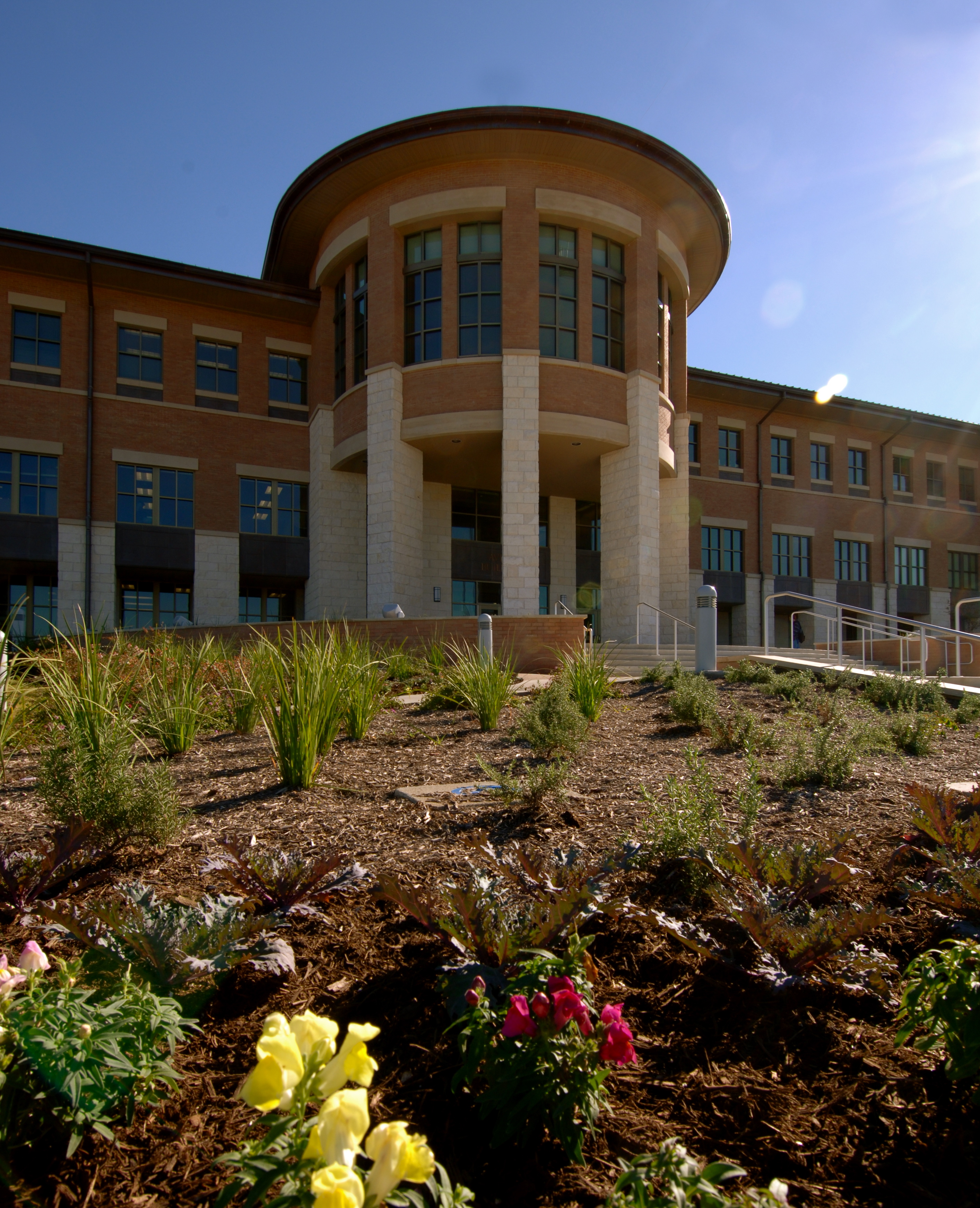
The university's Round Rock Campus (RRC) is located in Round Rock, Texas, 20 mi north of Austin. Originally known as the Round Rock Higher Education Center (RRHEC), the facility was opened in 1996 in temporary buildings with a small number of classes. By 2004, the fifteen temporary buildings, in a lot adjacent to Westwood High School, were full to capacity. A year earlier, the Avery family of Round Rock had donated 101 acres in northeast Round Rock to allow the former RRHEC to become its own campus. Construction of the Avery Building began in 2004, and the building opened its doors in August 2005.The 125,000-square-foot Avery Building was designed to offer instruction and student support in one building, with classrooms, labs, offices, and a library. In 2010 the Round Rock Campus opened the 77,740-square-foot, three-story Nursing Building. The St. David's School of Nursing admitted the first class of junior-level nursing majors in fall 2010. An additional health professions, known as Willow Hall, opened in 2018. A groundbreaking ceremony for a new academic building, Esperanza Hall, was held in December 2024.
Curriculum
The Round Rock Campus offers the junior and senior level classes to complete bachelor's degrees as well as graduate degrees, post baccalaureate certification, and continuing education programs. Students who complete requirements at the Round Rock Campus earn degrees from Texas State University.
Academics
Student body
| Race and ethnicity | Total | Economic diversity | |||
|---|---|---|---|---|---|
| Hispanic | {{bartable | 42 | % | 2 | background:green}} |
| White | {{bartable | 39 | % | 2 | background:cyan}} |
| Black | {{bartable | 9 | % | 2 | background:purple}} |
| Asian | {{bartable | 3 | % | 2 | background:orange}} |
| Two or more races | {{bartable | 3 | % | 2 | background:violet}} |
| Unknown | {{bartable | 2 | % | 2 | background:grey}} |
| International student | {{bartable | 1 | % | 2 | background:#008080}} |
| Low-income | {{bartable | 36 | % | 2 | background:red}} |
| Affluent | {{bartable | 64 | % | 2 | background:black}} |
As of the fall 2024 semester, Texas State University had a total enrollment of 40,678. Of the student body, 36,206 are undergraduate students with the remaining students being post-baccalaureate or graduate students. The university accepted 68% of freshmen applicants who applied to attend the fall 2023 semester. This includes the guaranteed acceptance of any Texas high school graduate with a grade point average that ranked them in the top 10% of their high school class. About 56% of undergraduate students earn their degree after six years. Hispanic students made up 30% of the student body in 2013, which increased to 32% in 2014, qualifying the university to be designated as a Hispanic-serving institution. Additionally, the student body consists of approximately 60% female students, 78% students who live off-campus, and only 10% students who are members of a fraternity or sorority.
Rankings
In 2024, Texas State University earned its fourth consecutive gold designation in the Veteran Education Excellence Recognition Award by the Texas Veterans Commission’s (TVC) Veterans Education Program. The university was also named a Fulbright Hispanic-Serving Institution Leader by the U.S. Department of State and was ranked among the best colleges in America by the Princeton Review, Wall Street Journal, and Forbes.
In the 2025 edition of the U.S. News & World Report rankings, Texas State was tied for 257th among national universities.
Colleges
Texas State University offers degrees in 99 bachelor programs, 91 master programs and 20 doctoral programs. The university has been accredited by the Southern Association of Colleges and Schools since 1925 and had its last review in 2021.
These programs are offered through nine academic colleges, including:
Research
In January 2012, Texas State University was designated an emerging research university by the Texas Higher Education Coordinating Board. To achieve this status a university must spend at least $14 million in its research endeavors and either offer at least 10 doctoral degrees or have at least 150 enrolled doctoral students. In 2016, the Carnegie Foundation for the Advancement of Teaching reclassified Texas State University as an R2 institution, the second-highest designation for research institutions in the country under Carnegie’s respected classification system. The university’s Run to R1 initiative is focused on achieving R1 status by 2027.
Texas State is home to more than 30 research centers and institutes, including the Center for Analytics and Data Science, The Meadows Center for Water and the Environment, The Texas School Safety Center, the Advanced Law Enforcement Rapid Response Training (ALERRT) Center, the Center for the Study of the Southwest, the Center for Texas Music History, and more.
One of Texas State's facilities includes its Science, Technology, and Advanced Research (STAR) Park that was approved by the Texas State University System Regents in May 2011 with a focus on environmental sustainability and biotechnology. The facility is funded through multiple grants including $1.8 million from the U.S. Economic Development Administration and $4.2 million from the Texas Emerging Technology Fund. The facility serves as a location for university faculty to perform advanced research and to commercialize that research into startup companies.
The Forensic Anthropology Center at Texas State is one of seven extant human decomposition research facilities (body farms) in the United States. It is the largest such forensics research facility in the world.
In August 2012, Texas State's River Systems Institute was renamed the Meadows Center for Water and the Environment. This name change was the result of donations totaling $5 million from the Meadows Foundation in Dallas, Texas. The center’s mission is to inspire “research, innovation, and leadership that ensures clean, abundant water for the environment and all humanity,” and its studies and initiatives focus on water management, education, conservation, and sustainability.
Faculty from the various college have consistently been awarded Fulbright Scholar grants resulting in Texas State's being recognized as one of the top producing universities of Fulbright Scholars.
Extracurricular activities
Residential life
Approximately 20% of Texas State students live in on-campus or in university-owned housing including about 88% of freshman students. Beginning in fall 2024, there were approximately 9,042 students in a variety of housing options including traditional dorms and apartment-style housing offered by the university.
Student organizations and Greek life
Texas State University has more than 300 student organizations registered with its Student Involvement department. These organizations include Greek organizations, academic groups, honors societies, service groups, sports clubs, and common interest groups. Texas State has more than 30 fraternities and sororities, including 13 fraternities from the North American Interfraternity Conference, 9 fraternities and sororities from the historically African-American National Pan-Hellenic Council, 8 sororities from the National Panhellenic Conference, and 8 multicultural fraternities and sororities from the National Multicultural Greek Council. After the death of a Phi Kappa Psi pledge in November 2017, Texas State University halted all Greek life activities. Greek life activities resumed in March 2018, following a restructure of the university's Greek system.
Music groups, student government, performance groups
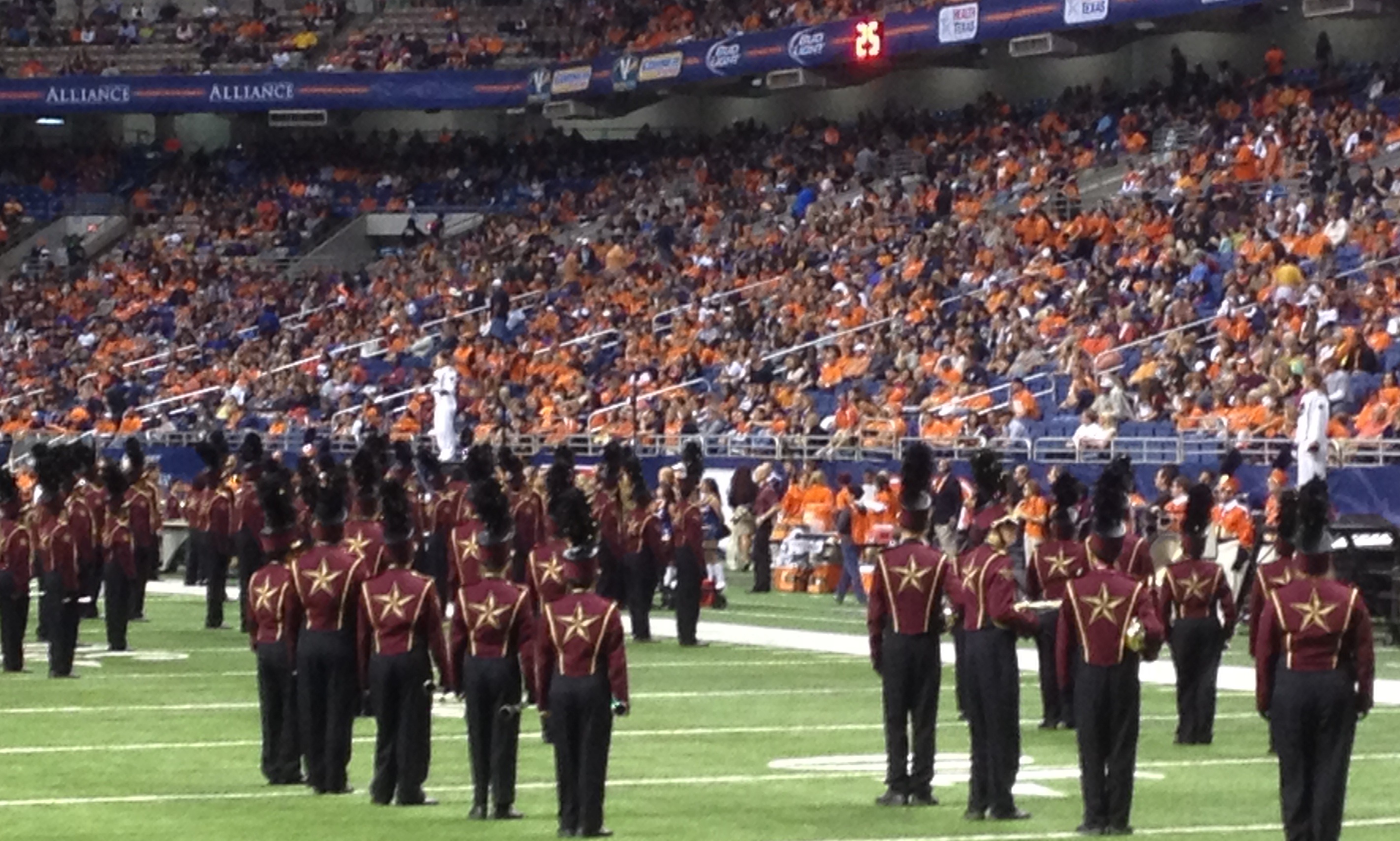
Bobcat Marching Band
The Bobcat Marching Band is the collegiate marching band of Texas State University. Nicknamed "The Pride of the Hill Country," the band began in 1919 as a casual association of student musicians on campus. It later evolved into a formal organization that performs at Texas State football games, NFL football games, professional soccer games, two presidential inaugurations, and a number of Hollywood movies and marching band oriented videos.
Student Government
The school's student government is an organization of both undergraduate and graduate students who represent student's interests with the university administration. Student government has dealt with issues including concealed carry on campus and the university's anti-tobacco policy. Student Government also administers a scholarship fund that any Texas State student can apply to earn.
Honors Societies

A number of honors societies exists on campus including Golden Key and the Alpha Chi honor society. Texas State was a charter member of Alpha Chi when it was created as the Scholarship Societies of the South in 1927. Texas State also has an active chapter of Alpha Phi Omega, National Service Fraternity.
Texas State Strutters
The Texas State Strutters are a precision dance team formed in 1960, the first of its kind at a four-year institution in the United States. The group performs to a variety of music including high kick, jazz, funk, and hip hop. The Strutters have performed nationally and internationally in 26 countries spanning 4 continents. Performances include two presidential inaugural parades, two Macy's Thanksgiving Day Parades, several NBA and NFL halftime shows, and America's Got Talent. They are the first university dance team to be invited to the People's Republic of China.
The Big Event
The Big Event, formerly known as Bobcat Build, is a yearly community service event that began in 2001 and is the largest such event run by students at the university. The event allows student organizations and individual Texas State students to sign up to perform service projects throughout the San Marcos community. The event has received recognition from state and national politicians including former state representative Patrick Rose and U.S. representative Lloyd Doggett.
Media
The oldest form of student media at Texas State was a yearbook originally called the Pedagogue and later renamed the Pedagog. It was first published in 1904 and served to record each year's events through photographs and articles. It was temporarily discontinued in 1975 due to a combination of the cost to publish the annual and a lack of student interest. It was published again in 1978 as part of the school's seventy-fifth anniversary. In 1984 it resumed regular publication. However, it was last published in 2000 after university committees recommended replacing the printed yearbook with a video disk containing the same contents. The annual has since been discontinued entirely.
The university's newspaper was first published in 1911 and called the Normal Star. Now called the University Star, it publishes coverage of the college's news, trends, opinions and sports. The newspaper is published on Tuesdays while classes are in session in the fall and spring semesters. The paper is published five times during the summer. The Star has a web site which contains videos, blogs and podcasts in addition to the articles that are published in the print version of the paper. The Star and its staff have received awards including merits from Hearst Journalism, the Texas Intercollegiate Press Association and the Society of Professional Journalists.
Located in the Trinity Building, Texas State's FM radio station, KTSW, broadcasts at 89.9 MHz and provides sports coverage of Texas State Athletics and independent music. The KTSW website provides live-streaming broadcasts, and the Texas State television channel employs KTSW broadcasts as background music. KTSW's morning show, Orange Juice and Biscuits, gained recognition in 2007 for being a finalist in Collegiate Broadcasters Inc.'s "Best Regularly Scheduled Program" award. In October 2008, as it was among Austin360.com's top ten-rated morning radio shows.
Athletics
Main article: Texas State Bobcats
Texas State currently competes at the NCAA Division I level and are currently members of the Sun Belt Conference, although in July 2025 it was announced that they would be joining the rebuilt Pac-12 conference in 2026. Texas State teams and athletes from multiple sports have won national and regional championships as well as medalists in the Olympic Games.
Mascot and logo
In 1920, Texas State adopted its first official mascot, the bobcat, at the urging of Oscar Strahan, who became the school's athletic director in 1919. Strahan suggested the bobcat because the cat is native to central Texas and is known for its ferocity. The bobcat did not get a name until 1964. At that time, Beth Greenlees won the Name the Bobcat contest with the name Boko the Bobcat. The athletic logo, or spirit mark, is referred to as the SuperCat logo. The current version of the logo was designed by a student in 2003. In August 2009, Texas State refined the logo with the addition of the Texas State lettering.
Rivalries
A thirteen-year rivalry with Nicholls State University ended with the 2011 football season. It began in 1998 when the annual football game between the two schools was at first cancelled due to severe flooding in San Marcos, where the game was to be played. The athletic directors and coaches later decided to postpone the game from October to November. To remember those affected by the floods, including some people who had died in it, a wooden oar was made with each school's colors and initials. The winning school would take possession of the oar for the next year and have the score inscribed on it. This rivalry became known as the Battle for the Paddle. The oar was last traded in 2010 when Nicholls State received it following 47–44 win over Texas State after four overtimes. Prior to the schools' meeting in 2011, Rob Bernardi, the athletic director for Nicholls State, said that they would not be bringing the oar to San Marcos and would leave it on display in the Nicholls State athletic offices. Due to Texas State changing conferences, Bernardi said it was unlikely that the schools will face each other in football again and that the rivalry was ending.
The rivalry with the University of Texas at San Antonio (UTSA) is dubbed the I-35 Showdown for the interstate highway that links San Marcos and San Antonio. A trophy consisting of an Interstate Highway 35 sign was originally given to the winner of the men's basketball game, but that tradition has been expanded to all sporting events between the two schools.
Texas State's only in-state Sun Belt conference rival was the University of Texas at Arlington (UT Arlington). The rivalry never ceased as both schools moved from the Southland Conference to the Western Athletic Conference then on to the Sun Belt Conference until 2022 when the Sun Belt stopped sponsoring non-football teams and UT Arlington returned to the Western Athletic Conference.
Transition to FBS
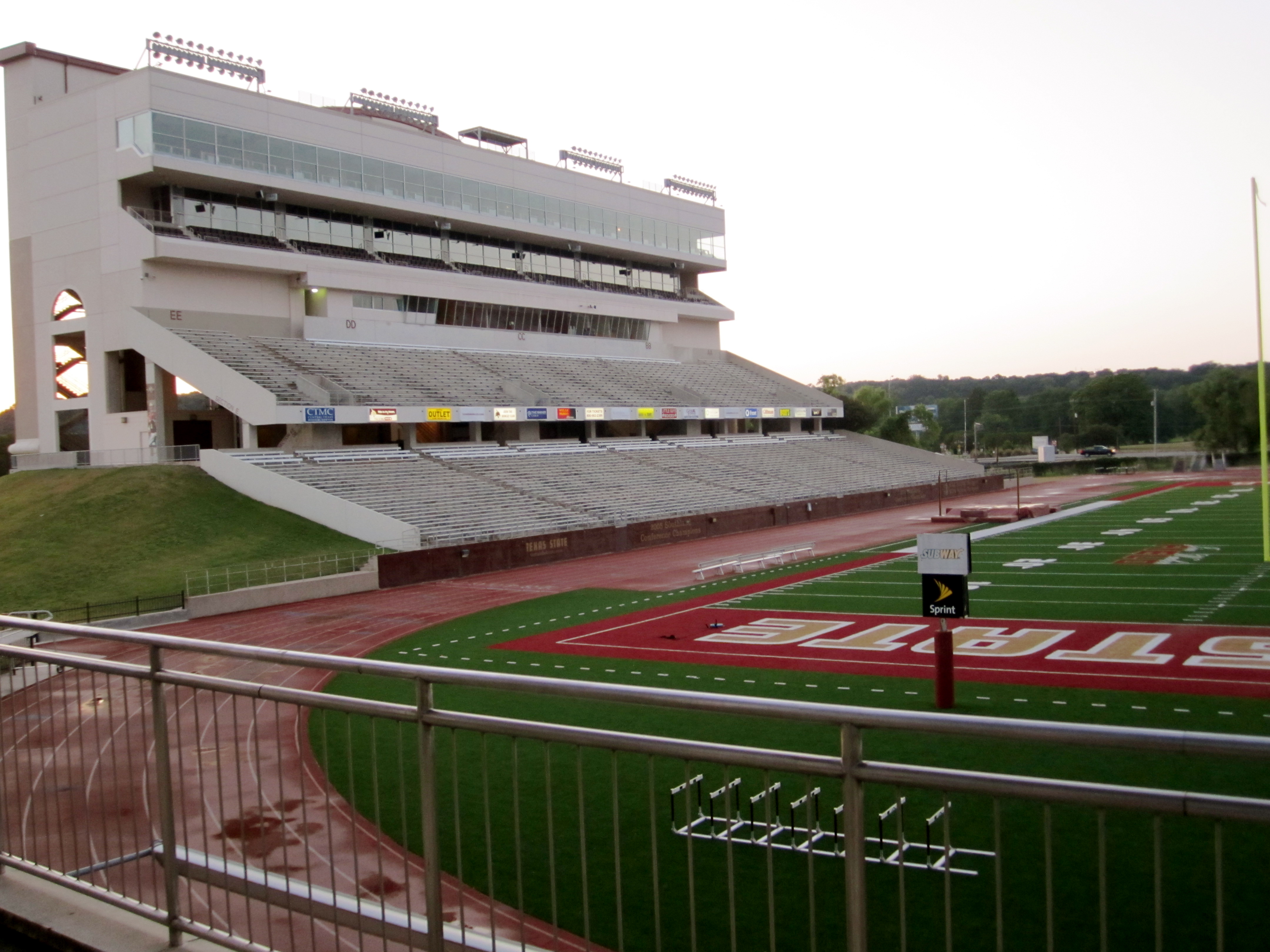
In the summer of 2007, university president Denise Trauth created the Athletic Strategic Planning Committee with the purpose of evaluating a move for the football team to go to the Football Bowl Subdivision (FBS). The committee released its final report in November 2007 which included a series of tasks that would need to be completed to make the move. The university called its efforts The Drive to FBS. Following the release of the committee's report, the university's Associated Student Government passed a bill for a student referendum to be held the following spring to obtain the student body's endorsement of an increase in fees to help pay for the move to the FBS. In February 2008, almost 80% of the students who voted in the referendum, approved a raise in the athletics fee by $10 over the next five years. Another set of milestones for the Drive involved improvements to Texas State's football stadium, Bobcat Stadium. Three phases of construction were completed to double the seating capacity of the stadium to 30,000, add luxury boxes, improvements to the press box, and replace the visitors' locker room.
Alumni
Main article: List of Texas State University alumni
File:Paul Goldschmidt in st.louis 2017.jpg|Paul Goldschmidt 7-time MLB All-Star File:37 Lyndon Johnson 3x4.jpg|Lyndon B. Johnson 36th President of the United States File:Robert L Rutherford.jpg|Robert L. Rutherford General, United States Air Force File:JohnSpencerSharp2013.jpg|John Sharp 14th Chancellor of the Texas A&M University System File:George Strait 2014 1.jpg|George Strait Country music singer File:Ricky Sanders.jpg|Ricky Sanders 2× Super Bowl champion (XXII, XXVI)
Texas State University's most notable alumnus is U.S. president Lyndon B. Johnson. Johnson attended the university, then known as the Southwest Texas State Teachers College, from 1926 until 1930 when he earned his Bachelor of Science degree. As a student, Johnson participated on the debate team and was an editor for the student newspaper, then known as the College Star. Johnson remains the only U.S. president who graduated from a university in the state of Texas.
Another notable alum is Grammy Award-winning American country music singer George Strait. Strait graduated in 1979 from the university, then known as Southwest Texas State University, with a Bachelor of Science in agriculture. As a student, Strait performed his first show with the Ace in the Hole Band at Cheatham Street Warehouse in San Marcos. In 2006, Strait was given an honorary Doctor of Humane Letters by University President Denise Trauth.
Also notable is the writer, producer, and director Taylor Sheridan. Sheridan attended Texas State University as a Theater Arts major but dropped out after his junior year. In 2025, he was awarded an honorary doctorate by the university.
Other notable alumni include: comedian Devon Walker, who joined the cast of Saturday Night Live in 2022; General Robert L. Rutherford, United States Air Force; musician Scott H. Biram; actor Powers Boothe; writer Tomás Rivera; Texas state representative Alfred P.C. Petsch; columnist "Heloise" (Ponce Cruse Evans); mathematician and former president of the American Mathematical Society R. H. Bing; St. Louis Cardinals first baseman Paul Goldschmidt; professional wrestler Lance Archer (Lance Hoyt); Texas musician Charlie Robison; and military historian Alan C. Carey.
2025 Termination of Thomas Alter
In September 2025, Texas State University made national headlines when it abruptly terminated Thomas Alter, a tenured associate professor of history, for comments he made during a panel at the online Revolutionary Socialism Conference. The termination, ordered by President Kelly Damphousse and endorsed by Texas State University System Chancellor Brian McCall, was justified on grounds that Alter's speech constituted "conduct that advocates for inciting violence" and was "incompatible with his responsibilities as a faculty member." The decision was based on video footage of the conference published online by a political opponent. The university's action was immediately criticized by academic and civil liberties organizations, including the American Association of University Professors (AAUP) and the Foundation for Individual Rights and Expression (FIRE), which argued the termination violated Alter's First Amendment rights and the core principles of academic freedom and tenure.
Legal and Academic Controversy
Legal experts noted that public university employees' speech is protected if it involves matters of public concern, unless it meets the strict Supreme Court standard from Brandenburg v. Ohio (1969) of being directed to inciting imminent lawless action. Critics of the termination argued that Alter's academic discussion of revolutionary socialism, without a call for immediate violence, was protected speech and that the administration's action was a politically motivated dismissal for expressing controversial political beliefs. The case drew parallels to the 1969 "San Marcos 10" incident, in which students were suspended for protesting the Vietnam War, highlighting ongoing tensions between institutional authority and free expression on campus.
Political Context and Reception
The termination was widely interpreted within the broader context of growing political pressure on public universities in Texas. Observers noted that the statements from President Damphousse and Chancellor McCall echoed rhetoric and legislative efforts from the Texas state government, particularly the Republican Party, which had recently increased scrutiny of university curricula and faculty speech deemed ideologically oppositional. Professor Alter's firing was cited by critics as an example of the authoritarian tendencies within the state's GOP leadership, demonstrating a willingness to override tenure protections and academic freedom to enforce political orthodoxy. Supporters of the university's decision argued it was a necessary action to maintain order and uphold state values.
The incident remained under legal review as of late 2025, with Professor Alter expected to challenge his termination through the university's faculty grievance procedures and potential litigation, arguing a violation of his constitutional rights and a breach of contractual tenure protections.
Notes
References
References
- "Name History". Texas State University.
- "1899-1929: Founding and Early Years".
- "State of Texas State".
- (July 16, 2025). "Operating Budget Fiscal Year 2026".
- "State of Texas State".
- "State of Texas State".
- "State of Texas State".
- (September 12, 2024). "Texas State set enrollment record".
- "Carnegie Classifications Institution Lookup". Center for Postsecondary Education.
- (February 5, 2016). "Texas State earns higher Carnegie Foundation research ranking".
- (January 12, 2012). "Texas State Upgraded to Emerging Research Status".
- (August 23, 2024). "State of Texas State 2024".
- (June 18, 2018). "STAR Park".
- Steinberg, R.U.. [http://www.austinchronicle.com/news/2008-04-04/608463/ "Listening to the Bones"] {{Webarchive. link. (August 3, 2020 , ''[[The Austin Chronicle]]'', Austin, April 4, 2008. Retrieved on May 31, 2013.)
- "Fifty Years of Teacher Education: A Brief History of Southwest Texas State Teachers College, San Marcos, Texas, 1901–1951". Journalism and Mass Communication, School of.
- (January 1922). ["The Public School Laws of the State of Texas"]({{google books). The Department of Education, State of Texas.
- (March 11, 2014). "Texas State University". Texas State Historical Association.
- French, Roger Franklin. (August 1939). "A History of Southwest Texas State Teachers College". Southwest Texas State Teachers College.
- Barnett, Marissa. (April 30, 2014). "Texas State University to honor five African-Americans who integrated campus in 1963". Austin American-Statesman.
- (August 26, 2005). "Regents agree to statue honoring LBJ at Texas State". Texas State University.
- "Johnson signs legislation into law". LBJ Library and Museum.
- Bills, E. R. (2019). ''The San Marcos 10: An Antiwar Protest in Texas''. Charleston, S.C.: The History Press, 2019.
- Hickey, Joan Inman. (2011). "Learning from the Past, Planning for the Future: A Geographic History of San Marcos, Texas and Texas State University-San Marcos". Texas State University-San Marcos.
- Brown, Ronald C.. (1979). "Beacon on the Hill: Southwest Texas State University, 1903-1978". Faculty Publications-University College, Texas State University-San Marcos.
- (March 6, 2003). "Bill filed today to change Southwest Texas State University's name". Office of State Senator Jeff Wentworth.
- Reinhart, Diana. (May 3, 2003). "A shock to the system". Beaumont Enterprise.
- Parker, Kolten. (April 11, 2013). "Texas State University to shed San Marcos". San Antonio Express News.
- Wiggins, Mark. (May 13, 2013). "Euthanasia, cyber security measures among 35 bills signed by governor so far". KVUE TV.
- Hamilton, Reeve. (August 24, 2013). "A Seventh New Name for Texas State University".
- Najmabadi, Shannon. (November 8, 2019). "Dept. of Education reviewing Texas State's compliance with federal crime-reporting statute".
- DeGeurin, Mack. "A Texas university reported 8 rapes on campus in 2016-17, but now admits there were 38. Experts say this problem is happening nationwide.".
- Najmabadi, Shannon. (October 1, 2019). "Texas State dramatically under-reported the number of sexual assaults on campus in 2016 and 2017".
- Najmabadi, Shannon. (December 13, 2019). "Accusations of shoddy hiring practices dog Texas State University police department".
- (January 22, 2009). "Texas State Facts". Institutional Research, Texas State University.
- "Traditions - Quad". Texas State University.
- "The Fighting Stallions, (sculpture)". Art Inventories Catalog.
- Allen, David S.. (June 2011). "From Parks to Free Speech Zones: Spatial Frameworks and the Regulation of American Dissent in Public Space". [[University of Wisconsin–Milwaukee]].
- {{cite court. link. (1970)
- (April 7, 2007). "Lights, Camera & Action". txstatebobcats.com.
- (April 1974). "Southwestern Historical Quarterly". The Texas State Historical Association.
- "National Register Information System". National Register of Historic Places.
- "Old Main". Texas State University.
- "About the Library". Texas State University.
- French, Roger Franklin. (1939). "A history of the Southwest Texas State Teachers College". Southwest Texas State Teachers College.
- "Sewell Park". Texas State University-San Marcos.
- Cass, Ashley. (February 9, 2009). "Frisbee Dan: A San Marcos treasure".
- "History of Texas State Round Rock Campus : Texas State University Round Rock Campus : Texas State University".
- (2024-12-09). "Esperanza Hall groundbreaking ushers in new growth at TXST Round Rock Campus".
- "Bachelor's Degrees: Round Rock Campus". Texas State University.
- "Master's Degrees: Round Rock Campus". Texas State University.
- "Certification and Continuing Education Programs: Round Rock Campus". Texas State University.
- "College Scorecard: Texas State University". [[United States Department of Education]].
- (2024-09-12). "Texas State announces record enrollment, other milestones for fall 2024".
- "Student enrollment". Texas State University Office of the President.
- (April 2013). "Texas State University By the Numbers 2012-2013". Texas State University Enrollment Management and Marketing.
- "Additional information for applicants". ApplyTexas.org.
- Kever, Jeannie. (September 29, 2010). "Enrollment, diversity skyrocket at Texas colleges". Houston Chronicle.
- (Jan 2016). "Total Enrollment by Race Ethnicty". Txstate.edu.
- Ludwig, Melissa. (September 19, 2010). "Enrollment, diversity on the rise at universities". San Antonio Express-News.
- "Texas State University".
- (2024-10-23). "Texas State earns fourth consecutive gold award from Texas Veterans Commission".
- (2024-11-20). "TXST named Fulbright Hispanic-Serving Institution Leader by U.S. Department of State".
- "Best U.S. Colleges 2025 - WSJ / College Pulse Rankings".
- "Best 390 Colleges: 2025 Edition".
- "Forbes America's Top Colleges List 2025 - Best US Universities Ranked".
- (2025-01-23). "Facts & Data".
- (August 2011). "Member, Candidate and Applicant List". Southern Association of College and Schools.
- (2024-10-11). "SACSCOC Accreditation".
- . (June 8, 2016). ["Texas State classified as Emerging Research University"](https://www.txstate.edu/news/news_releases/news_archive/2012/January-2012/EmergingResearch011212.html).
- Hamilton, Reeve. (January 12, 2012). "Texas State Upgraded to Emerging Research Status".
- (2019-06-24). "Texas State earns higher Carnegie Foundation research ranking".
- (2025-01-23). "Run to R1".
- (2025-02-18). "Texas State Center for Analytics and Data Science (TXST CADS)".
- (2024-12-01). "The Meadows Center for Water and the Environment".
- "Home {{!}} Texas School Safety Center".
- "Advanced Law Enforcement Rapid Response Training: Advanced Law Enforcement Rapid Response Training".
- (2025-02-19). "Center for the Study of the Southwest".
- (2024-12-10). "Center for Texas Music History".
- (2024-10-04). "Centers & Institutes".
- (May 23, 2011). "Regents approve technology commercialization center at Texas State". San Antonio Business Journal.
- (August 13, 2010). "Texas State University jumps into commercialization". Austin Business Journal.
- George, Patrick. (August 12, 2012). "Texas State University and City of San Marcos win $1.85M research development grant". Austin American-Statesman.
- (2024-11-14). "About".
- "Hidden In Plain Sight {{!}} PDF to Flipbook".
- (2011–2012). "Fulbright US Scholar Directory". Council for International Exchange of Scholars.
- Hendricks, Mark. (October 21, 2009). "Texas State recognized as among top producers of Fulbright students". San Marcos Mercury.
- (November 23, 2010). "Texas State recognized as Fulbright leader". San Marcos Mercury.
- (2024-06-07). "Student Enrollment".
- Choueiry, Lucciana. "TXST plans for on-campus housing as enrollment increases".
- Choueiry, Lucciana. "TXST plans for on-campus housing as enrollment increases".
- (November 15, 2017). "Texas State Halts Greek Activities After Fraternity Pledge Dies". The New York Times.
- "History : University Bands". Texas State University–San Marcos.
- Vega, Jackie. (November 30, 2010). "TX State students back concealed carry". KXAN.
- Batura, Sean. (August 1, 2011). "Texas State kicks-off tobacco-free policy". San Marcos Mercury.
- "ASG and University Bookstore Scholarship". Texas State University-San Marcos.
- "Golden Key International Honour Society Honor Society Chapters". Association of College Honor Societies.
- "Member Institutions". Alpha Chi National College Honor Society.
- Doelle, Blake. "Jerry and Linda Fields donated $250,000 to Strutters Commitment". San Marcos Mercury.
- Peterson, Bill. (April 13, 2009). "Strutters to perform at Strahan Coliseum". San Marcos Mercury.
- "Strutters - History".
- (July 31, 2008). "Strutters advance in 'America's Got Talent'". San Marcos Daily Record.
- (November 15, 2012). "Texas State Strutters To Perform At Macy's Thanksgiving Day Parade". KGNB 1420 AM.
- (December 14, 2006). "Reconstructing Bobcat Build". San Marcos Daily Record.
- "Bobcat Build FAQ". Texas State University-San Marcos.
- Doelle, Chris. (April 4, 2008). "Bobcat Build this Saturday". San Marcos Mercury.
- Rollins, Brad. (March 31, 2010). "Doggett congratulates Bobcat Build organizers". San Marcos Mercury.
- Brown, Ronald C.. (1999). "Up the Hill, Down the Years". The Donning Company Publishers.
- "Texas Newspapers". MondoNewspapers.
- Wardwell, Sean. (February 28, 2009). "Student photographer places in prestigious photojournalism competition". San Marcos Mercury.
- (March 28, 2010). "A Congratulations To The University Star Staff". The University Star.
- (March 11, 2011). "SPJ announces 2010 Region 8 Mark of Excellence Award Winners". Society of Professional Journalists.
- Lamb, Lauren. (October 7, 2008). "KTSW morning show makes waves in Austin 360 poll". University News Service.
- Bromberg, Nick. (June 30, 2025). "Texas State officially joins rebuilt Pac-12 as eighth football member". [[Yahoo! Sports]].
- "Championships". Texas State Athletics.
- "Boko's History". Texas State University.
- "Office of University Marketing - Athletics". Texas State University-San Marcos.
- "Bobcat Logo". Texas State University.
- (August 12, 2009). "Texas State Refines Athletics Mark". TxStateBobcats.com.
- "Branding Standards and Graphic Identity Tool Kit". Texas State University-San Marcos.
- "Battle for the Paddle". Texas State University.
- McElroy, Kelly. (September 30, 2011). "Goodbye to the paddle". The Courier / HoumaToday.com.
- Briggs, Jerry. (October 2, 2011). "Texas State paddles Nicholls State, 38-12". San Antonio Express News.
- "UTSA Jargon". University of Texas-San Antonio.
- "I-35 Maroon vs Orange Rivalry Series". Texas State University-San Marcos.
- (January 18, 2016). "First-Place, Rivalry Showdowns Highlight Busy Week".
- Hendricks, Mark. "Texas State to host second public meeting on tailgating". University News Service, Texas State University-San Marcos.
- Rollins, Brad. (February 1, 2008). "With eye on the big time, Texas State considers move to next level in NCAA". San Marcos Mercury.
- Hendricks, Mark. (February 13, 2008). "Texas State students approve increased athletics fee". University News Service, Texas State University-San Marcos.
- Rosner, Mark. (September 1, 2010). "Texas State unveils plans to expand Bobcat Stadium". Austin American Statesman.
- (February 14, 2011). "Regents approve design for $33 million stadium expansion". San Marcos Mercury.
- "President Lyndon B. Johnson's Biography". Lyndon Baines Johnson Library and Museum.
- (January 1968). "The Student Editorials of Lyndon Baines Johnson". Texas State University-San Marcos.
- "LBJ Statue". Texas State University-San Marcos.
- "Cheatham Street Warehouse History". Cheatham Street Warehouse.
- (May 30, 2006). "Strait Presented Honorary Doctorate". CMT News.
- (May 30, 2006). "Country superstar Strait receives honorary doctorate". Texas State University-San Marcos.
- (May 12, 2025). "Texas State University awards honorary doctorates to Richard A. Castro, Jack Martin, Taylor Sheridan".
- (July 2007). "Emmy-Winning Actor Powers Boothe". Cross & Crescent.
- "Tomás Rivera Mexican American Children's Book Award Winners". Austin Public Library.
- "Who Is Heloise?". Heloise Inc..
- University Star, "Texas State terminates history professor over comments made at conference", Sept. 10, 2025.
- AAUP Statement on Academic Freedom and Tenure; FIRE, "Texas State University Fires Professor for Protected Speech", Sept. 2025.
- Legal Analysis: "The Alter Termination and the Brandenburg Test", Chronicle of Higher Education, Sept. 2025.
- The University Star, "Looking Back: The San Marcos 10", Sept. 15, 2025.
- The Texas Tribune, "GOP Scrutiny of Higher Education Intensifies", Aug. 2025.
- The New York Times, "A Professor's Firing Signals a New Front in Texas's Culture War", Sept. 11, 2025.
- Inside Higher Ed, "Legal Challenges Mount in Texas Professor's Firing", Sept. 2025.
This article was imported from Wikipedia and is available under the Creative Commons Attribution-ShareAlike 4.0 License. Content has been adapted to SurfDoc format. Original contributors can be found on the article history page.
Ask Mako anything about Texas State University — get instant answers, deeper analysis, and related topics.
Research with MakoFree with your Surf account
Create a free account to save articles, ask Mako questions, and organize your research.
Sign up freeThis content may have been generated or modified by AI. CloudSurf Software LLC is not responsible for the accuracy, completeness, or reliability of AI-generated content. Always verify important information from primary sources.
Report