From Surf Wiki (app.surf) — the open knowledge base
Texas Longhorn
American breed of cattle

American breed of cattle
| Field | Value |
|---|---|
| name | Texas Longhorn |
| image | Texas Longhorn cow.jpg |
| image_alt | A blonde cow with long spreading horns |
| status | |
| country | United States |
| coat | red, white, black, brown |
| horn | horned, large thick horns |
| subspecies | taurus |
The Texas Longhorn is an American breed of beef cattle, characterized by its long horns, which can span more than 8 ft from tip to tip. It derives from cattle brought from the Iberian Peninsula to the Americas by Spanish conquistadors from the time of the Second Voyage of Christopher Columbus until about 1512. For hundreds of years the cattle lived a semi-feral existence on the rangelands; they have a higher tolerance of heat and drought than most European breeds. The coat can be of any color or mix of colors; in some 40% of the cattle it is some shade of red, often a light red.
In the twenty-first century, the Longhorn is considered a part of the cultural heritage of Texas.
History
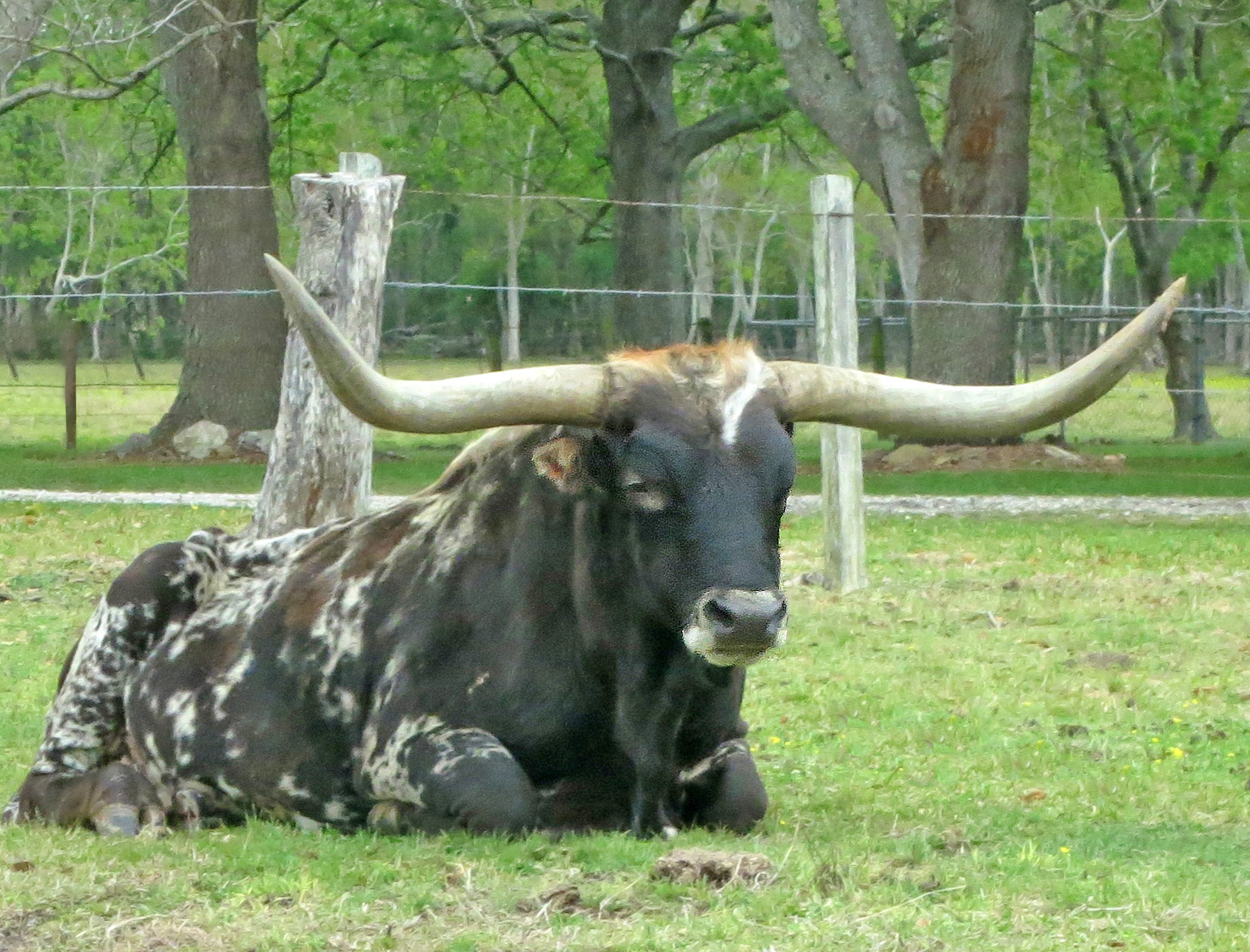

The Texas Longhorn derives from cattle brought to the Americas by Spanish conquistadors from the time of the Second Voyage of Christopher Columbus until about 1512. The first cattle were landed in 1493 on the Caribbean island of La Isla Española (now known as Hispaniola) to provide food for the colonists.
Over the next two centuries, the Spaniards used the cattle in Mexico and gradually moved them north to accompany their expanding settlements. The Spaniards reached the area that became known as "Texas" near the end of the 17th century. Eventually, some cattle escaped or were turned loose on the open range, where they remained mostly feral for the next two centuries. Over several generations, descendants of these cattle developed to have high feed- and drought-stress tolerances and other "hardy" characteristics that have given Longhorns their reputation as livestock.
The Texas Longhorn stock slowly dwindled, but in 1927, the breed was saved from near extinction by enthusiasts from the United States Forest Service. They collected a small herd of stock to breed on the Wichita Mountains Wildlife Refuge in Lawton, Oklahoma. The breed also received significant attention after a Texas Longhorn named "Bevo" was adopted as the mascot of The University of Texas at Austin in 1917. The animal's image became commonly associated with the school's sports teams, known as the Texas Longhorns. A few years later, J. Frank Dobie and others gathered small herds to keep in Texas state parks. Oilman Sid W. Richardson helped finance the project. The Longhorns were cared for largely as curiosities, but the stock's longevity, resistance to disease, and ability to thrive on marginal pastures resulted in a revival of the breed as beef stock and for their link to Texas history.
In 1957, Charles Schreiner III began creating a Longhorn herd on his ranch, the Y O, in Mountain Home, Texas, as a tribute to the ranching legacy of his grandfather, Captain Charles Armand Schreiner, and the Longhorns he ran on his ranches. Schreiner purchased five heifers and one bull calf for $75 each from the Wichita Mountains Wildlife Refuge near Lawton. In 1964, Schreiner founded the Texas Longhorn Breeders Association of America. The YO herd were the first cattle registered with the association. To draw attention to the Longhorn and its new association, in 1966, Schreiner organized a cattle drive of Longhorn steers from San Antonio, Texas to Dodge City, Kansas.{{cite web
In 1995, the Texas Legislature designated the Texas Longhorn as the state large mammal. In the 21st century, Texas Longhorns from elite bloodlines can sell for $40,000 or more at auction. The record of $380,000 on March 18, 2017, was for a cow, 3S Danica, and heifer calf at side, during the Legacy XIII sale in Fort Worth, Texas.
Registries for the breed include: the Texas Longhorn Breeders Association of America, founded in 1964 by the Kerr County rancher Charles Schreiner III; the International Texas Longhorn Association; and the Cattlemen's Texas Longhorn Registry. The online National Texas Longhorn Museum displays the diversity of horns found in the breed, stories about notable individual cattle of the breed, and a gallery of furniture made from cattle horns.
Characteristics
The Longhorn is genetically close to Iberian cattle breeds such as the De Lidia and Retinta of Spain and the Alentejana and Mertolenga of Portugal. Like other Criollo cattle of the Americas and many breeds of southern Europe, it is principally of taurine (European) derivation, but has a small admixture of indicine genetic heritage; this may be a consequence of gene flow across the Strait of Gibraltar from cattle of African origin dating to before the time of the Spanish Conquest.
The horns are in some cases very long. In general, the horns of bulls are of moderate length, while those of steers may be much longer. In 2022 the Guinness Book of Records reported the longest spread of cattle horns (on a living animal) to be: 323.7 cm for a steer called Poncho Via; 265.1 cm for a cow named 3S Danica; and 262.5 cm for a bull named Cowboy Tuff Chex. All three were Texas Longhorns.
Coat color is extremely variable. In some 40% of the cattle it is some shade of red, often a light red; the only shade of red not seen is the deep colour typical of the Hereford. The finching pattern is common; when the base color is black it is called zorillo, from the Spanish word for 'skunk'. Other colors include variations of black, blue, brown, cream, dun, grey, yellow or white, either with or without brindling (called gateada, from the Spanish word for 'cat'), speckling or spotting. Speckled and solid-coloured animals are in roughly equal proportion.
Use
The Longhorn was traditionally reared for beef. In the 21st century it is considered part of the cultural heritage of Texas; it is the official large mammal of the state.
It may be kept for conservation reasons, or bred for greater horn length. It is occasionally used for steer riding.
References
References
- Rouse, John E.. (1977). "The Criollo: Spanish Cattle in the Americas". University of Oklahoma Press.
- Barragy, Terrence J.. (2003). "Gathering Texas Gold". Cayo Del Grullo Press.
- Donald E. Worcester. ""Longhorn Cattle," Handbook of Texas Online". Published by the Texas State Historical Association.
- (April 1976). "Trail drive to Mark opening of Center". ICASALS Newsletter.
- (19 March 2017). "Texas Longhorn Cow Sells For $380,000.00".
- "Cattlemen's Texas Longhorn Registry". Cattlemen's Texas Longhorn Registry.
- "The Alan Rogers Texas Longhorn Museum".
- Kidd, K. K.. (1980). "Immunogenetic and Population Genetic Analyses of Iberian Cattle". Animal Blood Groups and Biochemical Genetics.
- Barbara Rischkowsky, Dafydd Pilling (editors) (2007).[https://web.archive.org/web/20200623201209/http://www.fao.org/3/a1250e/annexes/List%20of%20breeds%20documented%20in%20the%20Global%20Databank%20for%20Animal%20Genetic%20Resources/List_breeds.pdf List of breeds documented in the Global Databank for Animal Genetic Resources], annex to [https://web.archive.org/web/20170110125634/http://www.fao.org/3/a-a1250e.pdf ''The State of the World's Animal Genetic Resources for Food and Agriculture'']. Rome: Commission on Genetic Resources for Food and Agriculture, Food and Agriculture Organization of the United Nations. {{isbn. 9789251057629. Archived 23 June 2020.
- 9781780647944.
- [https://dadis-breed-datasheet-ext-ws.firebaseapp.com/?country=USA&specie=Cattle&breed=Texas%20Longhorn&lang=en Breed data sheet: Texas Longhorn / United States of America (Cattle)]. Domestic Animal Diversity Information System of the Food and Agriculture Organization of the United Nations. Accessed February 2022.
- (July 15, 2017). "Oklahoma couple breeds longhorns for riding".
- [https://www.guinnessworldrecords.com/search?term=cattle%20horns&page=1&type=record&max=20&partial=_Results& Records: "cattle horns"]. ''Guinness Book of Records''. Guinness World Records. Accessed February 2022.
- Janet Vorwald Dohner (2001). ''The Encyclopedia of Historic and Endangered Livestock and Poultry Breeds''. New Haven, Connecticut; London: Yale University Press. {{isbn. 0300088809.
- (March 25, 2013). "New World cattle show ancestry from multiple independent domestication events". Proceedings of the National Academy of Sciences.
- Siebert, Charles. (July 2011). "Food Ark". National Geographic.
- Joshua Specht (2016). [http://www.jstor.org/stable/24691590 The Rise, Fall, and Rebirth of the Texas Longhorn: An Evolutionary History]. ''Environmental History''. '''21''' (2):343–363. {{doi. 10.1093/envhis/emv148. {{subscription required>
- [https://web.archive.org/web/20211019093005/https://livestockconservancy.org/heritage-breeds/heritage-breeds-list/texas-longhorn-cattle Texas Longhorn Cattle (CTLR)]. The Livestock Conservancy. Archived 19 October 2021.
- [https://web.archive.org/web/20211214162933/https://livestockconservancy.org/wp-content/uploads/2021/06/CattleChart2021.pdf Quick Reference Guide to Heritage Cattle]. The Livestock Conservancy. Archived 14 December 2021.
- Kate Galbraith (October 12, 2012). [https://www.texastribune.org/2012/10/12/why-texas-longhorns-owe-their-survival-oklahoma/ Symbol of Texas Owes its Survival in Part to Oklahoma]. ''The Texas Tribune''. Accessed May 2023.
- "A $380,000 Longhorn? A Look At The Never-ending Race For The Biggest Horns In Texas". Texas Standard.
- [https://www.tsl.texas.gov/ref/abouttx/symbols.html Texas State Symbols]. Texas State Library and Archives Commission. Accessed May 2023.
- (September 26, 2017). "A fresh mount: Bob McCormick breaks longhorn steer to ride for bicentennial parade".
- Daniel Oppenheimer (March 25, 2013). [https://www.sciencedaily.com/releases/2013/03/130325160514.htm Decoding the genetic history of the Texas longhorn]. ''ScienceDaily''. University of Texas at Austin. Accessed February 2022.
This article was imported from Wikipedia and is available under the Creative Commons Attribution-ShareAlike 4.0 License. Content has been adapted to SurfDoc format. Original contributors can be found on the article history page.
Ask Mako anything about Texas Longhorn — get instant answers, deeper analysis, and related topics.
Research with MakoFree with your Surf account
Create a free account to save articles, ask Mako questions, and organize your research.
Sign up freeThis content may have been generated or modified by AI. CloudSurf Software LLC is not responsible for the accuracy, completeness, or reliability of AI-generated content. Always verify important information from primary sources.
Report