From Surf Wiki (app.surf) — the open knowledge base
Tettigoniidae
Family of insects
Family of insects
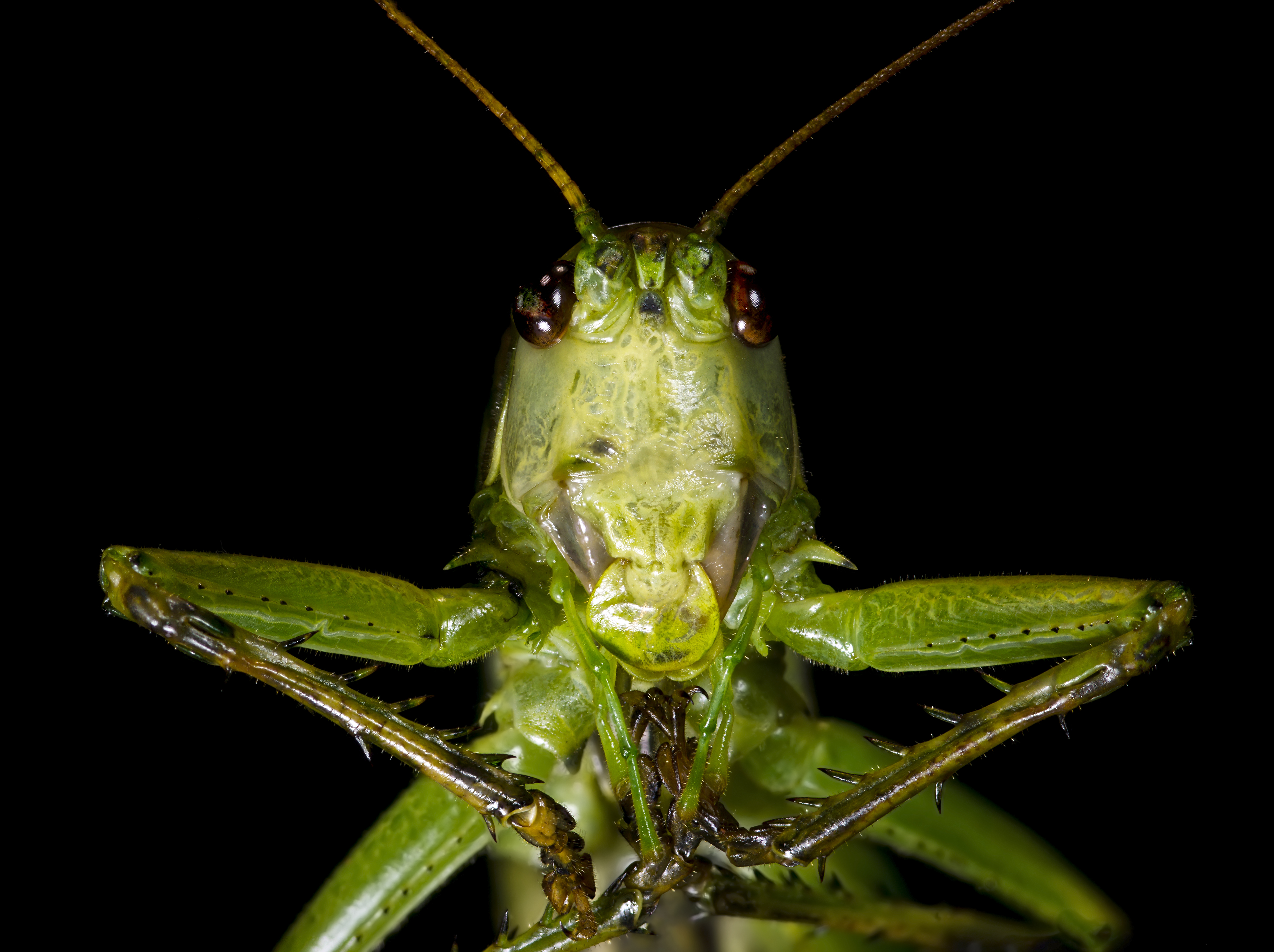
Insects in the family Tettigoniidae are commonly called katydids (especially in North America) They have previously been known as "long-horned grasshoppers". More than 8,000 species are known. Part of the suborder Ensifera, the Tettigoniidae are the only extant (living) family in the superfamily Tettigonioidea.
Many species are nocturnal in habit, having strident mating calls and may exhibit mimicry or camouflage, commonly with shapes and colours similar to leaves.
Etymology
The family name Tettigoniidae is derived from the genus Tettigonia, of which the great green bush cricket is the type species; it was first described by Carl Linnaeus in 1758. In Latin tettigonia means a kind of small cicada, leafhopper; it is from the Greek τεττιγόνιον tettigonion, the diminutive of the imitative (onomatopoeic) τέττιξ, tettix, cicada. All of these names such as tettix with repeated sounds are onomatopoeic, imitating the stridulation of these insects. The common name katydid is also onomatopoeic and comes from the particularly loud, three-pulsed song, often rendered "ka-ty-did", of the nominate subspecies of the North American Pterophylla camellifolia, belonging to the subfamily Pseudophyllinae, which are known as "true katydids".
Description and life cycle
Description
Tettigoniids range in size from as small as 5 mm to as large as 130 mm. The smaller species typically live in drier or more stressful habitats which may lead to their small size. The small size is associated with greater agility, faster development, and lower nutritional needs. Tettigoniids are tree-living insects that are most commonly heard at night during summer and early fall. Tettigoniids may be distinguished from the grasshopper by the length of their filamentous antennae, which may exceed their own body length, while grasshoppers' antennae are always relatively short and thickened.

Life cycle

Eggs are typically oval and may be attached in rows to plants. Where the eggs are deposited relates to the way the ovipositor is formed. It consists of up to three pairs of appendages formed to transmit the egg, to make a place for it, and place it properly. Tettigoniids have either sickle-shaped ovipositors which typically lay eggs in dead or living plant matter, or uniform long ovipositors which lay eggs in grass stems. When tettigoniids hatch, the nymphs often look like small, wingless versions of the adults, but in some species, the nymphs look nothing at all like the adult and rather mimic other species such as ants, spiders and assassin bugs, or flowers, to prevent predation. The nymphs remain in a mimic state only until they are large enough to escape predation. Once they complete their last molt (after about 5 successful molts), they are then prepared to mate.
Distribution
Tettigoniids are found on every continent except Antarctica. The vast majority of katydid species live in the tropical regions of the world. For example, the Amazon basin tropical forests are home to over 2,000 species. However, katydids are found in the cool, dry temperate regions, as well, with about 255 species in North America.
Classification
The Tettigoniidae are a large family and have been divided into a number of subfamilies:
- Austrosaginae (Australia)
- Bradyporinae (southeast Europe, west & central Asia)
- Conocephalinae (global)
- Hetrodinae (Africa)
- Hexacentrinae (pantropical, especially Asia)
- Lipotactinae (Asia)
- Listroscelidinae (Americas, Madagascar, Australia)
- Meconematinae (global)
- Mecopodinae (South America, Africa, Southeast Asia, Oceania)
- Microtettigoniinae (Australia)
- Phaneropterinae (global)
- Phasmodinae (Australia)
- Phyllophorinae (Australasia)
- Pseudophyllinae (global)
- Pterochrozinae (Central and South America)
- Saginae (North America, Africa, Europe)
- Tettigoniinae (global)
- Tympanophorinae (Australia)
- Zaprochilinae (Australia)
|Sattelschrecke.jpg|Ephippiger ephippiger (Bradyporinae) |Conocephalus fuscus qtl1.jpg|Conocephalus fuscus (Conocephalinae) |CSIRO ScienceImage 178 A Parap Grasshopper.jpg|Paraphisis sp. (Meconematinae) |Phaneroptera falcata.jpg|Phaneroptera falcata (Phaneropterinae) |Leaf-mimic Katydid (Pseudophyllus titan) (7852012270).jpg|Pseudophyllus titan (Pseudophyllinae) |Roesel's bush-cricket (Metrioptera roeselii diluta) male.jpg|Metrioptera roeselii (Tettigoniinae)
The Copiphorinae were previously considered a subfamily, but are now placed as tribe Copiphorini in the subfamily Conocephalinae. The genus Acridoxena is now placed in the tribe Acridoxenini of the Mecopodinae (previously its own subfamily, Acridoxeninae).
Extinct taxa
The Orthoptera species file lists:
- †Pseudotettigoniinae (North America, Europe)
- †Rammeinae (Europe)
- †Tettigoidinae (Australia) ;Genera incertae sedis
- †Locustites Heer, 1849: 3 spp.
- †Locustophanes Handlirsch, 1939: †L. rhipidophorus Handlirsch, 1939
- †Prophasgonura Piton, 1940: †P. lineatocollis Piton, 1940
- †Protempusa Piton, 1940: †P. incerta Piton, 1940
- †Prototettix Giebel, 1856: †P. lithanthraca (Goldenberg, 1854)
The genus †Triassophyllum is extinct and may be placed here or in the Archaeorthoptera.
Ecology
_male.jpg)
The diet of most tettigoniids includes leaves, flowers, bark, and seeds, but many species are exclusively predatory, feeding on other insects, snails, or even small vertebrates such as and lizards. Some are also considered pests by commercial crop growers and are sprayed to limit growth, but population densities are usually low, so a large economic impact is rare.
Tettigoniids are serious insect pests of karuka (Pandanus julianettii). The species Segestes gracilis and Segestidea montana eat the leaves and can sometimes kill trees. Growers will stuff leaves and grass in between the leaves of the crown to keep insects out.
By observing the head and mouthparts, where differences can be seen in relation to function, it is possible to determine what type of food the tettigoniids consume. Large tettigoniids can inflict a painful bite or pinch if handled, but seldom break the skin.
Some species of bush crickets are consumed by people, such as the nsenene (Ruspolia differens) in Uganda and neighbouring areas.
Communication
The males of tettigoniids have sound-producing organs located on the hind angles of their front wings. In some species, females are also capable of stridulation. Females chirp in response to the shrill of the males. The males use this sound for courtship, which occurs late in the summer. The sound is produced by rubbing two parts of their bodies together, called stridulation. In many cases this is done with the wings, but not exclusively. One body part bears a file or comb with ridges; the other has the plectrum, which runs over the ridges to produce a vibration. For tettigoniids, the fore wings are used to sing. Tettigoniids produce continuous songs known as trills. The size of the insect, the spacing of the ridges, and the width of the scraper all influence what sound is made.
Many species stridulate at a tempo which is governed by ambient temperature, so that the number of chirps in a defined period of time can produce a fairly accurate temperature reading. For American katydids, the formula is generally given as the number of chirps in 15 seconds plus 37 to give the temperature in degrees Fahrenheit.
Predation
_with_female_katydid_prey_(Tettigoniidae_sp.).jpg)
Some tettigoniids have spines on different parts of their bodies that work in different ways. The Listroscelinae have limb spines on the ventral surfaces of their bodies. This works in a way to confine their prey to make a temporary cage above their mouthparts. The spines are articulated and comparatively flexible, but relatively blunt. Due to this, they are used to cage and not penetrate the prey's body. Spines on the tibiae and the femora are usually more sharp and nonarticulated. They are designed more for penetration or help in the defensive mechanism they might have. This usually works with their diurnal roosting posture to maximize defense and prevent predators from going for their head.
Defense mechanisms

When tettigoniids go to rest during the day, they enter a diurnal roosting posture to maximize their cryptic qualities. This position fools predators into thinking the katydid is either dead or just a leaf on the plant. Various tettigoniids have bright coloration and black apical spots on the inner surfaces of the tegmina, and brightly colored hind wings. By flicking their wings open when disturbed, they use the coloration to fool predators into thinking the spots are eyes. This, in combination with their coloration mimicking leaves, allows them to blend in with their surroundings, but also makes predators unsure which side is the front and which side is the back.
Katydid
I LOVE to hear thine earnest voice, Wherever thou art hid, Thou testy little dogmatist, Thou pretty Katydid! Thou mindest me of gentlefolks, - Old gentlefolks are they, - Thou say'st an undisputed thing In such a solemn way.
Thou art a female, Katydid! I know it by the trill That quivers through thy piercing notes, So petulant and shrill. I think there is a knot of you Beneath the hollow tree, - A knot of spinster Katydids, - Do Katydids drink tea?
O, tell me where did Katy live, And what did Katy do? And was she very fair and young, And yet so wicked, too? Did Katy love a naughty man, Or kiss more cheeks than one? I warrant Katy did no more Than many a Kate has done.
To A Katydid
LITTLE friend among the tree-tops, Chanting low your vesper hymns, Never tiring, Me inspiring, Seated 'neath the swaying limbs, Do you know your plaintive calling, When the summer dew is falling, Echoes sweeter through my brain Than any soft, harmonic strain?
Others call you an intruder, Say discordant notes you know; Or that sadness, More than gladness, From your little heart doth flow; And that you awake from sleeping Thoughts in quiet they were keeping, Faithless love, or ill-laid schemes, Hopes unanchored — broken dreams.
No such phantoms to my vision Doth your lullaby impart, But sweet faces, No tear traces, Smile as joyous in my heart, As when first at mother's knee Learned I your sweet mystery. I defend you with my praises, For your song my soul upraises.
Oft I fancy when your neighbors, In some secret thicket hid, Are debating, Underrating What that little maiden did, That above their clam'rous singing I can hear your accents ringing, Like a voice that must defend From abuse some time-loved friend.
Dream I not of fame or fortune, Only this I inward crave, Sweet assurance, Long endurance, Of a love beyond the grave. Should my songs die out and perish, You'll my name repeat and cherish; Though all trace is lost of me, Still you'll call from tree to tree.
Reproductive behavior
The males provide a nuptial gift for the females in the form of a spermatophylax, a body attached to the males' spermatophore and consumed by the female, to distract her from eating the male's spermatophore and thereby increase his paternity.
Polygamy
The Tettigoniidae have polygamous relationships. The first male to mate is guaranteed an extremely high confidence of paternity when a second male couples at the termination of female sexual refractoriness. The nutrients that the offspring ultimately receive will increase their fitness. The second male to mate with the female at the termination of her refractory period is usually cuckolded.
Competition
The polygamous relationships of the Tettigoniidae lead to high levels of male-male competition. Male competition is caused by the decreased availability of males able to supply nutritious spermaphylanges to the females. Females produce more eggs on a high-quality diet; thus, the female looks for healthier males with a more nutritious spermatophylax. Females use the sound created by the male to judge his fitness. The louder and more fluent the trill, the higher the fitness of the male.
Stress response
In species which produce larger food gifts, the female often seeks out the males to copulate. This, however, is a cost to females as they risk predation while searching for males. Also, a cost-benefit tradeoff exists in the size of the spermatophore which the male tettigoniids produce. When males possess a large spermatophore, they benefit by being more highly selected for by females, but they are only able to mate one to two times during their lifetimes. Inversely, male Tettigoniidae with smaller spermatophores have the benefit of being able to mate two to three times per night, but have lower chances of being selected by females. Even in times of nutritional stress, male Tettigoniidae continue to invest nutrients within their spermatophores. In some species, the cost of creating the spermatophore is low, but even in those which it is not low, it is still not beneficial to reduce the quality of the spermatophore, as it would lead to lower reproductive selection and success. This low reproductive success is attributed to some Tettigoniidae species in which the spermatophylax that the female receives as a food gift from the male during copulation increases the reproductive output of the reproduction attempt. However, in other cases, the female receives few, if any, benefits.
The reproductive behavior of bush crickets has been studied in great depth. Studies found that the tuberous bush cricket (Platycleis affinis) has the largest testes in proportion to body mass of any animal recorded. They account for 14% of the insect's body mass and are thought to enable a fast remating rate.
References
References
- Ragge DR. (1965). "Grasshoppers, Crickets & Cockroaches of the British Isles". F Warne & Co, London.
- (2009). "Encyclopedia Of Insects".
- "Katydid".
- {{L&S. tettigonia. ref
- "Tettigoniidae".
- {{LSJ. tettigo/nion. τεττιγόνιον, {{LSJ. te/ttic. τέττιξ. ref.
- "Tettix".
- {{OEtymD. katydid. (7 March 2016)
- "common true katydid (Pterophylla camellifolia)".
- "Funk & Wagnalls New World Encyclopedia". EBSCO Publishing.
- (15 July 2010). "A guide to the katydids of Australia". Journal of Insect Conservation.
- "Bush crickets". BBC Nature.
- {{OSF
- [http://orthoptera.speciesfile.org/Common/basic/Taxa.aspx?TaxonNameID=1133737 Orthoptera species file (retrieved 3 January 2018)]
- [https://www.gbif.org/species/121404587 GBIF: ''Triassophyllum'' Papier et al., 1997 (retrieved January 2018))]
- "Tree of Life project".
- (1982). "Growing food in the Southern Highlands Province of Papua New Guinea". AFTSEMU (Agricultural Field Trials, Surveys, Evaluation and Monitoring Unit) of the World Bank funded project in the Southern Highlands of Papua New Guinea.
- "Columbia Electronic Encyclopedia".
- (January 2010). "Exploring Sound with Insects". Science Scope.
- (2013). "The Insects: Structure and function". Cambridge University Press.
- "Can you tell the temperature by listening to the chirping of a cricket?". U.S. Library of Congress.
- (24 Dec 2003). "The spiny devil katydids, ''Panacanthus'' Walker (Orthoptera: Tettigoniidae): an evolutionary study of acoustic behaviour and morphological traits". Systematic Entomology.
- (August 2004). "Notes on the biology and ecology of the leaf-mimicking katydid ''Typophyllum bolivari'' Vignon (Orthoptera: Tettigoniidae: Pseudophyllinae: Pterochrozini)". Journal of Orthoptera Research.
- [https://books.google.com/books?id=kXd4bRr71a4C&dq=Oliver+Wendell+Holmes+Katydid&pg=PA356 ''A Library of Poetry and Song: Being Choice Selections from The Best Poets. With An Introduction by William Cullen Bryant''], New York, J.B. Ford and Company, 1871, pp. 356-357.
- [https://books.google.com/books?id=TiA7AQAAIAAJ&pg=PA9 ''The Poetical Works of Oliver Wendell Holmes''], Boston And New York, Houghton, Mifflin And Company, 1893, p. 9.
- [https://books.google.com/books?id=1NUtAAAAMAAJ&pg=PA7 ''Katydid's Poems: With A Letter By Jno. Aug. Williams''], Courier-Journal Job Printing Company, 1887, pp. 7-8.
- (1998). "The function of nuptial feeding in insects: A review of empirical studies". Biological Reviews.
- (December 1988). "Courtship feeding in katydids benefits the mating male's offspring". Behavioral Ecology and Sociobiology.
- (1994). "Mate feeding, offspring investment, and sexual differences in katydids (Orthoptera: Tettigoniidae)". Behavioral Ecology.
- (2000). "Nutritional condition influences investment by male katydids in nuptial food gifts". Ecological Entomology.
- (2010). "Larger testes are associated with a higher level of polyandry, but a smaller ejaculate volume, across bushcricket species (Tettigoniidae)". Biology Letters.
This article was imported from Wikipedia and is available under the Creative Commons Attribution-ShareAlike 4.0 License. Content has been adapted to SurfDoc format. Original contributors can be found on the article history page.
Ask Mako anything about Tettigoniidae — get instant answers, deeper analysis, and related topics.
Research with MakoFree with your Surf account
Create a free account to save articles, ask Mako questions, and organize your research.
Sign up freeThis content may have been generated or modified by AI. CloudSurf Software LLC is not responsible for the accuracy, completeness, or reliability of AI-generated content. Always verify important information from primary sources.
Report