From Surf Wiki (app.surf) — the open knowledge base
Tetradecagon
Polygon with 14 edges

Polygon with 14 edges
In geometry, a tetradecagon or tetrakaidecagon or 14-gon is a fourteen-sided polygon.
Regular tetradecagon
A regular tetradecagon has Schläfli symbol {14} and can be constructed as a quasiregular truncated heptagon, t{7}, which alternates two types of edges.
The area of a regular tetradecagon of side length a is given by :A = \frac{14}{4}a^2\cot\frac{\pi}{14} \approx 15.3345a^2
Construction
As 14 = 2 × 7, a regular tetradecagon cannot be constructed using a compass and straightedge. However, it is constructible using neusis with use of the angle trisector, or with a marked ruler, as shown in the following two examples.
An animation (1 min 47 s) from a neusis construction with radius of circumcircle \overline{OA} = 6,
according to Andrew M. Gleason, based on the angle trisection by means of the tomahawk.]]

An animation (1 min 20 s) from a neusis construction with marked ruler, according to David Johnson Leisk (Crockett Johnson).]]
Symmetry
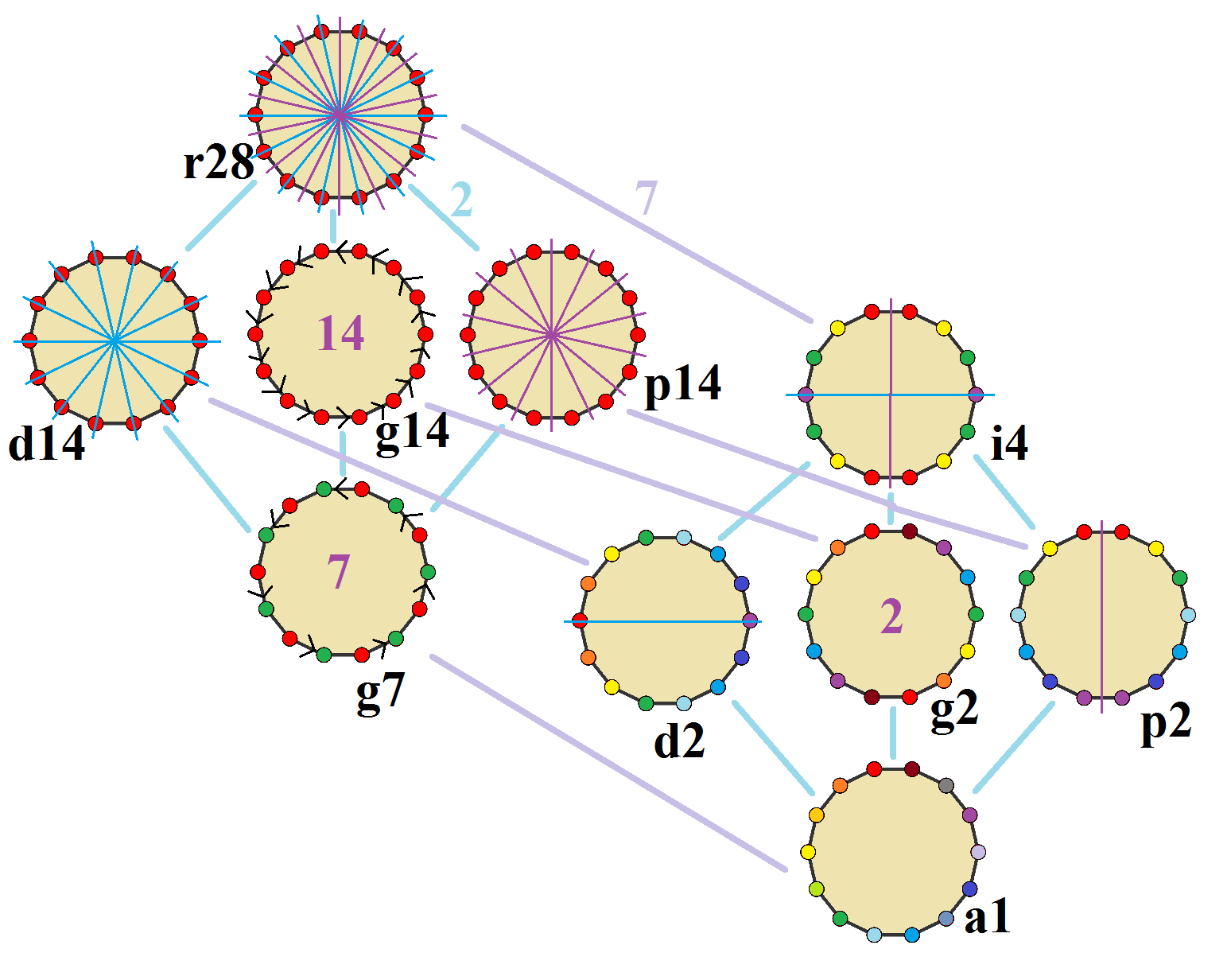
The regular tetradecagon has Dih14 symmetry, order 28. There are 3 subgroup dihedral symmetries: Dih7, Dih2, and Dih1, and 4 cyclic group symmetries: Z14, Z7, Z2, and Z1.
These 8 symmetries can be seen in 10 distinct symmetries on the tetradecagon, a larger number because the lines of reflections can either pass through vertices or edges. John Conway labels these by a letter and group order. Full symmetry of the regular form is r28 and no symmetry is labeled a1. The dihedral symmetries are divided depending on whether they pass through vertices (d for diagonal) or edges (p for perpendiculars), and i when reflection lines path through both edges and vertices. Cyclic symmetries in the middle column are labeled as g for their central gyration orders.
Each subgroup symmetry allows one or more degrees of freedom for irregular forms. Only the g14 subgroup has no degrees of freedom but can be seen as directed edges.
The highest symmetry irregular tetradecagons are d14, an isogonal tetradecagon constructed by seven mirrors which can alternate long and short edges, and p14, an isotoxal tetradecagon, constructed with equal edge lengths, but vertices alternating two different internal angles. These two forms are duals of each other and have half the symmetry order of the regular tetradecagon.
Dissection
| [[File:14-cube t0 A13.svg | 160px]]14-cube projection | [[File:14-gon rhombic dissection-size2.svg | 160px]]84 rhomb dissection |
|---|
Coxeter states that every zonogon (a 2m-gon whose opposite sides are parallel and of equal length) can be dissected into m(m-1)/2 parallelograms. In particular this is true for regular polygons with evenly many sides, in which case the parallelograms are all rhombi. For the regular tetradecagon, m=7, and it can be divided into 21: 3 sets of 7 rhombs. This decomposition is based on a Petrie polygon projection of a 7-cube, with 21 of 672 faces. The list defines the number of solutions as 24698, including up to 14-fold rotations and chiral forms in reflection.
| [[File:7-cube_graph.svg | 160px]] | [[File:14-gon-dissection.svg | 160px]] | [[File:14-gon-dissection-star.svg | 160px]] | [[File:14-gon rhombic dissection2.svg | 160px]] | [[File:14-gon rhombic dissectionx.svg | 160px]] | [[File:14-gon-dissection-random.svg | 160px]] |
|---|
Numismatic use
The regular tetradecagon is used as the shape of some commemorative gold and silver Malaysian coins, the number of sides representing the 14 states of the Malaysian Federation.
Related figures

A tetradecagram is a 14-sided star polygon, represented by symbol {14/n}. There are two regular star polygons: {14/3} and {14/5}, using the same vertices, but connecting every third or fifth points. There are also three compounds: {14/2} is reduced to 2{7} as two heptagons, while {14/4} and {14/6} are reduced to 2{7/2} and 2{7/3} as two different heptagrams, and finally {14/7} is reduced to seven digons.
A notable application of a fourteen-pointed star is in the flag of Malaysia, which incorporates a yellow {14/6} tetradecagram in the top-right corner, representing the unity of the thirteen states with the federal government.
| Compounds and star polygons | n | 1 | 2 | 3 | 4 | 5 | 6 | 7 | Form | Regular | Compound | Star polygon | Compound | Star polygon | Compound | Image | Internal angle | |||||||
|---|---|---|---|---|---|---|---|---|---|---|---|---|---|---|---|---|---|---|---|---|---|---|---|---|
| [[File:Regular_polygon_14.svg | 100px]] | |||||||||||||||||||||||
| {14/1} = {14} | [[File:Regular_star_figure_2(7,1).svg | 100px]] | ||||||||||||||||||||||
| {14/2} = 2{7} | [[File:Regular_star_polygon_14-3.svg | 100px]] | ||||||||||||||||||||||
| {14/3} | [[File:Regular_star_figure_2(7,2).svg | 100px]] | ||||||||||||||||||||||
| {14/4} = 2{7/2} | [[File:Regular_star_polygon_14-5.svg | 100px]] | ||||||||||||||||||||||
| {14/5} | [[File:Regular_star_figure_2(7,3).svg | 100px]] | ||||||||||||||||||||||
| {14/6} = 2{7/3} | [[File:Regular_star_figure_7(2,1).svg | 100px]] | ||||||||||||||||||||||
| {14/7} or 7{2} | ||||||||||||||||||||||||
| ≈154.286° | ≈128.571° | ≈102.857° | ≈77.1429° | ≈51.4286° | ≈25.7143° | 0° |
Deeper truncations of the regular heptagon and heptagrams can produce isogonal (vertex-transitive) intermediate tetradecagram forms with equally spaced vertices and two edge lengths. Other truncations can form double covering polygons 2{p/q}, namely: t{7/6}={14/6}=2{7/3}, t{7/4}={14/4}=2{7/2}, and t{7/2}={14/2}=2{7}.
| Isogonal truncations of heptagon and heptagrams | Quasiregular | Isogonal | QuasiregularDouble covering | ||||
|---|---|---|---|---|---|---|---|
| [[File:regular_polygon_truncation_7_1.svg | 100px]]t{7}={14} | [[File:regular_polygon_truncation_7_2.svg | 100px]] | [[File:regular_polygon_truncation_7_3.svg | 100px]] | [[File:regular_polygon_truncation_7_4.svg | 100px]] |
| [[File:regular_star_truncation_7-3_1.svg | 100px]]t{7/3}={14/3} | [[File:regular_star_truncation_7-3_2.svg | 100px]] | [[File:regular_star_truncation_7-3_3.svg | 100px]] | [[File:regular_star_truncation_7-3_4.svg | 100px]] |
| [[File:regular_star_truncation_7-5_1.svg | 100px]]t{7/5}={14/5} | [[File:regular_star_truncation_7-5_2.svg | 100px]] | [[File:regular_star_truncation_7-5_3.svg | 100px]] | [[File:regular_star_truncation_7-5_4.svg | 100px]] |
Isotoxal forms
An isotoxal polygon can be labeled as {pα} with outer most internal angle α, and a star polygon {(p/q)α}, with q is a winding number, and gcd(p,q)=1, q
| [[File:Isotoxal tetradecagon.svg | 100px]]{7α} | [[File:Intersecting_isotoxal_tetradecagon.svg | 100px]]{(7/2)α} | [[File:Intersecting isotoxal tetradecagon3.svg | 100px]]{(7/3)α} | [[File:Intersecting isotoxal tetradecagon4.svg | 100px]]{(7/4)α} | [[File:Intersecting isotoxal tetradecagon5.svg | 100px]]{(7/5)α} | [[File:Intersecting isotoxal tetradecagon6.svg | 100px]]{(7/6)α} |
|---|
Petrie polygons
Regular skew tetradecagons exist as Petrie polygon for many higher-dimensional polytopes, shown in these skew orthogonal projections, including:
| Petrie polygons | B7 | 2I2(7) (4D) | A13 | D8 | E8 | |
|---|---|---|---|---|---|---|
| [[File:7-cube_t6.svg | 100px]] | |||||
| 7-orthoplex | [[File:7-cube_t0.svg | 100px]] | ||||
| 7-cube | [[File:7-7_duopyramid_ortho.png | 100px]]7-7 duopyramid | [[File:7-7 duoprism ortho-Dih7.png | 100px]]7-7 duoprism | ||
| [[File:13-simplex_t0.svg | 100px]] | |||||
| 13-simplex | [[File:8-cube_t7_B7.svg | 100px]] | ||||
| 511 | [[File:8-demicube_t0_D8.svg | 100px]] | ||||
| 151 | [[File:4 21 t0 B7.svg | 100px]] | ||||
| 421 | [[File:2 41 t0 B7.svg | 100px]] | ||||
| 241 |
References
References
- Wantzel, Pierre. (1837). "Recherches sur les moyens de Reconnaître si un Problème de géométrie peau se résoudre avec la règle et le compas". Journal de Mathématiques.
- Gleason, Andrew Mattei. (March 1988). "Angle trisection, the heptagon, p. 186 (Fig.1) –187". The American Mathematical Monthly.
- [http://mathworld.wolfram.com/Heptagon.html Weisstein, Eric W. "Heptagon." From MathWorld, A Wolfram Web Resource.]
- John H. Conway, Heidi Burgiel, [[Chaim Goodman-Strauss]], (2008) The Symmetries of Things, {{isbn. 978-1-56881-220-5 (Chapter 20, Generalized Schaefli symbols, Types of symmetry of a polygon pp. 275-278)
- [[Coxeter]], Mathematical recreations and Essays, Thirteenth edition, p.141
- ''The Numismatist'', Volume 96, Issues 7-12, Page 1409, American Numismatic Association, 1983.
- The Lighter Side of Mathematics: Proceedings of the Eugène Strens Memorial Conference on Recreational Mathematics and its History, (1994), ''Metamorphoses of polygons'', [[Branko Grünbaum]]
This article was imported from Wikipedia and is available under the Creative Commons Attribution-ShareAlike 4.0 License. Content has been adapted to SurfDoc format. Original contributors can be found on the article history page.
Ask Mako anything about Tetradecagon — get instant answers, deeper analysis, and related topics.
Research with MakoFree with your Surf account
Create a free account to save articles, ask Mako questions, and organize your research.
Sign up freeThis content may have been generated or modified by AI. CloudSurf Software LLC is not responsible for the accuracy, completeness, or reliability of AI-generated content. Always verify important information from primary sources.
Report