From Surf Wiki (app.surf) — the open knowledge base
Tetractys
Symbol of ten points laid in four rows

Symbol of ten points laid in four rows
The tetractys (), or tetrad, or the tetractys of the decad is a triangular figure consisting of ten points arranged in four rows: one, two, three, and four points in each row, which is the geometrical representation of the fourth triangular number. As a mystical symbol, it was very important to the secret worship of Pythagoreanism. There were four seasons, and the number was also associated with planetary motions and music.
Pythagorean symbol
- The first four numbers symbolize the musica universalis and the Cosmos as:
- Monad – Unity
- Dyad – Power – Limit/Unlimited (peras/apeiron)
- Triad – Harmony
- Tetrad – Kosmos
- The four rows add up to ten, which was unity of a higher order (The Dekad).
- The Tetractys symbolizes the four classical elements—air, fire, water, and earth.
- The Tetractys represented the organization of space:
- the first row represented zero dimensions (a point)
- the second row represented one dimension (a line of two points)
- the third row represented two dimensions (a plane defined by a triangle of three points)
- the fourth row represented three dimensions (a tetrahedron defined by four points)
A prayer of the Pythagoreans shows the importance of the Tetractys (sometimes called the "Mystic Tetrad"), as the prayer was addressed to it.
Bless us, divine number, thou who generated gods and men! O holy, holy Tetractys, thou that containest the root and source of the eternally flowing creation! For the divine number begins with the profound, pure unity until it comes to the holy four; then it begets the mother of all, the all-comprising, all-bounding, the first-born, the never-swerving, the never-tiring holy ten, the keyholder of all.
The Pythagorean oath also mentioned the Tetractys: :By that pure, holy, four lettered name on high, :nature's eternal fountain and supply, :the parent of all souls that living be, :by him, with faith find oath, I swear to thee.
It is said that the Pythagorean musical system was based on the Tetractys as the rows can be read as the ratios of 4:3 (perfect fourth), 3:2 (perfect fifth), 2:1 (octave), forming the basic intervals of the Pythagorean scales. That is, Pythagorean scales are generated from combining pure fourths (in a 4:3 relation), pure fifths (in a 3:2 relation), and the simple ratios of the unison 1:1 and the octave 2:1. Note that the diapason, 2:1 (octave), and the diapason plus diapente, 3:1 (compound fifth or perfect twelfth), are consonant intervals according to the tetractys of the decad, but that the diapason plus diatessaron, 8:3 (compound fourth or perfect eleventh), is not.
The Tetractys [also known as the decad] is an equilateral triangle formed from the sequence of the first ten numbers aligned in four rows. It is both a [[mathematics
mathematical]] idea and a [[metaphysics
Kabbalist symbol


In the work by anthropologist Raphael Patai entitled The Hebrew Goddess, the author argues that the tetractys and its mysteries influenced the early Kabbalah. A Hebrew tetractys has the letters of the Tetragrammaton inscribed on the ten positions of the tetractys, from right to left. It has been argued that the Kabbalistic Tree of Life, with its ten spheres of emanation, is in some way connected to the tetractys, but its form is not that of a triangle. The occultist Dion Fortune writes: :The point is assigned to Kether; :the line to Chokmah; :the two-dimensional plane to Binah; :consequently the three-dimensional solid naturally falls to Chesed.
The relationship between geometrical shapes and the first four Sephirot is analogous to the geometrical correlations in Tetraktys, shown above under #Pythagorean symbol, and unveils the relevance of the Tree of Life with the Tetraktys.
Occurrence
.jpg)
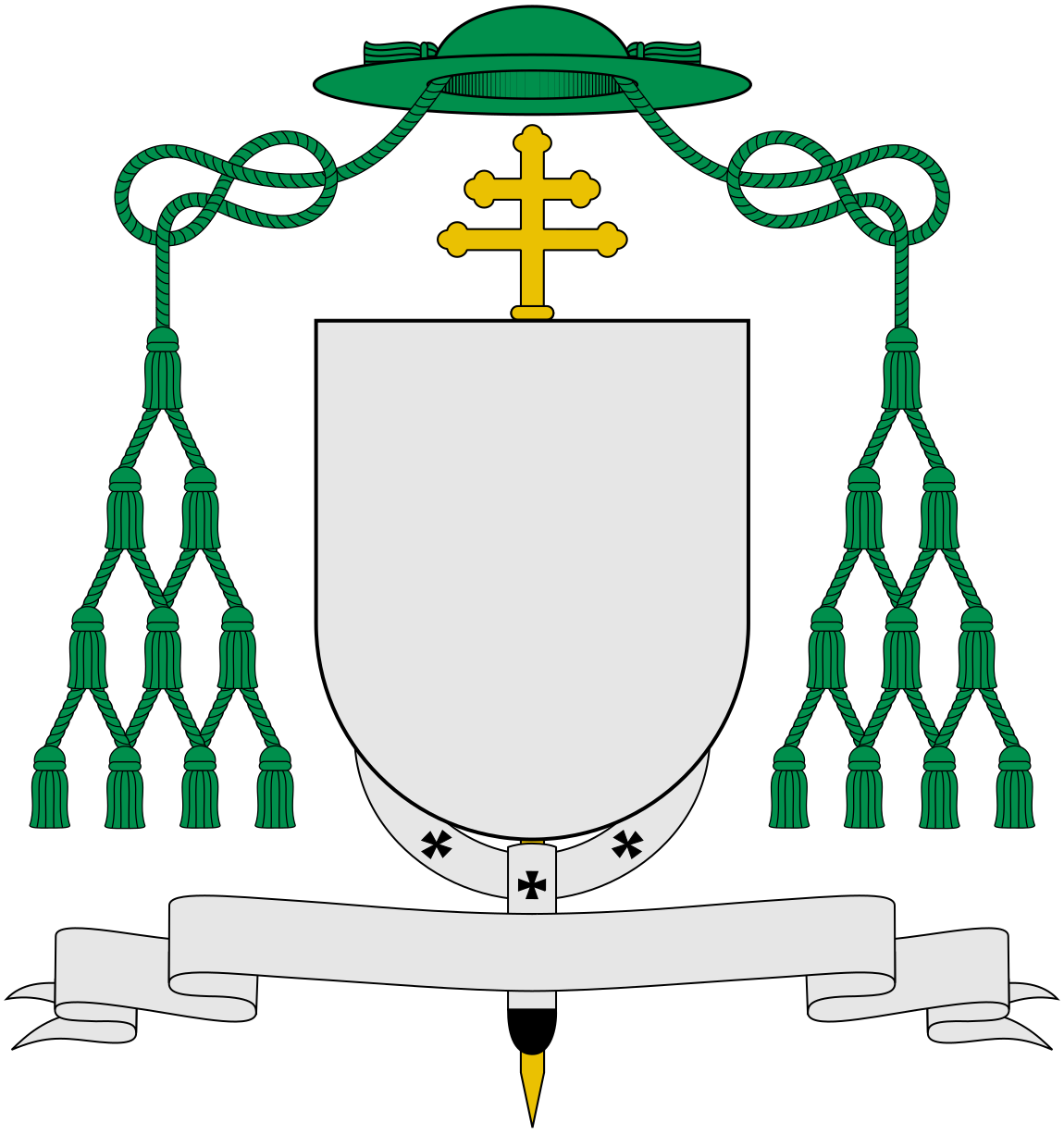
The tetractys occurs (generally coincidentally) in the following:
- the baryon decuplet
- an archbishop's coat of arms
- the arrangement of bowling pins in ten-pin bowling
- the arrangement of billiard balls in ten-ball pool
- a Chinese checkers board
- the "Christmas Tree" formation in association football
In poetry
In English-language poetry, a tetractys is a syllable-counting form with five lines. The first line has one syllable, the second has two syllables, the third line has three syllables, the fourth line has four syllables, and the fifth line has ten syllables. A sample tetractys would look like this:
:Mantrum :Your / :fury / :confuses / :us all greatly. / :Volatile, big-bodied tots are selfish. //
The tetractys was created by Ray Stebbing, who said the following about his newly created form:
:"The tetractys could be Britain's answer to the haiku. Its challenge is to express a complete thought, profound or comic, witty or wise, within the narrow compass of twenty syllables.
References
References
- "The Theosophical Glossary". Forgotten Books.
- Eduard Zeller. "Outlines of the History of Greek Philosophy".
- Dimitra Karamanides. (2005). "Pythagoras: pioneering mathematician and musical theorist of Ancient Greece". The Rosen Publishing Group.
- ''The Pythagorean Sourcebook and Library'' by [[Kenneth Sylvan Guthrie]]
- Dantzig, Tobias ([1930], 2005) Number. The Language of Science. p. 42
- [[Introduction to Arithmetic]] – [[Nicomachus]]
- (2005). "The Musical Order of the World: Kepler, Hesse, Hindemith-Siglind Bruhn". Pendragon Press.
- "A Dictionary of Greek and Roman Antiquities(1890) – William Smith, LLD, William Wayte, G. E. Marindin, Ed.".
- "Plutarch, De animae procreatione in Timaeo – Goodwin, Ed. (lang.: English)".
- (January 2012). "Sacred Architecture of London – Nigel Pennick". Aeon Books.
- Patai, Raphael. (1967). "The Hebrew Goddess". Wayne State University Press.
- The Mystical Qabalah, Dion Fortune, Chapter XVIII, 25
- "English Syllable Counters".
- "Ben Johnson - Poetry Forms - Tetractys".
This article was imported from Wikipedia and is available under the Creative Commons Attribution-ShareAlike 4.0 License. Content has been adapted to SurfDoc format. Original contributors can be found on the article history page.
Ask Mako anything about Tetractys — get instant answers, deeper analysis, and related topics.
Research with MakoFree with your Surf account
Create a free account to save articles, ask Mako questions, and organize your research.
Sign up freeThis content may have been generated or modified by AI. CloudSurf Software LLC is not responsible for the accuracy, completeness, or reliability of AI-generated content. Always verify important information from primary sources.
Report