From Surf Wiki (app.surf) — the open knowledge base
Territorial evolution of Russia
none

none
The borders of Russia changed through military conquests and by ideological and political unions from the 16th century.
Tsarist Russia
Main article: Expansion of Russia (1500–1800)
The formal end to Tatar rule over Russia was the defeat of the Tatars at the Great Stand on the Ugra River in 1480. Ivan III () and Vasili III () had consolidated the centralized Russian state following the annexations of the Novgorod Republic in 1478, Tver in 1485, the Pskov Republic in 1510, Volokolamsk in 1513, Ryazan in 1521, and Novgorod-Seversk in 1522.
After a period of political instability between 1598 and 1613, which became known as the Time of Troubles, the Romanovs came to power in 1613 and the expansion-colonization process of the tsardom continued. While Western Europe colonized the New World, the Tsardom of Russia expanded overland – principally to the east, north and south.
This continued for centuries; by the end of the 19th century, the Russian Empire reached from the Baltic Sea, to the Black Sea, to the Pacific Ocean, and for some time included colonies in the Americas (1732–1867) and an unofficial colony in Africa (1889) in present-day Djibouti that lasted only a month.
Expansion into Asia and the Caucasus

The first stage from 1582 to 1650 resulted in North-East expansion from the Urals to the Pacific. Geographical expeditions mapped much of Siberia. The second stage from 1785 to 1830 looked South to the areas between the Black Sea and the Caspian Sea. The key areas were Armenia and Georgia, with some better penetration of the Ottoman Empire, and Persia. By 1829, Russia controlled all of the Caucasus as shown in the Treaty of Adrianople of 1829. The third era, 1850 to 1860, was a brief interlude jumping to the East Coast, annexing the region from the Amur River to Manchuria. The fourth era, 1865 to 1885 incorporated Turkestan, and the northern approaches to India, sparking British fears of a threat to India in the Great Game.
Historian Michael Khodarkovsky describes Tsarist Russia as a "hybrid empire" that combined elements of continental and colonial empires. According to Kazakh scholar Kereihan Amanzholov, Russian colonialism had "no essential difference with the colonialist policies of Britain, France, and other European powers". Qing China defeated Russia in the early Sino-Russian border conflicts, although the Russian Empire later acquired Outer Manchuria in the Amur Annexation through the 1858 Treaty of Aigun from China. During the Boxer Rebellion, the Russian Empire invaded Manchuria in 1900, and the Blagoveshchensk massacre occurred against Chinese residents on the Russian side of the border. Russian Empire reached its maximum territory in Asia with the Russo-Japanese War, where after its defeat, Russia ceded Manchuria, southern Sakhalin, Russian Dalian, and Port Arthur to Japan with the Treaty of Portsmouth, though Russia kept the northern portion of the Chinese Eastern Railway.
Table of changes
Changes in territory to the Tsardom of Russia and Russian Empire, from 1547 to 1905, listed chronologically:
| Year | Tsar | Territory taken | Taken from/by | Background | Map | 1552 | 1556 | 1562 | 1563 | 1566 | 1580 | 1582 | 1585 | 1598 | 1582 – 1778 | 1617 | 1618 | 1634 | 1644 | 1667 | 1681 | 1686 | 1700 | 1711 | 1721 | 1723 | 1732 | 1739 | 1743 | 1758 | 1762 | 1771 | 1772 | 1774 | 1783 | 1792 | 1793 | 1795 | 1799 | 1801 | 1807 | 1809 | 1810 | 1812 | 1813 | 1813 | 1815 | 1828 | 1829 | 1856 | 1858 | 1859 | 1860 | 1730–1863 | 1864 | 1866 | 1867 | 1873 | 1875 | 1876 | 1878 | 1885 | 1895 | 1905 | ||||||||||
|---|---|---|---|---|---|---|---|---|---|---|---|---|---|---|---|---|---|---|---|---|---|---|---|---|---|---|---|---|---|---|---|---|---|---|---|---|---|---|---|---|---|---|---|---|---|---|---|---|---|---|---|---|---|---|---|---|---|---|---|---|---|---|---|---|---|---|---|---|---|---|---|---|---|---|
| Ivan the Terrible | Khanate of Kazan | Khanate of Kazan | Russo-Kazan Wars | [[File:KazanKhanate1500.png | Location of Kazan | 150px]] | ||||||||||||||||||||||||||||||||||||||||||||||||||||||||||||||||||||
| Ivan the Terrible | Astrakhan Khanate | Astrakhan Khanate | Russian control of the Volga trade route | [[File:Map of Russia (2014–2022) - Astrakhan Oblast.svg | Location of Astrakhan | 150px]] | ||||||||||||||||||||||||||||||||||||||||||||||||||||||||||||||||||||
| Ivan the Terrible | Nevel | Grand Duchy of Lithuania | Livonian War | {{Location map+ | width=170 | European Russia | float=center | caption= | places= | |||||||||||||||||||||||||||||||||||||||||||||||||||||||||||||||||
| Ivan the Terrible | Polotsk and Velizh | Grand Duchy of Lithuania | Livonian War | |||||||||||||||||||||||||||||||||||||||||||||||||||||||||||||||||||||||
| Ivan the Terrible | Usvyaty | Grand Duchy of Lithuania | Livonian War | |||||||||||||||||||||||||||||||||||||||||||||||||||||||||||||||||||||||
| Ivan the Terrible | Loss of Usvyaty | Polish–Lithuanian Commonwealth | Livonian War | |||||||||||||||||||||||||||||||||||||||||||||||||||||||||||||||||||||||
| Ivan the Terrible | last=Tatomir | first=Lucjan | title=Geografia ogólna i statystyka ziem dawnej Polski | year=1868 | publisher=Drukarnia "Czasu" W. Kirchmayera | location=Kraków | language=pl | page=144}} | Polish–Lithuanian Commonwealth | Livonian War | [[File:Truce of Jam Zapolski 1582.PNG | center | frameless | 168x168px]] | ||||||||||||||||||||||||||||||||||||||||||||||||||||||||||||
| Feodor I of Russia | Sevsk | Polish–Lithuanian Commonwealth | ||||||||||||||||||||||||||||||||||||||||||||||||||||||||||||||||||||||||
| Feodor I of Russia | Khanate of Sibir | Khanate of Sibir | Conquest of the Khanate of Sibir | [[File:Khanate of Sibir.png | Khanate of Sibir | 150px]] | ||||||||||||||||||||||||||||||||||||||||||||||||||||||||||||||||||||
| gradual | Siberia | Indigenous people | Russian conquest of Siberia | [[File:North Asia (orthographic projection).svg | center | frameless | 143x143px]] | |||||||||||||||||||||||||||||||||||||||||||||||||||||||||||||||||||
| Time of Troubles | Loss of Ingria and Kexholm County | Sweden | Ingrian War | [[File:Sw BalticProv en.png | center | frameless | 110x110px]] | |||||||||||||||||||||||||||||||||||||||||||||||||||||||||||||||||||
| Time of Troubles | Loss of Severia, Smolensk region, Sebezh and Nevel | Polish–Lithuanian Commonwealth | Russo-Polish War (1609-1618) | [[File:Truce of Deulino 1618-1619.PNG | center | frameless | 125x125px]] | |||||||||||||||||||||||||||||||||||||||||||||||||||||||||||||||||||
| Michael I of Russia | Town of Serpeysk | Polish–Lithuanian Commonwealth | Smolensk War | [[File:VoivodatoDeSmolensk1635-es.svg | center | frameless | 142x142px]] | |||||||||||||||||||||||||||||||||||||||||||||||||||||||||||||||||||
| Michael I of Russia | Town of Trubchevsk | Polish–Lithuanian Commonwealth | ||||||||||||||||||||||||||||||||||||||||||||||||||||||||||||||||||||||||
| Alexis of Russia | Smolensk, Left-bank Ukraine, Kiev (temporary), Zaporizhzhia (condominium with Poland) | Polish–Lithuanian Commonwealth | Russo-Polish War (1654–1667) | [[File:Truce of Andrusovo 1667.PNG | Truce of Andrusovo 1667 | 150px]] | ||||||||||||||||||||||||||||||||||||||||||||||||||||||||||||||||||||
| Feodor III of Russia | Qasim Khanate | Qasim Khanate | Death of Queen Fatima Soltan | [[File:Map of Russia - Ryazan Oblast (2008-03).svg | Location of Qasim Khanate | 150px]] | ||||||||||||||||||||||||||||||||||||||||||||||||||||||||||||||||||||
| Peter the Great | Gain of Kiev and Zaporizhzhia | Polish–Lithuanian Commonwealth | Union with Poland against Ottoman Empire (Great Turkish War) | [[File:Irp1686.png | 150px | Union with Poland against Turkey]] | ||||||||||||||||||||||||||||||||||||||||||||||||||||||||||||||||||||
| Peter the Great | Gain of Azov (temporary) | Ottoman Empire | Russo-Turkish War (1686-1700) | |||||||||||||||||||||||||||||||||||||||||||||||||||||||||||||||||||||||
| Peter the Great | Loss of Azov | Ottoman Empire | Russo-Turkish War (1710-1711) | |||||||||||||||||||||||||||||||||||||||||||||||||||||||||||||||||||||||
| Peter the Great | Livonia, Estonia, Ingria, and Karelia | Sweden | Great Northern War | [[File:NystatIngria.png | Treaty of Nystad | 150px]] | ||||||||||||||||||||||||||||||||||||||||||||||||||||||||||||||||||||
| Peter the Great | Derbent, Baku, Shirvan, Gilan, Mazandaran, and Astarabad | Guarded Domains of Iran | Russo-Persian War (1722–1723) | [[File:Territorial Expansion of Russia.svg | Treaty of Constantinople | 150px]] | ||||||||||||||||||||||||||||||||||||||||||||||||||||||||||||||||||||
| Anna of Russia | Loss of Derbent, Baku, Shirvan, Gilan, Mazandaran, and Astarabad | Guarded Domains of Iran | Russo-Turkish War (1735–1739) | |||||||||||||||||||||||||||||||||||||||||||||||||||||||||||||||||||||||
| Anna of Russia | Regain of Azov | Ottoman Empire | Russo-Turkish War (1735-1739) | |||||||||||||||||||||||||||||||||||||||||||||||||||||||||||||||||||||||
| Elizabeth of Russia | South-western Karelia | Sweden | Russo-Swedish War (1741–1743) | [[File:Altfinnland.png | Treaty of Åbo | 150px]] | ||||||||||||||||||||||||||||||||||||||||||||||||||||||||||||||||||||
| Elizabeth of Russia | Sambia, Lithuania Minor, Natangia | Kingdom of Prussia | Seven Years' War | |||||||||||||||||||||||||||||||||||||||||||||||||||||||||||||||||||||||
| Peter III | Loss of Sambia, Lithuania Minor, Natangia | Kingdom of Prussia | Miracle of the House of Brandenburg | |||||||||||||||||||||||||||||||||||||||||||||||||||||||||||||||||||||||
| Catherine the Great | Kalmyk Khanate | Kalmyk Khanate | exodus of the Kalmyks to Dzungaria | [[File:Mongolia XVII.png | Location of Kalmyk Khanate | 150px]] | ||||||||||||||||||||||||||||||||||||||||||||||||||||||||||||||||||||
| Catherine the Great | Inflanty Voivodeship and parts of historic White Ruthenia (modern eastern Belarus, and Nevel, Rudnya, Sebezh, Shumyachi, Usvyaty, Velizh) | Polish–Lithuanian Commonwealth | First Partition of Poland | [[File:Polish-Lithuanian Commonwealth 1773-1789.PNG | First Partition of Poland | 150px]] | ||||||||||||||||||||||||||||||||||||||||||||||||||||||||||||||||||||
| Catherine the Great | Southern Bug and Karbadino | Ottoman Empire | Russo-Turkish War (1768–1774) | [[File:Treaty of Küçük Kaynarca.svg | Crimean Khanate (in yellow) | 150px]] | ||||||||||||||||||||||||||||||||||||||||||||||||||||||||||||||||||||
| Catherine the Great | Crimean Khanate | Ottoman Empire | Annexation of the vassal state | |||||||||||||||||||||||||||||||||||||||||||||||||||||||||||||||||||||||
| Catherine the Great | Yedisan | Ottoman Empire | Russo-Turkish War (1787–1792) | [[File:Map of Ukraine political Edisan.png | Location of Yedisan | 150px]] | ||||||||||||||||||||||||||||||||||||||||||||||||||||||||||||||||||||
| Catherine the Great | Right-bank Ukraine, most of Podolia, eastern Volhynia and Belarus | Polish–Lithuanian Commonwealth | Second Partition of Poland | [[File:Second Partition of Poland 1793.PNG | Second Partition of Poland | 150px]] | ||||||||||||||||||||||||||||||||||||||||||||||||||||||||||||||||||||
| Catherine the Great | Courland, Semigalia, Samogitia, Kaunas, Vilnius, western Polesie and Volhynia | Polish–Lithuanian Commonwealth | Third Partition of Poland | [[File:Rzeczpospolita Rozbiory 3.png | Partitions of Poland | 150px]] | ||||||||||||||||||||||||||||||||||||||||||||||||||||||||||||||||||||
| Paul I of Russia | Alaska | Indigenous people | Russian America | [[File:1860-russian-america.jpg | Russian Alaska in 1860 | 150px]] | ||||||||||||||||||||||||||||||||||||||||||||||||||||||||||||||||||||
| Alexander I of Russia | Eastern Georgia | Kingdom of Kartli-Kakheti | Annexation of Georgia | [[File:Khartli-Kakheti.svg | Eastern Georgia | 150px]] | ||||||||||||||||||||||||||||||||||||||||||||||||||||||||||||||||||||
| Alexander I of Russia | Białystok | Kingdom of Prussia | Napoleonic Wars | [[File:Rzeczpospolitapodrozb.png | center | frameless]] | ||||||||||||||||||||||||||||||||||||||||||||||||||||||||||||||||||||
| Alexander I of Russia | Tarnopol | Austrian Empire | War of the Fifth Coalition | |||||||||||||||||||||||||||||||||||||||||||||||||||||||||||||||||||||||
| Grand Duchy of Finland | Sweden | Finnish War | [[File:The Finnish war map5.svg | Grand Duchy of Finland | 150px]] | |||||||||||||||||||||||||||||||||||||||||||||||||||||||||||||||||||||
| Alexander I of Russia | Western Georgia | Kingdom of Imereti | Annexation of Georgia | |||||||||||||||||||||||||||||||||||||||||||||||||||||||||||||||||||||||
| Alexander I of Russia | Bessarabia (Moldova) | Ottoman Empire | Russo-Turkish War (1806–1812) | [[File:Southeast Europe 1812 map en.PNG | Location of Bessarbia | 150px]] | ||||||||||||||||||||||||||||||||||||||||||||||||||||||||||||||||||||
| Alexander I of Russia | Duchy of Warsaw (Under occupation) | France | Napoleonic Wars | [[File:Duchy of Warsaw 1809-1815.PNG | Duchy of Warsaw | 150px]] | ||||||||||||||||||||||||||||||||||||||||||||||||||||||||||||||||||||
| Alexander I of Russia | Georgia, Dagestan, parts of northern Azerbaijan, and parts of northern Armenia | Sublime State of Persia | Russo-Persian War (1804–1813) | [[File:Gulistan-Treaty.jpg | Losses by Persia | 150px]] | ||||||||||||||||||||||||||||||||||||||||||||||||||||||||||||||||||||
| Alexander I of Russia | Congress Poland | Duchy of Warsaw | Napoleonic Wars | [[File:KingdomofPoland1815 hu.svg | center | frameless | 121x121px]] | |||||||||||||||||||||||||||||||||||||||||||||||||||||||||||||||||||
| Loss of Tarnopol | Austrian Empire | |||||||||||||||||||||||||||||||||||||||||||||||||||||||||||||||||||||||||
| Nicholas I of Russia | Iğdır Province, rest of northern Azerbaijan, and Armenia | Sublime State of Persia | Russo-Persian War (1826–1828) | [[File:Map Iran 1900-en.png | Losses by Persia | 150px]] | ||||||||||||||||||||||||||||||||||||||||||||||||||||||||||||||||||||
| Nicholas l of Russia | Danube Delta, Anapa, Novorossiysk, Poti, Akhaltsikhe and Akhalkalaki | Ottoman Empire | Russo-Turkish War (1828-1829) | [[File:Treaty of of Turkmenchay (1828) and Andrinople (1829).png | center | frameless]] | ||||||||||||||||||||||||||||||||||||||||||||||||||||||||||||||||||||
| Alexander II of Russia | Loss of Danube Delta and Southern Bessarabia | Principality of Moldavia (Ottoman Empire) | Crimean War | [[File:Cahul_Ismail_si_Bolgrad.PNG | center | frameless | 145x145px]] | |||||||||||||||||||||||||||||||||||||||||||||||||||||||||||||||||||
| Alexander II of Russia | North of the Amur River | Qing Empire (China) | Second Opium War | [[File:MANCHURIA-U.S.S.R BOUNDARY Ct002999.jpg | Convention of Peking | 150px]] | ||||||||||||||||||||||||||||||||||||||||||||||||||||||||||||||||||||
| Alexander II of Russia | Caucasian Imamate | Caucasian Imamate | Caucasian War | [[File:Imamat 1854.png | center | frameless]] | ||||||||||||||||||||||||||||||||||||||||||||||||||||||||||||||||||||
| Alexander II of Russia | East of the Ussuri River | Qing Empire (China) | Second Opium War | [[File:MANCHURIA-U.S.S.R BOUNDARY Ct002999.jpg | Convention of Peking | 150px]] | ||||||||||||||||||||||||||||||||||||||||||||||||||||||||||||||||||||
| gradual | Kazakhstan | Lesser Horde, Middle Horde, Great Horde | Incorporation of the Kazakh Khanate | [[File:Russia 1533-1896.gif | Kazakhstan | 150px]] | ||||||||||||||||||||||||||||||||||||||||||||||||||||||||||||||||||||
| Alexander II of Russia | Circassia | Circassians | Caucasian War | |||||||||||||||||||||||||||||||||||||||||||||||||||||||||||||||||||||||
| Alexander II of Russia | Uzbekistan | Emirate of Bukhara | Russian conquest of Bukhara | [[File:Buhara.PNG | conquest of Uzbekistan | 150px]] | ||||||||||||||||||||||||||||||||||||||||||||||||||||||||||||||||||||
| Alexander II of Russia | Loss of Alaska | United States of America | Alaska Purchase | [[File:1860-russian-america.jpg | Russian Alaska in 1860 | 150px]] | ||||||||||||||||||||||||||||||||||||||||||||||||||||||||||||||||||||
| Alexander II of Russia | North Turkmenistan | Khanate of Khiva | Khivan campaign of 1873 | [[File:Khiva.PNG | conquest of Turkmenistan | 150px]] | ||||||||||||||||||||||||||||||||||||||||||||||||||||||||||||||||||||
| Alexander II of Russia | Sakhalin | Empire of Japan | border settlement with Japan | [[File:Kurilen und Sachalin 1875-1945.svg | Sakhalin and Kuril islands | 150px]] | ||||||||||||||||||||||||||||||||||||||||||||||||||||||||||||||||||||
| Alexander II of Russia | Kyrgyzstan and West Tajikistan | Khanate of Kokand | Annexation of the vassal state | [[File:Kokand.PNG | conquest of Kokand | 150px]] | ||||||||||||||||||||||||||||||||||||||||||||||||||||||||||||||||||||
| Alexander II of Russia | Regain of Southern Bessarabia | Ottoman Empire | Russo-Turkish War (1877–1878) | [[File:Cahul Ismail si Bolgrad.PNG | center | frameless | 126x126px]] | |||||||||||||||||||||||||||||||||||||||||||||||||||||||||||||||||||
| Kars Oblast and Batum Oblast | [[File:The Russo-Turkish War in Caucasia, 1877.gif | Kars and Batumi | 150px]] | |||||||||||||||||||||||||||||||||||||||||||||||||||||||||||||||||||||||
| Alexander III of Russia | South Turkmenistan | Turkmens | Turkmen campaign | {{Location map+ | Turkmenistan | AlternativeMap = Relief Map of Turkmenistan.png | float=left | caption = Turkmen campaign of 1880–85 | ||||||||||||||||||||||||||||||||||||||||||||||||||||||||||||||||||
| * Blue=Russian fort; Yellow=Khanate of Khiva. | places = | |||||||||||||||||||||||||||||||||||||||||||||||||||||||||||||||||||||||||
| Alexander III of Russia | East Tajikistan | sparsely populated | Exploration of the Pamir plateau | [[File:Gorno-Badakhshan Autonomous Province in Tajikistan.svg | Pamir region | 150px]] | ||||||||||||||||||||||||||||||||||||||||||||||||||||||||||||||||||||
| Nicholas II of Russia | Loss of South Sakhalin | Empire of Japan | Russo-Japanese War | [[File:Sakhalinska olb1914.png | South Sakhalin | 150px]] |
Russian SFSR and Soviet Union
After the October Revolution of November 1917, Poland and Finland became independent from Russia and remained so thereafter. The Russian Empire ceased to exist, and the Russian SFSR, 1917–1991, was established on much of its territory. Its area of effective direct control varied greatly during the Russian Civil War of 1917 to 1922. Eventually the revolutionary Bolshevik government regained control of most of the former Eurasian lands of the Russian Empire, and in 1922 joined the Russian SFSR to Belarus, Transcaucasia, and Ukraine as the four constituent republics of a new state, the Union of Soviet Socialist Republics (USSR), which lasted until December 1991. In the Caucasus, in 1921, the Kars Oblast and southern Batum Oblast (gained by the Russian Empire in 1878) were ceded back to Turkey by the Treaty of Kars.
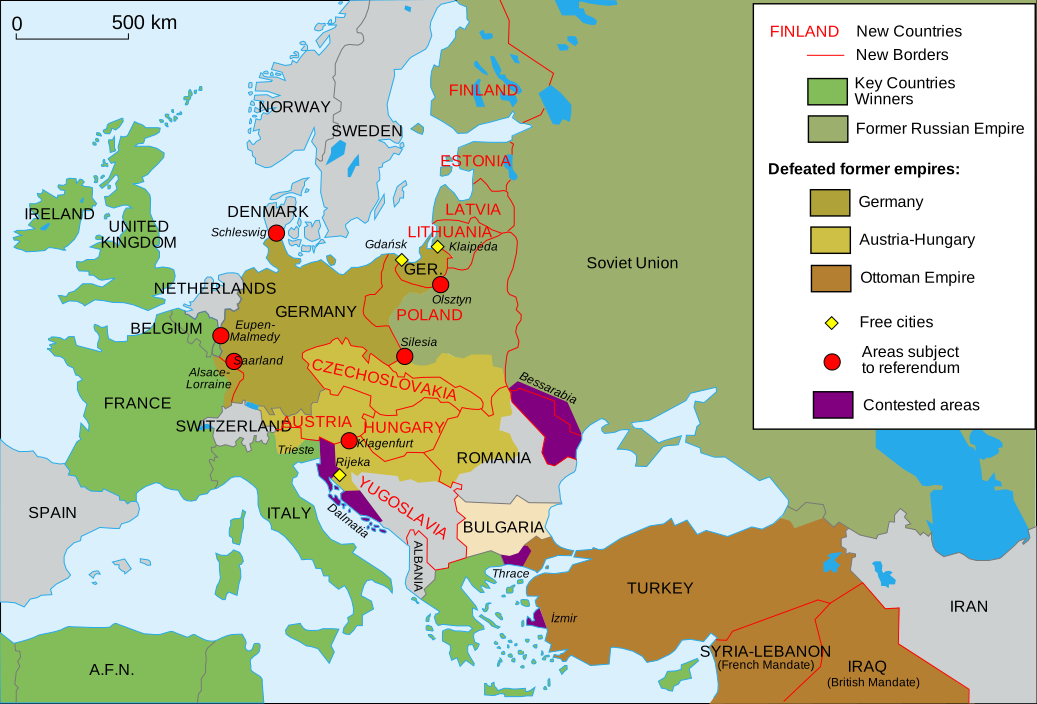
Territories of the former Russian Empire that permanently or temporarily became independent:
- Crimean People's Republic, 1917–1918
- Republic of Aras, 1918–1919
- Alash Autonomy, 1917–1920
- Kingdom of Lithuania (1918), 1918
- Ukrainian People's Republic, Ukrainian State, 1917–1921
- Duchy of Courland and Semigallia (1918), 1918
- First Republic of Armenia, 1918–1920
- Azerbaijan Democratic Republic, 1918–1920
- Republic of Finland, 1917–
- Kingdom of Finland (1918), 1918–1919
- Belarusian Democratic Republic, 1918–1919
- Balagad state, 1919–1926
- North Caucasian Emirate, 1919–1920
- Republic of Latvia, 1919–1940
- Republic of Central Lithuania, 1920–1922
- Centrocaspian Dictatorship, 1918
- Democratic Republic of Georgia, 1918–1921
- Moldavian Democratic Republic, 1917–1918
- Mountainous Republic of the Northern Caucasus, 1917–1920
- Provisional National Government of the Southwestern Caucasus, 1918–1919
- North Ingria, 1919–1920
- Transcaucasian Democratic Federative Republic, 1918
In 1919, northern Mhlyn, Novozybkiv, Starodub, and Surazh counties (uks) of Ukraine's Chernihiv Governorate were transferred from the Ukrainian SSR to the new Gomel Governorate of the Russian republic. In February 1924, Tahanrih and Shakhtinsky counties (okruhas) were transferred from the Donetsk Governorate of Ukraine to Russia's North Caucasus krai.
By the end of World War II the Soviet Union had annexed:
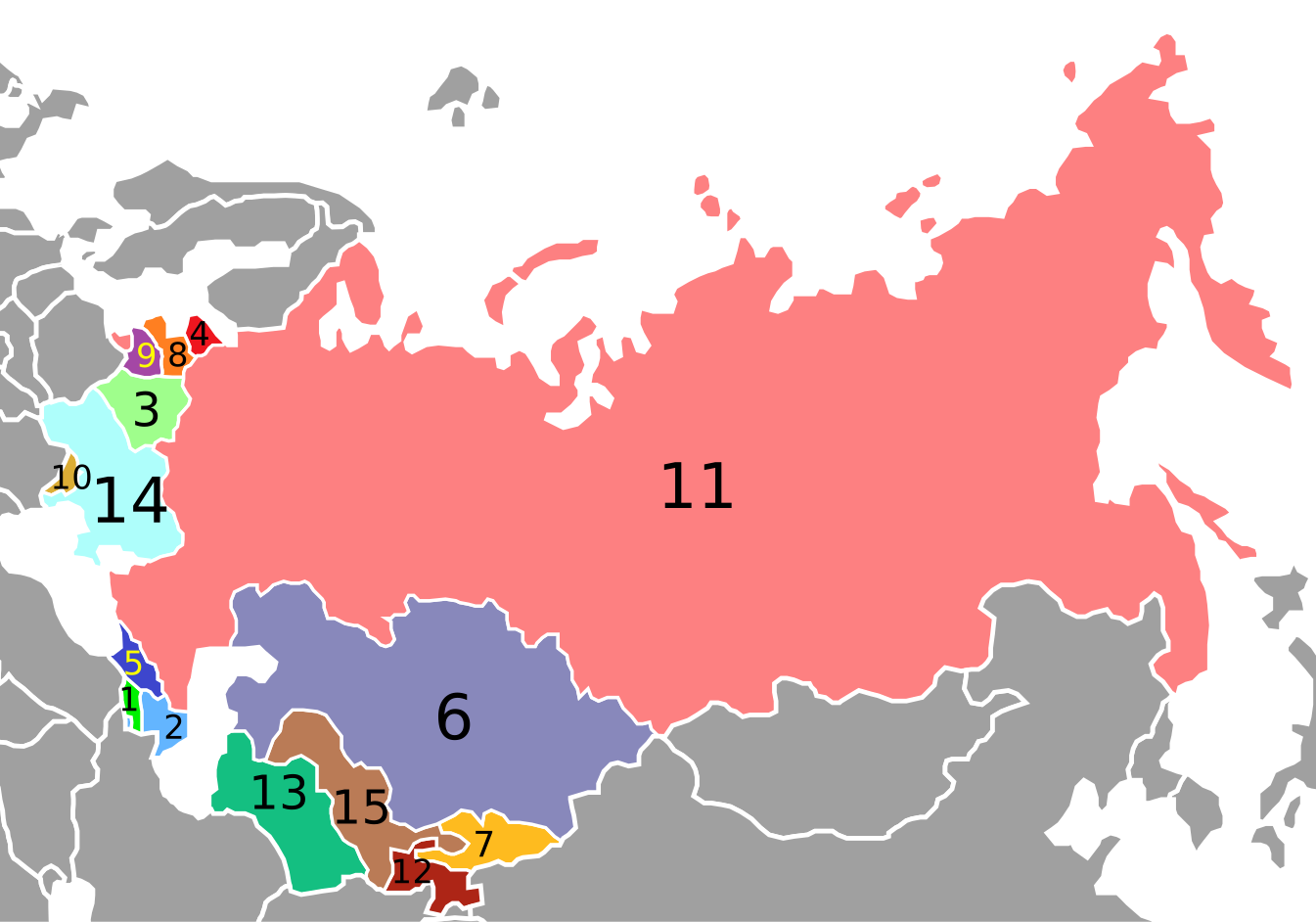
1 Armenia, 2 Azerbaijan, 3 Belarus, 4 Estonia, 5 Georgia, 6 Kazakhstan, 7 Kyrgyzstan, 8 Latvia, 9 Lithuania, 10 Moldova, 11 Russia, 12 Tajikistan, 13 Turkmenistan, 14 Ukraine, 15 Uzbekistan]]
- the Kresy (modern Western Belarus and Western Ukraine) from the Second Polish Republic (see Territories of Poland annexed by the Soviet Union), annexed in September–October 1939
- Estonia, Latvia, and Lithuania, occupied in August 1940
- Bessarabia (Moldova), Hertsa, and part of Bukovina, occupied from Romania after an ultimatum in 1940
- Parts of Karelia and Salla in 1940, Pechengsky Raion (Petsamo) in 1944, from Finland and a 50-year lease on the naval base at Porkkala in 1944
- Carpathian Ruthenia, formerly in Czechoslovakia and occupied in 1944
- Tuva (independent 1921–1944; previously governed by Mongolia and by the Manchu Empire)
- Part of East Prussia (now Kaliningrad Oblast) from Nazi Germany, in 1945
- The Klaipėda Region, re-annexed to Lithuania in 1945
- The Kuril Islands and southern Sakhalin from Japan, occupied in 1945 Of these, Pechenga, Salla, Tuva, Kaliningrad Oblast, the Kurils, and Sakhalin were added to the territory of the RSFSR.
In late 1945, Soviet Russia annexed the northern border strip of the Masurian District (current southern border strip of Kaliningrad Oblast) with the towns of Gierdawy (now Zheleznodorozhny) and Iławka (now Bagrationovsk) from Poland and expelled the already formed local Polish administration.
The Chinese Eastern Railway, formerly a tsarist concession, was taken again by the Soviet Union after the 1929 Sino-Soviet conflict, the railway was returned in 1952.
Meanwhile, territories were removed from the Russian SFSR, including Turkmenistan and Uzbekistan in 1924, Kazakhstan and Kyrgyzstan in 1936, and Karelo-Finland from 1945 to 1956. The Crimean oblast and city of Sevastopol were transferred to Ukraine on 19 February 1954 (later annexed by the Russian Federation in 2014).
There were numerous minor border changes between Soviet republics as well.
After World War II, the Soviet Union set up seven satellite states, in which local politics, military, and foreign and domestic policies were dominated by the Soviet Union:
- People's Socialist Republic of Albania (until 1961)
- People's Republic of Bulgaria
- Czechoslovak Socialist Republic
- German Democratic Republic
- Hungarian People's Republic
- Polish People's Republic
- Socialist Republic of Romania (until 1965)
Russian Federation
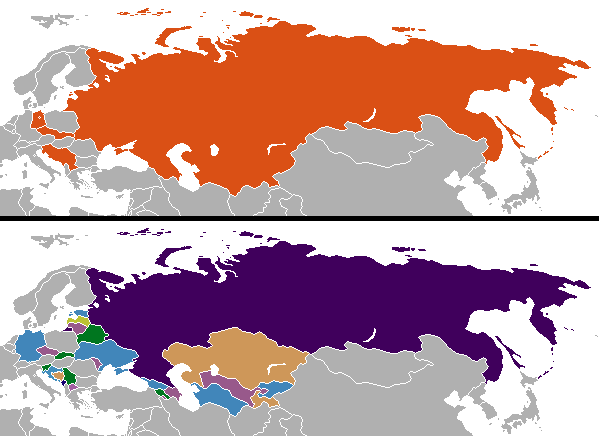
The dissolution of the Soviet Union has led to the creation of independent post-Soviet states, with the Russian SFSR declaring its independence in December 1991 and changing its name to the Russian Federation.
The Chechen Republic of Ichkeria was a secessionist government of the Chechen Republic during 1991–2000. After Russian defeat at the Battle of Grozny, the First Chechen War ended with Russia recognizing the new Ichkerian government of president Maskhadov in January 1997 and signing a peace treaty in May. But Russia invaded again in 1999, restoring a Chechen Republic and the Ichkeria government was exiled in 2000.
The Russian Federation has been involved in territorial disputes with several its neighbours, including with Japan over the Kuril Islands, with Latvia over the Pytalovsky Raion (settled in 1997), with China over parts of Tarabarov Island and Bolshoy Ussuriysky Island (settled in 2001), with its coastal neighbours over Caspian Sea boundaries, and with Estonia over the adjoining border. Russia also had disputes with Ukraine over the status of the federal city of Sevastopol, but agreed it belonged to Ukraine in the 1997 Russian–Ukrainian Friendship Treaty, and over the uninhabited Tuzla Island, but gave up this claim in the 2003 Treaty on the Sea of Azov and the Kerch Strait.
The Russian Federation has also used its armed forces, armed formations, and material support to help establish the disputed breakaway states of Transnistria in Moldova after the Transnistria War, and South Ossetia and Abkhazia, after the 2008 war in Georgia. In 2008, shortly after announcing the recognition of Abkhazia and South Ossetia, Russian president Dmitry Medvedev laid out a foreign policy challenging the US-dominated "single-pole" world order and claiming a privileged sphere of influence in the near abroad around the Russian Federation and farther abroad. Following these conflicts, both Transnistria and South Ossetia have made proposals for joining Russia.
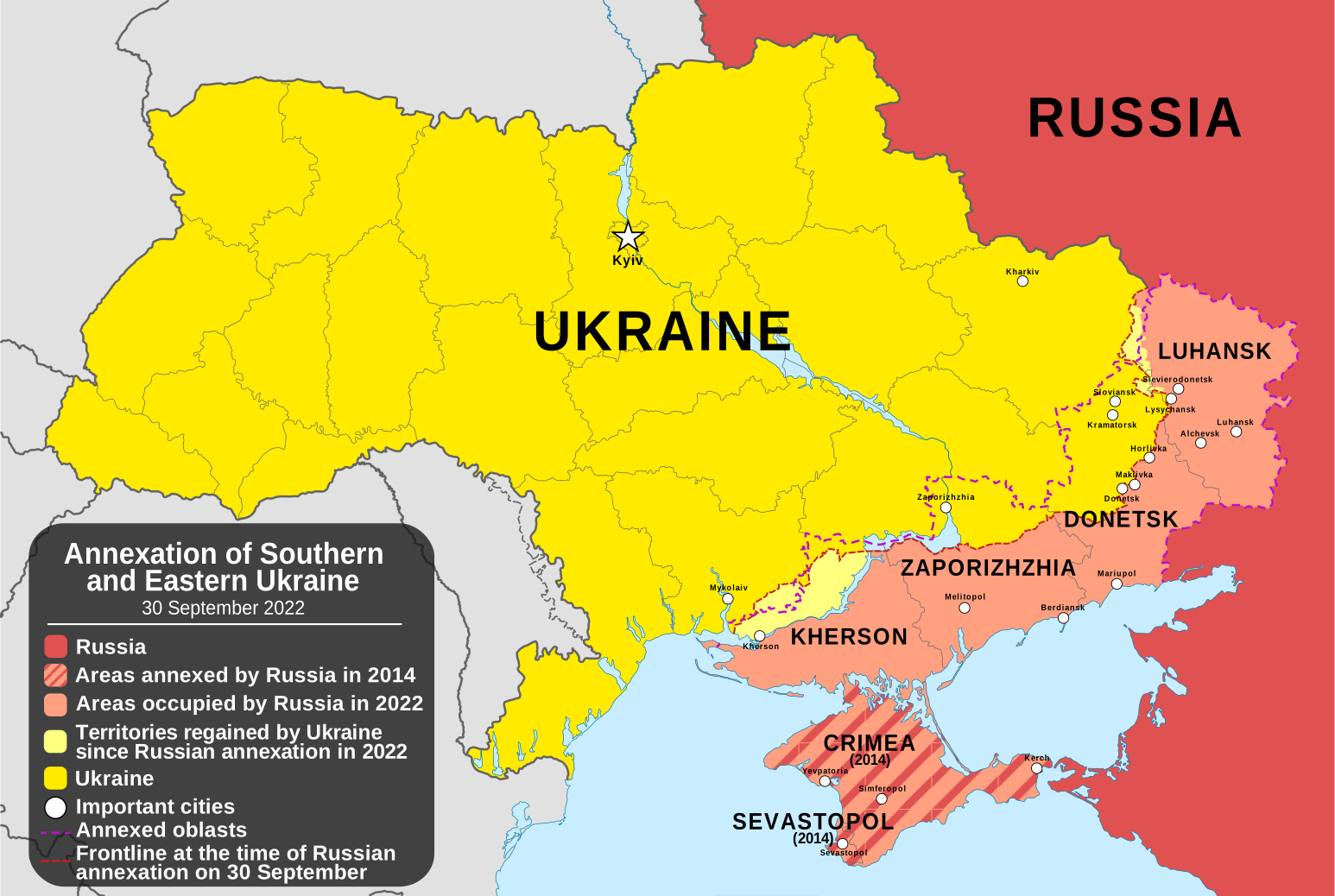
In 2014, when after months of protests in Ukraine, pro-Russian Ukrainian president Viktor Yanukovych was deposed in the Revolution of Dignity, Russian troops occupied Ukraine's Crimean peninsula, and after a hasty referendum the Kremlin annexed Crimea and Sevastopol. The annexation was not recognized by Ukraine or most other members of the international community. A few weeks later, an armed conflict broke out the Donbas region of Ukraine, in which the Kremlin denies an active role, but is widely considered to be fuelled by soldiers, militants, weapons, and ammunition from the Russian Federation.
On February 21, 2022, the Russian president Vladimir Putin signed a decree recognizing the independence of two Donbas republics in Ukraine, and invaded the region. Two days later, Russian troops openly invaded Ukrainian-held territory of Ukraine, a move widely seen as an attempt to conduct regime change and occupy much or all of Ukraine. After failing to seize Ukraine's capital Kyiv for over a month, the Russian defence minister stated that the main goal of the war was the "liberation of the Donbas", but later a Russian general stated that it was to seize eastern and southern Ukraine right through to Transnistria, a breakaway territory in Moldova.
On 30 September 2022, Putin announced in a speech that Russia was to annex four partially occupied regions of Ukraine: Donetsk, Kherson, Luhansk, and Zaporizhzhia Oblasts. However, Russia's annexation of these territories was widely condemned by the international community, and Russia does not control the full territory of any of the four annexed regions, and its government was unable to describe the new international "borders".
References
References
- Allen F. Chew, An Atlas of Russian History: Eleven Centuries of Changing Borders (2nd ed. 1967). pp 14–43.
- John Channon, ''The Penguin historical atlas of Russia'' (1995) pp 8–12, 44–75.
- Brian Catchpole, ''A map history of Russia'' (1983) pp 6–31.
- Allen F. Chew, ''An Atlas of Russian History: Eleven Centuries of Changing Borders'' (2nd ed. 1967)
- "Empire of the steppe: Russia's colonial experience on the Eurasian frontier".
- "The Great Game, 1856-1907: Russo-British Relations in Central and East Asia {{!}} Reviews in History".
- Lin, Yuexin Rachel. (2017). "White water, Red tide: Sino-Russian conflict on the Amur 1917–20". Historical Research.
- . (1886). "Słownik geograficzny Królestwa Polskiego i innych krajów słowiańskich, Tom VII".
- . (1887). "Słownik geograficzny Królestwa Polskiego i innych krajów słowiańskich, Tom VIII".
- . (1892). "Słownik geograficzny Królestwa Polskiego i innych krajów słowiańskich, Tom XII".
- Tatomir, Lucjan. (1868). "Geografia ogólna i statystyka ziem dawnej Polski". Drukarnia "Czasu" W. Kirchmayera.
- . (1889). "Słownik geograficzny Królestwa Polskiego i innych krajów słowiańskich, Tom X".
- . (1892). "Słownik geograficzny Królestwa Polskiego i innych krajów słowiańskich, Tom XII".
- Ciesielski, Tomasz. (2010). "Wielkie wojny w Prusach. Działania militarne między dolną Wisłą a Niemnem na przestrzeni wieków".
- Ciesielski, p. 168
- . (1886). "Słownik geograficzny Królestwa Polskiego i innych krajów słowiańskich, Tom VII".
- . (1893). "Słownik geograficzny Królestwa Polskiego i innych krajów słowiańskich, Tom XIII".
- "Chernihiv gubernia".
- Struk, Danylo Husar. (1993-12-15). "Encyclopedia of Ukraine: Volume IV: Ph-Sr". University of Toronto Press.
- Krinko, Evgeny F.. (2015). "'…To Elect a Parity Commission': Documents about the Transfer of Taganrog and Shakhty Districts to the RSFSR in 1924–1925". Russkii Arhkiv.
- Eberhardt, Piotr. (2018). "Kwestia podziału Prus Wschodnich w okresie II wojny światowej". Przegląd Geograficzny.
- Walker, Michael M.. (2017). "The 1929 Sino-Soviet war : the war nobody knew".
- Elleman, Bruce A.. (1994). "The Soviet Union's Secret Diplomacy Concerning the Chinese Eastern Railway, 1924–1925". The Journal of Asian Studies.
- [https://books.google.com/books?id=E7pQDwAAQBAJ&pg=PA132 Vladimir Tismaneanu, Marius Stan, Cambridge University Press, 17 May, 2018, ''Romania Confronts Its Communist Past: Democracy, Memory, and Moral Justice'', p. 132]
- Kramer, Andrew E.. (2008-09-01). "Russia Claims Its Sphere of Influence in the World". [[The New York Times]].
- "Interview given by Dmitry Medvedev to Television Channels Channel One, Rossia, NTV".
- (2022-03-29). "Russia pledges to scale down military activity near Kyiv, Chernihiv — live updates".
- Ma, Alexandra. "Russia says its goal in Ukraine is to conquer the country's eastern and southern regions".
- (22 April 2022). "Ukraine war: What are Russia's plans for its 'second phase' - and why does it include Moldova?".
- "Signing of treaties on accession of Donetsk and Lugansk people's republics and Zaporozhye and Kherson regions to Russia". Kremlin.
- (30 September 2022). "Putin says Russia has 'four new regions' as he announces annexation of Ukrainian territory". Reuters.
- "Global condemnation for Russia's illegal annexation of Ukrainian territory". DW.
- "Russia no longer has full control of any of four 'annexed' Ukrainian provinces". Guardian.
This article was imported from Wikipedia and is available under the Creative Commons Attribution-ShareAlike 4.0 License. Content has been adapted to SurfDoc format. Original contributors can be found on the article history page.
Ask Mako anything about Territorial evolution of Russia — get instant answers, deeper analysis, and related topics.
Research with MakoFree with your Surf account
Create a free account to save articles, ask Mako questions, and organize your research.
Sign up freeThis content may have been generated or modified by AI. CloudSurf Software LLC is not responsible for the accuracy, completeness, or reliability of AI-generated content. Always verify important information from primary sources.
Report