From Surf Wiki (app.surf) — the open knowledge base
Territoire de Belfort
Department of France
Department of France
| Field | Value |
|---|---|
| name | Territoire de Belfort |
| native_name_lang | fr |
| type | Department of France |
| image_skyline | 2014-09-02 16-24-37 cathedrale-st-christ-belfort.jpg |
| image_caption | Belfort Cathedral |
| image_flag | Drapeau fr département Territoire de Belfort.svg |
| image_shield | Blason département fr Territoire de Belfort.svg |
| image_map | Territoire de Belfort-Position.svg |
| map_caption | Location of Territoire de Belfort in France |
| coordinates | |
| subdivision_type | Country |
| subdivision_name | France |
| subdivision_type1 | Region |
| subdivision_name1 | Bourgogne-Franche-Comté |
| seat_type | Prefecture |
| seat | Belfort |
| parts_type | Subprefectures |
| parts_style | para |
| p1 | None |
| leader_party | LR |
| leader_title | President of the Departmental Council |
| leader_name | Florian Bouquet |
| unit_pref | Metric |
| area_footnotes | |
| area_total_km2 | 609.4 |
| population_total | |
| population_as_of | |
| population_footnotes | |
| population_rank | 99th |
| population_density_km2 | auto |
| blank_name_sec1 | Department number |
| blank_info_sec1 | 90 |
| blank_name_sec2 | Arrondissements |
| blank_info_sec2 | 1 |
| blank1_name_sec2 | Cantons |
| blank1_info_sec2 | 9 |
| blank2_name_sec2 | Communes |
| blank2_info_sec2 | 101 |
| timezone1 | CET |
| utc_offset1 | +1 |
| timezone1_DST | CEST |
| utc_offset1_DST | +2 |
| footnotes | French Land Register data, which exclude estuaries and lakes, ponds and glaciers larger than 1 km2 |
The Territoire de Belfort (; "Territory of Belfort") is a department in the northeastern French region of Bourgogne-Franche-Comté. In 2020, the population was 140,120. The department, which spans a relatively small surface area of 609.4 km2 (235.3 sq mi), is situated just southwest of the European Collectivity of Alsace. It also shares a border with the Swiss canton of Jura to the southeast. Its prefecture is Belfort.
History
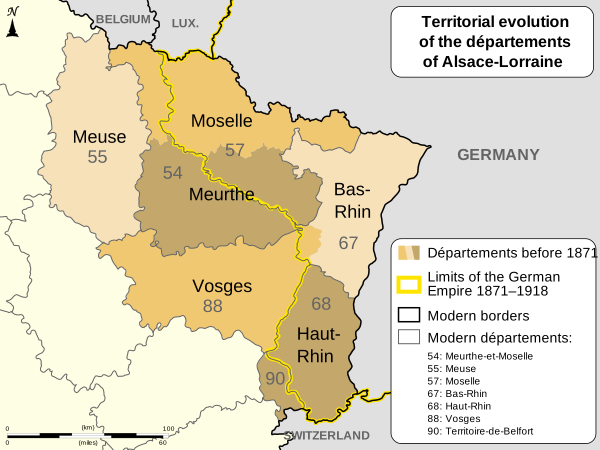
The administrative district of Territoire de Belfort was created under the terms of the 1871 Treaty of Frankfurt. The German Empire annexed almost all of Alsace. Still, the French were able to negotiate the retention of the Territoire de Belfort, which was thereby separated from the rest of Alsace (where it had been part of the department of Haut-Rhin). There were three principal reasons for this exceptional treatment:
- The population in and around Belfort was French-speaking.
- Belfort had demonstrated heroic resistance under Colonel Pierre Denfert-Rochereau against the German invasion. Belfort's left-wing Catholic Deputy Émile Keller now conducted a similarly forceful political campaign in the National Assembly. He argued that ceding heroic Belfort to Germany after the war would be unthinkable.
- Since Belfort is situated in a relatively flat passage between the Vosges and Jura mountain ranges (known as the Belfort Gap), the Germans agreed to leave the city in France, as Prussian military officers indicated that this strategy would give Germany a more defensible border.
After retaining its unique status as a territoire for just over half a century, Belfort was officially recognized as France's 90th department in 1922. France had recovered Alsace three years earlier, but the decision was made not to reintegrate Belfort into its former department. There was talk of giving it a new departmental name, with suggestions that included "Savoureuse" (after the main river of the new department) or "Mont-Terrible" (the name of a former Napoleonic department embracing parts of Switzerland). Still, there was no consensus for a name change, and the department continues to be known as the Territoire de Belfort.
When the regions of France were created, Belfort was not included in the region of Alsace, but the adjacent region of Franche-Comté, since January 2016, Bourgogne-Franche-Comté.
Geography
Geographers might contend that Belfort lies on the ridge that divides two regions of France, but before 1870, it was politically part of Alsace. However, in terms of the political regions established in 1982, the Territoire de Belfort has found itself in the Franche-Comté rather than Alsace.
The department has an area of only 609 km2 (235 sq. miles), making it the fifth smallest of Metropolitan France (after Paris and its suburbs, Hauts-de-Seine, Seine-Saint-Denis, and Val-de-Marne). It is slightly smaller than Saint Lucia or Jakarta, Indonesia.
Principal towns
The most populous commune is Belfort, the prefecture. As of 2019, there are 4 communes with more than 5,000 inhabitants:
| Commune | Population (2019) |
|---|---|
| Belfort | 46,443 |
| Delle | 5,667 |
| Valdoie | 5,269 |
| Beaucourt | 5,010 |
Economy
The median net income per household for the department in 2017 was €21,310. The averaged figure for the Territoire de Belfort masked relatively large disparities, such as that between Belfort itself at €17,920 and Bermont at €26,600.
Population and demographics
In 2019, the department recorded a population of 141,318. Of these, slightly more than 46,000 live in the commune of Belfort itself, which accounts for over 32% of the department's population.
|1872|56781|1881|74244|1891|83670|1901|92304|1911|101386|1921|94338|1931|99403|1936|99497|1946|86648|1954|99427|1962|109371|1968|118450|1975|128125|1982|131999|1990|134097|1999|137408|2006|141201|2011|143348|2016|144089}}
Four principal phases can be identified in the population trends during the two centuries between 1801 and 2000.
- The period from 1800 to 1872 was marked by steady economic development and a relatively high birth rate. However, the cholera epidemic, which in 1851 arose from increasing urbanisation, along with a more general economic slow-down, reduced the rate of increase in the third quarter of the century. Between 1803 and 1872, the recorded population increased from 37,558 to 56,781.
- After the loss to Germany of most of Alsace in 1871, the Belfort population was boosted by the arrival of large numbers of refugees from "Germanisation": the years between 1871 and 1914 saw the development of large factories, with the mechanical and textile sectors being prominent growth areas. The population increase and the economic development were at their most intense in the Belfort conglomeration itself. By 1911, the territoire's population figure stood at 101,392.
- Between 1914 and 1945, the economic narrative was dominated by two world wars and the period of stagnation that came between them. The population declined, having dropped to 86,648 in 1946.
- After 1945, the region became a focus for industrial growth, with population levels following a similar rise trend, reaching 131,999 by 1982. Nevertheless, as in many parts of France, from about 1980 it became clear that the economic crisis of the 1970s was having a lasting effect, slowing the pace of expansion.
Administration
Its departmental code is 90, and its prefecture (capital) is Belfort. There is a single arrondissement (Belfort), which is subdivided into 9 cantons and thence into 101 communes.
Politics
The president of the Departmental Council is Florian Bouquet, first elected in 2015.
Current National Assembly Representatives
| Constituency | Member | Party | |
|---|---|---|---|
| The Republicans (France)}}" | Territoire de Belfort's 1st constituency | Ian Boucard | |
| National Rally}}" | Territoire de Belfort's 2nd constituency | Guillaume Bigot |
Current Senate Representatives
| Constituency | Member | Party | |
|---|---|---|---|
| The Republicans (France)}}" | Territoire de Belfort's Senate constituency | Cédric Perrin |
Tourism
File:LionBelfort.jpg|The Lion of Belfort commemorates the resistance of Belfort during the Franco-Prussian War. File:Grande Rue 2.JPG|Streets in Belfort File:2012-11-16 15-34-20-cascade-savoureuse.jpg|Cascade of the Savoureuse river File:Vue aérienne eurockeennes.JPG|Eurockéennes music festival
References
References
- (4 May 2022). "Répertoire national des élus: les conseillers départementaux".
- [https://www.insee.fr/fr/statistiques/fichier/6011060/dep90.pdf Populations légales 2019: 90 Territoire de Belfort], INSEE.
- (16 May 1871). "Bismarks Mittheilung über den Friedendschluss". Passauer Zeitung.
- "Comparateur de territoire: Commune de Belfort (90010), Territoire de Belfort (90), Commune de Bermont (90011)". [[INSEE]].
- "Historique du Territoire de Belfort".
- "Évolution et structure de la population en 2016". INSEE.
- Assemblée Nationale. "Assemblée nationale ~ Les députés, le vote de la loi, le Parlement français". Assemblee-nationale.fr.
- "Liste par département - Sénat".
This article was imported from Wikipedia and is available under the Creative Commons Attribution-ShareAlike 4.0 License. Content has been adapted to SurfDoc format. Original contributors can be found on the article history page.
Ask Mako anything about Territoire de Belfort — get instant answers, deeper analysis, and related topics.
Research with MakoFree with your Surf account
Create a free account to save articles, ask Mako questions, and organize your research.
Sign up freeThis content may have been generated or modified by AI. CloudSurf Software LLC is not responsible for the accuracy, completeness, or reliability of AI-generated content. Always verify important information from primary sources.
Report