From Surf Wiki (app.surf) — the open knowledge base
Terpsichore
Muse of dancing and chorus in Greek mythology

Muse of dancing and chorus in Greek mythology
| Field | Value |
|---|---|
| type | Greek |
| name | Terpsichore |
| image | Terpsichore from Villa Adriana (Prado E-41) 01.jpg |
| caption | Greek statue of Terpsichore from Hadrian's villa, presently at the Prado Museum (Madrid) |
| god_of | Goddess of Dance and Chorus |
| symbols | Lyre |
| member_of | the Muses |
| abode | Mount Olympus |
| parents | Zeus and Mnemosyne |
| siblings | Euterpe, Polyhymnia, Urania, Clio, Erato, Thalia, Calliope, Melpomene and several paternal half-siblings |
| consort | Apollo, Achelous, Ares |
| children | Linus, Biston, the Sirens |
In Greek mythology, Terpsichore (; , "delight in dancing") is one of the nine Muses and goddess of dance and chorus. She lends her name to the word "terpsichorean", which means "of or relating to dance".
Appearance
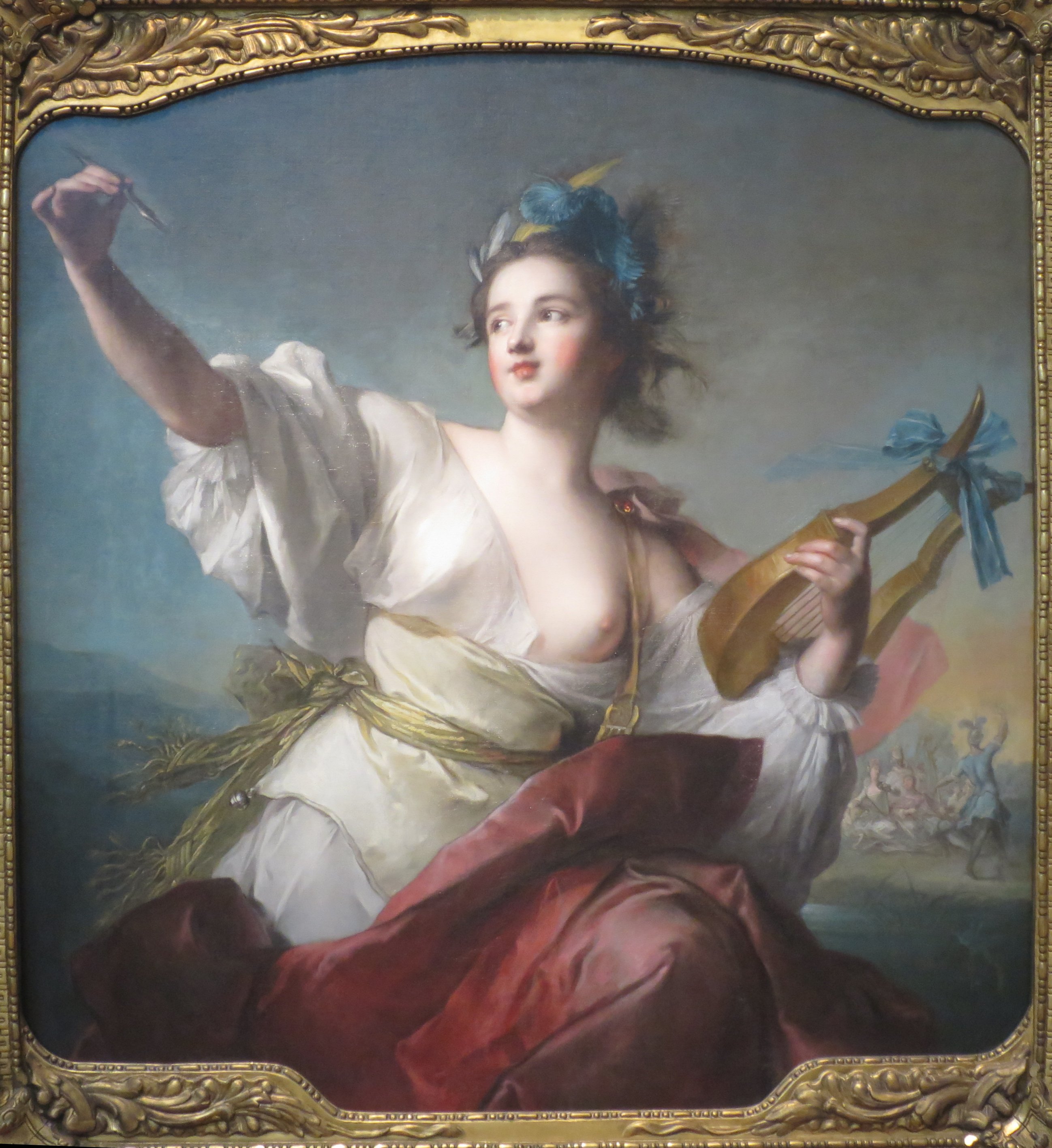
Terpsichore is usually depicted sitting down, holding a lyre, accompanying the dancers' choirs with her music. Her name comes from the Greek words τέρπω ("delight") and χoρός ("dance").
Family
According to Hesiod's Theogony, Zeus lay with the Titan Mnemosyne each night for nine nights in Piera, producing the nine Muses.
According to Apollonius of Rhodes, Terpsichore was the mother of the Sirens by the river god Achelous. The Etymologicum Magnum mentions her as the mother of the Thracian king Biston by Ares. According to the Byzantine scholar Eustathius, Terpsichore was the mother of the Thracian king Rhesus by the river god Strymon.
In culture
Historical
- The British 32-gun frigate commanded by Captain Bowen participated in the Battle of Santa Cruz de Tenerife (1797).
Literature
- When The Histories of Herodotus were divided by later editors into nine books, each book was named after a Muse. Terpsichore was the name of the fifth book.
Music and dance
- Terpsichore (1612) is the title of a large collection of dance tunes collected by Michael Praetorius, some originating with Pierre-Francisque Caroubel and some later adapted for wind ensemble by Bob Margolis.
- Terpsichore is also found in François Couperin's "Second Ordre" from the Pièces de clavecin.
- The third version (HWV 8c) of Handel's opera Il pastor fido (1712) includes a new prologue written in 1734 titled Terpsicore.
- The eighteenth century French dancer and courtesan Marie-Madeleine Guimard named the private theater in her private palace (1766) the Temple of Terpsichore.
Notes
References
- Apollonius of Rhodes, Apollonius Rhodius: the Argonautica, translated by Robert Cooper Seaton, W. Heinemann, 1912. Internet Archive.
- Etymologicum Magnum, edited by Friderici Sylburgii, Leipzig, J. A. G. Weigel, 1816. Internet Archive.
- Gantz, Timothy, Early Greek Myth: A Guide to Literary and Artistic Sources, Johns Hopkins University Press, 1996, Two volumes: (Vol. 1), (Vol. 2).
- Hesiod, Theogony, in The Homeric Hymns and Homerica with an English Translation by Hugh G. Evelyn-White, Cambridge, Massachusetts, Harvard University Press; London, William Heinemann Ltd., 1914. Online version at the Perseus Digital Library. Internet Archive.
References
- Gantz, p. 54; [[Hesiod]], ''[[Theogony]]'' [http://data.perseus.org/citations/urn:cts:greekLit:tlg0020.tlg001.perseus-eng1:53-62 53–62], [http://data.perseus.org/citations/urn:cts:greekLit:tlg0020.tlg001.perseus-eng1:901-937 915–7].
- Tzetzes]], ''Chiliades,'' [http://www.theoi.com/Text/TzetzesChiliades1.html#14 1.14], line 338 & 348.
- ''[[Etymologicum Magnum]]'', [https://archive.org/details/etymologikontome00etymuoft/page/n109/mode/2up?view=theater 197.59 (p. 179)].
- [[Eustathius of Thessalonica. Eustathius]] on [[Homer]], ''[[Iliad]]'' p. 817.{{verify source. (June 2023)
This article was imported from Wikipedia and is available under the Creative Commons Attribution-ShareAlike 4.0 License. Content has been adapted to SurfDoc format. Original contributors can be found on the article history page.
Ask Mako anything about Terpsichore — get instant answers, deeper analysis, and related topics.
Research with MakoFree with your Surf account
Create a free account to save articles, ask Mako questions, and organize your research.
Sign up freeThis content may have been generated or modified by AI. CloudSurf Software LLC is not responsible for the accuracy, completeness, or reliability of AI-generated content. Always verify important information from primary sources.
Report