From Surf Wiki (app.surf) — the open knowledge base
Ternopil Oblast
Region of Ukraine

Region of Ukraine
| Field | Value |
|---|---|
| name | Ternopil Oblast |
| native_name | Тернопільська область |
| native_name_lang | uk |
| official_name | Ternopilska oblast |
| nicknames | Тернопілля (uk), Тернопільщина (uk), |
| settlement_type | Oblast |
| image_flag | Flag of Ternopil Oblast.svg |
| flag_alt | Flag of Ternopil Oblast |
| image_shield | Coat of Arms of Ternopil Oblast.svg |
| shield_alt | Coat of arms of Ternopil Oblast |
| image_map | Ternopil in Ukraine.svg |
| mapsize | 275px |
| coordinates | |
| subdivision_type | Country |
| subdivision_name | |
| parts_type | Largest cities |
| parts_style | para |
| seat_type | Administrative center |
| seat | Ternopil |
| leader_title | Governor |
| leader_name | Vyacheslav Nehoda |
| leader_title1 | Oblast council |
| leader_name1 | 64 seats |
| leader_title2 | Chairperson |
| leader_name2 | Volodymyr Bolyeshchuk |
| unit_pref | Metric |
| area_total_km2 | 13823 |
| area_rank | Ranked 22nd |
| population_footnotes | |
| population_total | 1021713 |
| population_rank | Ranked 21st |
| population_as_of | 2022 |
| population_blank1_title | Annual growth |
| population_density_km2 | auto |
| demographics_type1 | GDP |
| demographics1_footnotes | |
| demographics1_title1 | Total |
| demographics1_info1 | ₴ 82 billion |
| (€2.1 billion) | |
| demographics1_title2 | Per capita |
| demographics1_info2 | ₴ 79,412 |
| (€2,100) | |
| blank5_name_sec1 | HDI (2022) |
| blank5_info_sec1 | 0.722 |
| blank_name_sec1 | Raions |
| blank_info_sec1 | 3 |
| blank1_name_sec1 | Cities |
| blank1_info_sec1 | 14 |
| blank3_name_sec1 | Settlements |
| blank3_info_sec1 | 17 |
| blank4_name_sec1 | Villages |
| blank4_info_sec1 | 1019 |
| timezone1 | EET |
| utc_offset1 | +2 |
| postal_code_type | Postal code |
| postal_code | 46-49 |
| area_code_type | Area code |
| area_code | +380-35 |
| iso_code | UA-61 |
| registration_plate_type | Vehicle registration |
| blank_name_sec2 | FIPS 10-4 |
| blank_info_sec2 | UP22 |
| blank1_name_sec2 | NUTS statistical regions of Ukraine |
| blank1_info_sec2 | UA52 |
| website | www.adm.gov.te.ua |
Галичина (uk) (€2.1 billion) (€2,100)
Ternopil Oblast (), also referred to as Ternopilshchyna () or Ternopillia (), is an oblast (province) of Ukraine. Its administrative center is Ternopil, through which flows the Seret, a tributary of the Dniester. Population:
One of the natural wonders of the region are its cave complexes. Although Ternopil Oblast is among the smallest regions in Ukraine, over 100 caves have been discovered there. Scientists believe these are only 20% of all possible caves in the region. The biggest cave is Optymistychna Cave. Measuring 267 km in total length, it is the longest cave in Eurasia and the fifth-longest in the world. Twenty percent of the land in the region is chernozem soil.
Among its attractions, Ternopil Oblast has 34 castles. By at least one account, the most prominent is the Zbarazh Castle with fortifications that expand over 16 ha and was the center of a 17th-century standoff between troops of Bohdan Khmelnytsky and the army of the Polish–Lithuanian Commonwealth. The Dniester Canyon passes through the oblast; it is considered one of the wonders of Ukraine, stretching for 250 km.
Geography
The oblast is located in western Ukraine and has an area of 13800 km2. It is situated at the western part of the Podilian Upland, which is known for its rocky terrain. Among noticeable mountains there are the Kremenets Mountains. The oblast is also famous for its caves.
One of the major rivers in the country, the Dniester, forms the southern and southwestern borders of Ternopil Oblast with the adjacent Chernivtsi Oblast and Ivano-Frankivsk Oblast. Its tributaries that flow through the oblast include Zbruch, Seret, and Strypa. The Seret River is a left tributary of the Dniester flowing through the city of Ternopil.
Ternopil Oblast is surrounded by five other oblasts of Ukraine: Chernivtsi Oblast – to the south, Ivano-Frankivsk Oblast – to the southwest, Lviv Oblast – to the northwest, Rivne Oblast – to the north, and Khmelnytskyi Oblast – to the east.
History
Historic administrative affiliation of the area:
- 1199–1253: Principality of Galicia-Volhynia
- 1253–1434: Kingdom of Galicia-Volhynia
- 1434–1569: Kingdom of Poland: Ruthenian Voivodeship, Podolian Voivodeship / Grand Duchy of Lithuania: Ziemia wołyńska
- 1566–1569: Kingdom of Poland: Ruthenian Voivodship, Podolskie Voivodship / Grand Duchy of Lithuania: Volyn Voivodship
- 1569–1672: Polish-Lithuanian Commonwealth, Crown of the Kingdom of Poland, Lesser Poland Province of the Polish Crown (Małopolska): Ruthenian Voivodeship, Volyn Voivodeship, Podolskie Voivodeship
- 1672–1699: Poland-Lithuania, Crown of the Kingdom of Poland, Małopolska province: Ruthenian Voivodeship, Volyn Voivodeship / Ottoman Empire: Podolia Eyalet
- 1699–1772: Poland-Lithuania, Crown of the Kingdom of Poland, Małopolska province: Ruthenian Voivodeship, Volyn Voivodeship, Podolskie Voivodeship
- 1772–1795: Habsburg monarchy: Kingdom of Galicia and Lodomeria (Austrian Partition) / Poland-Lithuania, Crown of the Kingdom of Poland, Lesser Poland Province: Volhynia Voivodship
- 1795–1804: Habsburg Monarchy: Galicia and Lodomeria, East Galicia (Austrian Partition) / Russian Empire: Volhynia Governorate (Russian Partition)
- 1804–1809: Austrian Empire: Galicia and Lodomeria, East Galicia (Austrian Partition) / Russian Empire: Volyn Governorate (Russian Partition)
- 1809–1815: Austrian Empire: Galicia and Lodomeria (Austrian Partition) / Russian Empire: Volyn Governorate (Russian Partition), (formerly of the Austrian Partition)
- 1815–1867: Austrian Empire: Galicia and Lodomeria (Austrian Partition) / Russian Empire: Volyn Governorate (Russian Partition)
- 1867–November 1918: Austria-Hungary: Galicia and Lodomeria (Austrian Partition) / Russian Empire: Volhynia Governorate (Russian Partition)
- November 1918–July 1919 - West Ukrainian People's Republic (de facto)
- 1919 (de facto; 1923 de jure)–1945: Rzeczpospolita Polska: Tarnopol Voivodeship, Volyn Voivodeship
- 1944 (de facto; 1945 de jure)–1991: USSR, Ukrainian SSR: Ternopil region
- since 1991: Ukraine: Ternopil region
From the 12th century the area belonged to Galicia–Volhynia until Galicia–Volhynia was incorporated into the Kingdom of Poland and Grand Duchy of Lithuania in the 14th century.
In 1569 Poland and Lithuania united into the Polish-Lithuanian Commonwealth.
From the First Partition of Poland in 1772 until the end of World War I the area which would become Ternopil Oblast was mostly part of the Kingdom of Galicia and Lodomeria, a possession of the Habsburg Monarchy, Austrian Empire and finally Austria-Hungary. In Ukraine today, there are three oblasts (provinces) that largely formed the eastern part of Galicia and Lodomeria until 1918. Ivano-Frankivsk Oblast was entirely contained in the kingdom, as was the vast majority of Lviv Oblast (only a few small areas and villages near Sokal were not). The southern and central parts of Ternopil Oblast were within the kingdom while the northern parts (pre-2020 raions: Kremenets, Shumsk, Lanivtsi and the northern half of Zbarazh; post-2020: Kremenets Raion and small parts of Ternopil Raion) remained with Poland Lithuania; from 1795 (Third Partition) they belonged to the Russian Volhynian Governorate (specifically the Kremenetsky Uyezd). During the Napoleonic Wars the area around Ternopil was annexed by Russia in the 1809 Treaty of Schönbrunn becoming the ; it was ceded back to Austria in 1815 (Congress of Vienna). The Tarnopolsky Krai roughly covered the eastern two-thirds of the post-2022 Ternopil Raion and the Chortkiv Raion up to the Strypa; in pre-2020 terms it corresponded with the cities of Ternopil and Chortkiv and the Borshchiv, Chortkiv, Husiatyn, Pidvolochysk, Terebovlia, Ternopil and Zalishchyky raions, the southern half of Zbarazh raion, the eastern and northern parts of Buchach raion and some eastern parts of Zboriv and Kozova raions.
From 1917 the formerly Russian part came under the Ukrainian People's Republic (Ukrainian State April–December 1918; also claimed by the Ukrainian People's Republic of Soviets/Ukrainian Soviet Republic December 1917–April 1918 and the Ukrainian SSR from March 1919); from 1918 the formerly Austrian part was controlled by the West Ukrainian People's Republic (nominally part of the Ukrainian People's Republic from 22 January 1919) but ultimately the whole area fell to the Second Polish Republic in 1921 following the Ukrainian War of Independence, Polish–Ukrainian War and Polish–Soviet War. The formerly Austrian parts became part of the Tarnopol Voivodeship, while the formerly Russian parts became part of the Volhynian Voivodeship, specifically the . The southern pre-2020 raions of Ternopil Oblast were partially coterminous with Galicia and Lodomeria's districts/counties and Interwar Poland's counties.
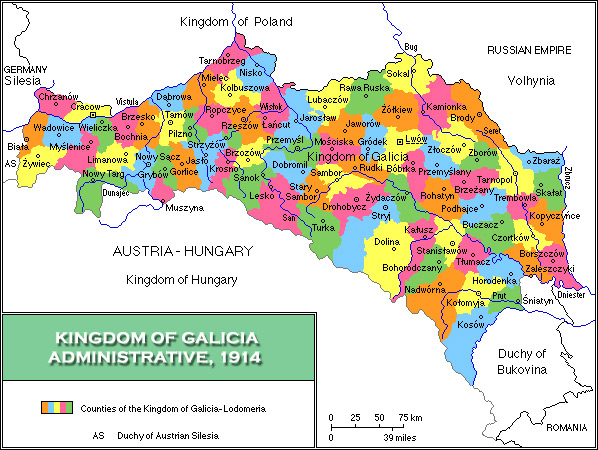
| Raions of Ternopil Oblast (until 2020) | Equivalent districts/counties of Galicia and Lodomeria |
|---|---|
| Berezhany Raion | Western part of |
| Brzeżany county. | |
| Borshchiv Raion | Borszczów |
| Buchach Raion | Buczacz county |
| Chortkiv Raion | Czortków and the southern part |
| of Kopychyntsi county | |
| Husiatyn Raion | Kopychyntsi |
| Kozova Raion | Eastern part of Brzeżany county |
| except for the city of Brzeżany itself. | |
| Monastyryska Raion | Western part of Buczacz county. |
| Pidhaitsi Raion | Western part of Podhajce county. |
| Pidvolochysk Raion | Skalat county and the |
| eastern part of Zbaraż county | |
| Terebovlia Raion | Trembowla county in the east and |
| Podhajce county in the west. | |
| Ternopil Raion | Tarnopol county |
| Zalishchyky Raion | Zalishchyky |
| Zbarazh Raion | The western part of Zbaraż county |
| and the southern part of Brody county. | |
| Zboriv Raion | Zborów county |
The oblast was created during the Second World War when both Nazi Germany and later the Soviet Union invaded Poland. Due to the Polish national policy in the area (Pacification action), many people favored the Soviet invasion of Eastern Galicia at first. However, soon thereafter, the Soviet security agencies started a witch hunt among nationally oriented members of Ukrainian resistance who emigrated to Poland after the Soviet-Ukrainian War as well as other reasons. Many of local population were exiled to Siberia regardless of their ethnic background. On December 4, 1939, the voivodeship division in the West Ukraine was abolished and replaced with the existing Soviet administrative division oblast. Ternopil Oblast (originally Tarnopol Oblast) was established based mostly on the Tarnopol Voivodeship and southern portions of the Volhynian Voivodeship.
During the invasion of the Soviet Union by Nazi Germany, Ternopil became an object of fierce fighting between Soviet and German forces because of its importance as a rail transportation hub. During German occupation, the region (except for its Volhynian portion) became part of the District of Galicia and transferred to administration by the General Government. After the war, a destroyed residential section of Ternopil, near the river, was turned into an artificial lake rather than being rebuilt. Additionally, upon annexation to the Soviet Union's Ukrainian SSR, most ethnic Poles in the region were forcibly relocated to Poland, whose national borders had shifted far to the west. The area of the former Polish voivodeship was expanded by adding territory in the north, though the westernmost parts were transferred to the Lviv oblast. After 1945 Soviet authorities also encouraged ethnic Russians to settle in territories newly annexed to the Soviet Union, including the Ternopil oblast, though western Ukraine remained considerably less Russian than eastern Ukraine.
As Ukraine achieved independence in the 1990s, western Ukraine remained the heartland of Ukrainian political and cultural nationalism, and the political affiliations of Ternopil voters reflected that viewpoint. In the first elections after independence, the People's Movement of Ukraine was the leading party in the oblast. A majority of oblast voters supported the Ukrainian nationalist-oriented Electoral Bloc Yuliya Tymoshenko in the 2002 Ukrainian parliamentary election. Over 88% of voters supported Yulia Tymoshenko of the All-Ukrainian Union "Fatherland" in the 2010 Ukrainian presidential election.
By 2005, the population of the oblast had grown to roughly 225,000, consisting primarily of ethnic Ukrainians with a large Russian or Russian-speaking minority. The city of Ternopil has important institutions of higher education, including two teacher's colleges, an international medical school with instruction in English, and one of three economics institutes in Ukraine.

The religion of the majority is Ukrainian Greek Catholic, though there is a notable Orthodox presence and a small Protestant minority. Many churches which were closed or destroyed under Soviet rule have rebuilt since independence. The local Jewish community, which was very large before 1939, disappeared in the Holocaust and was not reestablished after 1945. There are no active synagogues in the oblast and only a few isolated individuals affiliating with the Jewish faith.
Points of interest


The oblast is known for its castles and fortresses. Due to the underfunding of the state program for the preservation of cultural heritage, many of objects of historical significance are in poor condition. The following historic-cultural sites were nominated for the Seven Wonders of Ukraine.
- Verteba Cave, a cave in Borshchiv Raion
- Bohyt, a hill near Zbruch River where was found the Zbruch idol (Husiatyn Raion)
- Buchach Ratusha, a former town hall in Buchach
- Pochaiv Lavra, located in the city of Pochaiv, one of the biggest holy places of Christian Orthodox in Ukraine
- Zarvanytsia Spiritual Center, a big holy place of Greek Catholics of Podillia (Terebovlia Raion)
- Vyshnivets Palace, a princely palace in Vyshnivets (Zbarazh Raion)
- Camp UPA, a museum of Ukrainian resistance movement in Shumsk Raion
- Dzhuryn Waterfall
- Castles of Ternopil Region (Ternopil Castle, Berezhany Castle, Zbarazh Castle, and others)
Population
The estimated population is
Ethnic composition
According to the 2001 Ukrainian census, ethnic Ukrainians accounted for 97.8% of the population of Ternopil Oblast, and ethnic Russians for 1.2%.
Language

Ternopil Oblast was one of the few oblasts of the Ukrainian SSR where the share of Ukrainian speakers was increasing despite the Russification of Ukraine carried out in the USSR. Native language of the population of Ternopil Oblast according to the results of population censuses:
| 1959 | 1970 | 1989 | 2001 | |||||
|---|---|---|---|---|---|---|---|---|
| Ukrainian | ||||||||
| Russian | ||||||||
| Other |
Native language of the population of the raions and cities of Ternopil Oblast according to the 2001 Ukrainian census:
| Ukrainian | Russian | |||
|---|---|---|---|---|
| Ternopil Oblast | ||||
| City of Ternopil | ||||
| Berezhany Raion | ||||
| Borshchiv Raion | ||||
| Buchach Raion | ||||
| Husiatyn Raion | ||||
| Zalishchyky Raion | ||||
| Zbarazh Raion | ||||
| Zboriv Raion | ||||
| Kozova Raion | ||||
| Kremenets Raion | ||||
| (in pre-2020 borders) | ||||
| Lanivtsi Raion | ||||
| Monastyryska Raion | ||||
| Pidvolochysk Raion | ||||
| Pidhaitsi Raion | ||||
| Terebovlia Raion | ||||
| Ternopil Raion | ||||
| (in pre-2020 borders) | ||||
| Chortkiv Raion | ||||
| (in pre-2020 borders) | ||||
| Shumsk Raion |
Ukrainian is the only official language on the whole territory of Ternopil Oblast.
On 6 November 2018, a moratorium on the public use of Russian-language cultural products was imposed in Ternopil Oblast by a decision of the Ternopil Oblast Council.
According to a poll conducted by Rating from 16 November to 10 December 2018 as part of the project «Portraits of Regions», 95% of the residents of Ternopil Oblast believed that the Ukrainian language should be the only state language on the entire territory of Ukraine. 2% believed that Ukrainian should be the only state language, while Russian should be the second official language in some regions of the country. 3% found it difficult to answer.
In 2022, Ternopil Oblast Council approved the «Regional Programme for the Development and Functioning of the Ukrainian Language in the Ternopil Oblast for 2023—2027», the main objectives of which are to strengthen the positions of the Ukrainian language in various spheres of public life in the oblast and to Ukrainianize the refugees from other regions of Ukraine.
According to the research of the Content Analysis Centre, conducted from 15 August to 15 September 2024, the topic of which was the ratio of Ukrainian and Russian languages in the Ukrainian segment of social media, 94.6% of posts from Ternopil Oblast were written in Ukrainian (92.0% in 2023, 85.8% in 2022, 49.5% in 2020), while 5.4% were written in Russian (8.0% in 2023, 14.2% in 2022, 50.5% in 2020).
After Ukraine declared independence in 1991, Ternopil Oblast, as well as Ukraine as a whole, experienced a gradual Ukrainization of the education system, which had been Russified during the Soviet era. Dynamics of the ratio of the languages of instruction in general secondary education institutions in Ternopil Oblast:
According to the State Statistics Service of Ukraine, in the 2023—2024 school year, all 105,619 pupils in general secondary education institutions in Ternopil Oblast were studying in classes where Ukrainian was the language of instruction.
Age structure
: 0-14 years: 15.7% (male 86,309/female 81,940) : 15-64 years: 69.0% (male 360,305/female 381,271) : 65 years and over: 15.3% (male 53,364/female 110,887) (2013 official)
Median age
: total: 38.6 years : male: 35.8 years : female: 41.4 years (2013 official)
Economy and transportation

The economy is predominantly agriculturally oriented. Among industries, there is a well developed food industry particularly sugar production, alcohol, and dairy (such as butter). There is also number of factories such as "Vatra" (lighting equipment), Ternopil Harvester Plant, "Orion" (radio communication) among a few.
Ternopil Oblast has an adequate network of highways, while the city of Ternopil is located at the intersection of main European corridors along the E50 and E85 highways. There is a small airport in Ternopil (Ternopil Airport) which however mostly is used for charter flights. There is a well developed railroad network which is a part of the Lviv Railways. Water transportation is very limited and mostly along the Dniester River.
Subdivisions
Main article: Administrative divisions of Ternopil Oblast


After 18 July 2020
| 3 | Chortkiv | Chortkiv | 334,3 | 22 | 7 | 9 |
|---|
Before 18 July 2020 Before the 2020 administrative reform, Ternopil Oblast was administratively subdivided into 17 raions (districts), as well as 1 city (municipality) which is directly subordinate to the oblast government: Ternopil, the administrative center of the oblast. The average area of a raion was around 808 km2, the biggest one was Terebovlia Raion covering 1130 km2 and the smallest one - Pidhaitsi Raion with 496 km2. The average population number was around 50.6 thousands which is just below the national average.
| style="text-align:left; font-weight:normal;" | In English | In Ukrainian | Administrative Center | ||
|---|---|---|---|---|---|
| Berezhany Raion | Бережанський район | ||||
| Berezhanskyi raion | |||||
| Borshchiv Raion | Борщівський район | ||||
| Borshchivskyi raion | |||||
| Buchach Raion | Бучацький район | ||||
| Buchatskyi raion | |||||
| Chortkiv Raion | Чортківський район | ||||
| Chortkivskyi raion | |||||
| Husiatyn Raion | Гусятинський район | ||||
| Husiatynskyi raion | |||||
| Kozova Raion | Козівський район | ||||
| Kozivskyi raion | |||||
| Kremenets Raion | Кременецький район | ||||
| Kremenetskyi raion | |||||
| Lanivtsi Raion | Лановецький район | ||||
| Lanovetskyi raion | |||||
| Monastyryska Raion | Монастириський район | ||||
| Monastyryskyi raion | |||||
| Pidhaitsi Raion | Підгаєцький район | ||||
| Pidhayetskyi raion | |||||
| Pidvolochysk Raion | Підволочиський район | ||||
| Pidvolochyskyi raion | |||||
| Shumsk Raion | Шумський район | ||||
| Shumskyi raion | |||||
| Terebovlia Raion | Теребовлянський район | ||||
| Terebovlanskyi raion | |||||
| Ternopil Raion | Тернопільський район | ||||
| Ternopilskyi raion | |||||
| Zalishchyky Raion | Заліщицький район | ||||
| Zalishchytskyi raion | |||||
| Zbarazh Raion | Збаразький район | ||||
| Zbarazkyi raion | |||||
| Zboriv Raion | Зборівський район | ||||
| Zborivskyi raion |
Notable people
In town of Buchach was born a Nobel Prize recipient, writer Shmuel Yosef Agnon. The prize was given for works about fate of Galician Jews. Agnon worked for a Lviv newspaper, but after refusal to serve in the army he moved to Mandatory Palestine. In Ukraine he published over 70 of his early works.
- Solomiya Krushelnytska, one of the brightest soprano opera stars of the first half of the 20th century, was born in Biliavyntsi., Chortkiv Raion.
- Petro Gadz, entrepreneur and politician
- Mike Mazurki, American professional athlete and actor 196 cm (6 ft 5 in) in height
- Lee Strasberg, American theatre director and actor
- Mykola Bychok, Cardinal who participated in the 2025 papal conclave which elected Leo XIV was born here in 1980
Gallery
File:UA-TE Ternopol Buran 02 28-08-11.JPG|Ternopil Buran File:1. Почаївська лавра.JPG|Pochaiv Lavra File:61-224-0001 Zbarazh Castle RB 18.jpg|Zbarazh Castle File:Čortkiv, celek, kostel.jpg|Chortkiv File:Панорама Кременця з Замкової гори.JPG|Kremenets from Zamkova Hill File:Berezhany Ukr (212).JPG|Berezhany File:Панорама Теребовлі з Замкової гори.jpg|Terebovlia File:Народний будинок (мур) Борщів.jpg|Borshchiv File:Бучач - панорама Західна сторона. Андрій Л..jpg|Buchach File:Zalischyky panorama1.jpg|Zalishchyky File:Теребовлянський замок - 2.jpg|Terebovlia Castle File:Waterfall Chervonohorod.jpg|Dzhuryn Waterfall File:61-208-5089 NNP Dnister Canyon 2 RB.jpg|Dniester Canyon National Nature Park File:Дівочі скелі.jpg|Kremenets Mountains National Nature Park File:Medobory zap.jpg|Medobory Nature Reserve File:Печера Вертеба Вхід.JPG|Entrance to Verteba Cave
References
References
- (2011). "Toponymic Guidelines for Map and Other Editors for International Use". DerzhHeoKadastr and Kartographia.
- (24 August 2024). "Zelensky appoints Nehoda as head of Ternopil RSA".
- "Валовии регіональнии продукт".
- "Sub-national HDI - Area Database - Global Data Lab".
- link. (2020-11-01 . 24 Kanal (youtube).)
- {{in lang. uk [http://pop-stat.mashke.org/ukraine-ethnic2001.htm Етнічний склад населення України, 2001 рік]
- [http://db.ukrcensus.gov.ua/MULT/Database/Census/databasetree_en.asp Банк даних, перепис 2001 року]
- "Динамика численности этнических украинцев в УССР: на основе итогов Всесоюзных переписей населения 1959 г., 1970 г. и 1979 г.".
- Итоги Всесоюзной переписи населения 1959 года: Украинская ССР, стр. 168—193
- Численность и состав населения СССР: по данным Всесоюзной переписи населения 1979 года. Центральное статистическое управление СССР, 1984
- ''Чорний С.'' Національний склад населення України в ХХ сторіччі (2001)
- Итоги Всесоюзной переписи населения 1970 года. Том IV — М., Статистика, 1973
- "Всеукраїнський перепис населення 2001. Розподіл населення за національністю та рідною мовою".
- "Перепис 1989. Розподіл населення за національністю та рідною мовою (0,1)".
- "Розподіл населення за національністю та рідною мовою, Тернопільська область".
- "Про забезпечення функціонування української мови як державної".
- "На Тернопільщині ввели мораторій на російськомовний продукт". [[Deutsche Welle]].
- (2018-12-26). "«ПОРТРЕТИ РЕГІОНІВ»: ПІДСУМКИ. Зведені дані, порівняльний аналіз між областями". [[Rating (sociological group).
- (2023-03-17). "На Тернопільщині працює програма підтримки розвитку української мови". Телекомпанія TV-4.
- "Програма розвитку та функціонування української мови у Тернопільській області на 2023–2027 роки".
- (2024-10-28). "Частка дописів українською мовою в соцмережах зросла до 56 %, — Центр контент-аналізу".
- ""Радикальний прогрес". У соцмережах української стало набагато більше, — дослідження".
- Barbara A. Anderson and Brian D. Silver, "Equality, Efficiency, and Politics in Soviet Bilingual Education Policy, 1934-1980," American Political Science Review 78 (December 1984): 1019-1039.
- "Джерело".
- "Збірник «Статистичний щорічник України» за 2008 рік". [[State Statistics Service of Ukraine.
- "Збірник «Статистичний щорічник України» за 2012 рік". [[State Statistics Service of Ukraine.
- "Збірник «Статистичний щорічник України» за 2018 рік". [[State Statistics Service of Ukraine.
- link. (). link. ()
- link. (). link. ()
- "Збірник «Статистичний щорічник України» за 2022 рік". [[State Statistics Service of Ukraine.
- "Загальна середня освіта в Україні у 2023 році".
- wrestler, football and basketball
This article was imported from Wikipedia and is available under the Creative Commons Attribution-ShareAlike 4.0 License. Content has been adapted to SurfDoc format. Original contributors can be found on the article history page.
Ask Mako anything about Ternopil Oblast — get instant answers, deeper analysis, and related topics.
Research with MakoFree with your Surf account
Create a free account to save articles, ask Mako questions, and organize your research.
Sign up freeThis content may have been generated or modified by AI. CloudSurf Software LLC is not responsible for the accuracy, completeness, or reliability of AI-generated content. Always verify important information from primary sources.
Report