From Surf Wiki (app.surf) — the open knowledge base
Terminal nerve
Cranial nerve 0
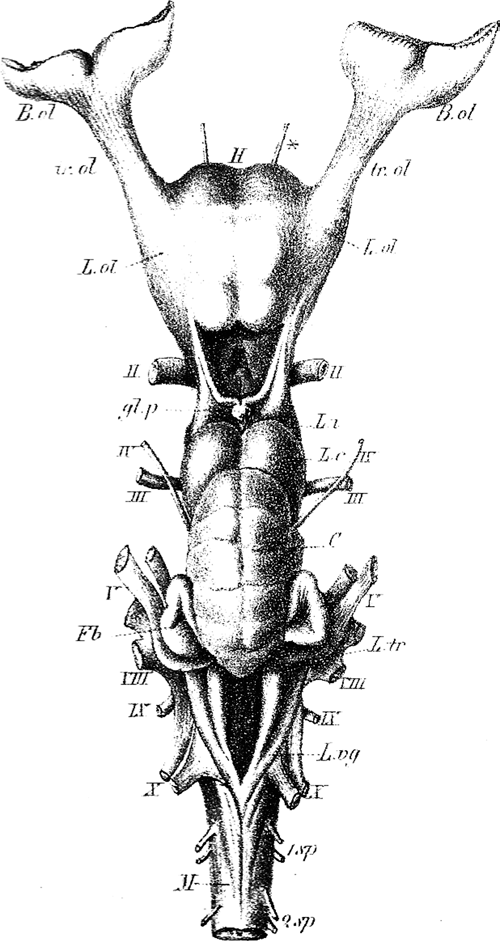
Cranial nerve 0
| Field | Value |
|---|---|
| Name | Terminal nerve |
| Latin | nervus terminalis |
| Image | Lawrence 1960 1.3.png |
| Caption | Left The terminal nerve as it is shown on the ventral side of a dog-fish brain. (Topmost label) |
The terminal nerve, also known as cranial nerve zero or simply as CN 0, is a nerve that was not included in the seminal classification of the cranial nerves as CN I through CN XII, but has since been recognized and listed in TA2. It was discovered by German scientist Gustav Fritsch in 1878 in the brains of sharks, and was first found in humans in 1913. Studies have confirmed that the terminal nerve is a common finding in the adult human brain.
The accepted name of terminal nerve is due to its entrance in the lamina terminalis regions. The nerve has previously been called cranial nerve XIII, zero nerve, nerve N, and NT. |doi-access= free }}
Structure
The terminal nerve appears just in front of the other cranial nerves and would, if earlier recognized, have been classified as cranial nerve one. It first appears bilaterally as a microscopic plexus of unmyelinated peripheral nerve fibers in the subarachnoid space covering the straight gyrus. The plexus appears near the cribriform plate and travels posteriorly toward the olfactory trigone and lamina terminalis.
The terminal nerve is clearly seen in the human embryo but loses some of its ganglion cells before birth making it less recognizable in adults. The nerve is therefore often overlooked in autopsies, and is often torn out upon exposing the brain. Careful dissection is necessary to visualize the nerve.
Development
The zebrafish was used as a developmental model in research from 2004.
The connections between the terminal nerve and the olfactory system have been extensively studied in human embryos. Olfactory nerve fibers enter the brain at stage 17, fibers from the vomeronasal organ and fibers of the terminal nerve enter the brain at stages 17 and 18. During prenatal development some of the ganglion cells are lost.
Function
The functions of the terminal nerve are only speculated on together with possible pathological implications. Although very close to the olfactory nerve, the terminal nerve is not connected to the olfactory bulb, where smells are analyzed. This suggests that the nerve is either vestigial or may be related to the sensing of pheromones. The nerve may modulate olfactory inputs making pheromones (particularly sex pheromones) more detectable. This hypothesis is further supported by the fact that the terminal nerve projects to the medial and lateral septal nuclei and the preoptic areas, all of which are involved in reproduction in mammals. A 1987 study found that mating in hamsters is reduced when the terminal nerve is severed.
Clinical significance
Alterations in the terminal nerve structure may be implicated in Kallmann syndrome.
Additional images
File:Johnston Cranial nerve 0.png|Three forms of the nerve on the underside of human brains File:Sobo 1909 629.png|Brain viewed from below. Gyrus rectus seen at anterior centre.
References
References
- (March 2024). "Smelling TNT: Trends of the Terminal Nerve". Int J Mol Sci.
- (March 2019). "Cranial Pair 0: The Nervus Terminalis". The Anatomical Record.
- Whitlock KE. (September 2004). "Development of the nervus terminalis: origin and migration". Microscopy Research and Technique.
- (2004). "Olfactory structures in staged human embryos". Cells Tissues Organs.
- Von Bartheld CS. (September 2004). "The terminal nerve and its relation with extrabulbar "olfactory" projections: lessons from lampreys and lungfishes". Microscopy Research and Technique.
- (11 August 1987). "Terminal nerve damage impairs the mating behavior of the male hamster". Brain Research.
- (January 2020). "Gli3 Regulates Vomeronasal Neurogenesis, Olfactory Ensheathing Cell Formation, and GnRH-1 Neuronal Migration". J Neurosci.
This article was imported from Wikipedia and is available under the Creative Commons Attribution-ShareAlike 4.0 License. Content has been adapted to SurfDoc format. Original contributors can be found on the article history page.
Ask Mako anything about Terminal nerve — get instant answers, deeper analysis, and related topics.
Research with MakoFree with your Surf account
Create a free account to save articles, ask Mako questions, and organize your research.
Sign up freeThis content may have been generated or modified by AI. CloudSurf Software LLC is not responsible for the accuracy, completeness, or reliability of AI-generated content. Always verify important information from primary sources.
Report