From Surf Wiki (app.surf) — the open knowledge base
Ten Commandments
Biblical principles relating to ethics and worship
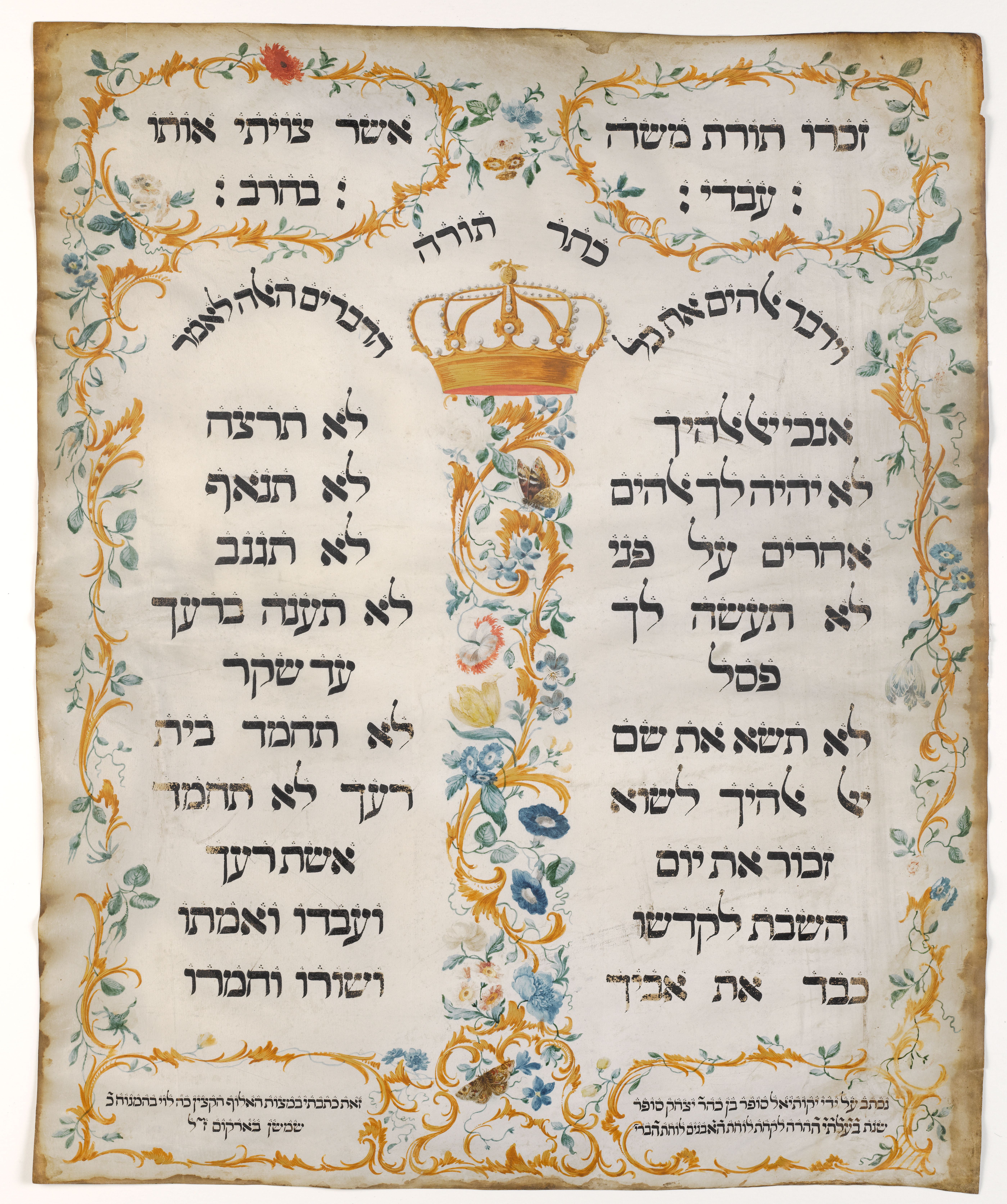
Biblical principles relating to ethics and worship
The Ten Commandments (), or the Decalogue (from Latin decalogus, from Ancient Greek , ), are religious and ethical directives, structured as a covenant document, that, according to the Hebrew Bible, were given by God to Moses. The text of the Ten Commandments appears in three markedly distinct versions in the Hebrew Bible: at Exodus , Deuteronomy , and the "Ritual Decalogue" of Exodus .
The biblical narrative describes how God revealed the Ten Commandments to the Israelites at Mount Sinai amidst thunder and fire, gave Moses two stone tablets inscribed with the law, which he later broke in anger after witnessing the worship of a golden calf, and then received a second set of tablets to be placed in the Ark of the Covenant. Scholars have proposed a range of dates and contexts for the origins of the Decalogue. “Three main dating schemes have been proposed: (1) it was suggested that the Decalogue was the earliest legal code given at Sinai, with Moses as author, and the Amphictyony confederation as its setting (Albright 1939, 1949, Buber 1998, and others); (2) the Decalogue was considered a product of the pre-exilic monarchic period, well embedded in the deuteronomistic writings, but presumed to reflect earlier periods of evolution (and possibly to be of northern origin; Carmichael 1985, Reventlow 1962, and Weinfeld 1990, 1991, 2001, among others); (3) the Decalogue has been understood as a postexilic product shaped primarily by deuteronomistic and priestly currents in the eighth century BCE and forward, and secondarily by prophetic and or wisdom influences. Among the features that seem to point to the lateness of the collection are its gradual literary evolution and its place within the Sinai traditions (Aaron 2006, Blum 2011, Hölscher 1988, and others). Harrelson (1962, who accepted this third dating suggestion) was cautious enough to admit that there were no good arguments to substantiate firmly any of these general frameworks” Interpretations of its content vary widely, reflecting debates over its legal, political, and theological development, its relation to ancient treaty forms, and differing views on authorship and emphasis on ritual versus ethics.
Different religious traditions divide the seventeen verses of Exodus 20:1–17 and Deuteronomy 5:4–21 into ten commandments in distinct ways, often influenced by theological or mnemonic priorities despite the presence of more than ten imperative statements in the texts. The Ten Commandments are the foundational core of Jewish law (Halakha), connecting and supporting all other commandments and guiding Jewish ritual and ethics. Most Christian traditions regard the Ten Commandments as divinely authoritative and foundational to moral life, though they differ in interpretation, emphasis, and application within their theological frameworks. The Quran presents the Ten Commandments given to Moses as moral and legal guidance focused on monotheism, justice, and righteousness, paralleling but differing slightly from the biblical version. Interpretive differences arise from varying religious traditions, translations, and cultural contexts affecting Sabbath observance, prohibitions on killing and theft, views on idolatry, and definitions of adultery.
Some scholars have criticized the Ten Commandments as outdated, authoritarian, and potentially harmful in certain interpretations, such as those justifying harsh punishments or religious violence, like the Galician Peasant Uprising of 1846. In the United States, they have remained a contentious symbol in public spaces and schools, with debates intensifying through the 20th and 21st centuries and culminating in recent laws in Texas and Louisiana mandating their display—laws now facing legal challenges over separation of church and state. The Ten Commandments have been depicted or referenced in various media, including two major films by Cecil B. DeMille, the Polish series Dekalog, the American comedy The Ten, multiple musicals and films, and a satirical scene in Mel Brooks’s History of the World Part I.
Terminology

The Ten Commandments are mentioned at Exodus , Deuteronomy and Deuteronomy . In all sources, the terms are translatable as "the ten words", "the ten sayings", or "the ten matters". In Mishnaic Hebrew they are called עֲשֶׂרֶת הַדִּבְּרוֹת (ʿĂśéreṯ had-Dibbərôṯ), a precise equivalent.
In the Septuagint, the 2nd–3rd BC century Greek translation of the Hebrew Bible, the phrase was translated as δεκάλογος, dekálogos or "ten-word"; this Greek word became decalogus in Latin, which entered the English language as "Decalogue", providing an alternative name for the Ten Commandments. The Tyndale and Coverdale English Christian biblical translations used "ten verses". The Geneva Bible used "ten commandments", whose convention was followed by the Bishops' Bible and the Authorized Version (the "King James" version). Most major English versions henceforth have used the word "commandments".
The stone tablets, as opposed to the Ten Commandments inscribed on them, are called (Lūḥôṯ hab-Bərîṯ), "tablets of the covenant", or (Lūḥôṯ hā-ʿƏḏūṯ), "tablets of the testimony".
Biblical narrative

The biblical narrative of the revelation at Sinai begins in Exodus 19 after the arrival of the children of Israel at Mount Sinai (also called Horeb). On the morning of the third day of their encampment, "there were thunders and lightnings, and a thick cloud upon the mount, and the voice of the trumpet exceeding loud", and the people assembled at the base of the mount. After "the came down upon mount Sinai", Moses went up briefly and returned to prepare the people, and then in Exodus 20 "God spoke" to all the people the words of the covenant, that is, the "ten commandments" as it is written. Modern biblical scholarship differs as to whether describes the people of Israel as having directly heard all or some of the decalogue, or whether the laws are only passed to them through Moses.
The people were afraid to hear more and moved "afar off", and Moses responded with "Fear not." Nevertheless, he drew near the "thick darkness" where "the presence of the Lord" was to hear the additional statutes and "judgments", all which he "wrote" in the "book of the covenant" which he read to the people the next morning, and they agreed to be obedient and do all that the had said. Moses escorted a select group consisting of Aaron, Nadab and Abihu, and "seventy of the elders of Israel" to a location on the mount where they worshipped "afar off" and they "saw the God of Israel" above a "paved work" like clear sapphire stone.
The mount was covered by the cloud for six days, and on the seventh day Moses went into the midst of the cloud and was "in the mount forty days and forty nights." And Moses said, "the delivered unto me two tablets of stone written with the finger of God; and on them was written according to all the words, which the spake with you in the mount out of the midst of the fire in the day of the assembly." Before the full forty days expired, the children of Israel collectively decided that something had happened to Moses, and compelled Aaron to fashion a golden calf, and he "built an altar before it" and the people "worshipped" the calf.

After the full forty days, Moses came down from the mountain with the tablets of stone: "And it came to pass, as soon as he came nigh unto the camp, that he saw the calf, and the dancing: and Moses' anger waxed hot, and he cast the tablets out of his hands, and brake them beneath the mount." After the events in chapters 32 and 33, the told Moses, "Hew thee two tablets of stone like unto the first: and I will write upon these tablets the words that were in the first tablets, which thou brakest." "And he wrote on the tablets, according to the first writing, the ten commandments, which the spake unto you in the mount out of the midst of the fire in the day of the assembly: and the gave them unto me." These tablets were later placed in the Ark of the Covenant.
{{anchor|Numbering schemes|Numbering}}Commandments text and numbering ==
Religious traditions
Surviving Hebrew manuscripts from before the seventh century, such as the Dead Sea Scrolls, format the text of the commandments as a single seamless flow of prose together with its context. Since the text elaborates on some commands more than others, it contains far more than ten grammatical sentences. Due to this, the originally intended way of grouping them into ten enumerable commands is not obvious from the text itself. Since then, various traditions have emerged which divide the same text into ten in different ways.
By the tenth century, the Masoretic Text had established consistent formatting for the Hebrew text which has closed portion breaks (similar in appearance to a tab character in the middle of a line) that correspond to the Lutheran divisions in the chart below.
Translations into other languages, both before and after the Masoretic Text, are generally arranged on the page according to the style of the target language, without preserving the layout of whatever Hebrew they are working from. So, for example, Modern English Bible translations tend to arrange the text into the familiar notion of paragraphs, and two different translators may put paragraph breaks in different places, with or without attempting to satisfy the number ten.
Different religious traditions categorize the seventeen verses of Exodus 20:1–17 and their parallels in Deuteronomy 5:4–21 into ten commandments in different ways as shown in the table. Some suggest that the number ten is a choice to aid memorization rather than a matter of theology.
| LXX | P | R | T | S | A | C | L | Commandment (KJV) | Verses | Text | Verses | Text | ||||||||||||||||||||||
|---|---|---|---|---|---|---|---|---|---|---|---|---|---|---|---|---|---|---|---|---|---|---|---|---|---|---|---|---|---|---|---|---|---|---|
| — | — | (0) | 1 | — | — | 1 | — | I am the Lord thy God | 2 | 6 | ||||||||||||||||||||||||
| 1 | 1 | 1 | 2 | 1 | 1 | 1 | 1 | Thou shalt have no other gods before me | 3 | 7 | ||||||||||||||||||||||||
| 2 | 2 | 2 | 2 | 1 | 1 | 1 | 1 | Thou shalt not make unto thee any graven image | 4–6 | 8–10 | ||||||||||||||||||||||||
| 3 | 3 | 3 | 3 | 2 | 2 | 2 | 2 | Thou shalt not take the name of the Lord thy God in vain | 7 | 11 | ||||||||||||||||||||||||
| 4 | 4 | 4 | 4 | 3 | 3 | 3 | 3 | Remember the sabbath day, to keep it holy | 8–11 | |||||||||||||||||||||||||
| 4 | 4 | 4 | 4 | 3 | 3 | 3 | 3 | Observe the sabbath day, to keep it holy | 12–15 | |||||||||||||||||||||||||
| 5 | 5 | 5 | 5 | 4 | 4 | 4 | 4 | Honour thy father and thy mother | 12 | 16 | ||||||||||||||||||||||||
| 6 | 8 | 6 | 6 | 5 | 5 | 5 | 5 | Thou shalt not kill | 13 | 17 | ||||||||||||||||||||||||
| 7 | 6 | 7 | 7 | 6 | 6 | 6 | 6 | Thou shalt not commit adultery | 14 | 18 | ||||||||||||||||||||||||
| 8 | 7 | 8 | 8 | 7 | 7 | 7 | 7 | Thou shalt not steal | 15 | 19 | ||||||||||||||||||||||||
| 9 | 9 | 9 | 9 | 8 | 8 | 8 | 8 | Thou shalt not bear false witness against thy neighbour | 16 | 20 | ||||||||||||||||||||||||
| 10 | 10 | 10 | 10 | 9 | 10 | 10 | 9 | Thou shalt not covet thy neighbour's house | 17a | |||||||||||||||||||||||||
| 10 | 10 | 10 | 10 | 9 | 10 | 10 | 9 | Thou shalt not desire thy neighbour's house | 21b | |||||||||||||||||||||||||
| 10 | 10 | 10 | 10 | 9 | 9 | 9 | 10 | Thou shalt not covet thy neighbour's wife... | 17b | 21a | ||||||||||||||||||||||||
| 10 | 10 | 10 | 10 | 9 | 10 | 10 | 10 | ...or his slaves, or his animals, or anything of thy neighbour | 17c | 21c | ||||||||||||||||||||||||
| — | — | — | — | 10 | — | — | — | You shall set up these stones, which I command you today, on [Mount] Ārgarizem | 13d | last1=Florentin | first1=Moshe | title=The Samaritan Pentateuch: An English Translation with a Parallel Annotated Hebrew Text | last2=Tal | first2=Abraham | publisher=University of Cambridge & OpenBook Publishers | year=2024 | isbn=978-1-80511-355-3 | location= | pages=365 | doi=10.11647/obp.0415 | doi-access=free }} | 17d | last1=Florentin | first1=Moshe | title=The Israelite Samaritan Version of the Torah | last2=Tal | first2=Abraham | publisher=University of Cambridge & OpenBook Publishers | year=2024 | isbn=978-1-80511-355-3 | location= | pages=776 | doi=10.11647/obp.0415 | doi-access=free }} |
Categorization
There are two major approaches to categorizing the commandments. One approach distinguishes the prohibition against other gods (verse 3) from the prohibition against images (verses 4–6):
- LXX: Septuagint (3rd century BC), generally followed by Eastern Orthodox Christians.
- R: Reformed Christians follow Calvin's Institutes (1536) which follows the Septuagint; this system is also in the Anglican Book of Common Prayer.
Another approach combines verses 3–6, the prohibition against images and the prohibition against other gods, into a single command while still maintaining ten commandments. Samaritan and Jewish traditions include another commandment, whereas Christian traditions will divide coveting the neighbor's wife and house.
- P: Ashburnham Pentateuch?
- T: Jewish Talmud (), makes the "prologue" the first "saying" or "matter."
- S: Samaritan Pentateuch (), contains additional instruction to Moses about making a sacrifice to Yahweh, which Samaritans regard as the 10th commandment.
- A: Augustine (4th century), combines verses 3–6 into a single commandment, similar to the grouping found in the Talmud, but omits the prologue as a commandment and divides the prohibition on coveting into two commandments, following the word order of Deuteronomy 5:21 rather than Exodus 20:17.
- C: Roman Catholicism largely follows Augustine, which was reiterated in the Catechism of the Catholic Church (1992) changing "the sabbath" into "the lord's day" and dividing Exodus 20:17, prohibiting covetousness, into two commandments, in order to fulfill the number 10.
- L: Lutherans follow Luther's Large Catechism (1529), which follows Augustine and Roman Catholic tradition but subordinates the prohibition of images to the sovereignty of God in the First Commandment and uses the word order of Exodus 20:17 rather than Deuteronomy 5:21 for the ninth and tenth commandments.
Religious interpretations
The Ten Commandments are written with room for varying interpretation, reflecting their role as a summary of fundamental principles. They are not as explicit or as many other biblical laws and commandments, because they provide guiding principles that apply universally, across changing circumstances. They do specify severe punishments for their violation. Their precise import must be worked out in each separate situation.
The Bible indicates the special status of the Ten Commandments among all other Torah laws in several ways:
- They have a uniquely terse style.
- Of all the biblical laws and commandments, the Ten Commandments alone are said to have been "written with the finger of God" ().
- The stone tablets were placed in the Ark of the Covenant (, ).
Judaism

The Ten Commandments form the basis of Jewish Rabbinic law, stating God's universal and timeless standard of right and wrong – unlike the rest of the 613 commandments which Jewish interpretative tradition claims are in the Torah, which include, for example, various duties and ceremonies such as various halachich kashrut dietary laws, and the rituals to be performed by priests in the Holy Temple. Jewish tradition considers the Ten Commandments the theological basis for the rest of the commandments. Philo, in his four-book work The Special Laws, treated the Ten Commandments as headings under which he discussed other related commandments. Similarly, in The Decalogue he stated that "under [the "commandment… against adulterers"] many other commands are conveyed by implication, such as that against seducers, that against practisers of unnatural crimes, that against all who live in debauchery, that against all men who indulge in illicit and incontinent connections." Others, such as Rabbi Saadia Gaon, have also made groupings of the commandments according to their links with the Ten Commandments.
According to Conservative Rabbi Louis Ginzberg, the Ten Commandments are virtually entwined, in that the breaking of one leads to the breaking of another. Echoing an earlier rabbinic comment found in the commentary of Rashi to the Song of Songs (4:5) Ginzberg explained—there is also a great bond of union between the first five commandments and the last five. The first commandment: "I am the Lord, thy God," corresponds to the sixth: "Thou shalt not kill," for the murderer slays the image of God. The second: "Thou shalt have no strange gods before me," corresponds to the seventh: "Thou shalt not commit adultery," for conjugal faithlessness is as grave a sin as idolatry, which is faithlessness to God. The third commandment: "Thou shalt not take the name of the Lord in vain," corresponds to the eighth: "Thou shalt not steal," for stealing results in a false oath in God's name. The fourth: "Remember the Sabbath day, to keep it holy," corresponds to the ninth: "Thou shalt not bear false witness against thy neighbor," for he who bears false witness against his neighbor commits as grave a sin as if he had borne false witness against God, saying that He had not created the world in six days and rested on the seventh day (the holy Sabbath). The fifth commandment: "Honor thy father and thy mother," corresponds to the tenth: "Covet not thy neighbor's wife," for one who indulges this lust produces children who will not honor their true father, but will consider a stranger their father.
The traditional Rabbinical Jewish belief is that the observance of these commandments and the other mitzvot are required solely of the Jewish people and that the laws incumbent on humanity in general are outlined in the seven Noahide laws, a concept that is not found anywhere in the Tanakh, several of which overlap with the Ten Commandments. In the era of the Sanhedrin transgressing any one of six of the Ten Commandments theoretically carried the death penalty, the exceptions being the First Commandment, honouring your father and mother, saying God's name in vain, and coveting, though this was rarely enforced due to a large number of stringent evidentiary requirements imposed by the oral law.
Two tablets
Main article: Tablets of Stone
The arrangement of the commandments on the two tablets is interpreted in different ways in the classical Jewish tradition. Rabbi Hanina ben Gamaliel says that each tablet contained five commandments, "but the Sages say ten on one tablet and ten on the other", that is, that the tablets were duplicates. This can be compared to diplomatic treaties of the ancient Near East, in which a copy was made for each party.
According to the Talmud, the compendium of traditional Rabbinic Jewish law, tradition, and interpretation, one interpretation of the biblical verse "the tablets were written on both their sides", is that the carving went through the full thickness of the tablets, yet was miraculously legible from both sides.
Use in Jewish ritual

The Mishna records that during the period of the Second Temple, the Ten Commandments were recited daily, or to dispel a claim by early Christians that only the Ten Commandments were handed down at Mount Sinai rather than the whole Torah.
In later centuries rabbis continued to omit the Ten Commandments from daily liturgy in order to prevent confusion among Jews that they are only bound by the Ten Commandments, and not also by many other biblical and Talmudic laws, such as the requirement to observe holy days other than the sabbath.
However, some rabbinic authorities still recommend reading the Ten Commandments privately as part of unscheduled, non-communal prayer. The Ten Commandments are included in some prayerbooks for this purpose.
Today, the Ten Commandments are heard in the synagogue three times a year: as they come up during the readings of Exodus and Deuteronomy, and during the festival of Shavuot. though many rabbis, including Maimonides, have opposed this custom since one may come to think that the Ten Commandments are more important than the rest of the Mitzvot.
In printed Chumashim, as well as in those in manuscript form, the Ten Commandments carry two sets of cantillation marks. The ta'am 'elyon (upper accentuation), which makes each Commandment into a separate verse, is used for public Torah reading, while the ta'am tachton (lower accentuation), which divides the text into verses of more even length, is used for private reading or study. The verse numbering in the Torah follows the ta'am tachton. In the Torah, the references to the Ten Commandments are therefore and .
Samaritan
The Samaritan Pentateuch varies in the Ten Commandments passages, both in that the Samaritan Deuteronomical version of the passage is much closer to that in Exodus, and in that Samaritans count as nine commandments what others count as ten. The Samaritan tenth commandment is on the sanctity of Mount Gerizim.
The text of the Samaritan tenth commandment follows:
Christianity
Most traditions of Christianity hold that the Ten Commandments have divine authority and continue to be valid, though they have different interpretations and uses of them. The Apostolic Constitutions, which implore believers to "always remember the ten commands of God," reveal the importance of the Decalogue in the early Church. Through most of Christian history the decalogue was considered a summary of God's law and standard of behaviour, central to Christian life, piety, and worship.
Distinctions in the order and importance of said order continues to be a theological debate, with texts within the New Testament confirming the more traditional ordering, which follows the Septuagint of adultery, murder and theft, as opposed to the currently held order of the Masoretic of murder, adultery, theft.
Protestantism, under which there are several denominations of Christianity, in general gives more importance to biblical law and the gospel. Magisterial Protestantism takes the Ten Commandments as the starting point of Christian moral life. Different versions of Christianity have varied in how they have translated the bare principles into the specifics that make up a full Christian ethic.
References in the New Testament
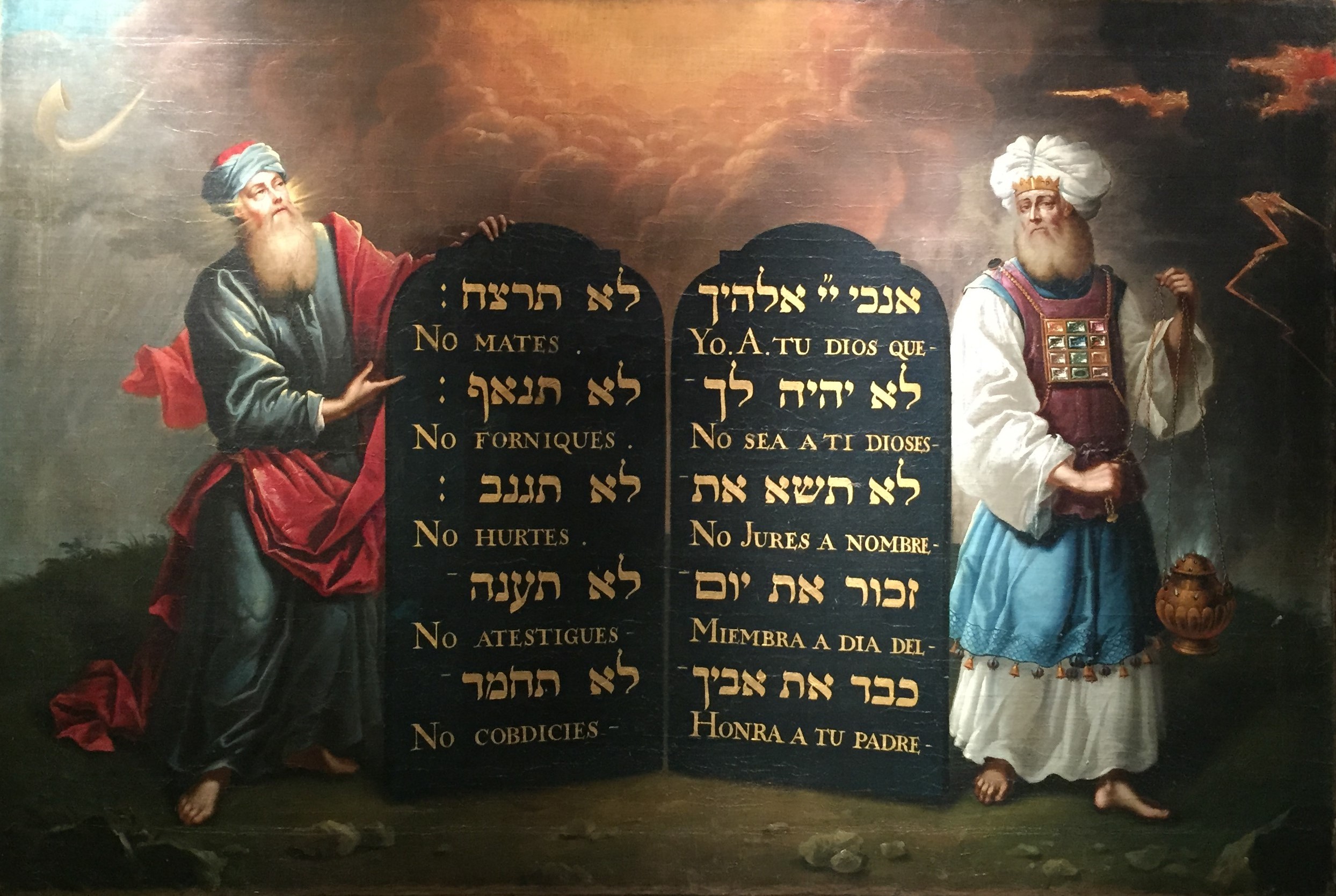
During his Sermon on the Mount, Jesus explicitly referenced the prohibitions against murder and adultery. In Jesus repeated five of the Ten Commandments, followed by that commandment called "the second" () after the first and great commandment.
He saith unto him, Which? Jesus said, Thou shalt do no murder, Thou shalt not commit adultery, Thou shalt not steal, Thou shalt not bear false witness, Honour thy father and thy mother: and, Thou shalt love thy neighbour as thyself.|}}
In his Epistle to the Romans, Paul the Apostle also mentioned five of the Ten Commandments and associated them with the neighbourly love commandment.
Anglicanism
In Anglicanism, the Articles of the Church of England, revised and altered by the Assembly of Divines, at Westminster, in the year 1643 state that "no Christian man whatsoever is free from the obedience of the commandments which are called moral. By the moral law, we understand all the Ten Commandments taken in their full extent."
Baptists
Baptists believe The Ten Commandments are a summary of the requirements of a works covenant (called the "Old Covenant"), given on Mount Sinai to the nascent nation of Israel. The Old Covenant is fulfilled by Christ at the cross. Unbelievers are still under the Law. The law reveals man's sin and need for the salvation that is Jeshua. Repentance from sin and faith in Christ for salvation is the point of the entire Bible. They do reflect the eternal character of God, and serve as a paragon of morality.
Catholicism
Main article: Ten Commandments in Catholic theology
In Catholicism it is believed that Jesus freed Christians from the rest of Jewish religious law, but not from their obligation to keep the Ten Commandments. It has been said that they are to the moral order what the creation story is to the natural order.
According to the Catechism of the Catholic Church—the official exposition of the Catholic Church's Christian beliefs—the Commandments are considered essential for spiritual good health and growth, and serve as the basis for social justice. Church teaching of the Commandments is largely based on the Old and New Testaments and the writings of the early Church Fathers. The Catechism of the Catholic Church believes that in the New Testament, Jesus acknowledged their validity summarizing them into two "great commandments."
The great commandments contain the Law of the Gospel, summed up in the Golden Rule. The Law of the Gospel is expressed particularly in the Sermon on the Mount. The Catechism of the Catholic Church explains that, "the Law of the Gospel fulfills the commandments of the Law. The Lord's Sermon on the Mount, far from abolishing or devaluing the moral prescriptions of the Old Law, releases their hidden potential and has new demands arise from them: it reveals their entire divine and human truth. It does not add new external precepts, but proceeds to reform the heart, the root of human acts, where man chooses between the pure and the impure, where faith, hope, and charity are formed and with them the other virtues." The New Law "fulfills, refines, surpasses, and leads the Old Law to its perfection."
Lutheranism

The Lutheran Churches divide Mosaic Law into three components: the (1) moral law, (2) civil law, (3) ceremonial law. Of these, the moral law as contained in the Ten Commandments remains in force today.
The Lutheran division of the commandments follows the one established by St. Augustine, following the then current synagogue scribal division. The first three commandments govern the relationship between God and humans, the fourth through eighth govern public relationships between people, and the last two govern private thoughts. See Luther's Small Catechism and Large Catechism.
Methodism
The moral law contained in the Ten Commandments, according to the founder of the Methodist movement John Wesley, was instituted from the beginning of the world and is written on the hearts of all people. As with the Reformed view, Wesley held that the moral law, which is contained in the Ten Commandments, stands today:
In keeping with Wesleyan covenant theology, "while the ceremonial law was abolished in Christ and the whole Mosaic dispensation itself was concluded upon the appearance of Christ, the moral law remains a vital component of the covenant of grace, having Christ as its perfecting end." As such, in Methodism, an "important aspect of the pursuit of sanctification is the careful following" of the Ten Commandments.
Orthodox

The Eastern Orthodox Church holds its moral truths to be chiefly contained in the Ten Commandments. A confession begins with the Confessor reciting the Ten Commandments and asking the penitent which of them he has broken.
Pentecostalism
The Pentecostal Christianity believes the Ten Commandments were given directly from God summarizing the absolutes of spiritual and moral living that God intended for his people. They also attach a specific significance observing that the Feast of Pentecost commemorates the giving of the Ten Commandments to Moses. This view, admitted by several founders of the Pentecostal Church has passed into modern Christian ethic, where the feast is also celebrated as "the day of the giving of the Law" or Shavuot as observed by Judaic liturgical books and Jewish Christianity. Pentecostals believe giving of the Ten Commandments on Mount Sinai fifty days after Passover and the disciples of Jesus Christ receiving the Holy Spirit of God, as foretold by Him, fifty days after His Resurrection on Day of Pentecost was foretold by the prophet Jeremiah symbolizing God giving His Church the gift of the Holy Spirit, where law is written, not on tablets of stone, but in their hearts. Pentecostal Christianity believes that through Jesus Christ and with the exception of the Ten Commandments, they are not bound by the 613 Commandments of the Old Testament and any adherence to Judaic Halakha.
Reformed Christianity
Reformed Christianity includes the Continental Reformed, Presbyterian, Congregationalist, and Reformed Anglican traditions. The Heidelberg Catechism, in explaining the third use of the Law, teaches that the moral law as contained in the Ten Commandments is binding for Christians and that it instructs Christians how to live in service to God in gratitude for His grace shown in redeeming mankind. John Calvin deemed this third use of the Law as its primary use.
Presbyterianism
The Westminster Confession, held by Presbyterian Churches, holds that the moral law contained in the Ten Commandments "does forever bind all, as well justified persons as others, to the obedience thereof".
Dispensationalism
With the emergence of dispensationalism (held to by Churches such as the Plymouth Brethren and certain Independent Baptists), certain communities believe and teach their adherents that all of the Law of Moses was fulfilled by Jesus Christ by His Crucifixion, death and resurrection and the Law of Moses including the Ten Commandments no longer apply to them while others believe in following only the commandments that appear in the New testament and hence do not follow or observe them as part of their faith and worship.
The Church of Jesus Christ of Latter-day Saints
According to the doctrine of the Church of Jesus Christ of Latter-day Saints, Jesus completed rather than rejected the Mosaic law. The Ten Commandments are considered eternal gospel principles necessary for exaltation. 13:15–16, 13:21–24 and Doctrine and Covenants. According to the Book of Mosiah, a prophet named Abinadi taught the Ten Commandments in the court of King Noah and was martyred for his righteousness. Abinadi knew the Ten Commandments from the brass plates.
In an October 2011 address, the Church president and prophet Thomas S. Monson taught "The Ten Commandments are just that—commandments. They are not suggestions." In that same talk he used small quotations listing the numbering and selection of the commandments. This and other sources don't include the prologue, making it most consistent with the Septuagint numbering.
A splinter group of the Church called the "Church of Jesus Christ of Latter Day Saints (Strangite)" have a belief similar to the Samaritans where they have the entire Ten Commandments in their scripture where others only have nine. The Strangite fourth Commandment is "Thou shalt love thy neighbor as thyself." The Strangite's founder and namesake James Strang wrote in "Note on the Decalogue" as part of the Book of the Law of the Lord (a Strangite holy book) that no other version of the Decalogue contains more than nine commandments and speculated that his fourth Commandment was omitted from other works perhaps as early as Josephus' time (circa 37-100 AD).
Islam
Moses and the Tablets
Main article: Tablets of Stone#In the Quran
The receiving of the Ten Commandments by Prophet Musa (Moses) is dealt with in much detail in Islamic tradition with the meeting of Moses with God on Mount Sinai described in Surah A'raf (7:142-145). The Revealing of the Tablets on which were the Commandments of God is described in the following verse:
The Tablets are further alluded to in verses 7:150, when Moses threw the Tablets down in anger at seeing the Israelites' worshipping of the golden calf, and in 7:154 when he picked up the Tablets having recovered from his anger:
Classical views
Three verses of Surah An'am (6:151–153) are widely taken to be a reinstatement (or revised version) of the Ten Commandments either as revealed to Moses originally or as they are to be taken by Muslims now:
152. "6And come not near to the orphan's property, except to improve it, until he (or she) attains the age of full strength; 7And give full measure and full weight with justice. We burden not any person, but that which he can bear. 8And whenever you give your word (i.e. judge between men or give evidence, etc.), say the truth even if a near relative is concerned, 9And fulfill the Covenant of Allah. This He commands you, that you may remember.
153. "10And verily, this (the Commandments mentioned in the above Verses) is my Straight Path, so follow it, and follow not (other) paths, for they will separate you away from His Path. This He has ordained for you that you may become Al-Muttaqun (the pious)."}}
Evidence for these verses having some relation to Moses and the Ten Commandments is from the verse which immediately follows them:
According to a narration in Mustadrak Hakim, Ibn Abbas, a prominent narrator of Israiliyat traditions said, "In Surah Al-An`am, there are clear Ayat, and they are the Mother of the Book (the Qur'an)." He then recited the above verses.
Also in Mustadrak Hakim is the narration of Ubada ibn as-Samit:
He then recited the (above) Ayah (6:151–153).
He then said, "Whoever fulfills (this pledge), then his reward will be with Allah, but whoever fell into shortcomings and Allah punishes him for it in this life, then that will be his recompense. Whoever Allah delays (his reckoning) until the Hereafter, then his matter is with Allah. If He wills, He will punish him, and if He wills, He will forgive him."}}
Ibn Kathir mentions a narration of Abdullah ibn Mas'ud in his Tafsir:
| Order | Commandment in the Quran | Surat Al-An'am | Surat Al-Isra | Corresponding in the Bible |
|---|---|---|---|---|
| First Commandment | Do not associate others with God | (151) | (22) | Do not put other gods before me |
| Second Commandment | Honour your parents | (23–24) | Honour thy father and thy mother | |
| Third Commandment | Do not kill your children for fear of poverty | (26–31) | Do not murder | |
| Fourth Commandment | Do not come near indecencies, openly or secretly. | (32) | Do not covet thy neighbour's wife, Do not commit adultery | |
| Fifth Commandment | Do not take a life except justly | (33) | Do not murder | |
| Sixth Commandment | Do not come near the property of the orphan except to enhance it | (152) | (34) | Do not covet his slaves, or his animals, or anything of thy neighbour |
| Seventh Commandment | Give full measure and weigh with justice | (35) | Thou shalt not steal. (And the biblical "Remember the sabbath day" is absent in the Quran.) | |
| Eighth Commandment | Whenever you testify, maintain justice even regarding a close relative | (36) | Do not bear false witness against thy neighbour | |
| Ninth Commandment | Fulfil your covenant with God | (34) | Do not take the name of the Lord thy God in vain | |
| Tenth Commandment | Follow God's path and not any other | (153) | (37–39) | Do not put other gods before me. Do not make unto thee any graven image or idols neither kneel before them nor worship them |
Other views
Main points of interpretative difference
Sabbath day
The Abrahamic religions observe the Sabbath in various ways. In Judaism it is observed on Saturday (reckoned from dusk to dusk). In Christianity, it is sometimes observed on Saturday, sometimes on Sunday, and sometimes not at all (non-Sabbatarianism). Observing the Sabbath on Sunday, the day of resurrection, gradually became the dominant Christian practice from the Jewish-Roman wars onward. The Church's general repudiation of Jewish practices during this period is apparent in the Council of Laodicea (4th century AD) where Canons 37–38 state: "It is not lawful to receive portions sent from the feasts of Jews or heretics, nor to feast together with them" and "It is not lawful to receive unleavened bread from the Jews, nor to be partakers of their impiety". Canon 29 of the Laodicean council specifically refers to the sabbath: "Christians must not judaize by resting on the [Jewish] Sabbath, but must work on that day, rather honouring the Lord's Day; and, if they can, resting then as Christians. But if any shall be found to be judaizers, let them be anathema from Christ."
Killing or murder
Main article: Thou shalt not kill
.jpg)
Multiple translations exist of the fifth/sixth commandment; the Hebrew words (lo tirtzach) are variously translated as "thou shalt not kill" or "thou shalt not murder".
The imperative is against unlawful killing resulting in bloodguilt. The Hebrew Bible contains numerous prohibitions against unlawful killing, but does not prohibit killing in the context of warfare (), capital punishment () or defending against a home invasion (), which are considered justified. The New Testament is in agreement that murder is a grave moral evil, and references the Old Testament view of bloodguilt.
Theft
Main article: Thou shalt not steal
German Old Testament scholar Albrecht Alt: Das Verbot des Diebstahls im Dekalog (1953), suggested that the commandment translated as "thou shalt not steal" was originally intended against stealing people, against abductions and slavery, in agreement with the Talmudic interpretation of the statement as "thou shalt not kidnap" (Sanhedrin 86a).
Alt's claim is somewhat questionable, because the decalogue verse (Exodus 20:12, Deuteronomy 5:16) forbids theft in general, whereas the Sanhedrin 86a discussion (abductions and slavery) deals with another biblical verse: Deuteronomy 24:7 which explicitly refers to theft (i.e. abduction) of a person in order to sell that person.
Idolatry
Main article: Idolatry, Idolatry in Judaism, Idolatry in Christianity, Shirk (Islam)
In Judaism there is a prohibition against making or worshipping an idol or a representation of God, but there is no restriction on art or simple depictions unrelated to God. Islam has a stronger prohibition, banning not just representations of God, but also in some cases of Muhammad, humans and, in some interpretations, any living creature.
In the non-canonical Gospel of Barnabas, it is claimed that Jesus stated that idolatry is the greatest sin as it divests a man fully of faith, and hence of God. The words attributed to Jesus prohibit not only worshipping statues of wood or stone; but also statues of flesh. "...all which a man loves, for which he leaves everything else but that, is his god, thus the glutton and drunkard has for his idol his own flesh, the fornicator has for his idol the harlot and the greedy has for his idol silver and gold, and so the same for every other sinner." Idolatory was thus the basic sin, which manifested in various acts or thoughts, which displace the primacy of God. However, the Gospel of Barnabas does not form part of the Christian bible. It is known only from 16th- and 17th-century manuscripts, and frequently reflects Islamic rather than Christian understandings.
Eastern Orthodox tradition teaches that while images of God, the Father, remain prohibited, depictions of Jesus as the incarnation of God as a visible human are permissible. To emphasize the theological importance of the incarnation, the Orthodox Church encourages the use of icons in church and private devotions, but prefers a two-dimensional depiction. In modern use (usually as a result of Roman Catholic influence), more naturalistic images and images of the Father, however, also appear occasionally in Orthodox churches, but statues, i.e. three-dimensional depictions, continue to be banned.
Adultery
This commandment forbade male Israelites from having sexual intercourse with the wife of another Israelite; the prohibition did not extend to their own slaves. Sexual intercourse between an Israelite man, married or not, and a woman who was neither married nor betrothed was not considered adultery. This concept of adultery stems from a society that was not strictly monogamous, where the patriarchal economic aspect of Israelite marriage gave the husband an exclusive right to his wife, whereas the wife, as the husband's possession, did not have an exclusive right to her husband.
Louis Ginzberg argued that the tenth commandment (Covet not thy neighbor's wife) is directed against a sin which may lead to a trespassing of all Ten Commandments.
Critical historical analysis

Early theories
Julius Wellhausen's documentary hypothesis (1883) suggests that Exodus 20–23 and 34 "might be regarded as the document which formed the starting point of the religious history of Israel." Deuteronomy 5 then reflects King Josiah's attempt to link the document produced by his court to the older Mosaic tradition.
Bernard Levinson argues that the idea of Exodus 34:11–26 as an ancient, independent, pre-Deuteronomic legal source originated with Goethe, significantly influenced Wellhausen’s formulation of the documentary hypothesis, and reflects broader intellectual currents, including Goethe’s construction of the Jew as the particularistic "other" in contrast to the universal German Protestant self.
20th century discussion
According to John Bright, there was an important distinction between the Decalogue and the "book of the covenant" (Exodus 21–23 and 34:10–24). The Decalogue, he argues, was modelled on the suzerainty treaties of the Hittites (and other Mesopotamian Empires), that is, represents the relationship between God and Israel as a relationship between king and vassal, and enacts that bond.
"The prologue of the Hittite treaty reminds his vassals of his benevolent acts... (compare with Exodus 20:2 "I am the your God, who brought you out of the land of Egypt, out of the house of slavery"). The Hittite treaty also stipulated the obligations imposed by the ruler on his vassals, which included a prohibition of relations with peoples outside the empire, or enmity between those within." (Exodus 20:3: "You shall have no other gods before Me"). Viewed as a treaty rather than a law code, its purpose is not so much to regulate human affairs as to define the scope of the king's power.
Julius Morgenstern argued that Exodus 34 was distinct from the Jahwist document, identifying it with king Asa's reforms in 899 BC. Bright, however, believes that like the Decalogue this text has its origins in the time of the tribal alliance. The book of the covenant, he notes, bears a greater similarity to Mesopotamian law codes (e.g. the Code of Hammurabi which was inscribed on a stone stele). He argues that the function of this "book" is to move from the realm of treaty to the realm of law: "The Book of the Covenant (Ex., chs. 21 to 23; cf. ch. 34), which is no official state law, but a description of normative Israelite judicial procedure in the days of the Judges, is the best example of this process." According to Bright, then, this body of law too predates the monarchy.
According to Kaufmann, the Decalogue and the book of the covenant represent two ways of manifesting God's presence in Israel: the Ten Commandments taking the archaic and material form of stone tablets kept in the Ark of the Covenant, while the book of the covenant took oral form to be recited to the people.
21st century scholarship
Michael Coogan argues that each of the three versions of the Ten Commandments are "significantly different… indicating that its text was not fixed in ancient Israel."
Archaeologists Israel Finkelstein and Neil Asher Silberman argue that "the astonishing composition came together… in the seventh century BC". An even later date (after 586 BC) is suggested by David H. Aaron; his book argues for "the probability that these documents were written very late in the history of biblical literature - indeed, so late as to constitute a literary afterthought in the development of Israelite ethnic self-definition."
Biblical scholar Timothy S. Hogue argues that the Decalogue in the book of Exodus originated in the northern kingdom of Israel around the 9th-8th centuries BC, based on parallels with Luwian texts from that time as well as the references in the Decalogue to the masseboth which were destroyed during the religious reforms of Hezekiah and Josiah.
According to Book of Deuteronomy, the tablets were placed in the Ark of the Covenant. Thomas Römer argued in 2015 that "clearly… the tablets of the law are a substitute for something else." He holds that "the original Ark contained a statue i.e. a [cult image] of Yhwh" and that it was "brought into the Jerusalem temple under Josiah", which he specifically identifies as "two betyles (sacred stones), or two cult image statues symbolizing Yhwh and his female companion Ashera or a statue representing Yhwh alone."
The Ritual Decalogue
Main article: Ritual Decalogue

Exodus 34:28 identifies a different list, that of Exodus 34:11–27, as the Ten Commandments. Since this passage does not prohibit murder, adultery, theft, etc., but instead deals with the proper worship of Yahweh, some scholars call it the "Ritual Decalogue", and disambiguate the Ten Commandments of traditional understanding as the "Ethical Decalogue".
Richard Elliott Friedman argues that the Ten Commandments at Exodus 20:1–17 "does not appear to belong to any of the major sources. It is likely to be an independent document, which was inserted here by the Redactor." In his view, the Covenant Code follows that version of the Ten Commandments in the northern Israel E narrative. In the J narrative in Exodus 34 the editor of the combined story known as the Redactor (or RJE), adds in an explanation that these are a replacement for the earlier tablets which were shattered. "In the combined JE text, it would be awkward to picture God just commanding Moses to make some tablets, as if there were no history to this matter, so RJE adds the explanation that these are a replacement for the earlier tablets that were shattered." He suggests that differences in the J and E versions of the Ten Commandments story are a result of power struggles in the priesthood. The writer has Moses smash the tablets "because this raised doubts about the Judah's central religious shrine".
Political importance
Christopher Hitchens criticised the Ten Commandments for failing to prohibit either rape, child abuse, slavery or genocide, while elsewhere, he said, the Bible even appears to endorse slavery and genocide. He explained these failings by concluding that the commandments were man-made, reflecting "a nomadic tribe whose main economy is primitive agriculture and whose wealth is sometimes counted in people as well as animals"; furthermore, a tribe which believes it has been "promised the land and flocks of other people: the Amalekites and Midianites and others whom God orders them to kill, rape, enslave, or exterminate". Hitchens described the God of the Bible as "a Bronze Age demagogue", whose omission of these offences was "negligent ... even by the lax standards of the time". He criticised as immoral the collective punishment of future children for the failings of their ancestors, where it states in the third commandment: "I the lord thy God am a jealous God, visiting the iniquity of the fathers upon the children unto the third and fourth generation." Regarding the tenth commandment, he questioned why, given that human beings seem so susceptible to the temptations of lust and envy that their creator prohibits, a god would have in fact created them that way. He wrote: "This leaves us with the insoluble mystery ... Create them sick, and then command them to be well?" Hitchens argued that the Ten Commandments are not a sound foundation for law or morality, as they reflect authoritarianism, insecurity, and outdated tribal values, and that the real issue is not their public display but the incompatibility of religion with true ethical reasoning.
According to Richard J. Clifford, Jesuit priest and professor emeritus of Old Testament at Weston Jesuit School of Theology, the tenth commandment accepts slavery as normal, as it states: "You shall not covet your neighbor's wife, his male or female slave, his ox or donkey, or anything that belongs to your neighbor."
According to some scholars, certain interpretations of the Commandments have been problematic for people, like capital punishment for blasphemy, idolatry, apostasy, adultery, cursing one own's parents, and Sabbath-breaking.
During an 1846 uprising, now known as the Galician slaughter, by impoverished and famished Galician Eastern European peasants (serfs) directed against szlachta (Polish nobles) because of their oppression (for example, manorial prisons), a popular rumor had it that the Austrian Emperor had abolished the Ten Commandants, which the peasants took as permission and religious justification to massacre the szlachta – the prime representatives and beneficiaries of the crown in Austrian Galicia. This uprising is credited with helping to bring on the demise, in 1848, of serfdom with corvée labor in Galicia.
United States debate over display on public property
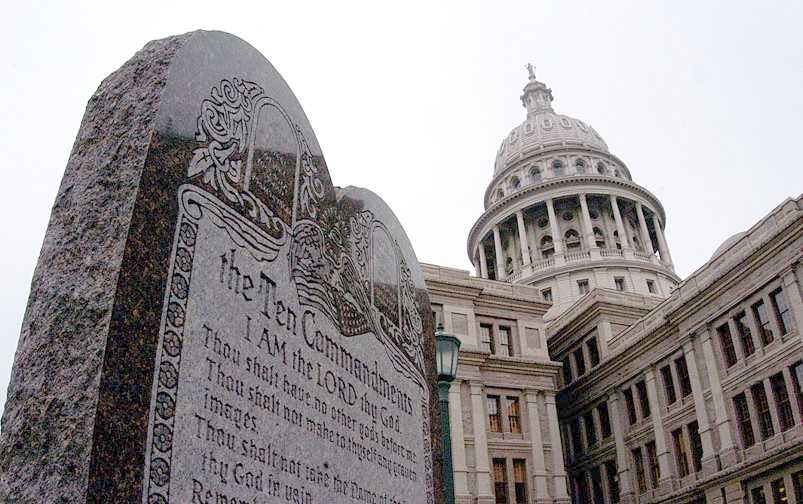

European Protestants replaced some visual art in their churches with plaques of the Ten Commandments after the Reformation. In England, such "Decalogue boards" also represented the English monarch's emphasis on rule of royal law within the churches. The United States Constitution forbids establishment of religion by law; however images of Moses holding the tablets of the Decalogue, along other religious figures including Solomon, Confucius, and Muhammad holding the Quran, are sculpted on the north and south friezes of the pediment of the Supreme Court building in Washington. Images of the Ten Commandments have long been contested symbols for the relationship of religion to national law.
In the 1950s and 1960s the Fraternal Order of Eagles placed possibly thousands of Ten Commandments displays in courthouses and school rooms, including many stone monuments on courthouse property. Because displaying the commandments can reflect a sectarian position if they are numbered, the Eagles developed an ecumenical version that omitted the numbers, as on the monument at the Texas capitol. Hundreds of monuments were also placed by director Cecil B. DeMille as a publicity stunt to promote his 1956 film The Ten Commandments. Placing the plaques and monuments to the Ten Commandments in and around government buildings was another expression of mid-twentieth-century U.S. civil religion, along with adding the phrase "under God" to the Pledge of Allegiance.
By the beginning of the twenty-first century in the U.S., however, Decalogue monuments and plaques in government spaces had become a legal battleground between religious as well as political liberals and conservatives. Organizations such as the American Civil Liberties Union (ACLU) and Americans United for Separation of Church and State launched lawsuits challenging the posting of the ten commandments in public buildings. The ACLU has been supported by a number of religious groups such as the Presbyterian Church (U.S.A.) and the American Jewish Congress.
In public schools
In 1980, the U.S. Supreme Court in Stone v. Graham ruled unconstitutional a Kentucky statute that required the posting of a copy of the Ten Commandments on the wall of each public classroom in the state, because the statute lacked a nonreligious, legislative purpose.
In 2023, Texas Republican politician Phil King introduced SB 1515 of the 88th Session of the Texas Senate, which would require that the Ten Commandments be displayed in every classroom of every public school in Texas. The bill eventually lapsed in the State House when the session closed without voting it. It was later passed in 2025 as Texas Senate Bill 10. The law faces multiple legal challenges under the Establishment Clause and Free Exercise Clause of the First Amendment. In November 2025, a federal judge issued a preliminary injunction blocking the state law.
On June 19, 2024, Louisiana Governor Jeff Landry signed House Bill 71 mandating display of the Ten Commandments in every public school classroom. The bill also permits the additional display of the Mayflower Compact, the United States Declaration of Independence or the Northwest Ordinance. Governor Landry stated that the Ten Commandments are "not solely religious, but that it has historical significance." The bill mandates a text that includes the phrase "Thou shalt not make to thyself any graven images" indicating that it comes not from a traditional Bible but instead from the Eagles-DeMille promotion campaign. A group of parents challenged the law in court, and on November 12, 2024, United States District Judge John W. deGravelles granted a temporary injunction, stating that the law is "unconstitutional on its face." On November 15, the United States Court of Appeals for the Fifth Circuit granted an emergency stay motion from the state of Louisiana, limiting the ruling to the five parishes whose school boards were named as defendants in the case. In June 2025, the Fifth Circuit ruled that Louisiana's law requiring the Ten Commandments be displayed in all public school classrooms in the state is unconstitutional. The court affirmed the lower court's November 2024 decision.
In Arkansas, a Ten Commandments law was signed into law by Governor Sarah Huckabee Sanders on April 14, 2025. In August 2025, the U.S. District Court for the Western District of Arkansas ruled that the law was unconstitutional under Stone v. Graham and granted the plaintiff-parents' request for a preliminary injunction.
Cultural references
Arthur Hugh Clough's poem "The Latest Decalogue" (1862) is a parody of the Ten Commandments in English verse form, directed at those who love money more than righteous behavior.
Two famous films with this name were directed by Cecil B. DeMille: a 1923 silent film which stars Theodore Roberts as Moses, and a 1956 version filmed in VistaVision starring Charlton Heston as Moses.
Both Dekalog, a 1989 Polish film series directed by Krzysztof Kieślowski, and The Ten, a 2007 American film, use the Ten Commandments as a structure for 10 smaller stories.
Other media about the Ten Commandments include a 2000 musical, 2004 musical, 2006 miniseries, 2007 animated film, 2010 film, and a 2016 Brazilian film.
The receipt of the Ten Commandments by Moses was satirized in Mel Brooks's 1981 movie History of the World Part I, which shows Moses (played by Brooks, in a similar costume to Charlton Heston's Moses in the 1956 film), receiving three tablets containing fifteen commandments, but before he can present them to his people, he stumbles and drops one of the tablets, shattering it. He then presents the remaining tablets, proclaiming Ten Commandments.
References
References
- "Deuteronomy 4:13 – multiple versions and languages".
- "Deuteronomy 10:4 – multiple versions and languages". Studybible.info.
- Rooker, Mark. (2010). "The Ten Commandments: Ethics for the Twenty-First Century". B&H Publishing Group.
- {{OEtymD. Decalogue
- "Exodus 34:28 – multiple versions and languages". Studybible.info.
- Crossway Bibles. (28 December 2011). "Holy Bible: English Standard Version". Crossway.
- {{Bibleref2. Deuteronomy 4:13; 5:22. 9. Deuteronomy 4:13, 5:22
- Somer, Benjamin D. ''Revelation and Authority: Sinai in Jewish Scripture and Tradition'' (The Anchor Yale Bible Reference Library). pp = 40.
- {{Bibleref. Exodus. 20:21
- {{Bibleref2. Exodus. 21–23. 9. Exodus 21–23
- {{Bibleref2. Exodus. 24:4. 9
- {{Bibleref2. Exodus. 24:7. 9
- {{Bibleref2. Exodus. 24:1,9. 9
- {{Bibleref2. Exodus. 24:1–11. 9
- {{Bibleref2. Exodus. 24:16–18. 9
- {{Bibleref2. Deuteronomy. 9:10. 9
- {{Bibleref2. Exodus. 32:1–5. 9. Ex. 32:1–5
- {{Bibleref2. Exodus. 32:6–8. 9. Ex. 32:6–8
- {{Bibleref2. Exodus. 32:19. 9. Ex.32:19
- {{Bibleref2. Exodus. 34:1. 9. Ex. 34:1
- {{Bibleref2. Deuteronomy. 10:4. 9
- {{Bibleverse. Deuteronomy. 4:10–13. HE, {{Bibleverse-nb. Deut.. 5:22. HE, {{Bibleverse-nb. Deut.. 9:17. HE, {{Bibleverse-nb. Deut.. 10:1–5. HE
- "Dead Sea Scrolls Plate 981, Frag 2, B-314643 ManuScript 4Q41-4Q Deut".
- Mechon Mamre, {{Bibleverse. Exodus. 20. HE (The closed portion breaks are marked with " {ס} ".)
- {{bibleverse. Exodus. 20:1–17
- {{bibleverse. Deuteronomy. 5:4–21
- Chan, Yiu Sing Lúcás. (2012). "The Ten Commandments and the Beatitudes". [[Rowman & Littlefield]].
- I am the {{Lord your God, who brought you out of the land of Egypt, out of the house of slavery.
- You shall have no other gods before me.
- You shall not make for yourself a carved image, or any likeness of anything that is in heaven above, or that is in the earth beneath, or that is in the water under the earth. You shall not bow down to them or serve them, for I the {{Lord your God am a jealous God, visiting the iniquity of the fathers on the children to the third and the fourth generation of those who hate me, but showing steadfast love to thousands of those who love me and keep my commandments.
- You shall not take the name of the {{Lord your God in vain, for the {{Lord will not hold him guiltless who takes his name in vain.
- Remember the Sabbath day, to keep it holy. Six days you shall labor, and do all your work, but the seventh day is a Sabbath to the {{Lord your God. On it you shall not do any work, you, or your son, or your daughter, your male slave, or your female slave, or your livestock, or the sojourner who is within your gates. For in six days the {{Lord made heaven and earth, the sea, and all that is in them, and rested on the seventh day. Therefore the {{Lord blessed the Sabbath day and made it holy.
- Observe the Sabbath day, to keep it holy, as the {{Lord your God commanded you. Six days you shall labor and do all your work, but the seventh day is a Sabbath to the {{Lord your God. On it you shall not do any work, you or your son or your daughter or your male slave or your female slave, or your ox or your donkey or any of your livestock, or the sojourner who is within your gates, that your male slave and your female slave may rest as well as you. You shall remember that you were a slave in the land of Egypt, and the {{Lord your God brought you out from there with a mighty hand and an outstretched arm. Therefore the {{Lord your God commanded you to keep the Sabbath day.
- Honor your father and your mother, that your days may be long in the land that the {{Lord your God is giving you.
- Honor your father and your mother, as the {{Lord your God commanded you, that your days may be long, and that it may go well with you in the land that the {{Lord your God is giving you.
- You shall not murder.
- You shall not commit adultery.
- And you shall not commit adultery.
- You shall not steal.
- And you shall not steal.
- You shall not bear false witness against your neighbor.
- And you shall not bear false witness against your neighbor.
- You shall not covet your neighbor's house
- And you shall not desire your neighbor's house, his field,
- You shall not covet your neighbor's wife …
- And you shall not covet your neighbor's wife.
- … or his male slave, or his female slave, or his ox, or his donkey, or anything that is your neighbor's.
- … or his male slave, or his female slave, his ox, or his donkey, or anything that is your neighbor's.
- And when you have passed over the Yardan [Jordan], you shall set up these stones, which I command you today, on [Mount] Ārgarizem [Gerizim].
- (2024). "The Samaritan Pentateuch: An English Translation with a Parallel Annotated Hebrew Text". University of Cambridge & OpenBook Publishers.
- (2024). "The Israelite Samaritan Version of the Torah". University of Cambridge & OpenBook Publishers.
- (2006). "Religious Politics in Post-reformation England". The Boydell Press.
- [http://bookofconcord.org/lc-3-tencommandments.php Luther's Large Catechism] {{Webarchive. link. (5 November 2013 (1529))
- (2012). "The Decalogue Through the Centuries: From the Hebrew Scriptures to Benedict XVI". Westminster John Knox Press.
- link. (23 June 2016 . Westminster John Knox Press (2004). {{ISBN). 0-664-22323-0
- (2009). "The Ten Commandments". Presbyterian Publishing Corp..
- (2005). "Etz Hayim Study Guide". Jewish Publication Society.
- link. (3 May 2016 Westminster John Knox Press (2001), originally ''The Plain Man's Guide to Ethics'' (1973). {{ISBN). 0-664-22346-X
- link. (16 June 2016 , Westminster John Knox Press (2009) {{ISBN). 0-664-22711-2
- link. (3 June 2016 . Sterling Publishing Company (2009) {{ISBN). 1-4027-6884-2
- link. (26 April 2016 . HarperCollins (1995). {{ISBN). 0-06-062179-6 "There are 603 more Torah commandments. But in giving these ten – with their wise insight into the human condition – God established a standard of right and wrong, a powerful code of behavior, that is universal and timeless."
- "Philo: The Special Laws, I".
- "Philo: The Decalogue".
- אלכסנדר קליין, [https://www.biu.ac.il/JH/Parasha/yitro/cla.html ייחודם של עשרת הדיברות] {{Webarchive. link. (7 August 2020)
- Ginzberg, Louis, [https://philologos.org/__eb-lotj/vol3/p03.htm#THE%20UNITY%20OF%20THE%20TEN%20COMMANDMENTS ''The Legends of the Jews'', Vol. III: The Unity of Ten Commandments] {{Webarchive. link. (7 August 2018 , (Translated by Henrietta Szold), Johns Hopkins University Press: 1998, {{ISBN). 0-8018-5890-9
- Talmud Makkos 1:10
- Rabbi Ishmael. "Mekhilta".
- Margaliot, Dr. Meshulam. (July 2004). "What was Written on the Two Tablets?". Bar-Ilan University.
- {{bibleverse. Exodus. 32:15
- ''[[Talmud. Babylonian Talmud]]'', tractate [[Shabbat (Talmud). Shabbat]] 104a.
- before the reading of the [[Shema Yisrael]] (as preserved, for example, in the [[Nash Papyrus]], a Hebrew manuscript fragment from 150 to 100 BC found in Egypt, containing a version of the Ten Commandments and the beginning of the Shema); but that this practice was abolished in the synagogues so as not to give ammunition to heretics who claimed that they were the only important part of Jewish law,Yerushalmi Berakhot, Chapter 1, fol. 3c. See also Rabbi David Golinkin, [http://www.myjewishlearning.com/holidays/Jewish_Holidays/Shavuot/In_the_Community/Torah_Reading_and_Haftarah/The_Ten_Commandments/In_Liturgy.shtml Whatever Happened to the Ten Commandments?] {{Webarchive. link. (15 June 2009)
- ''Talmud''. tractate [https://www.sefaria.org/Berakhot.12a Berachot 12a.] {{Webarchive. link. (12 June 2018)
- "Beit Yosef, Orach Chaim 1:14:1".
- "Shulchan Arukh, Orach Chayim 1:5".
- "Mishnah Berurah 1:16".
- "Siddur Ashkenaz, Weekday, Shacharit, Post Service, Ten Commandments 1".
- link. (24 May 2015 Chief Rabbi. Retrieved 24 May 2015)
- Gaster, Moses. (1923). "The Samaritan Tenth Commandment". The [[Schweich Lectures]].
- (2005). "I Am the Lord Your God". [[William B. Eerdmans]].
- Roberts, Alexander. (2007). "The Ante-Nicene Fathers". Cosimo, Inc..
- Turner, Philip. (2005). "I Am the Lord Your God". [[William B. Eerdmans]].
- Heiser, Michael. (2015). "I Dare You Not to Bore Me with the Bible". Lexham Press.
- link. (5 May 2016. Church Publishing (2008). {{ISBN). 1-59627-100-0
- Neal, Daniel. (1843). "The History of the Puritans, Or Protestant Non-conformists". Harper.
- "Book of the Covenant".
- Schreiner, Thomas. (November 2018). "The Old Covenant Is Over. The Old Testament Is Authoritative.".
- [http://ids.org/wp-content/uploads/articles/israel.pdf A New Covenant Theology of Israel] {{Webarchive. link. (19 January 2025 , pp. 1, 4)
- Jan Kreeft, ''Catholic Christianity: A Complete Catechism of Catholic Beliefs Based on the Catechism of the Catholic Church'', [https://archive.org/details/catholicchristia00kree/page/202 ch. 5]. Ignatius Press (2001). {{ISBN. 0-89870-798-6
- Kreeft, Peter. (2001). "Catholic Christianity". Ignatius Press.
- Carmody, Timothy R.. (2004). "Reading the Bible". [[Paulist Press]].
- Paragraph number 2052–2074. (1994). "Catechism of the Catholic Church". Libreria Editrice Vaticana.
- Paragraph number 1970. (1994). "Catechism of the Catholic Church". Libreria Editrice Vaticana.
- Paragraph number 1967–1968. (1994). "Catechism of the Catholic Church". Libreria Editrice Vaticana.
- (9 March 2015). "Old Testament Law". [[Wisconsin Evangelical Lutheran Synod]].
- [http://bookofconcord.org/smallcatechism.php#tencommandments Luther's Small Catechism] {{Webarchive. link. (27 September 2011 (1529))
- Rodes, Stanley J.. (2014). "From Faith to Faith: John Wesley's Covenant Theology and the Way of Salvation". James Clarke & Co.
- Campbell, Ted A.. (2011). "Methodist Doctrine: The Essentials, 2nd Edition". Abingdon Press.
- (1913). "The Sabbath Recorder, Volume 75". George B. Utter.
- Sebastian Dabovich, ''Preaching in the Russian Church'', [https://archive.org/details/preachinginruss00dabogoog/page/n71 p. 65]. Cubery (1899).
- Alexander Hugh Hore, ''Eighteen Centuries of the Orthodox Church'', [https://archive.org/details/eighteencenturi00horegoog/page/n38 p. 36]. J. Parker and Co. (1899).
- "Bible Gateway passage: Acts 1-8 - New King James Version".
- "Bible Gateway passage: Jeremiah 31:33-34 - New King James Version".
- (2018). "God's Law in Old and New Covenants". [[Orthodox Presbyterian Church]].
- "Westminster Confession of Faith: Chapter XIX – Of the Law of God".
- "Are We Under The Ten Commandments, Today?".
- "Do we have to keep the Ten Commandments given in the Old Testament?".
- "The Savior's Use of the Old Testament". The Church of Jesus Christ of Latter-day Saints.
- "Mosiah 12:34–36". churchofjesuschrist.org.
- "Mosiah 13:15–16". churchofjesuschrist.org.
- "Mosiah 13:20–24". churchofjesuschrist.org.
- "Ten Commandments". The Church of Jesus Christ of Latter-day Saints.
- (1992). "Abinadi". Macmillan.
- [http://www.ldsces.org/manuals/book-of-mormon-institute-student-manual/bm1996-05-mos-5-3.asp Mosiah 13:11–26 :The Ten Commandments] {{Webarchive. link. (3 December 2013 : "Some may wonder how Abinadi could have read the Ten Commandments that God gave to Moses. It should be remembered that the brass plates Nephi obtained contained the five books of Moses ([https://www.churchofjesuschrist.org/study/scriptures/bofm/1-ne/5.10-11?lang=eng Nephi 5:10–11] {{Webarchive). link. (22 November 2019 ). This record, which would have contained the Ten Commandments, had been passed down by Nephite prophets and record keepers. The previous scriptures were known to King Noah and his priests because they quoted from Isaiah and referred to the law of Moses (see Mosiah 12:20–24, 28).")
- "Stand in Holy Places – Thomas S. Monson". ChurchofJesusChrist.org.
- "No Other Gods – Dallin H. Oaks". ChurchofJesusChrist.org.
- [[Book of the Law of the Lord]], pp. 24–25. This commandment is number four in Strang's version of the Decalogue.
- [[Book of the Law of the Lord]], pp. 38–46.
- ''[[Qisas Al-Anbiya. Qasas ul Anbiya]]'' (Stories of the Prophets) ''Ibn Kathir''
- ''The Noble Quran'', trans. Muhsin Khan; Taqi-ud-Din Hilali. Verse 7:145
- ''The Noble Quran'', trans. Muhsin Khan; Taqi-ud-Din Hilali. Verse 7:154
- link. (4 April 2013 , see Chapter heading for the Commentary of Verse 6:151)
- (7 November 2017). "The Infographic Guide to the Bible: The Old Testament: A Visual Reference for Everything You Need to Know". Simon and Schuster.
- (2014). "The Quranic Ten Commandments: This Is My Straight Path Al An'am (6:153)". Hussein M. Naguib.
- The numbering of the verses is given in bold while the numbering of the Commandments is in superscript.
- ''The Noble Quran'', trans. Muhsin Khan; Taqi-ud-Din Hilali. Verses 6:151–153
- ''The Noble Quran'', trans. Muhsin Khan; Taqi-ud-Din Hilali. Verse 6:154
- link. (4 April 2013 , Commentary of verse 6:151. [[Al-Hakim Nishapuri). Al-Hakim]] said, "Its chain is Sahih, and they ([[Sihah Sitta]]) did not record it."
- link. (4 April 2013 , Commentary of verse 6:151. [[Isnad]]: Dawud Al-Awdy narrated that, Ash-Sha
bi said that, Alqamah said that Ibn Masud said (the above narration).) - [http://www.newadvent.org/fathers/3806.htm Synod of Laodicea (4th Century)] {{Webarchive. link. (15 June 2006 – New Advent)
- [http://studybible.info/compare/Exodus%2020:13 Exodus 20:13] {{Webarchive. link. (21 October 2011 Multiple versions and languages.)
- [https://www.jewishvirtuallibrary.org/jsource/judaica/ejud_0002_0003_0_03145.html Bloodguilt, Jewish Virtual Library] {{Webarchive. link. (10 September 2015 , Genesis 4:10, Genesis 9:6, Genesis 42:22, Exodus 22:2–2, Leviticus 17:4, Leviticus 20, Numbers 20, Deuteronomy 19, Deuteronomy 32:43, Joshua 2:19, Judges 9:24, 1 Samuel 25, 2 Samuel 1, 2 Samuel 21, 1 Kings 2, 1 Kings 21:19, 2 Kings 24:4, Psalm 9:12, Psalm 51:14, Psalm 106:38, Proverbs 6:17, Isaiah 1:15, Isaiah 26:21, Jeremiah 22:17, Lamentations 4:13, Ezekiel 9:9, Ezekiel 36:18, Hosea 4:2, Joel 3:19, Habakkuk 2:8, Matthew 23:30–35, Matthew 27:4, Luke 11:50–51, Romans 3:15, Revelation 6:10, Revelation 18:24)
- Matthew 5:21, Matthew 15:19, Matthew 19:19, Matthew 22:7, Mark 10:19, Luke 18:20, Romans 13:9, 1 Timothy 1:9, James 2:11, Revelation 21:8
- Matthew 23:30–35, Matthew 27:4, Luke 11:50–51, Romans 3:15, Revelation 6:10, Revelation 18:24
- [http://www.barnabas.net/index.php/chapters/424-chapter-32-statues-of-flesh Chapter 32: Statues of Flesh] {{Webarchive. link. (15 January 2018 ''Barnabas.net'')
- [https://web.archive.org/web/20110826202022/http://www.latrobe.edu.au/arts/barnabas/Barncoloured.html Gospel of Barnabas chapter XXXIII] ''Latrobe Edu''
- Cirillo, Luigi. (1977). "Évangile de Barnabé". Beauchesne.
- Alexander Hugh Hore, [https://archive.org/details/eighteencenturi00horegoog/page/n265 ''Eighteen Centuries of the Orthodox Church''], J. Parker and co. (1899)
"The images or Icons, as they are called, of the Greek Church are not, it must be remarked, sculptured images, but flat pictures or mosaics; not even the Crucifix is sanctioned; and herein consists the difference between the Greek and Roman Churches, in the latter of which both pictures and statues are allowed, and venerated with equal honour." [https://archive.org/details/eighteencenturi00horegoog/page/n265 p. 353] - Collins, R. F. (1992). "Ten Commandments." In D. N. Freedman (Ed.), ''The Anchor Yale Bible Dictionary'' (Vol. 6, p. 386). New York: Doubleday
- (2007). "Encyclopaedia Judaica". Macmillan Reference USA.
- Ginzberg, Louis, [https://philologos.org/__eb-lotj/vol3/p03.htm#THE%20OTHER%20COMMANDMENTS%20REVEALED%20ON%20SINAI ''The Legends of the Jews'', Vol. III: The other Commandments Revealed on Sinai] {{Webarchive. link. (7 August 2018 , (Translated by Henrietta Szold), Johns Hopkins University Press: 1998, {{ISBN). 0-8018-5890-9
- Julius Wellhausen 1973 ''Prolegomena to the History of Israel'' Glouster, MA: Peter Smith. 392
- M., Levinson, Bernard. (2002). "Goethe's Analysis of Exodus 34 and its Influence on Julius Wellhausen: The Pfropfung of the Documentary Hypothesis". Zeitschrift für die alttestamentliche Wissenschaft.
- link. (28 April 2016)
- Cornfeld, Gaalyahu Ed ''Pictorial Biblical Encyclopedia'', MacMillan 1964 p. 237
- link. (28 April 2016)
- Morgenstern, Julius. (1927). "The Oldest Document of the Hexateuch". HUAC.
- Bright, John, 2000, ''A History of Israel'' 4th ed. p. 173.
- link. (28 April 2016)
- Yehezkal Kaufmann 1960 ''The Religion of Israel: From its beginnings to the Babylonian Exile'' trans. and Abridged by Moshe Greenberg. New York: Schocken Books, pp. 174–175.
- Coogan, Michael. (2014). "The Ten Commandments: A Short History of an Ancient Text". Yale University Press.
- Israel Finkelstein, Neil Asher Silberman (2002). ''The Bible Unearthed'', p. 70.
- "Etched in Stone: The Emergence of the Decalogue".
- Hogue, Timothy S.. (2023). "The Ten Commandments: Monuments of Memory, Belief, and Interpretation". Cambridge University Press.
- Thomas Römer, ''The Invention of God'' (Harvard University Press, 2015), p. 92.
- Römer, Thomas. (2023). "The mysteries of the Ark of the Covenant". Studia Theologica - Nordic Journal of Theology.
- {{bibleverse. Exodus. 34:28
- {{bibleverse. Exodus. 34:11–27
- ''The New Oxford Annotated Bible with the Apocrypha''. Augmented Third Edition, New Revised Standard Version, 2007
- ''The Hebrew Bible: A Brief Socio-Literary Introduction''. Norman Gottwald, 2008
- ''Dictionary of the Old Testament: Pentateuch''. T. Desmond Alexander and David Weston Baker, 2003
- ''Commentary on the Torah''. Richard Elliott Friedman, 2003
- Friedman, p. 153
- Friedman, p. 177
- Friedman, Richard Elliott. "Who Wrote The Bible?" 1987 pp. 73–74
- Hitchens, Christopher. (2010-03-04). "The New Commandments".
- Clifford, Richard J.. (2025-05-27). "Why the Ten Commandments should not be posted in public school classrooms".
- Hitchens, Christopher. (27 August 2003). "Dump the Ten Commandments.".
- (2003). "Social-science commentary on the Synoptic Gospels". Fortress Press.
- Abel, Michael K.. (2018). "America Versus the Ten Commandments: Exploring One Nation's Commitment to Biblical Morality". Covenant Books, Incorporated.
- Wright, Christopher J.H.. (2019). "Knowing God Through the Old Testament: Three Volumes in One". InterVarsity Press.
- Marshall, Christopher. (2011). "Dictionary of Scripture and Ethics". Baker Publishing Group.
- Hobson, Tom. (2011). "What's On God's Sin List for Today?". Wipf and Stock Publishers.
- (2009). "Everyday Law in Biblical Israel: An Introduction". Presbyterian Publishing Corporation.
- (1989). "The Decline and Fall of the Habsburg Empire, 1815-1918". Routledge.
- (2008). "Literary and Cultural Images of a Nation Without a State: The Case of Nineteenth-Century Poland". Peter Lang.
- (2001). "Musical Constructions of Nationalism: Essays on the History and Ideology of European Musical Culture, 1800-1945". Cork University Press.
- Prothero, G. W.. (1920). "Austrian Poland". H.M. Stationery Office, London, via World Digital Library.
- "Courtroom Friezes: North and South Walls".
- "Ten Commandments Monuments".
- Emmet V. Mittlebeeler, (2003) "Ten Commandments." P. 434 in ''The Encyclopedia of American Religion and Politics''. Edited by P. A. Djupe and L. R. Olson. New York: Facts on File.
- (10 September 2001). "MPR: The Ten Commandments: Religious or historical symbol?". News.minnesota.publicradio.org.
- PCUSA Assembly Committee on General Assembly Procedures D.3.a https://wayback.archive-it.org/3822/20160614072458/http://archive.pcusa.org/ga216/business/commbooks/comm03.pdf
- link. (4 September 2014)
- (November 17, 1980). "STONE v. GRAHAM, 449 U.S. 39 (1980)".
- (20 April 2023). "Public schools would have to display Ten Commandments under bill passed by Texas Senate". The Texas Tribune.
- link. (17 March 2025 , ''Texas Legislature Online'', April 23, 2023.)
- Goodman, J. David. (May 24, 2023). "Bill to Force Texas Public Schools to Display Ten Commandments Fails". [[The New York Times]].
- (2025-05-28). "Texas Gov. Greg Abbott plans to sign Ten Commandments bill after Senate approval".
- Schneider, Andrew. (July 2, 2025). "Civil liberties organizations sue Texas over law requiring Ten Commandments display in public schools". Houston Public Media.
- Watson, Michelle. (2025-11-19). "Texas judge temporarily blocks law requiring ten commandments in schools".
- (2024 }} https://legis.la.gov/legis/ViewDocument.aspx?d=1379435 {{Webarchive). "HB71 SCHOOLS: Requires the display of the Ten Commandments in schools".
- Cline, Sara. (2024-06-20). "Louisiana's public classrooms now have to display the Ten Commandments". Associated Press.
- (20 May 2024). "Louisiana Will Post The Twelve Commandments In Schools". slacktivist.
- (2024-11-12). "Federal judge blocks Louisiana law that requires classrooms to display Ten Commandments".
- (15 November 2024). "Court temporarily limits scope of ruling that Louisiana's Ten Commandments law is unconstitutional". The Associated Press.
- (2025-06-20). "Appeals court blocks Louisiana law requiring public schools to display Ten Commandments - CBS News".
- [https://wgntv.com/news/ten-commandments-in-god-we-trust-in-classrooms-is-now-arkansas-law/ 10 Commandments now in Arkansas classrooms by law]
- (August 5, 2025). "Arkansas Parents Sway Judge to Pause Ten Commandments Law (1)". [[Bloomberg News]].
- Grube, Christina. (August 5, 2025). "Federal judge stops enforcement of Arkansas Ten Commandments law".
- "The Ten".
- Patrick Chandler. (2018-03-31). "History of the World Part 1 (Mel Brooks) - Old Testament - Moses - Ten Commandments".
This article was imported from Wikipedia and is available under the Creative Commons Attribution-ShareAlike 4.0 License. Content has been adapted to SurfDoc format. Original contributors can be found on the article history page.
Ask Mako anything about Ten Commandments — get instant answers, deeper analysis, and related topics.
Research with MakoFree with your Surf account
Create a free account to save articles, ask Mako questions, and organize your research.
Sign up freeThis content may have been generated or modified by AI. CloudSurf Software LLC is not responsible for the accuracy, completeness, or reliability of AI-generated content. Always verify important information from primary sources.
Report