From Surf Wiki (app.surf) — the open knowledge base
Tempus fugit
Latin phrase meaning "time flies"

Latin phrase meaning "time flies"
Tempus fugit () is a Latin phrase, usually translated into English as "time flies". However, the literal translation of 'fugit' is 'flees' not 'flies'. The expression comes from line 284 of book 3 of Virgil's Georgics, where it appears as fugit irreparabile tempus: "it escapes, irretrievable time". The phrase is used in both its Latin and English forms as a proverb that "time's a-wasting".
Usage
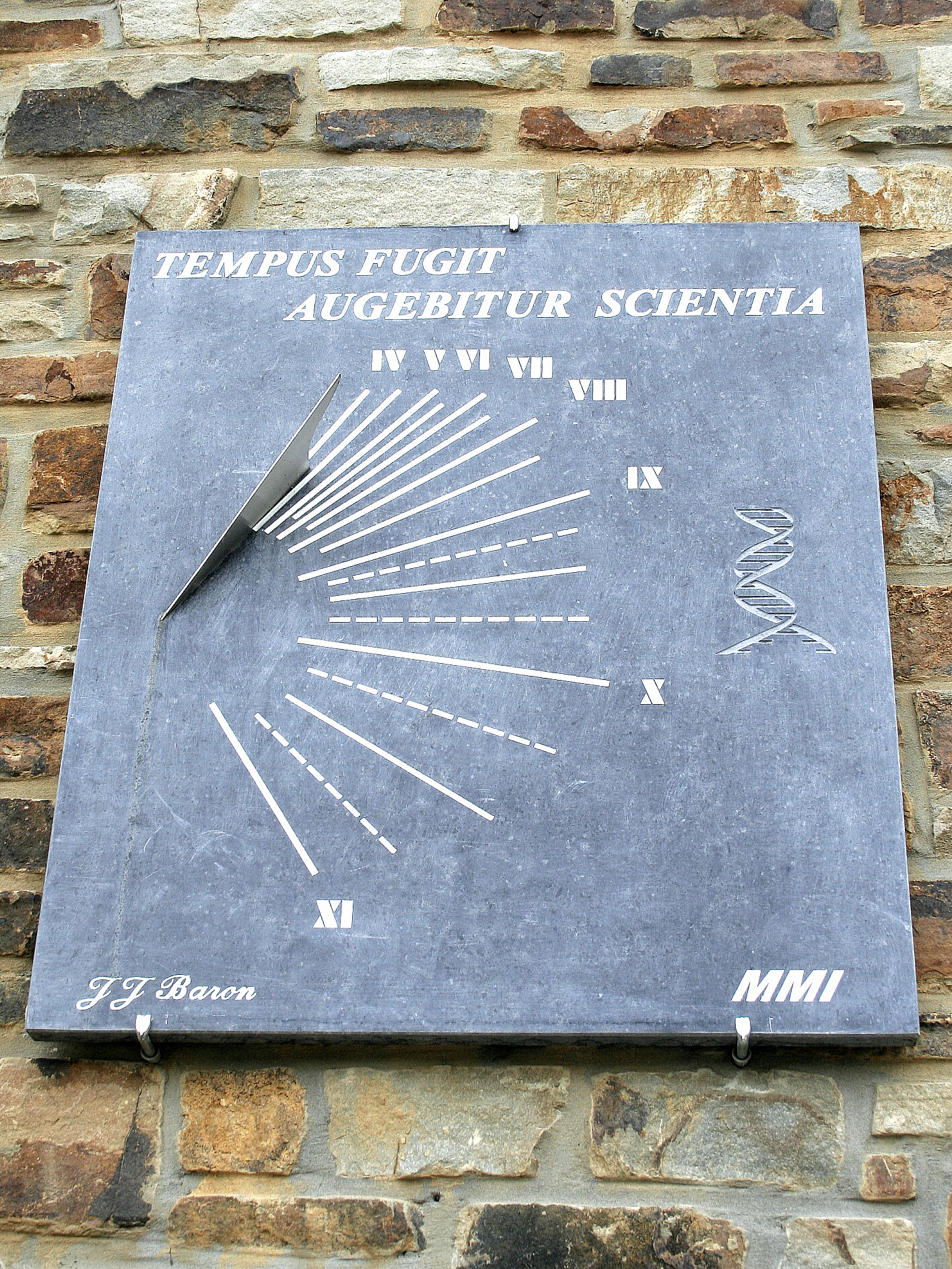
Tempus fugit is typically employed as an admonition against sloth and procrastination (cf. carpe diem) rather than an argument for licentiousness (cf. "gather ye rosebuds while ye may"); the English form is often merely descriptive: "time flies like the wind", "time flies when you're having fun".
The phrase is a common motto, particularly on sundials and clocks. It also has been used on gravestones.
Some writers have attempted rebuttals: "Time goes, you say? Ah, no! alas, time stays, we go." by Henry Austin Dobson (1840–1921)."Hêd Amser! / Meddi Na! / Erys Amser / Dyn Â" on sundial at Univ of Bangor, North Wales. says the sundial was commissioned by Sir William Henry Preece, and offers an English equivalent: "Time flies, thou sayest – Nay! Man flies; Time still doth stay." Another English version is: "Time Flies, Say Not So: Time Remains,'Tis Man Must Go."
Bud Powell's composition "Tempus Fugue-it" is a pun on the phrase.
In the ''Georgics''
The phrase's full appearance in Virgil's Georgics is:
| Original | ||
|---|---|---|
| (Virgil) | Translation | |
| (Dryden) | Translation | |
| (Rhoades) | ||
| Omne adeo genus in terris *hominumque ferarumque* | Thus every Creature , and of every Kind , | |
| The secret Joys of sweet Coition find : | ||
| Not only Man's Imperial Race ; . . . | Nay, every race on earth of men, and beasts, | |
| et genus aequoreum, pecudes *pictae*que volucres, | . . . but they | |
| That wing the liquid Air ; or swim the Sea , | ||
| Or haunt the Desart , . . . | And ocean-folk, and flocks, and painted birds, | |
| in furias *ignem*que ruunt: amor omnibus idem. ... | . . . rush into the flame : | |
| For Love is Lord of all ; and is in all the same . | Rush to the raging fire: love sways them all. | |
| Sed fugit interea, fugit inreparabile tempus, | But time is lost , which never will renew , | Fast flies meanwhile the irreparable hour, |
| singula dum capti circumvectamur amore. | While we too far the pleasing Path pursue ; | |
| Surveying Nature , with too nice a view . | As point to point our charmed round we trace. |
References
References
- [[Publius Vergilius Maro. Vergilius Maro, Publius]]. [[s:la:Georgicon/Liber III. ''Georgicon'', III]]. c. 29 BC. Hosted at [[Wikisource]]. {{in lang. la
- [[John Dryden
- [[James Rhoades. Rhoades, James]] (trans.). [http://classics.mit.edu/Virgil/georgics.3.iii.html ''Bucolics, Aeneid, and Georgics of Vergil'']. Ginn & Co. (Boston), 1900. Hosted at MIT. Accessed 30 May 2014.
This article was imported from Wikipedia and is available under the Creative Commons Attribution-ShareAlike 4.0 License. Content has been adapted to SurfDoc format. Original contributors can be found on the article history page.
Ask Mako anything about Tempus fugit — get instant answers, deeper analysis, and related topics.
Research with MakoFree with your Surf account
Create a free account to save articles, ask Mako questions, and organize your research.
Sign up freeThis content may have been generated or modified by AI. CloudSurf Software LLC is not responsible for the accuracy, completeness, or reliability of AI-generated content. Always verify important information from primary sources.
Report