From Surf Wiki (app.surf) — the open knowledge base
Temple tube station
London Underground station

London Underground station
| Field | Value |
|---|---|
| name | Temple |
| manager | London Underground |
| locale | Victoria Embankment |
| borough | City of Westminster |
| platforms | 2 |
| fare_zone | 1 |
| image_name | templetube.jpg |
| caption | Entrance on Victoria Embankment |
| coordinates | |
| map_type | Central London |
| original | District Railway |
| years1 | 30 May 1870 |
| years2 | 1 February 1872 |
| years3 | 1 August 1872 |
| years4 | 30 June 1900 |
| years5 | 31 December 1908 |
| events1 | Opened |
| events2 | Started "Outer Circle" (NLR) |
| events3 | Started "Middle Circle" (H&CR/DR) |
| events4 | Ended "Middle Circle" |
| events5 | Ended "Outer Circle" |
| tubeexits05 | 6.621 |
| tubeexits06 | 7.189 |
| tubeexits07 | 7.349 |
| tubeexits08 | 6.770 |
| tubeexits09 | 9.642-- |
| interchange | Blackfriars |
| interchange_note |


Temple is a London Underground station located at Victoria Embankment in the City of Westminster, close to its boundary with the City of London. It is on the Circle and District lines between Embankment and Blackfriars stations, and is in London fare zone 1.
The station was opened on 30 May 1870 with the name The Temple, from the Temple area in the vicinity of Temple Church, and from the Inner Temple and the Middle Temple, two of the four Inns of Court of London. The definite article in the name fell out of use quite early.
History
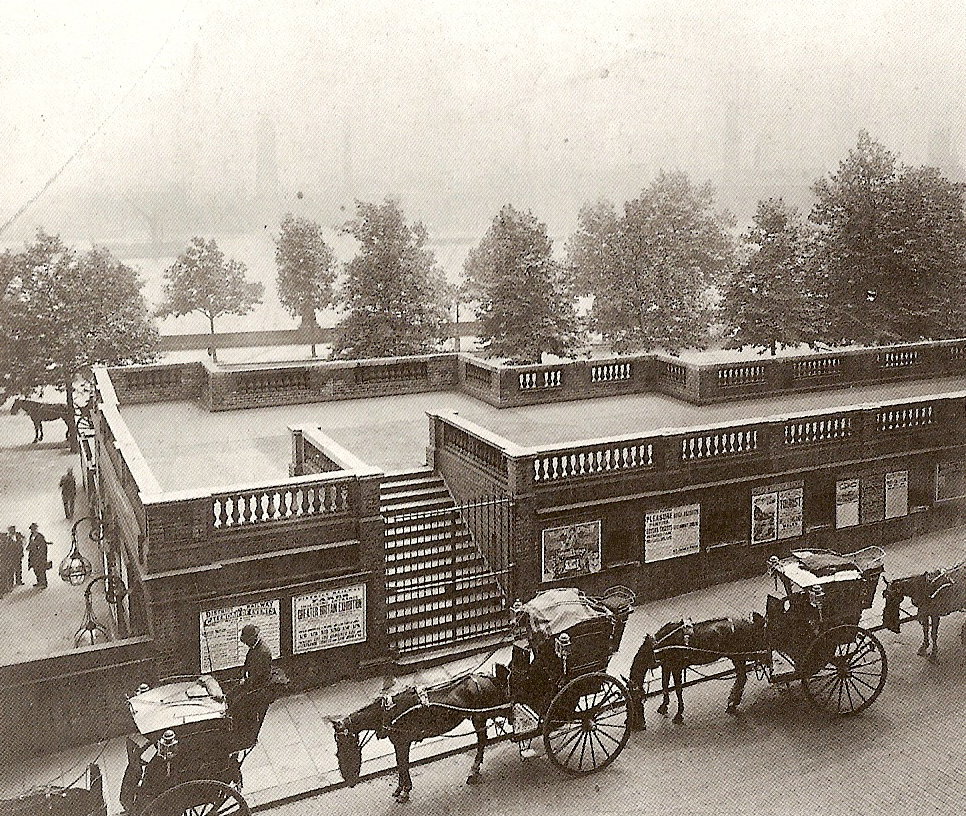
The Temple station was opened in the parish of St. Clement Danes on 30 May 1870 by the District Railway (DR; now the District line) when the company extended its line from Westminster to St. Paul's station (now called Blackfriars). The construction of the new section of the DR was planned in conjunction with the building of the Victoria Embankment and was achieved by the cut and cover method of roofing over a shallow trench. The current station was designed by the architect, Harry Ford. The building was limited to a single story at the insistence of local property owners.
The DR connected to the Metropolitan Railway (MR; now the Metropolitan line) at South Kensington and, although the two companies were rivals, each company operated its trains over the other's tracks in a joint service known as the "Inner Circle".

On 1 February 1872, the DR opened a northbound branch from its station at Earl's Court to connect to the West London Extension Joint Railway (WLEJR, now the West London line) which it connected to at Addison Road station (now Kensington (Olympia)). From that date the "Outer Circle" service began running over the DR's tracks. The service was run by the North London Railway (NLR) from its terminus at Broad Street (now demolished) in the City of London via the North London line to Willesden Junction, then the West London Line to Addison Road and the DR to Mansion House, which was the new eastern terminus of the DR.
From 1 August 1872, the "Middle Circle" service also began operations through the station running from Moorgate along the MR's tracks on the north side of the Inner Circle to Paddington then over the Hammersmith & City Railway (H&CR) track to Latimer Road then, via a now demolished link, to the West London line to Addison Road and the DR to Mansion House. The service was operated jointly by the H&CR and the DR.
On 30 June 1900, the Middle Circle service was withdrawn between Earl's Court and Mansion House.
At the beginning of the 20th century early plans for the Great Northern and Strand Railway (later incorporated into the Great Northern, Piccadilly & Brompton Railway and now part of the Piccadilly line) included a proposal for the line to continue to Temple. The plan was rejected and the route was ended instead at the now closed Aldwych station, about 200 m to the north.
On 31 December 1908, the Outer Circle service was withdrawn from the DR tracks.
In 1949, the Metropolitan line-operated Inner Circle route was given its own identity on the Tube map as the Circle line.
For many years, Temple station was closed on Sundays. In the new Tube Map of March 2005, it stated that it would be open on Sundays from 8th May 2005 onwards.
The rooftop of the station has been converted into an open-air art exhibition space known as The Artist's Garden.
References
References
- {{Citation London station interchange June 2020
- (2001). "The Moving Metroplois". Lawrence King.
This article was imported from Wikipedia and is available under the Creative Commons Attribution-ShareAlike 4.0 License. Content has been adapted to SurfDoc format. Original contributors can be found on the article history page.
Ask Mako anything about Temple tube station — get instant answers, deeper analysis, and related topics.
Research with MakoFree with your Surf account
Create a free account to save articles, ask Mako questions, and organize your research.
Sign up freeThis content may have been generated or modified by AI. CloudSurf Software LLC is not responsible for the accuracy, completeness, or reliability of AI-generated content. Always verify important information from primary sources.
Report