From Surf Wiki (app.surf) — the open knowledge base
Temple tank
Wells or reservoirs built as part of the temple complex near Indian temples
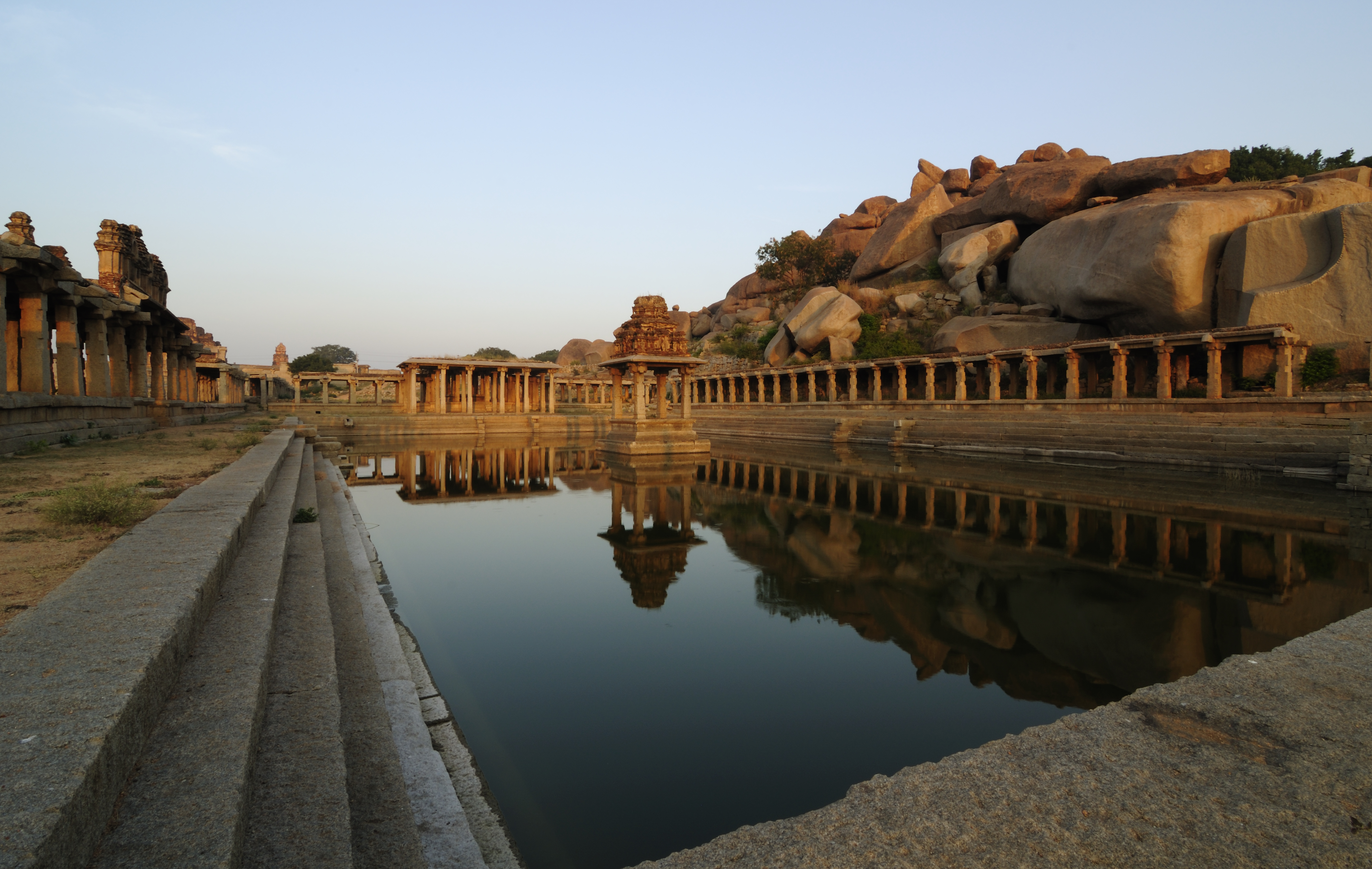
Wells or reservoirs built as part of the temple complex near Indian temples

Temple tanks are wells or reservoirs built as part of the temple complex near Indian temples. They are called pushkarini, kalyani, kunda, sarovara, tirtha, talab, pukhuri, ambalakkuḷam, etc. in different languages and regions of India. Some tanks are said to cure various diseases and maladies when bathed in.{{cite web |access-date=2007-02-24
Tank design
Since ancient times, the design of water storage has been important in India's temple architecture, especially in western India where dry and monsoon seasons alternate. Temple tank design became an art form in itself. An example of the art of tank design is the large, geometrically spectacular Stepped Tank at the Royal Center at the ruins of Vijayanagara, the capital of the Vijayanagara Empire, surrounding the modern town of Hampi. It is lined with green diorite and has no drain. It was filled by aqueduct.{{cite web
The tanks are used for ritual cleansing and during rites of consecration. The water in the tank is deemed to be sacred water from the Ganges River.
Stepwell
In India, a stepwell is a deep masonry well with steps going down to the water level in the well. It is called a vav in west India and a baoli in north India. Some were built by kings and were richly ornamented. They often were built by nobility, some being for secular use from which anyone could obtain water.
Kalyani
Kalyani, also called pushkarani, are ancient Hindu stepped bathing wells.
These wells were typically built near Hindu temples to accommodate bathing and cleansing activities before prayer. They are also used for immersion of Ganesha idols during Ganesha Chaturthi.
Sarovar
In Sikhism, temple tanks are called sarovar (Punjabi: ਸਰੋਵਰ sarōvara).
Gallery
File:Sarovar and the Golden Temple.jpg|Sarovar at the Sikh Harmandir Sahib, the "Golden Temple" at Amritsar, Punjab File:Temple tank (kalyani) at the Chennakeshava temple in Belur.jpg|A temple tank at Chennakesava Temple in Belur, Karnataka. File:Kusuma Sarovar Ghat.jpg|Kusuma Sarovar Ghat in Mathura district, Uttar Pradesh File:Hoysala Stepped Well (Pushkarni) at Hulikere.jpg|Hoysala stepped temple tank at Hulikere, Karnataka File:Shravanabelagola2007 - 05.jpg|Tank at Shravanabelagola, Karnataka File:Mahanandi-pushkarini4.JPG|Large kalyani at Mahanandi, Andhra Pradesh File:Trikuteshwara well.JPG|Well at Trikuteshwara temple, Gadag, Karnataka File:Pond Siva temple Kottakkal.jpg|Pond at Shiva temple near Kottakkal, Kerala File:Temple pond on way to Thiruvalllur.jpg|Temple pond on way to Thiruvalllur, Tamil Nadu File:Chidambaram Nataraja temple tank.JPG|Tank at Thillai Nataraja Temple, Chidambaram, Tamil Nadu File:Pushkarini at Simhachalam.jpg|Pushkarini at Simhachalam File:Yaganti.jpg|Yaganti Tank in Andhra Pradesh File:Kalyani-upper-ahobilam.jpg|Temple tank, Andhra Pradesh File:Boroli Temple Complex7.jpg|Example of a Shiva temple in a tank (Baroli Temples) File:Bhaktapur Garudh Kundal 18.jpg|Garuda Kunda in Bhaktapur, Nepal File:Godawari Temple, Godawari Mela1.jpg|Godawari Kunda, Godawari, Nepal
References
References
- Shuichi Takezawa. (August 2002). "Stepwells – Cosmology of Subterranean Architecture as seen in Adalaj". Journal of Architecture and Building Science.
- "Architecture - Stepwells".
- Thapar, Binda. (2004). "Introduction to Indian Architecture". Periplus Editions.
- "Architecture of the Indian Subcontinent - glossary".
- "Vav / vavdi / Baoli / Bavadi - Traditional stepwells".
- Harban Singh. (1998). "Encyclopedia of Sikhism". Punjabi University.
This article was imported from Wikipedia and is available under the Creative Commons Attribution-ShareAlike 4.0 License. Content has been adapted to SurfDoc format. Original contributors can be found on the article history page.
Ask Mako anything about Temple tank — get instant answers, deeper analysis, and related topics.
Research with MakoFree with your Surf account
Create a free account to save articles, ask Mako questions, and organize your research.
Sign up freeThis content may have been generated or modified by AI. CloudSurf Software LLC is not responsible for the accuracy, completeness, or reliability of AI-generated content. Always verify important information from primary sources.
Report