From Surf Wiki (app.surf) — the open knowledge base
Tempest in a teapot
English idiom
English idiom
Tempest in a teapot (American English), or also phrased as storm in a teacup (British English), or tempest in a teacup, is an idiom meaning a small event that has been exaggerated out of proportion. There are also lesser known or earlier variants, such as storm in a cream bowl, tempest in a glass of water, storm in a wash-hand basin, and storm in a glass of water.
Etymology
Cicero, in the first century BC, in his De Legibus, used a similar phrase in Latin, possibly the precursor to the modern expressions, Excitabat enim fluctus in simpulo ut dicitur Gratidius, translated: "For Gratidius raised a tempest in a ladle, as the saying is". Then in the early third century AD, Athenaeus, in the Deipnosophistae, has Dorion ridiculing the description of a tempest in the Nautilus of Timotheus by saying that he had seen a more formidable storm in a boiling saucepan. The phrase also appeared in its French form une tempête dans un verre d'eau ('a tempest in a glass of water'), to refer to the popular uprising in the Republic of Geneva near the end of the eighteenth century.
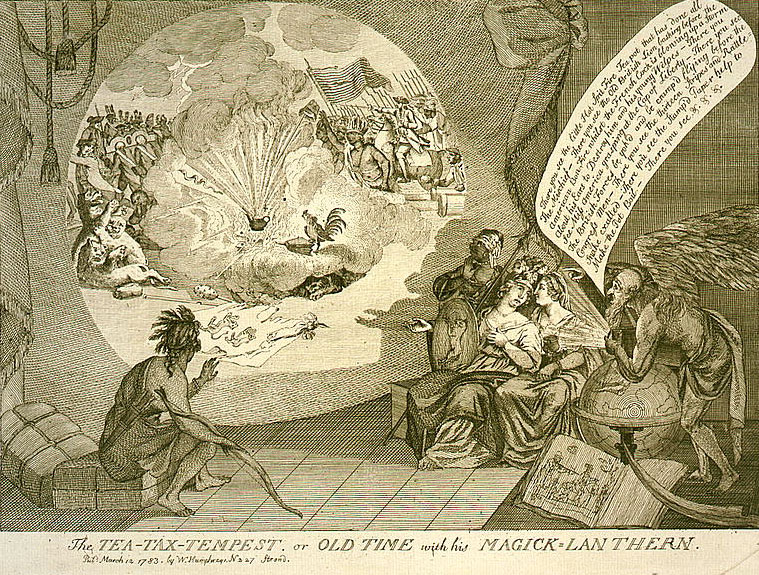
One of the earliest occurrences in print of the modern version is in 1815, where Britain's Lord Chancellor Thurlow, sometime during his tenure of 1783–1792, is quoted as referring to a popular uprising on the Isle of Man as a "tempest in a teapot". Also Lord North, Prime Minister of Great Britain, is credited for popularizing this phrase as characterizing the outbreak of American colonists against the tax on tea. This sentiment was then satirized in Carl Guttenberg's 1778 engraving of the Tea-Tax Tempest (shown above right), where Father Time flashes a magic lantern picture of an exploding teapot to America on the left and Britannia on the right, with British and American forces advancing towards the teapot. Just a little later, in 1825, in the Scottish journal Blackwood's Edinburgh Magazine, a critical review of poets Hogg and Campbell also included the phrase "tempest in a teapot".
The first recorded instance of the British English version, "storm in teacup", occurs in Catherine Sinclair's Modern Accomplishments in 1838. There are several instances though of earlier British use of the similar phrase "storm in a wash-hand basin".
Other languages
A similar phrase exists in numerous other languages:
- ar ('a storm in a cup')
- bn ('storm in a teacup')
- bg ('storm in a glass of water')
- 茶杯裡的風波、茶壺裡的風暴 ('winds and waves in a teacup; storm in a teapot')
- ('a storm in a glass of water')
- ('a storm in a glass of water')
- ('a storm in a glass of water')
- ('a large storm in a small glass')
- ('storm in a glass of water')
- ('typhoon in a teacup')
- ('storm in a glass of water')
- ('a storm in a glass of water')
- German: Sturm im Wasserglas ('storm in a glass of water')
- he ('storm in a teacup')
- Hindi: चाय की प्याली में तूफ़ान ('storm in a teacup')
- ('a storm in a glass of water')
- ('a storm in a glass of water')
- ('a storm in a glass of water')
- ja ('a storm in a glass')
- ko ('a typhoon in a teacup')
- ('to stir up waves in a ladle')
- ('storm in a glass of water')
- ('storm in a glass')
- ml ('storm in a tea cup')
- (Bokmål)/storm i eit vassglas (Nynorsk) ('a storm in a glass of water')
- fa ('to make a mountain out of hay - or a haystack')
- ('a storm in a glass of water')
- ('storm in a glass of water/a tempest in a glass of water')
- ('storm in a glass of water')
- ru ('storm in a glass of water')
- sr ('storm in a glass of water')
- ('a storm in a glass of water')
- ('storm in a glass of water')
- Turkish: bir kaşık suda fırtına ('storm in a spoon of water')
- Telugu: te ('storm in a tea cup')
- ('storm in a tea cup')
- Ukrainian: Буря в склянці води uk ('a tempest in a glass of water')
- Urdu: ur ('storm in a teacup')
- a shturem in a gloz vaser ('a storm in a glass of water'), or אַ בורע אין אַ לעפֿל וואַסער a bure in a lefl vaser ('a tempest in a spoon of water')
References
References
- Christine Ammer, ''The American Heritage dictionary of idioms'', p. 647, Houghton Mifflin Harcourt, 1997 {{ISBN. 0-395-72774-X, 9780395727744
- Reddall, Henry Frederic. (1892). "Fact, fancy, and fable: a new handbook for ready reference on subjects commonly omitted from cyclopaedias". A.C McClurg.
- Bartlett, John. (1891). "Familiar quotations: a collection of passages, phrases, and proverbs traced to their sources in ancient and modern literature". Little, Brown, and company.
- (March 1889). "Whence the phrase "a tempest in a teapot"?". Lippincott's Monthly Magazine: A Popular Journal of General Literature.
- Kett, Henry. (1814). "The flowers of wit, or, A choice collection of bon mots, both antient and modern, with biographical and critical remarks, Volume 2". Lackington, Allen, and co.
- (July 10, 1907). "A Tempest in a Teapot". Hartford Herald.
- Blackwood, William. (1825). "Scotch Poets, Hogg and Campbell". Blackwood's Edinburgh Magazine.
- "Tempest in a teapot". The Phrase Finder.
- Sinclair, Catherine. (1836). "Modern accomplishments ; or, The march of intellect". Waugh and Innes.
- "Storm in a wash-hand basin (pre-1938)". Google Books search.
This article was imported from Wikipedia and is available under the Creative Commons Attribution-ShareAlike 4.0 License. Content has been adapted to SurfDoc format. Original contributors can be found on the article history page.
Ask Mako anything about Tempest in a teapot — get instant answers, deeper analysis, and related topics.
Research with MakoFree with your Surf account
Create a free account to save articles, ask Mako questions, and organize your research.
Sign up freeThis content may have been generated or modified by AI. CloudSurf Software LLC is not responsible for the accuracy, completeness, or reliability of AI-generated content. Always verify important information from primary sources.
Report