From Surf Wiki (app.surf) — the open knowledge base
Telugu-Kannada alphabet
Historic abugida
Historic abugida
| Field | Value |
|---|---|
| name | Telugu-Kannada script |
| altname | Kannada-Telugu script |
| type | Abugida |
| time | 7th century –14th century |
| languages | Kannada |
| Telugu | |
| Tulu | |
| Konkani | |
| Sanskrit | |
| fam1 | Proto-Sinaitic script |
| fam2 | Phoenician alphabet |
| fam3 | Aramaic alphabet |
| fam4 | Brahmi script |
| fam5 | Kadamba script |
| sisters | Pyu |
| children | Kannada script, Telugu script |
| sample | Copper plates NMND-9.JPG |
| caption | Copper plate inscriptions in Kannada–Telugu script |
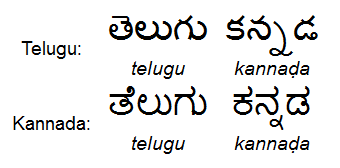
Telugu Tulu Konkani Sanskrit The Telugu–Kannada script (or Kannada–Telugu script) was a writing system used in Southern India. Despite some significant differences, the scripts used for the Telugu and Kannada languages remain quite similar and highly mutually intelligible. Satavahanas and Chalukyas influenced the similarities between Telugu and Kannada scripts.
History
The Dravidian family comprises about 73 languages including Telugu, Tamil, Kannada, and Malayalam. Satavahanas introduced the Brahmi to present-day Telugu and Kannada-speaking regions. But according to Georg Bühler, it seems more likely that the Bhattiprolu script represents a provincial offshoot of early Brahmi in the south, rather than a separate line of development from a hypothetical Semitic prototype itself, as Bühler believed.
During the 5th to 7th centuries the early Bādāmi Chālukyās and early Banavasi Kadambās used an early form of the Kadamba script in inscriptions. When Chalukya empire extended towards Telugu speaking regions they established another branch in Vengi, namely the Eastern Chalukyas or the Chalukyas of Vengi who later introduced Kadamba script to Telugu language which developed into the Telugu-Kannada script which was used between the 7th and 11th centuries CE.
Between 1100 CE and 1400 CE, the Telugu and Kannada scripts separated from the Telugu-Kannada script. Both the Telugu and Kannada scripts were standardised at the beginning of the nineteenth century.
Comparison
The following sections visualize the differences between modern-day Telugu (displayed on the left) and corresponding Kannada letters (displayed on the right).
Consonants
There is another legacy consonant ೞ/ఴ (ḻa) used to represent , but currently not in use.
Vowels
Independent vowels
Numerals
Unicode
Main article: Telugu (Unicode block), Kannada (Unicode block)
Although the alphabets for Telugu and Kannada languages could have been encoded under a single Unicode block with language-specific fonts to differentiate the styles, they were encoded separately by the governments due to socio-political reasons. Both the script variants were added to the Unicode Standard in October 1991 with the release of version 1.0.
References
Citations Bibliography
References
- "Evolution of Telugu Character Graphs".
- The Blackwell Encyclopedia of Writing Systems by Florian Coulmas, p. 228
- Handbook of Literacy in Akshara Orthography, R. Malatesha Joshi, Catherine McBride (2019), p. 29
- "Indian Epigraphy".
- "Epigraphical Studies in India - Sanskrit and Dravidian, Scripts used in India, Scripts Abroad".
- (1948). "Alphabet a key to the history of mankind".
- Austin, Peter. (2008). "One Thousand Languages: Living, Endangered, and Lost". [[University of California Press]].
This article was imported from Wikipedia and is available under the Creative Commons Attribution-ShareAlike 4.0 License. Content has been adapted to SurfDoc format. Original contributors can be found on the article history page.
Ask Mako anything about Telugu-Kannada alphabet — get instant answers, deeper analysis, and related topics.
Research with MakoFree with your Surf account
Create a free account to save articles, ask Mako questions, and organize your research.
Sign up freeThis content may have been generated or modified by AI. CloudSurf Software LLC is not responsible for the accuracy, completeness, or reliability of AI-generated content. Always verify important information from primary sources.
Report