From Surf Wiki (app.surf) — the open knowledge base
Telephone booth
Small structure furnished with a payphone
.jpg)
Small structure furnished with a payphone

A telephone booth, phone booth, telephone kiosk, telephone call box, telephone box or public call box is a tiny structure furnished with a payphone and designed for a telephone user's convenience; typically the user steps into the booth and closes the booth door while using the payphone inside.
In the United States and Canada, "telephone booth" (or "phone booth") is the commonly used term for the structure, while in the Commonwealth of Nations (particularly the United Kingdom and Australia), it is a "phone box".
Such a booth usually has lighting, a door to provide privacy, and windows to let others know if the booth is in use. The booth may be furnished with a printed directory of local telephone numbers, and in a formal setting, such as a hotel, may be furnished with paper and pen and even a seat. An outdoor booth may be made of metal and plastic to withstand the elements and heavy use, while an indoor booth (known as a silence cabinet) may have more elaborate design and furnishings. Most outdoor booths feature the name and logo of the telephone service provider.
History
.jpg)

The world's first telephone box called "Fernsprechkiosk", was opened on 12 January 1881 at Potsdamer Platz, Berlin. To use it, one had to buy paper tickets called Telefonbillet which allowed for a few minutes of talking time. In 1899, it was replaced by a coin-operated telephone.
William Gray is credited with inventing the coin payphone in the United States in 1889, and George A. Long was its developer.
In the UK, the creation of a national network of telephone boxes commenced in 1920, beginning with the K1 model which was made of concrete; however, the city of Kingston upon Hull is noted for having its individual phone service, Kingston Communications, with cream coloured phone boxes, as opposed to classic royal red in the rest of Britain. The Post Office was forced into allowing a less strident grey with red glazing bars scheme for areas of natural and architectural beauty. Ironically, some of these areas that have preserved their telephone boxes have now painted them red.
In the 1940s, at military bases during WWII, outdoor booths started to appear. But in general they were most commonly placed indoors, as they were mostly made of wood and didn't handle exposure to the elements well. This changed in 1954, when the Airlight outdoor telephone booth was introduced. Being made of glass and aluminium, they were designed especially for the outdoors and originally intended to serve motorists traveling on the highway.
Design

Starting in the 1970s, pay telephones were less commonly placed in booths in the United States. In many cities where they were once common, telephone booths have now been almost completely replaced by non-enclosed pay phones. In the United States, this replacement was caused, at least in part, by an attempt to make the pay telephones more accessible to disabled people. However, in the United Kingdom, telephones remained in booths more often than the non-enclosed setup. Although still fairly common, the number of phone boxes has declined sharply in Britain since the late 1990s due to the rise in use of mobile phones.
Many locations that provide pay-phones mount the phones on kiosks rather than in booths—this relative lack of privacy and comfort discourages lengthy calls in high-demand areas such as airports.
Special equipment installed in some telephone booths allows a caller to use a computer, a portable fax machine, or a telecommunications device for the deaf.
The Jabbrrbox, an enclosed structure for installation in open plan offices, was inspired by the telephone booth.
Cultural impact
The ubiquity of the phone booth led to its depiction in fiction. In comic books published by DC Comics, the telephone booth is occasionally the place where reporter Clark Kent discards his street clothing and transforms into the costumed superhero Superman. Some films and television series have reused or parodied this plot device. The 1965–1970 television series Get Smart used a phone booth, among other devices, as a secure means of entering CONTROL headquarters. The 2002 film Phone Booth takes place almost entirely in a telephone booth; a 2023 retrospective article notes that "the obsolescence is to the film's advantage."
La cabina ("The Telephone Box") is a 1972 Spanish television film directed by Antonio Mercero, and written by himself and José Luis Garci, starring José Luis López Vázquez. It first aired on 13 December 1972 on Televisión Española. In the 35-minute film, a man becomes trapped in a telephone booth, while passersby seem unable to help him. The film won the 1973 International Emmy Award for Fiction, the only Spanish programme to have won it.
The 1986 comedy film Clockwise features John Cleese's character vandalising a phone in a booth in frustration after it malfunctions. The scene played on the public perception in Britain at the time that telephone booths were frequently out of order.
The cover photograph of the album Deadlines (Strawbs) shows an upside-down man trapped inside a telephone booth full of water. The background shows a flat landscape during sunset circumstances. Photo Hipgnosis.
Privacy
Phone booths have been subject to wireless surveillance by law enforcement. For example, the landmark U.S. Supreme Court case of Katz v. United States involved the Constitutional question of whether the Federal Bureau of Investigation (FBI) could install a listening device outside of the booth.
Recent developments


Wireless services
The increasing use of mobile phones has led to a decreased demand for payphones, while the increasing use of laptops is leading to a new kind of service: in 2003, service provider Verizon announced that it would begin offering wireless computer connectivity in the vicinity of its phone booths in Manhattan. In 2006, the Verizon Wi-Fi telephone booth service was discontinued in favor of the more expensive Verizon Wireless' EVDO system.
Wireless access is motivating telephone companies to place wireless stations at locations that have traditionally hosted telephone booths, but stations are also appearing in new kinds of locations such as libraries, cafés, and trains. Phone booths have been slowly disappearing with the growth in use of mobile phones.
Vandalism
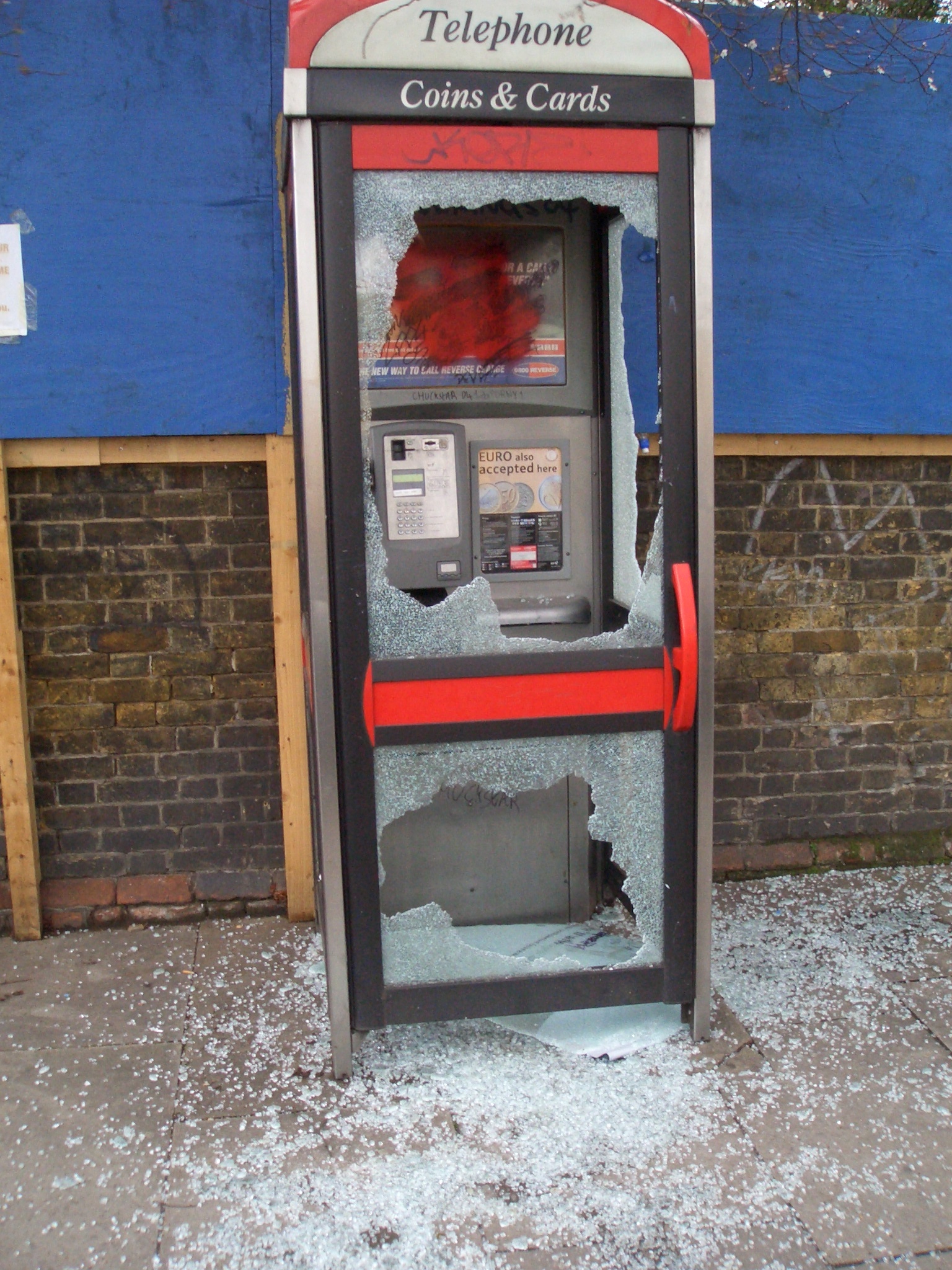
A rise in vandalism has prompted several companies to manufacture simpler booths with extremely durable pay phones.
Withdrawal of services
Pay phones may still be used by mobile/cellular phone users if their phone become unusable, is stolen, or for other emergency uses. These uses may make the complete disappearance of pay phones in the near future less likely.
Australia
Under the Universal Service Obligation, the Government of Australia legally requires Telstra to ensure standard phone services and payphones are "reasonably accessible to all people in Australia". Some communities, particularly in remote regional areas, rely on payphones, as well as people who do not have access to a mobile phone.
At their peak in the early 1990s, there were more than 80,000 public phone boxes across the country. By June 30, 2016, according to the Australian Communications & Media Authority there were about 24,000 payphones across Australia. On August 3, 2021, with 15,000 public phones remaining across Australia, Telstra announced that all calls to fixed line and mobile phones within Australia from public phones would become free of charge, and that it had no plans to further eliminate public phones.
Belgium
In Belgium, majority state-owned telco Belgacom took the last remaining phone booths out of service in June 2015.
Czech Republic
In June 2021 the last phone booth in the Czech Republic was closed and dismantled.
Denmark
In December 2017 the last three public telephone booths in Denmark had their telephones removed. They were situated in the town of Aarhus.
Finland

By 2007, Finnet companies and TeliaSonera Finland had discontinued their public telephones, and the last remaining operator Elisa Oyj did so early the same year.
France
According to Orange CEO, Stéphane Richard, there were only 26 public phone booths still operating in France as of 2021. The "Macron law" of 2015 ended Orange mandatory maintenance of a public phone booth network, its decline in use being caused by the cell phones era. These are, by law, maintained in rural area where there is no cell phone service. Consequently, they are removed once the area is properly covered by at least one mobile phone operator.

Ireland
.jpg)
Eir, the Universal Service Obligation carrier with regard to payphones, has been systematically removing payphones which fall under the minimum requirement for retention, of a rolling average of one minute of usage a day over six months.
As of June 2019, 456 locations retained payphones (with none in the entirety of County Leitrim); this was down from 1,320 in March 2014.
Italy
In May 2023 AGCOM established that TIM no longer has the obligation to guarantee the availability of telephone booths, with the exception of "places of social importance", such as hospitals (with at least ten beds), prisons, and barracks with at least fifty occupants. TIM will also be able to decommission booths in mountain refuges, while ensuring access to the mobile telephone network. AGCOM declared that 99.2% of public telephones are already covered by a mobile network with at least 2G technology (May 2023). In September 2023 over 90,000 booths which do not fall into the above-mentioned exceptions began being removed.
Jordan
In 2004, Jordan became the first country in the world not to have telephone booths generally available. The mobile/cellular phone penetration in that country has become so high that telephone booths had been rarely used for years. The two private payphone service companies, namely ALO and JPP, closed down.
Norway
The last functioning phone box in Norway was taken out of service in June 2016. However, 100 phone boxes have been preserved around the country and are protected under cultural heritage laws.
Sweden
The first telephone booth in Sweden was erected in 1890. In 1981 there were 44,000, but by 2013, only 1,200 remained, with the removal of the last one in 2015. A survey showed that in 2013, only 1% of the population in Sweden had used one during the previous year.
United Kingdom
Main article: Red telephone box, KX_telephone_boxes
The red telephone kiosk is recognised as a British icon and the BT Group still hold intellectual property rights in the designs of many of the telephone boxes, including registered trademark rights. BT is steadily removing public telephone kiosks from the streets of the UK. It is permitted to remove a kiosk without consultation provided that there is another kiosk within 400 m walking distance. In other cases, it is required to comply with Ofcom rules in consultation with the local authority. Some decommissioned red telephone boxes have been converted for other uses with the permission of BT Group, such as housing small community libraries or automated external defibrillators.
United States

Beginning in the 1990s, many large cities began instituting restrictions on where pay phones could be placed, under the belief that they facilitated crime. Only five percent of those remained in service by 2018. In 2015, a phone booth in Prairie Grove, Arkansas was placed on the National Register of Historic Places. New phone booth installations do sometimes occur, including the installation of a phone booth at Eaton Rapid's city hall.
In 2018, about a fifth of America's 100,000 remaining pay phones were in New York, according to the FCC.
Advertising
Many telephone boxes in the United Kingdom are now used for advertisements, bearing posters, with the development of "StreetTalk" by JCDecaux. This is in addition to the ST6 public telephone introduced in 2007 which is designed to feature a phone on one side and a JCDecaux-owned advertising space on the otherside. The advertising pays for the cost of maintaining the phone.
In 2018, the UK Local Government Association drew attention to "Trojan" telephone boxes. These are telephone boxes whose main purpose is advertising. A loophole in planning law allows these to be erected without planning permission and the LGA is seeking to close this loophole.
File:Phone booth in North Carolina.jpg|Partially enclosed pay phone in North Carolina, typical of many early replacements for telephone booths in the United States, continuing an enclosed space on three sides without the booth. File:Public Phone Booth - Kashmar (5).JPG|Public telephones in Kashmar, Iran; such structures replaced earlier booth enclosed telephones late in the 20th century File:Telephone box with internet access.JPG|Pay telephone with internet access in Münster, Germany. March 2014, still using the old booth format but without a door. File:Telefonzelle bei der Jesuitenkirche in Luzern.jpg|Modern telephone booth in Lucerne, Switzerland File:ManUsingPhoneBox Footscray.JPG|An example of a person using a Telstra phone box in Victoria, Australia; used after telephone booths were phased out. File:Telstra Payphone (With Internet Access) .jpg|A Telstra payphone booth in Australia that also serves as a Wi-Fi hotspot to access the internet, an example of a modern pay phone that supplanted the telephone booth. File:Orelhao ctbc.JPG|Telephone kiosk in Brazil, popularly called orelhão ("big ear") because of its shape File:London telephone booth.jpg|A decommissioned telephone booth in Ilford, London, 2022 File:Berlin telephone booth.jpg|A decommissioned telephone booth in Berlin, 2022 File:Public phone box in Belém (Pará) 01.jpg|Telephone kiosk in Brazil, popularly called orelhão ("big ear") in the special form of an animal, here a parrot, in Belém, 2001
References
References
- (21 March 2016). "Phone Boxes". legendarydartmoor.co.uk.
- [http://www.urbandesignlondon.com/?p=7168 Discussion Note on Phone Boxes, Kiosks and ATM machines] at Urban Design London
- Sag, Ivan. "Multiword Expressions: A Pain in the Neck for NLP". Stanford University.
- "Public Telephones". Melchior Telematics.
- "Das war 1881 - Ereignisse 1881". was-war-wann.de.
- "Site of World's First Pay Phone". ctmuseumquest.com.
- [https://www.archpaper.com/2015/11/national-park-service-calls-arkansas-phone-booth-significant-contributer-american-history/ Here's how a phone booth on the side of a highway in Arkansas landed on the National Register of Historic Places]
- [https://web.archive.org/web/20241229041757/https://www.texarkanagazette.com/news/2016/dec/11/phone-booth-company-allows-free-local-calls/ Phone booth company allows free local calls]
- Younis, Steve. "Superman and the Phone Booth". SupermanHomepage.com.
- (August 13, 2017). "A Place for Inside-the-Box Thinking". The New York Times.
- (April 4, 2023). "Phone Booth's Obsolescence Works To Its Thrilling Advantage". Paste Magazine.
- Mateos-Pérez, Javier. (3 September 2012). "Qué cosas vimos con Franco...". Ediciones Rialp.
- García García, Andrés. (11 January 2011). "Psicología y cine: vidas cruzadas". Editorial [[UNED]].
- Faulkner, Sally. (11 April 2013). "A History of Spanish Film: Cinema and Society 1910-2010". [[Bloomsbury Publishing USA]].
- "Clockwise".
- Lewin, David. (25 October 1987). "Python's Cleese stars are a salesman for "Wanda"". Los Angeles Times.
- Agur, Colin. (2013). "Negotiated Order: The Fourth Amendment, Telephone Surveillance, and Social Interactions, 1878-1968". Information & Culture.
- Jen Chung. (2 May 2005). "Goodbye Free Verizon WiFi". Gothamist LLC.
- (August 3, 2021). "Local, national and calls to mobiles will now be free from Telstra payphones". [[ABC News (Australia).
- [https://web.archive.org/web/20150828123319/http://www.eurocomms.com/industry-news/10714-belgacom-hangs-up-on-belgium-s-last-phone-booths Belgacom hangs up on Belgium's last phone booths], eurocomms.com; accessed 11 October 2017.
- (17 June 2021). "Last Czech phone booth to be removed".
- "V Čechách končí éra telefonních budek. Nadace O2 jako jejich poslední připomínku spouští charitativní aukci".
- David Rue Honoré. (20 December 2017). "Danmarks sidste mønttelefon er taget ned". [[Berlingske Tidende]].
- (15 November 2006). "Elisa luopuu yleisöpuhelinliiketoiminnasta syksyllä 2007". Elisa Oyj.
- (2021-04-23). "Il ne resterait plus que 26 cabines téléphoniques en France". Elisa Oyj.
- (3 August 2016). "Ever wonder why there are still payphones around Ireland? Here's why".
- Online, eir. "Advertise with us • eir ie".
- (26 May 2023). "Le cabine telefoniche non servono più".
- (22 March 2004). "Payphones suffer from cellphone growth 2004". CellularOnline.
- HJERTHOLM, TOM R.. (Feb 1, 2018). "– En ny tid venter kioskene".
- [https://www.dn.se/nyheter/sverige/sallsynt-telefonkiosk-overlever/ Sällsynt telefonkiosk överlever] (Swedish)
- [http://www.telia.se/media/2013/09/25/telefonkiosken-tackar-for-sig/7f2ba02a-e4ce-4db1-a3f6-c408d3f03367 Telefonkiosken tackar för sig] {{webarchive. link. (4 October 2013)
- "BBC - Press Office - The Great British Design Quest".
- (March 14, 2006). "Guidance on procedures for the removal of public call boxes".
- Professor Wu. (2018-11-03). "British phone box libraries".
- "CONVERT A PHONE BOX {{!}} Community Heartbeat Trust".
- Meyersohn, Nathaniel. (19 March 2018). "There are still 100,000 pay phones in America". CNN Money.
- Reizman, Renee. (2 February 2017). "What Killed the Pay Phone?". The Atlantic Monthly Group LLC.
- Bowden, Bill. (5 April 2015). "Phone booth historic site, hello?". Smithsonian Institution.
- Flory, Brad. (3 December 2014). "Brad Flory column: Why one 21st century city put a telephone booth on Main Street". MLive.com.
- Carlson, Jen. (28 February 2020). "Most Of The Last Remaining Pay Phones In NYC Will Be Ripped Out". Gothamist.
- "StreetTalk".
- "LGA: call for crackdown on 'trojan' telephone boxes amid 900 per cent rise in some areas".
This article was imported from Wikipedia and is available under the Creative Commons Attribution-ShareAlike 4.0 License. Content has been adapted to SurfDoc format. Original contributors can be found on the article history page.
Ask Mako anything about Telephone booth — get instant answers, deeper analysis, and related topics.
Research with MakoFree with your Surf account
Create a free account to save articles, ask Mako questions, and organize your research.
Sign up freeThis content may have been generated or modified by AI. CloudSurf Software LLC is not responsible for the accuracy, completeness, or reliability of AI-generated content. Always verify important information from primary sources.
Report