From Surf Wiki (app.surf) — the open knowledge base
Tegu
Common name of a number of species of lizards
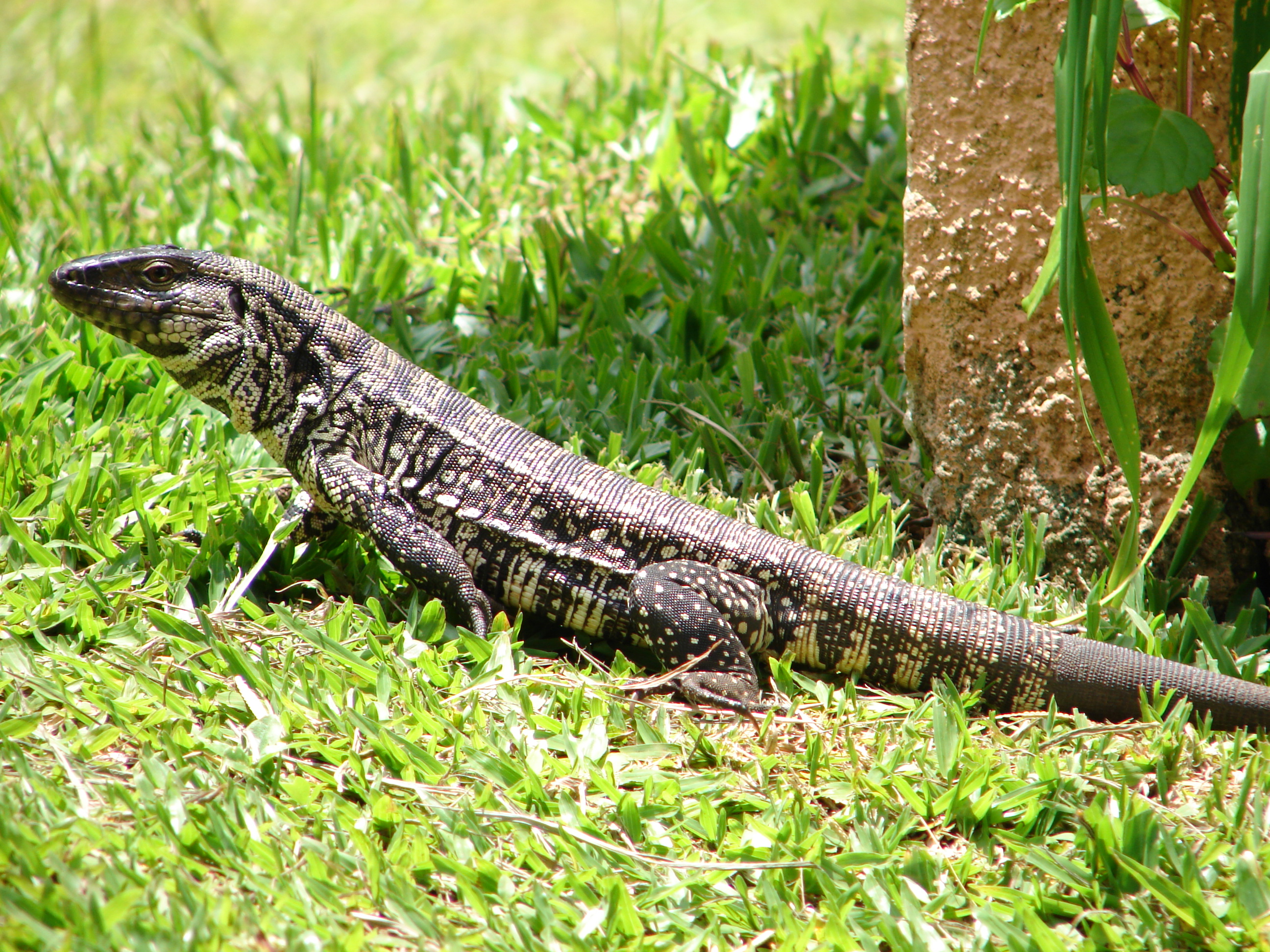
Common name of a number of species of lizards
lizards
Main article: Tupinambis, Teius
Tegu is a common name of a number of species of lizards that belong to the families Teiidae and Gymnophthalmidae. Tegus are native to Central and South America. They occupy a variety of habitats and are known for their large size and predatory habits.
Description
Tegus are, usually, black mixed with other colors and patterns; some have yellow, reddish or white bands along their backs, others have lines going down their bodies with unique markings on their sides. Their body shape is aerodynamic with long tails and strong legs. Most tegus grow to about a metre long, but the black and white tegu (S. merianae) can grow to about 1.3 m.
Although, in appearance, tegus resemble the Varanidae (monitors), they are not closely related to them. Their initial similarities are an example of convergent evolution, when unrelated or distantly-related species develop physical or behavioral similarities based on ecological niche, adaptations or environment.
Tegus use their tongues and vomeronasal organ to find chemical cues associated with their prey and other lizards. A vomeronasal organ is an organ of chemoreception located in the nasal chamber.
Habitat
Tegus naturally occur in rainforests, deciduous semiarid thorn forests, savannas, fields and grasslands. They have also adapted to open areas created by agriculture, parks and construction zones. They spend much of their time in burrows.
Diet
As omnivores, tegus feed on various foods including fruits, insects, frogs, small rodents, birds, eggs and carrion. Tegus living near humans may raid chicken coops for eggs and baby chicks, or scavenge leftover food such as crackers, cheese and chips.
Behavior
When confronted, a wild tegu initially stops moving with its head held up high, then attempts to flee. It may turn aggressive if cornered, biting and attacking with its tail. In contrast, captive-raised tegus can be docile, intelligent and social with their carers.
Tegus are popular in the international pet trade as owners often compare them to dogs due to their loving, casual nature.
In the coolest areas of their range, such as northern Argentina, tegus hibernate from June to September.
Endothermy
During the reproductive season, Argentine black and white tegus can raise their body temperature by up to 10 °C above the ambient temperature (seasonal reproductive endothermy). This is conjectured to be advantageous for them when coming out of hibernation, regrowing gonads, producing gametes (gametogenesis), mating, and (for females) producing eggs and incubating them.
Importance
Tegus are traditionally hunted for their meat, fat, and hides.
Argentine black and white tegus are widely and successfully bred and kept as pets, with red tegus being slightly less common in the hobby but still present. Additionally, Dracaena guianensis, the northern caiman lizard, is growing in popularity among breeders and hobbyists.
Some species have become invasive in the U.S. state of Florida and southern parts of Georgia.
Invasive populations in the United States
The Argentine black and white tegus (Salvator merianae) have established breeding colonies in multiple areas of Florida beyond their native territory including southern Miami-Dade and southwest Charlotte and west-central Hillsborough and eastern St. Lucie counties and southern Georgia. Tegus are generalist omnivores and efficient egg predators that threaten ground-nesting birds and reptiles (including gopher tortoises and alligators) and may affect Everglades restoration efforts. In Florida, tegus are listed as a Prohibited Species and cannot be possessed without a permit.{{cite web |last1=Johnson |first1=Steve A. |last2=McGarrity |first2=Monica |title=Florida Invader: Tegu Lizard |url=https://edis.ifas.ufl.edu/publication/UW340
Genera
"Tegu" generally refers to species of lizard in the genus Tupinambis, which belongs to the family Teiidae. Not all lizards known as tegus belong to the same genus. The word "tegu" may refer to species in any of the following genera:
- Callopistes: "dwarf tegus" (2 species)
- Crocodilurus: the "crocodile tegu" (1 species)
- Dicrodon: "desert tegus" (3 species)
- Dracaena: "caiman tegus", also known as "caiman lizards" (2 species)
- Euspondylus: "sun tegus" (11 species)
- Proctoporus: "sun tegus" (17 species)
- Salvator (includes the Argentine black and white tegu) (3 species)
- Teius (includes "four-toed tegu") (3 species)
- Tupinambis (8 species)
References
References
- (2018-08-03). "How huge pet South American tegu lizards are invading the US". The Telegraph.
- "Tegu".
- "Pantanal Escapes - Tegu".
- (22 January 2025). "Tegu as pet: 5 reasons why tegus are the best pet lizard".
- (2016). "Seasonal reproductive endothermy in tegu lizards". [[Science Advances]].
- (2006). "Monitoring and managing the harvest of tegu lizards in Paraguay". [[The Journal of Wildlife Management]].
- (2006). "Proximate composition, fatty acids, and cholesterol content of meat cuts from tegu lizard ''Tupinambis merianae''". [[Journal of Food Composition and Analysis]].
- "Do Argentine black and white tegus make good pets?".
- (22 January 2025). "Friendliest tegu species & best tegu for beginners".
- Nuwer, Rachel. (2014-08-04). "A lizard interloper presents a challenge in Florida". [[The New York Times]].
- Maxouris, Christina. (2020-05-14). "Georgia officials are asking the public to help them track 4 foot long, invasive lizards".
- (2022-12-05). "Florida Invader: Tegu Lizard". University of Florida IFAS Extension.
- "Argentine Black and White Tegus". Georgia Department of Natural Resources.
- Mederos, Lourdes. (2021-11-02). "Fighting the tegu spread, protecting Florida's wildlife, natural areas through sustained multiagency efforts". University of Florida.
- (2022-03-09). "New Research Verifies Invasive Tegu Lizards Adaptable to Various Climates". U.S. Geological Survey.
- (2018). "Modeling the distributions of tegu lizards in native and potential invasive ranges". Scientific Reports.
This article was imported from Wikipedia and is available under the Creative Commons Attribution-ShareAlike 4.0 License. Content has been adapted to SurfDoc format. Original contributors can be found on the article history page.
Ask Mako anything about Tegu — get instant answers, deeper analysis, and related topics.
Research with MakoFree with your Surf account
Create a free account to save articles, ask Mako questions, and organize your research.
Sign up freeThis content may have been generated or modified by AI. CloudSurf Software LLC is not responsible for the accuracy, completeness, or reliability of AI-generated content. Always verify important information from primary sources.
Report