From Surf Wiki (app.surf) — the open knowledge base
Teeth blackening
Custom of dyeing one's teeth black
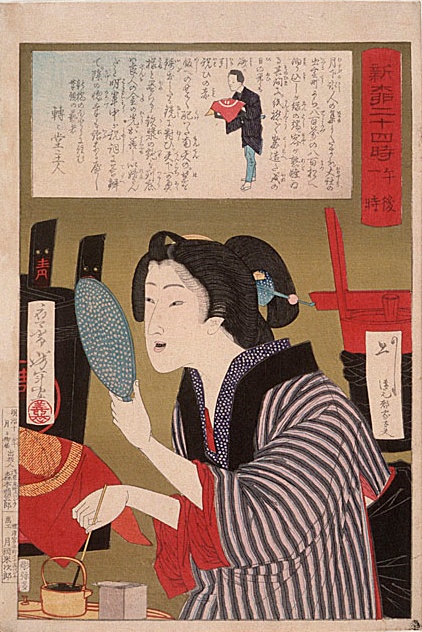
Custom of dyeing one's teeth black
Teeth blackening or teeth lacquering is a custom of dyeing one's teeth black. It was most predominantly practiced in Southeast Asian and Oceanic cultures, particularly among Austronesian, Austroasiatic, and Kra–Dai-speaking peoples. It was also practiced in Japan prior to the Meiji era, as well as in India. .
Teeth blackening is usually done during puberty. It was seen as a sign of maturity, beauty, and civilization. A common belief is that blackened teeth differentiated humans from animals. Teeth blackening is often done in conjunction with traditions of tooth sharpening and dental evulsion, as well as other body modification customs like tattoos. Teeth blackening and filing were regarded with fascination and disapproval by early European explorers and colonists.
The practice survives in some isolated ethnic groups in Southeast Asia and Oceania but has mostly disappeared after the introduction of Western beauty standards during the colonial era. It is mainly prevalent in older women, though the practice is still carried on by some younger women. Sometimes artificial teeth are used to achieve blackened teeth.
Teeth blackening is commonly confused with the red-stained teeth from betel chewing. However, betel chewing damages the teeth and gums, while teeth blackening does not.
East and Southeast Asia
Japan
Main article: Ohaguro
In Japan, teeth blackening is known as . ja existed in one form or another for hundreds of years, and was seen amongst the population as beautiful until the end of the Meiji period (1868–1911). Objects that were pitch black, such as glaze-like lacquer, were seen as beautiful.
Name
The word ja was an aristocratic term. There is an alternate term for ja, . At the old Imperial palace in Kyoto, it was called . Among civilians, such words as , and were used.
History
Traces of blackened teeth can be seen in the buried bones and ja of the Kofun period (300–538 CE). References to ja exist in The Tale of Genji and ja. At the end of the Heian period, at the time when aristocratic men and women reached puberty and celebrated their ja or ja, the Taira clan and other samurai, and pages working at large temples, dyed their teeth using kanemizu, a solution made from ferric acetate, created from soaking iron filings in vinegar, and tannins, derived from vegetables or tea. The Imperial family and other high-ranking aristocrats who had finished their ja (ceremony where a child is fitted with a ja) blackened their teeth and painted their eyebrows (). This was done in the Imperial household until the end of the Edo era.
In the Muromachi period (1336–1573), ja was generally seen among adults, though when the Sengoku period (1467–1615) began, so as to prepare for political marriages of convenience, when the daughters of military commanders were around 8 to 10 years old, they would blacken their teeth as a marking of their coming of age. Relatives and guardians of the bride who blackened their teeth were called . It is said that military commanders who were struck in the head on the battlefield and who did not want to be ugly would wear average women's makeup and would blacken their teeth. These faces imitated the Noh masks of women and young boys.
After the Edo period (1603–1867), only men of the Imperial House of Japan and the aristocracy blackened their teeth. Due to the odor and labor required for the process, as well as a feeling among young women that they were ageing, ja was done only by married women, unmarried women who were older than 18, sex workers and geisha. For rural people, ja was done only at times of special celebrations, such as Japanese festivals, wedding ceremonies, and funerals. There were also depictions of ja in fairy tales, such as "Gon, the Little Fox".
On February 5, 1870, the government banned ja and the process gradually became obsolete. After the Meiji period, it temporarily spread, but it almost entirely died out in the Taishō period (1912–1926).
In contemporary times, the only places where ja can be seen is in plays, on some older apprentice geisha, some festivals, and movies.
Vietnam
History


In Vietnam, teeth blackening (Vietnamese: nhuộm răng) was practiced by the majority Vietnamese people as well as by minority ethnic groups, such as the men of Si La people, who paint their teeth red while the women paint theirs black. These traditions declined in the 20th century, decade by decade with each new generation with in part due to Western influence from French colonists, colonial medical reports from the 1930s, stated that 80 percent of Tonkinese farmers had darkened teeth. Archaeological discovery show that teeth blackening was practiced as early as 400 BCE. Teeth blackening was seen as a sign of beauty. It was also a demonstration of civilization, as there was an idea that white teeth belonged to animals, savages, and evil spirits. In the 1920s, most women in Hanoi had blackened teeth.
Process
The process of teeth blackening begins with the sanitisation of the mouth. This was done by brushing the teeth with a mixture of dried betel, stewed charcoal powder, and salt. Before dyeing the teeth, the person who was dyeing had to chew and rinse their teeth with a rice wine-lemon juice mixture to prepare the surface of the teeth for dyeing. This part of the process is often very painful, as it causes the gums to become swollen. A solution of burnt coconut shells is then used on the teeth to obtain the black coloration. Other solutions that were used to dye the teeth black also included an iron solution.
Accounts
A passage in a 16th century biography of a Korean trader that went to Vietnam, Jowanbyeokjeon (), also mentions these customs,
Another passage in the 12th century Chinese book, Lingwai Daida () notes that,
In the 17th century book, An Nam chí nguyên (), it also records,
In the 17th century book, A Description of the Kingdom of Tonqueen by Samuel Baron, notes
The 16th century Ming dynasty book Shuyu Zhouzi Lu () which recorded history and customs of foreign nations around China had a section regarding teeth blackening in Vietnam,
During a brushtalk between Korean envoy (I Sangbong; Korean: 이상봉; Hanja: 李商鳳) and Vietnamese envoy (Lê Quý Đôn; chữ Hán: 黎貴惇) on 30 December 1760, I Sangbong mentioned the Vietnamese custom of teeth blackening that he observed in Lê Quý Đôn and the other Vietnamese envoys. During the Ming dynasty's conquest during the Ming–Hồ War, the Ming dynasty attempted a serious effort to assimilate the Vietnamese by ordering them to wear long hair and to stop teeth blackening so they could have white teeth and long hair like Chinese. The Vietnamese people were ordered to stop cutting and instead grow their hair long and switch to Han Chinese clothing in only a month by a Ming officials. Ming administrators said their mission was to "civilize" the unorthodox, by Han Chinese standards, appearance of the Vietnamese.
After regaining independence, a royal edict was issued by Vietnam in 1474, forbidding Vietnamese from adopting foreign languages, hairstyles and clothes like that of the Lao, Champa or the "Northerners" which referred to the Ming. The edict was recorded in the 1479 Complete Chronicle of Dai Viet of Ngô Sĩ Liên.
Literature
There is also a famous exhortation by emperor Quang Trung (1753–1792) before a battle with the Qing army where he mentions the customs of the Vietnamese people including teeth blackening,
打未底 (Đánh cho để đen răng)Fight to keep our teeth black. 打朱伮隻輪不返 (Đánh cho nó chích luân bất phản)Fight them so none of their war chariots could run off. 打朱伮片甲不還 (Đánh cho nó phiến giáp bất hoàn)Fight them so that not a single piece of armour returns. 打朱使知南國英雄之有主 (Đánh cho sử tri Nam Quốc anh hùng chi hữu chủ)Fight to let them know the heroes of the South has its own lord.}}
Philippines
In the Philippines, Spanish colonial official and historian, Antonio de Morga, recorded in his book, Sucesos de las Islas Filipinas (1609), on how local men and women of the Philippines cared and presented themselves at the time. It was noted by Morga:
The late 19th century Filipino nationalist, writer, and polymath, José Rizal, commented in his annotations to Morga's account that: "This custom still exists... This custom exists also among the married women of Japan, as a Sign of their chastity. It is now falling into disuse."
Thailand
In Thailand, teeth darkening was an established symbol of beauty, achieved for centuries with a paste called th, and love poems used to compare the dyed teeth of the beloveds to ebony and other valuable woods. When the 19th-century Thai king Mongkut lost his teeth, he replaced them with artificial teeth carved from dark red sappan wood.
Eastern India
Colouring teeth black was a tradition practised by various tribes of Eastern Himalayas, Naga Hills and Manipur in India, such as the Konyak Nagas and the Wancho Nagas.
Other areas
Teeth blackening has been documented throughout a number of other peoples in Asia and Oceania:
- China
- Blang people
- Dai
- Hmoob
- Jino
- Lahu
- Yao
- Taiwan
- Taiwanese indigenous peoples
- Laos
- Hani
- Katu
- Phunoi
- Philippines
- Luzon
- Mindanao
- Pacific Islands
- Palau
- Yap
- Mariana Islands
- Thailand
- Akha
- Lisu
- Vietnam
- Kinh
- Dao
- Lu
- Hmong people
- Nùng
- Si La
South Asia
Teeth blackening was also documented across Islamic culture in South Asia:
There is also evidence of the use of th in India among some practitioners of Hinduism, mainly to blacken the gums and sometimes the teeth; the 16th century poet Malik Muhammad Jayasi dedicated some lines in his epic poem Padmavat to the smile of the princess Rani Padmini, who ruled Chittorgarh in the 13th century, in which he compares her teeth to diamonds on black pedestals:
between each, deep, deep black. Like a gleam of lightning in a dark Autumn night, so are these thirty-two caused to flash.
Africa
Further west, teeth blackening has been documented as far as Madagascar.
Notes
References
References
- (2009). "'Teeth as black as a bumble bee's wings': The ethnobotany of teeth blackening in Southeast Asia". Ethnobotany Research & Applications.
- (2015). "''We Blacken Our Teeth with Oko to Make Them Firm'': Teeth Blackening in Oceania". Anthropologica.
- (15 March 2015). "Dental Ritual Mutilations and Forensic Odontologist Practice: a Review of the Literature". Acta Stomatologica Croatica.
- Пушкарева, Л.Н.. (2004). "Мед и млеко под языком твоим...". Этнографическое обозрение.
- [[Murasaki Shikibu]], ''The Tale of Genji'', translated by Royall Tyler. Chapter 6, p. 130. Penguin Classics. Reprint 2003. First published 2001. {{ISBN. 0-14-243714-X – see also note 57 by Royall Tyler
- "Ohaguro: The Beauty of Blackened Teeth in Old Japan".
- Klokke, Marijke J.. (2013). "Unearthing Southeast Asia's Past: Selected Papers from the 12th International Conference of the European Association of Southeast Asian Archaeologists". NUS Press.
- Nguyễn, Đình Hoà. (1999). "From the City Inside the Red River: A Cultural Memoir of Mid-century Vietnam". McFarland.
- Alves, Mark. (7 December 2020). "Historical Ethnolinguistic Notes on Proto-Austroasiatic and Proto-Vietic Vocabulary in Vietnamese".
- DeMello, Margo. (2012). "Faces Around the World: A Cultural Encyclopedia of the Human Face". ABC-CLIO.
- Nguyên, Xuân Hiên. (2006). "Betel-Chewing in Vietnam. Its Past and Current Importance". Anthropos.
- 李, 睟光. "趙完璧傳 (조완벽전)".
- Baldanza, Kathlene. (2016). "Ming China and Vietnam: Negotiating Borders in Early Modern Asia". Cambridge University Press.
- (1997). "The Vietnam Review: VR., Volume 3". Vietnam Review.
- (2012). "Sources of Vietnamese Tradition". Columbia University Press.
- Nguyễn, Bảo Như. (23 December 2018). "Kiên trì bảo vệ bản sắc văn hóa Việt".
- Keshavdas. (1990). "Rasikapriya of Keshavadasa". Motilal Banarsidass Publ..
- Sheila Benavente. "Mariana's Past". Offisland.com.
- (2015). "The ''missī''-stained finger-tip of the fair': A cultural history of teeth and gum blackening in South Asia". eJournal of Indian Medicine.
- Keshavdas, 1990, pp. 53–54
- "Zumbroich, Thomas J. 2012. 'Ny vazana tsy aseho vahiny' – 'Don't show your molars to strangers' – Expressions of teeth blackening in Madagascar. Ethnobotany Research & Applications 10:523–539".
This article was imported from Wikipedia and is available under the Creative Commons Attribution-ShareAlike 4.0 License. Content has been adapted to SurfDoc format. Original contributors can be found on the article history page.
Ask Mako anything about Teeth blackening — get instant answers, deeper analysis, and related topics.
Research with MakoFree with your Surf account
Create a free account to save articles, ask Mako questions, and organize your research.
Sign up freeThis content may have been generated or modified by AI. CloudSurf Software LLC is not responsible for the accuracy, completeness, or reliability of AI-generated content. Always verify important information from primary sources.
Report