From Surf Wiki (app.surf) — the open knowledge base
Taunggyi
Capital of Shan State, Myanmar
.jpg)
Capital of Shan State, Myanmar
| Field | Value |
|---|---|
| settlement_type | City |
| native_name | တောင်ကြီး (Burmese) |
| (Shan) | |
| ဝေင်ꩻတောင်ႏကီꩻ (Pa'O) | |
| official_name | Taunggyi |
| pushpin_label_position | bottom |
| pushpin_map | Myanmar |
| pushpin_map_caption | Location of Taunggyi, Myanmar |
| pushpin_mapsize | 300 |
| image_skyline | Shwe Bone Pwint Pagoda, Taunggyi,Shan.jpg |
| imagesize | 300px |
| image_caption | A view of Taunggyi |
| subdivision_type | Country |
| subdivision_name | Myanmar |
| subdivision_type1 | State |
| subdivision_name1 | Shan State |
| subdivision_type2 | District |
| subdivision_name2 | Taunggyi District |
| subdivision_type3 | Township |
| subdivision_name3 | Taunggyi Township |
| unit_pref | Imperial |
| population_total | 381,639 |
| population_urban | 264,804 |
| population_rural | 116,835 |
| population_footnotes | |
| population_as_of | 2014 Census |
| population_blank1 | Shan, Pa-O, Tai, Burmese Chinese, Burmese Indians, Gurkha |
| population_blank1_title | Ethnicities |
| population_blank2 | Buddhism, Islam, Christianity |
| population_blank2_title | Religions |
| population_density_km2 | auto |
| established_date | 1894 |
| established_title | Founded |
| coordinates | |
| elevation_ft | 4712 |
| elevation_m | 1436 |
| timezone | MST |
| utc_offset | +6.30 |
(Shan) ဝေင်ꩻတောင်ႏကီꩻ (Pa'O)
Taunggyi ( ) is the capital and largest city of Shan State, Myanmar (Burma); and lies on the Thazi-Kyaingtong road at an elevation of 4712 ft, just north of Shwenyaung and Inle Lake within the Myelat region. Taunggyi is the fifth largest city of Myanmar. Even though Taunggyi city is the capital of Shan State, 45% of population are Pa'O People,35% are Bamar People and 6% of population are Shan aka Tai People.The city is famous for its hot air balloon festival held annually on the full-moon day of Tazaungmon, the eighth month of the traditional Burmese calendar. Taunggyi is colloquially regarded as Myanmar's City of Music, famous for its live music heritage, diverse music culture, numerous festivals, and commitment to nurturing local talent and the music industry.
Etymology
The name Taunggyi (Burmese: တောင်ကြီးမြို့, Shan: ဝဵင်းတူၼ်ႈတီး) means "big mountain" in Burmese, referencing a ridge on the east of the city, part of the Shan Hills system, whose prominent high point is called Taung-chun or "The Spur." Locally this spur is also known as Mingalar Taung-chun, meaning “The Auspicious Spur.” The ridge has a more prominent and more popular feature known as Chauk Talone, meaning the Craigs.
Taunggyi is also known as Tonti (, ) in Shan and ဝေင်ꩻတောင်ႏကီꩻ (Pa'O pronunciation: [weŋ˨ tɔːŋ˧ kiː˨]) in Pa'O.
History
Prior to British colonisation, Taunggyi was a small Shan village called Tonti. The area lay on a wide shoulder of the Sittaung Hills of the Shan Hills and was populated by those ethnicities at the time. The signs of the original village of Taunggyi are long gone, but nearby villages can still be discerned quite easily.
During British occupation, the town became the chief city and capital of the Southern Shan States. Taunggyi's modern development began in 1894, when the British moved their administrative offices from Maing Thauk (Fort Stedman) on the eastern shores of Inle Lake to the higher elevation of Taunggyi, for health and geographical reasons. Although geographically within the state of Yawnghwe, the town was denoted as a "notified area" by the British, exempt from the administration of the Sawbwa, the hereditary rulers of Shan states in Upper Myanmar. By 1906, there existed a thousand houses. Because of civil unrest throughout the Shan States during the early 1900s, Taunggyi served as the chief garrison for military police. Taunggyi also served as a supply centre for the Shan States, and catered to persons of many nationalities.
Geography
Taunggyi is at an elevation of 4712 ft above sea level. It sits on a high intermontaine basin (erroneously called a plateau) that rapidly descends to the western lowland river valleys that make up central Myanmar, but is otherwise surrounded by mountain range. The city is 635 km from Yangon (Rangoun) by road.
Climate
Taunggyi has a humid subtropical climate (Köppen climate classification Cwa), closely bordering a subtropical highland climate (Cwb). There is a winter dry season (December–March) and a summer wet-season (April–November). Temperatures are very warm throughout the year; the winter months (December–February) are milder but the nights can be quite cool.
| Jan record high C = 28.4 | Feb record high C = 33.0 | Mar record high C = 33.0 | Apr record high C = 34.3 | May record high C = 34.6 | Jun record high C = 34.0 | Jul record high C = 31.0 | Aug record high C = 30.2 | Sep record high C = 28.7 | Oct record high C = 30.2 | Nov record high C = 30.0 | Dec record high C = 29.7 |year record high C = 34.6 | Jan record low C = 3.9 | Feb record low C = 5.0 | Mar record low C = 8.5 | Apr record low C = 11.5 | May record low C = 12.7 | Jun record low C = 13.2 | Jul record low C = 16.4 | Aug record low C = 16.2 | Sep record low C = 15.0 | Oct record low C = 10.0 | Nov record low C = 6.0 | Dec record low C = 3.0 |year record low C = 3.0 | access-date = 16 October 2023}} NOAA (extremes){{cite web
Demographics
Taunggyi is ethnically diverse, with inhabitants from the Shan, Bamar, and Pa'O ethnicities. The 2014 Myanmar Census reported that Taunggyi Township had a population of 381,639.
Transportation
The main access to Taunggyi is by the mountainous road. A railway line that passes through Taunggyi was built in 1995, but at the moment it offers no passenger service to Taunggyi. Regular railway passenger service to the rest of the country is through the town of Shwenyaung, 12 mi to the west. The nearest airport is Heho Airport, 24 mi about an hour driving distance, by road to the west of Taunggyi. Heho Airport has regular flights to Yangon, Mandalay and Bagan.
Culture

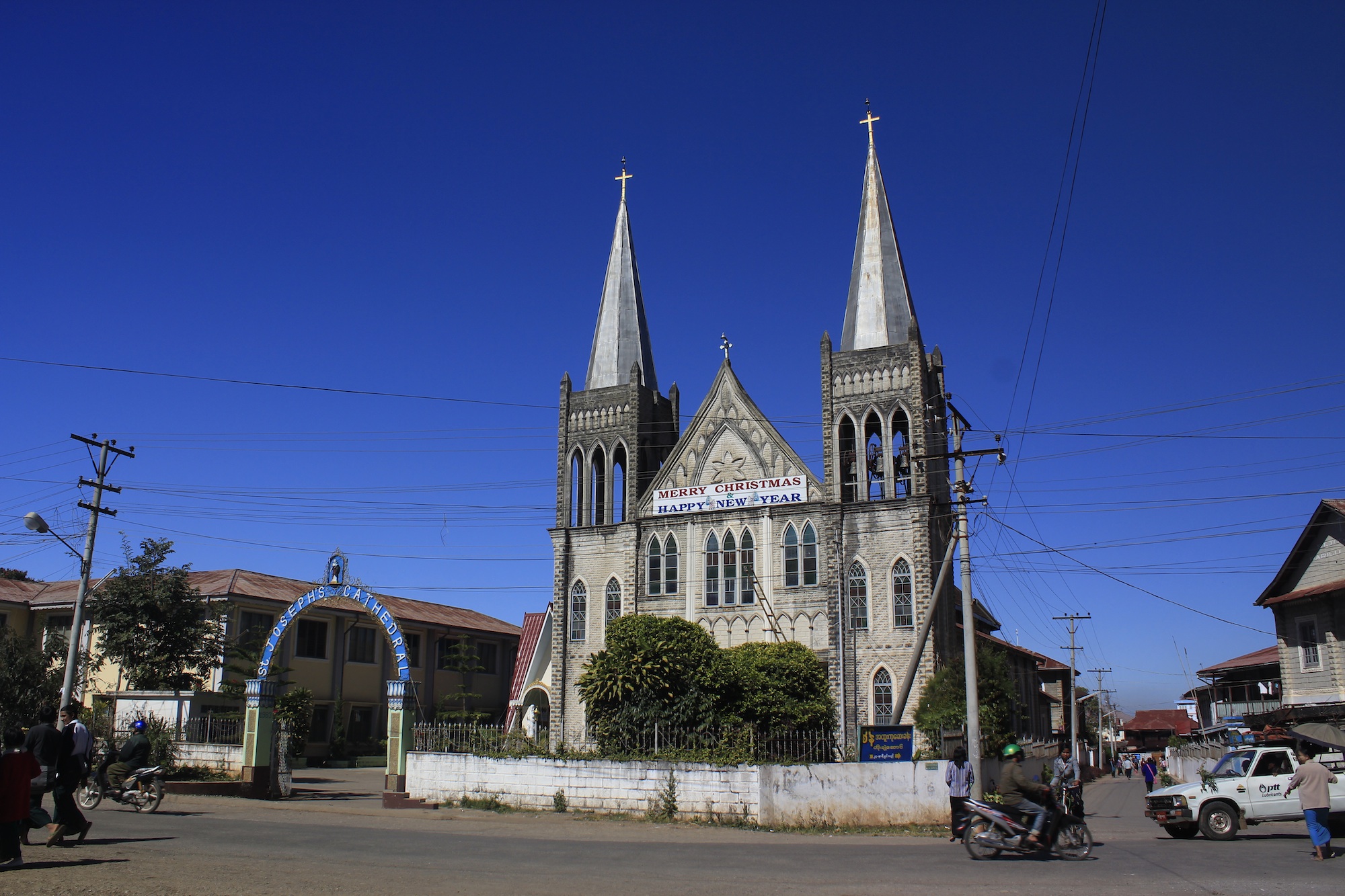

Taunggyi is the melting pot for the Myelat area of the Shan State. Like in most of Myanmar, influence of Buddhism is most evidenced by the monasteries scattered throughout the city. However, being a relatively new city, the monasteries are not of historical significance and architecturally not unique. There is also a significant Christian population, as the center of the Roman Catholic Archdiocese of Taunggyi the St. Joseph's Cathedral and its associated seminary are the main facilities, as well as a Baptist church. Both churches were established by early missionaries. There is also a smaller Anglican church, which originally served the British administrators, but recently it has fallen into a state of disrepair. Four mosques serve the Muslim communities of the city. Among four mosques, Panthay mosque serves the Chinese Panthay Muslims mainly. The other mosques are for large population of Burmese Muslims. There are also a few temples serving the Chinese Buddhist community. After 1990s, Chinese migrants are settling in Taunggyi and now they constitute the considerable proportion in communities.
The Taunggyi celebration of the Tazaungdaing Festival, a national holiday marking the end of the rainy season, has achieved international notoriety for pyrotechnic rockets involved in the Taunggyi Hot Air Balloon Festival. There were nine people injured in 2018, two deaths and 12 injuries in 2017, and four deaths in 2014.
Being the capital of the Shan State, Taunggyi hosts many government offices. The city also hosts Eastern Command of the Tatmadaw (Myanmar military) and it occupies a significant portion of the north-east area of the city. Shan State Cultural Museum lies in Taunggyi. The museum displays the Shan culture, as well as items of historical interest, such as the belongings of Sawbwa.
Economy
Tourism
The Taunggyi area is a popular tourist destination. The city itself has an interesting five-day market, where farmers from around the area would come to the Taunggyi on market day and sell fresh produce in the open market, but with more development of the city, the significance of market day has been lessened. However, the market-day tradition continues strong in the outlying small towns. Nearby, Inle Lake ၼွင်ႁႆၢးယႃႈ is the home of the unique Intha culture. Inlay is famous for its traditional crafts industry and floating markets that are accessible via traditional longboats. The most unique thing is that Intha row the boat with their leg. On the way to the Pindaya Caves provides visitors with a good view of the Myelat countryside. The Kekku Pagodasၵၢတ်ႇၵူႇ, which feature hundreds of stupas dating to the 16th century, are near Taunggyi.
Industry
There is no significant industry in Taunggyi. It used to be the trans-shipment point for many of the agricultural products of southern Shan State. However, due to recently imposed zoning regulations, most of these operations have been moved to the surrounding new town of Ayetharyar.
Agriculture
Another economy of Taunggyi is farming and gardening. Farmers around Taunggyi are mostly Shan and Pa-O ethnic origins. The main agricultural products of Taunggyi are potatoes, tea leaf, tomato, beans, damson and seasonal fruits.
Education
The city is home to:
- Taunggyi University
- University of Computer Studies, Taunggyi
- University of Medicine, Taunggyi
- Technological University, Taunggyi
- Taunggyi Education College
Sports
The 7,000-seat Taunggyi Stadium is a multi-use stadium in Taunggyi. The stadium is the home ground of Shan United FC, a Myanmar National League (MNL) football club.
Health care
Public Hospitals
- Sao San Tun General Hospital
- Taunggyi Women and Children Hospital
- Taunggyi University Hospital
- Mettashin Charity Hospital-Eye Care Services
Gallery
File:Taunggyi Sulamuni Pagoda.jpg|Taunggyi Sulamuni Pagoda File:TU Taunggyi.jpg|Technological University Taunggyi File:Sulamani Pagoda - Taunggyi.jpg|Sulamani Pagoda at night File:Baloon Festival - panoramio (4).jpg|Hot air balloon Festival File:Taunggyi-Myo Ma-Markt-22-gje.jpg|Myoma Market File:Taunggyi Medicine University.jpg|University of Medicine (Taunggyi) File:Taung Gyi Fireballon Event.jpg|A festival in Taunggyi
Notes
References
References
- (May 2015). "The 2014 Myanmar Population and Housing Census The Union Report Census Report Volume 2". Department of Population, Ministry of Immigration and Population.
- "Taunggyi {{!}} Myanmar". Encyclopedia Britannica.
- "Biggest Cities In Myanmar (Burma)". WorldAtlas.
- "Taunggyi's fire balloon festival". The Myanmar Times.
- {{Cite EB1911
- "Myanmar Climate Report". Norwegian Meteorological Institute.
- (October 2017). "Taunggyi Township Report".
- "Taunggyi's fire balloon festival". The Myanmar Times.
- (Nov 15, 2018). "တောင်ကြီးတန်ဆောင်တိုင်ဖွင့်ပွဲမီးပုံးပျံ ပျက်ကျလို့ မီးလောင်ဒဏ်ရာရသူတွေရှိ". BBC News မြန်မာ.
- "Festival Revellers Run From Exploding Hot Air Balloon in Myanmar".
- (Oct 31, 2017). "At Least 12 Injured at Taunggyi Balloon Festival".
- "Myanmar's Deadly Hot Air Balloon Festival".
- Sandoval, Greg. "Exclusive Photos: Flaming hot air balloon explodes in crowd, killing 2 in Myanmar".
- (Nov 10, 2014). "Taunggyi Balloon Festival Deaths Rise to 4".
- "ဦးကျော်ဝင်း ( ကန်ကြီးထောင့် မဲဆန္ဒနယ်)".
This article was imported from Wikipedia and is available under the Creative Commons Attribution-ShareAlike 4.0 License. Content has been adapted to SurfDoc format. Original contributors can be found on the article history page.
Ask Mako anything about Taunggyi — get instant answers, deeper analysis, and related topics.
Research with MakoFree with your Surf account
Create a free account to save articles, ask Mako questions, and organize your research.
Sign up freeThis content may have been generated or modified by AI. CloudSurf Software LLC is not responsible for the accuracy, completeness, or reliability of AI-generated content. Always verify important information from primary sources.
Report