From Surf Wiki (app.surf) — the open knowledge base
Tata Nano
Compact city car that was manufactured by Tata Motors

Compact city car that was manufactured by Tata Motors
| Field | Value |
|---|---|
| name | Tata Nano |
| image | Tata - Nano - Kolkata 2011-09-15 5184.JPG |
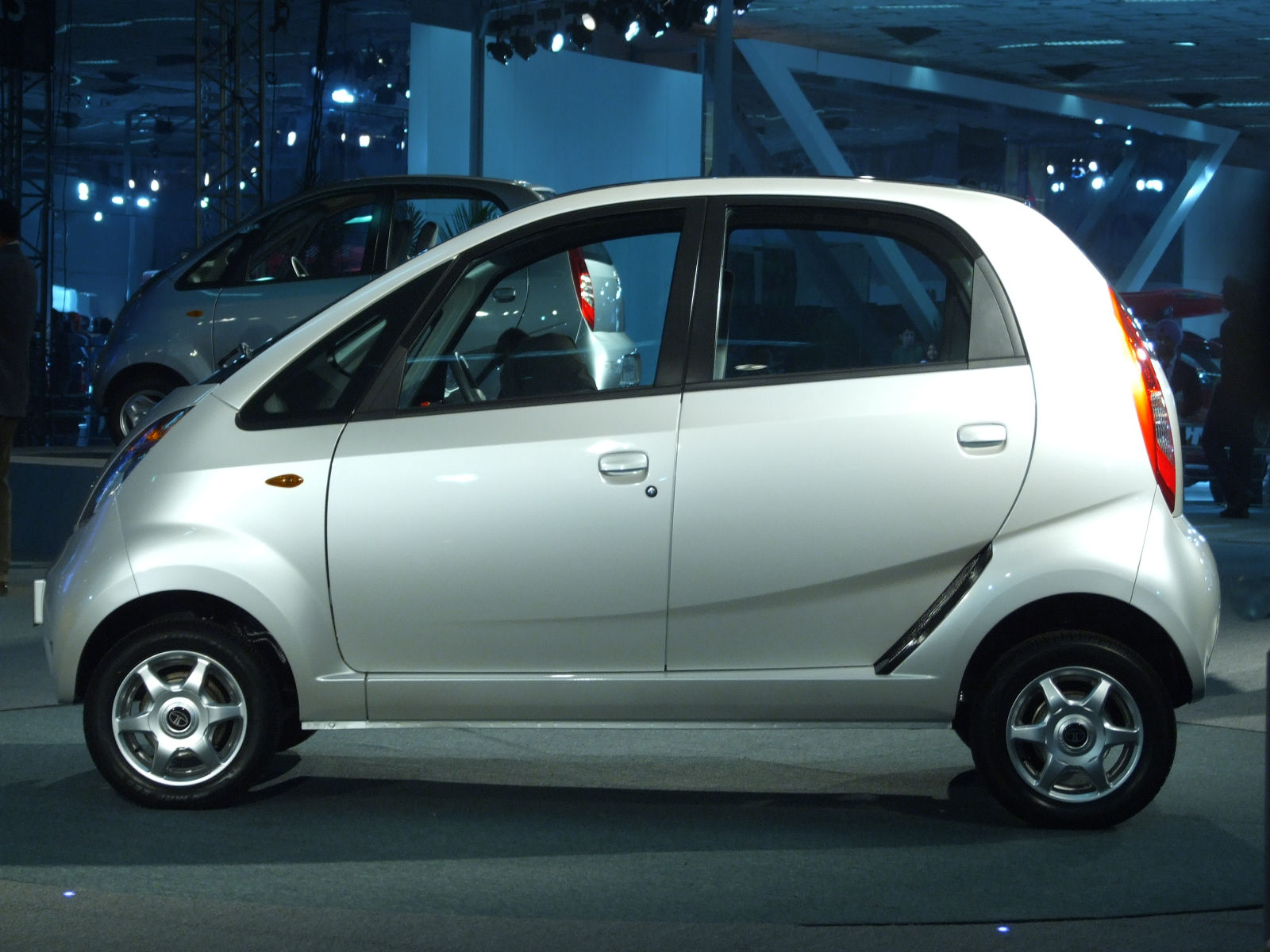
| alt | Four-door car with a one-box body style with steel wheels, an air intake located behind the rear passenger door, and no passenger side mirror |
| manufacturer | Tata Motors |
| production | 2008–2018 |
| aka | Tata GenX Nano (facelift 2015–2018) |
| assembly | India: Gujarat, Sanand (Sanand Plant) |
| class | City car |
| body_style | 4-door saloon car |
| 5-door hatchback (GenX Nano) | |
| layout | Rear-engine, rear-wheel-drive |
| platform | Tata X3 |
| engine | 624 cc I2 SOHC MPI petrol |
| transmission | 4-speed manual |
| 5-speed AMT (2015+) | |
| wheelbase | 2230 mm |
| length | 3099 mm |
| 3164 mm (GenX Nano) | |
| width | 1390 mm |
| height | 1652 mm |
| weight | 600 - |
| designer |
5-door hatchback (GenX Nano) 5-speed AMT (2015+) 3164 mm (GenX Nano)
The Tata Nano is a city car/microcar manufactured and marketed by Indian automaker Tata Motors over a single generation from 2008 to 2018. It was primarily sold in India as an inexpensive economy car for motorcycle and scooter drivers — with a launch price of () on 10 January 2008. The Nano has a rear-engine, rear-wheel-drive layout and was initially produced as a four-door saloon car with no rear cargo opening, with a five-door hatchback version introduced in 2015.
Tata Motors projected production figures of 250,000 annually at launch. This was not achieved, and various factors led to a decline in sales volume, including delays during the factory relocation from Singur to Sanand, early instances of the Nano catching fire and the perception that the Nano was unsafe and lacked quality from its aggressive cost cutting. Actual sales reached 7,591 for model year 2016-2017. The project lost money, as confirmed by former Tata Sons chairman Cyrus Mistry and by 2017 Tata Motors management.
In 2017, Tata Motors said manufacturing would continue due to the company's emotional commitment to the project. Production was eventually halted in May 2018. The Sanand Plant subsequently manufactured other hatchbacks, including the Tiago and Tigor.
History
After successfully launching the low cost Tata Ace truck in 2005, Tata Motors began development of an affordable passenger car that would appeal to the many Indians who ride motorcycles. The purchase price of this no frills auto was brought down by dispensing with most nonessential features, reducing the amount of steel used in its construction, and relying on low cost Indian labour.. The design featured only a driver's side wing mirror, one wiper blade, only three lug nuts per wheel and a fuel tank without filler cap. Tata said it was the first time a 2-cylinder petrol engine was being used in a car with single balancer shaft.
At introduction the Nano received attention due to its low price of 1 lakh rupees (Rs. 100,000). Some promotional material labeled the vehicle as "The People’s Car".
Expectations and effects
Expectations created for the car during the run up to its production were out of proportion with realised sales. A 2008 study by Indian rating agency CRISIL projected the Nano would expand the nation's car market by 65%, but, as of late 2012, news reports have detailed the underwhelming response of the Indian consumer to the offering; sales in the first two fiscal years after the car's unveiling remained steady at about 70,000 units. Tata intended to maintain a capacity to produce the car in much larger quantities, some 250,000 per year, should the need arise.
It was anticipated that its 2009 debut would greatly affect the used car market, and prices did drop 25–30% prior to the launch. Sales of the Nano's nearest competitor, the Maruti 800, fell by 20% immediately following the unveiling of the Nano. It is unknown if the Nano has had a lasting effect on the prices of and demand for close substitutes. In July 2012, Tata's Group chairman Ratan Tata, who retired in same year, said that the car had immense potential in the developing world while admitting that early opportunities were wasted due to initial problems. Due to the sales drops, only a single unit was produced in June 2018. The Sanand Plant now produces other hatchbacks like Tiago and Tigor.
Singur factory pullout
Main article: Tata Nano Singur controversy
Tata Motors announced in 2006 that the Nano would be manufactured in Singur, West Bengal. Local farmers soon began protesting the 'supposed' forced acquisition of their land the new factory entailed. Tata first delayed the Nano launch and later decided to build the car in a different state, Gujarat, instead.For initial delay, see Rain, political unrest delay Tatas' dream car Rediff.com, 3 August 2007
- For pullout from West Bengal site, see
- For relocation to Gujarat, see
Price
Announced as the lowest priced production car in the world, Tata aimed for a price of one lakh rupees, or 100,000, which was approximately $2,000 US at launch time. Only the very first customers were able to purchase the car at that price, and as of 2017, the price for the basic Nano started around 215,000 ($3,400 US).For only first customers receiving 100,000, see Many Indians were of the opinion that Tata just managed to offer offered a four-wheeled auto-rickshaw for a price of INR 2,00,000.
- For 2017 price, see Increasing material costs may be to blame for this rapid rise in price.
Compared to the Volkswagen Beetle it had a relatively low price, though still high in terms of the average salary of an Indian industrial worker or farmer. In 1990, a Beetle from Mexican factories was priced at $5,300, about $ in 2022. The Ford Model T's initial price was about $850, equivalent to $ in 2022. The price of the Nano was only just higher than the corrected price of the Briggs & Stratton Flyer of the 1910s, with the Flyer costing US$125 ($1,767 in 2016), while the Flyer might be classified as more of a go-kart than a car.
Cost-cutting features
The Nano's design implements many measures to reduce manufacturing costs.
| Tata Nano |
|---|
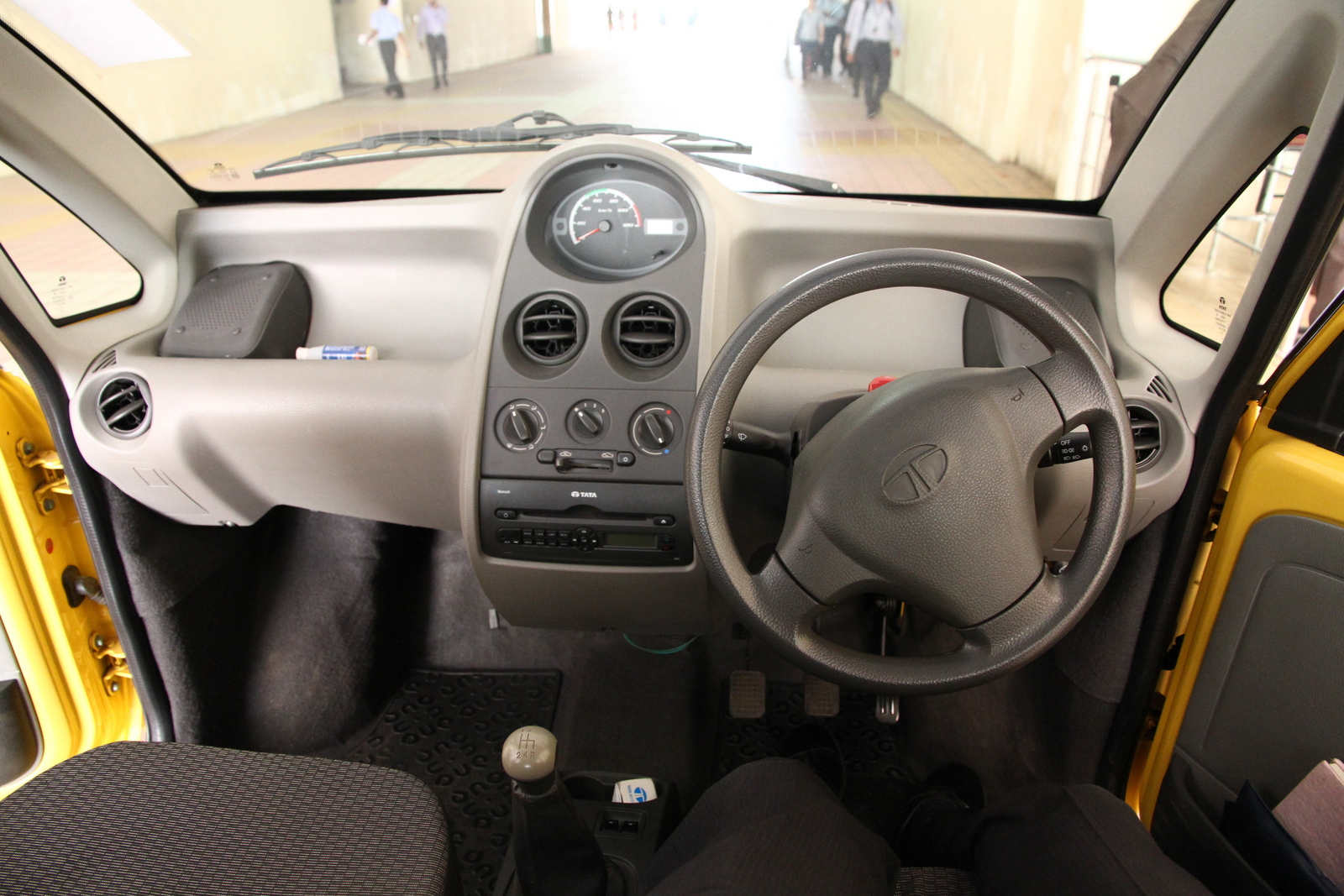
| The trunk was only initially accessible from inside, as the rearmost panel did not open. (full hatchback offered in 2015). |
| One windscreen wiper instead of the usual pair |
| No base power steering due to light weight. Added in higher variants in later models. |
| Three lug nuts per wheel |
| Driver side wing mirror on base model. Higher variants fitted with passenger side ORVM from 2012 onwards. |
| 1DIN Radio CD player |
| No airbags on any model |
| 624cc rear engine, 2 cylinders (312cc each) |
| Front&rear all drum brakes. |
| No air conditioning in base model |
| Front passenger seat same as the driver seat and the headrests are integrated. |
| Thinner 135/70R12 space saver spare tyre. |
| No external fuel filler cap. Fuel inlet is accessed by opening the front hood. |
| Front power windows only offered on highest variant. PW switches placed on central console rather than on door pads. |
Technical specifications
The Nano (2012) was a 38 PS car with a two-cylinder 624 cc engine mounted in the rear of the car. The car complied with Bharat Stage 4 Indian Emissions Standards, which are roughly equivalent to Euro 4.
The development of the Nano led to 31 design and 37 technology patents being filed.
| url=http://www.autoexpress.co.uk/news/autoexpressnews/214902/tata_nano.html | title=India's £1,250 car | access-date=14 January 2008 | work=Auto Express}} |
|---|
| Supplier | Part/system |
|---|---|
| Texspin | Clutch Bearings |
| Bosch | Oxygen sensor, Gasoline injection system (diesel will follow), starter, alternator, brake system |
| Continental AG | Gasoline fuel supply system, fuel level sensor |
| Caparo | Inner structural panels |
| HSI AUTO | Static sealing systems (Weather Strips) |
| Delphi | Instrument cluster |
| Rane Madras Limited | Steering Assembly |
| Denso | Windshield wiper system (single motor and arm) |
| FAG Kugelfischer | Rear-wheel bearing |
| Federal-Mogul | Pistons, Piston rings, Spark plugs, Gaskets, Systems protection |
| Ficosa | Rear-view mirrors, interior mirrors, manual and CVT shifters, washer system |
| Freudenberg | Engine sealing |
| GKN | Driveshafts |
| INA | Shifting elements |
| ITW Deltar | Outside and inside door handles |
| Johnson Controls | Seating |
| Mahle | Camshafts, spin-on oil filters, fuel filters and air cleaners |
| Saint-Gobain | Glass |
| TRW | Brake system |
| Ceekay Daikin/Valeo | Clutch sets |
| Vibracoustic | Engine mounts |
| Visteon | Air induction system |
| ZF Friedrichshafen AG | Chassis components, including tie rods |
| Behr | HVAC for the luxury version |
| Dürr | Lean Paint Shop |

Tata GenX Nano (2015–2018)

In May 2015, to revive the model's sales, Tata Motors introduced a series of enhancements both inside and outside the car. The name was changed to GenX Nano to underline the changes, the range was offered in 21 different versions, among them a 5-speed automated manual transmission. Electric power steering, air conditioning, and Bluetooth radio were available on top models in addition to new colors and alloy wheels. The body was strengthened and the front and rear bumpers were changed, which slightly increased the length to 3,164 millimeters. The interior was also redesigned with new fabrics and improved soundproofing. The rear hatchback and 5-seat homologation were introduced. The engine remained the 2-cylinder 624 cc with 38 hp.
Alternative power plants
The Nano was driven by a petrol engine. Though several variants were proposed, none were put into production. An upscale version was shown at an auto show.
Compressed-air engine
Tata Motors signed an agreement in 2007 with a French firm, Motor Development International, to produce a compressed air car Nano.
Electric vehicle
Tata discussed the possibility of producing an electric version, and while it showcased an electric vehicle Nano at the 2010 Geneva Motor Show, no such car came onto the market.
If an EV Nano had been produced the expectations were that it would have been a highly affordable electric car using lithium-ion batteries and having a range of 80 mi. A Norwegian electric car specialist, Miljøbil Grenland AS, was named as a proposed partner in the project.
Tata Nano CNG emax (Bi-fuel)
The Nano CNG emax was launched in October 2013. It could run on either gasoline or compressed natural gas. Initially, it was to be sold in Delhi and parts of Maharashtra and Lucknow, where CNG was available at fuel outlets. The bifuel engine was powered by both CNG and petrol. In natural gas operation, the engine delivered maximum power of 33 horsepower and 45 Nm of maximum torque. The tank had a capacity of 32 liters (8 US Gal/7 UK Gal) of CNG.
Tata Super Nano
In December 2014, Coimbatore-based JA Motorsport presented a 230 hp 1.3-liter engined version of the Nano called the 'Super Nano' at the Autocar Performance Show. Featuring a full body kit, slick tyres, a bolt-on roll cage, and smoked head and tail lamps, the Super Nano featured carbon fibre components, Recaro seats, and steering-mounted paddle shifters.
European export

An upscale Nano concept car called Nano Europa was shown at the 2009 Geneva Motor Show. However, there was no progress towards producing or marketing this upscale specification.
Car fires
There were reports of several fire incidents involving the Nano.
Reception
The Nano received a mixed reception from Indian consumers; reasons given included that it was still too expensive compared to a motorcycle, and the extended waiting time for delivery (a few months). Although it was identified as the most affordable car, a more expensive secondhand car signaled higher social status; the Nano was considered a "poor man's" vehicle, turning some customers away. The fires and other safety issues were also a concern.
Tata Motors ended FY16 selling 21,012 Nanos, up from 16,901 in FY15.
Safety
In 2014, Global NCAP 1.0 crash-tested an Indian-market Tata Nano at the ADAC facility in Germany in its pilot round of 64km/h front offset deformable barrier crash tests for its Safer Cars for India project (based on Latin NCAP 2013). They also crashed the Nano in the configuration for the UN's R94 test. Tata had made it public that a version of the Nano designed for export to Europe had passed R94, and they were also expecting a four star Euro NCAP result. In contrast, the Indian car failed the R94 test and scored zero stars for adult and child occupant protection in Global NCAP's tests. The Nano was not fitted with airbags, not even one for the driver, nor ABS. During the 64km/h NCAP test the passenger compartment not only became unstable but also showed extremely high levels of intrusion of the steering column and waist-level intrusion of the A-pillar, showing high risk of life-threatening injury to the driver's head, neck and chest and also indicating that less critical body regions like the knees, tibias and feet were unlikely to be recoverable. The Nano had only static two-point seatbelts for the rear seats and no child seat available for sale in India could pass the installation check, meaning that the Nano was unsuitable for safely transporting children. It achieved zero stars for child occupant protection, scoring no points in all areas of assessment.
Sales
At the time of launch Tata Motors planned to sell 250,000 units per year. The maximum sales ever achieved was 74,527 units during FY 2011-2012 and then sales declined rapidly year after year leading to a negligible market share of the car in the "A" segment. The product was expected to be phased out soon as dealers stopped placing orders.
FY 2009–2010 30,000 approx
FY 2010–2011 70,432
FY 2011–2012 74,527
FY 2012–2013 53,848
FY 2013–2014 21,129
FY 2014–2015 16,903
FY 2016-2017 7,591
FY 2017-2018 April - October 1,502
End of production
Due to the low sales of the model (only one Nano was assembled in June 2018 against the 275 assembled in June 2017) Tata Motors announced the end of production without any direct successor. The Nano wasn't accepted by potential buyers and sales were always lower than projected. The Sanand Plant now produces other hatchbacks like the Tiago and the Tigor.
Rumoured revival
In 2023 and 2024, according to some recent sources , there are some rumours that Tata could revive the Nano as an affordable all-electric car with a 150-250km range at a future date.
Awards
- 2010 Business Standard Motoring Indian car of the year
- 2010 Bloomberg UTV-Autocar car of the year
- 2010 Edison Awards, first place in the transportation category
- 2010 Good Design Awards, in the category of transportation
- 2014 India's Most Trusted hatchback car, according to The Brand Trust Report 2014 edition
In the media
- Small Wonder: The Making of Nano–a book about the creation of the Tata Nano
- A Megafactories episode on this vehicle
- From Bollywood to Hollywood in Jay Leno's garage. YouTube channel.
- Das Billigste Auto der Welt - Tata Nano. YouTube channel.
References
References
- "Manufacturing: Sanand". Tata Motors.
- (4 August 2017). "Analysis - Tata Motors' future models under the microscope". Just-Auto.com.
- Patton, Phil. (11 February 2010). "''A Tata Nano Takes Manhattan''". The New York Times.
- Chang, Richard S.. (10 January 2008). "Tata Nano: The World's Cheapest Car".
- "Tata Motors Shuts Down Loss Making Small Car Tata Nano Production".
- (4 November 2016). "Nano a loss-making product, says Tata Motors". Hindustan Times.
- (27 September 2017). "Tata Motors to continue Tata Nano production for now".
- (29 September 2017). "Tata Nano sales to continue in spite of no demand".
- "Air Asia Case Puts Spotlight Once Again on Cyrus Mistry's 'Legacy Hotspots'". The Wire.
- (7 August 2018). "Tata Motors' Sanand facility reaches 100% utilization". Tata Motors.
- Meredith, Robyn. (19 April 2007). "The Next People Car". Forbes.
- Bijoy. (12 April 2009). "Tata Nano – Nano second to none!". Business Standard.
- (11 January 2008). "Bodacious Tata: India Delivers World's Cheapest Car". Spiegel Online International.
- (2008-01-10). "Tata Motors unveils the People's Car".
- (12 January 2008). "Tata Nano may expand market by 65%: CRISIL- Automobiles-Auto-News By Industry-News". The Economic Times.
- Nair. (26 April 2012). "Two years on, Tata Nano sales yet to hit top gear". [[The Indian Express]].
- (11 February 2008). "Tata Nano sends used car prices tumbling in India". The Motor Report.
- (7 February 2008). "Nanomania overwhelms Indian car market". [[Autocar (magazine).
- (13 July 2012). "Why Ratan Tata thinks Nano has 'enormous potential'".
- (7 August 2018). "Tata Motors' Sanand facility reaches 100% utilization". Tata Motors.
- (28 August 2008). "Nano wars: Tata threatens to make the world's cheapest car somewhere else". The Economist.
- Kurczewski. (23 March 2009). "Tata Nano Launched in Mumbai". [[The New York Times]].
- Ireson. (5 August 2008). "Rising costs could eat Tata Nano's profits". Motor Authority.
- Uhlig. (20 October 1990). "Mexico City Journal; Miss the VW Bug? It Lives Beyond the Rio Grande". [[The New York Times]].
- (2012). "National Geographic - Megafactories - Season 1, Episode "Tato Nano"".
- (15 September 2010). "Quick Spin: 2011 Tata Nano CX – Driving the world's cheapest car". Autoblog Canada.
- (30 January 2014). "Tata Nano safety under scrutiny after dire crash test results". The Guardian.
- "Official specifications for Tata Nano". Tata Motors.
- (23 March 2009). "Tata Nano first impressions test".
- (27 October 2017). "Tata Nano vs Maruti 800 0-100 speed test (video)".
- (February 2008). "Nano Mania". Autocar India.
- "India's £1,250 car". Auto Express.
- "India's Tata low-cost Nano took a lot of high-tech". ae-plus.
- (19 May 2015). "Tata Nano GenX: cambio di rotta (in Italian) [Tata GenX Nano: change of direction]". [[Al Volante]].
- (19 May 2015). "Tata Motors launches the GenX Nano range, its new compact hatch". [[Tata Motors]].
- (20 May 2015). "2015 Tata GenX Nano Launched; Prices Start at 1.99 Lakh". CarAndBike.com.
- While the vehicle was supposed to be able to travel approximately {{convert. 200
- Hall, Kenneth. (10 July 2008). "Tata Nano could come with optional air-powered engine". MotorAuthority.
- (20 August 2008). "Tata plans E-Nano, electric version of Rs 1-lakh car". domain-b.com.
- (4 March 2010). "World's cheapest EV: Tata Nano electrifies Geneva show". USA Today.
- (November 2023). "Let Tata's Nano be electric". Merinews.com.
- (4 March 2010). "World's cheapest EV: Tata Nano electrifies Geneva show — Drive On: A conversation about the cars and trucks we drive". USA Today.
- [https://online.wsj.com/article/DN-CO-20131008-004342.html "Tata Motors Introduces Bi-Fuel Version of Nano Minicar"]. ''The Wall Street Journal'', Santanu Choudhury
- (8 October 2013). "Tata Motors launches the Tata Nano CNG emax". [[Tata Motors]].
- (12 December 2014). "230hp Super Tata Nano Revealed, Costs INR 25 Lakhs".
- "Tata unveils a Nano for Europe". Automotive News.
- (10 December 2010). "Tata's Nano, the Car That Few Want to Buy". The New York Times.
- "Where Did It All Go Wrong For Tata's Nano?". Pakistan Defence.
- Tavares. "Marketing lessons from tata nano".
- (30 January 2012). "Cheap proves costly for Tata Nano in status-conscious India". Daily News.
- Das. (2017-04-15). "Is the Tata Nano in the last leg of its journey?".
- "Tata Nano crash test on video".
- (31 January 2014). "Tata Nano safety under scrutiny after dire crash test results". Guardian.
- (31 January 2014). "Tata Nano falls short of global crash test standards – video". Guardian.
- (26 November 2017). "Tata Nano likely to be phased out soon as dealers stop placing orders". DNA India.
- (26 November 2017). "Bidding farewell to 'cheapest car': Tata Nano likely to be phased out soon". TimesNowNews.
- Nair, Avinash. (26 April 2012). "Two years on, Tata Nano sales yet to hit top gear". The Indian Express.
- (2013-05-05). "Popularity continues to elude Nano, sales down 88%". Hindustan Times.
- (5 March 2015). "Sales of Tata Nano, world's cheapest car, set to hit six-year lows". The Indian Express.
- (1 March 2014). "7 Reasons Why Tata Nano Did Not Take Off as Expected".
- Kumar, Arjun. (25 April 2017). "Tata Nano Sales At An All Time Low, 174 Units Sold In March". MotorBeam.
- (11 July 2018). "RIP Nano. World's Cheapest Car Goes Up in Smoke". [[Bloomberg L.P..
- (7 August 2018). "Tata Motors' Sanand facility reaches 100% utilization". Tata Motors.
- (26 December 2009). "BS Motoring Jury Award 2010: Tata Nano". Business Standard.
- (18 January 2010). "Nano, Pulsar among winners of Bloomberg UTV-Autocar awards". The Financial Express.
- (2 April 2010). "Edison Awards 2010 honoring innovation in the development and launch of new products and services". Edisonawards.com.
- (5 January 2010). "Tata Nano shines! Wins global design award". Rediff.com.
- "The Brand Trust Report 2014".
- (2014-02-18). "Tata Nano again tops 'most trusted automobile' list". The Hindu Business Line.
- "Ratan Tata didn't want Nano stitched like shirt around button: Book". dna.
- [https://carbuzz.com/news/from-bollywood-to-hollywood-leno-takes-stock-of-tata-nano From Bollywood to Hollywood, Leno Takes Stock of Tata Nano]
- (2014-04-04). "Das Billigste Auto der Welt - Tata Nano - [Doku/HD]".
This article was imported from Wikipedia and is available under the Creative Commons Attribution-ShareAlike 4.0 License. Content has been adapted to SurfDoc format. Original contributors can be found on the article history page.
Ask Mako anything about Tata Nano — get instant answers, deeper analysis, and related topics.
Research with MakoFree with your Surf account
Create a free account to save articles, ask Mako questions, and organize your research.
Sign up freeThis content may have been generated or modified by AI. CloudSurf Software LLC is not responsible for the accuracy, completeness, or reliability of AI-generated content. Always verify important information from primary sources.
Report