From Surf Wiki (app.surf) — the open knowledge base
Tasiujaq

| Field | Value |
|---|---|
| name | Tasiujaq |
| native_name | ᑕᓯᐅᔭᖅ |
| native_name_lang | ike |
| settlement_type | Northern village municipality |
| pushpin_map | Canada Quebec |
| pushpin_mapsize | 197 |
| image_skyline | Rue principale de Tasiujaq.jpg |
| coordinates | |
| coordinates_footnotes | |
| subdivision_type | Country |
| subdivision_name | Canada |
| subdivision_type1 | Province |
| subdivision_name1 | Quebec |
| subdivision_type2 | Region |
| subdivision_name2 | Nord-du-Québec |
| subdivision_type3 | TE |
| subdivision_name3 | Kativik |
| established_title1 | Constituted |
| established_date1 | February 2, 1980 |
| government_footnotes | |
| leader_title | Mayor |
| leader_name | Billy Cain |
| leader_title1 | Federal riding |
| leader_name1 | Abitibi—Baie-James—Nunavik—Eeyou |
| leader_title2 | Prov. riding |
| leader_name2 | Ungava |
| area_footnotes | |
| area_total_km2 | 67.30 |
| area_land_km2 | 65.53 |
| population_footnotes | |
| population_total | 420 |
| population_as_of | 2021 |
| population_density_km2 | 6.4 |
| population_blank1_title | Change (2016–21) |
| population_blank1 | 13.8% |
| population_blank2_title | Dwellings |
| population_blank2 | 120 |
| timezone | EST |
| utc_offset | −5 |
| timezone_DST | EDT |
| utc_offset_DST | −4 |
| postal_code_type | Postal code(s) |
| postal_code | J0M 1T0 |
| area_code | 819 |
| website |
Tasiujaq (, meaning: Which resembles a lake) is a northern village (Inuit community) in Nunavik, in northern Quebec, Canada. Its population in the Canada 2021 Census was 420.
Geography
Tasiujaq was built on the shores of Leaf Lake at the head of Deep Harbour and lies a few kilometres north of the tree line, where the shrub tundra finally gives way to the arctic tundra. Tasiujaq actually refers to the whole of Leaf Basin: Leaf Lake, Leaf Passage and Leaf Bay. Leaf Basin is renowned for its high tides, which regularly exceed 15 metres.
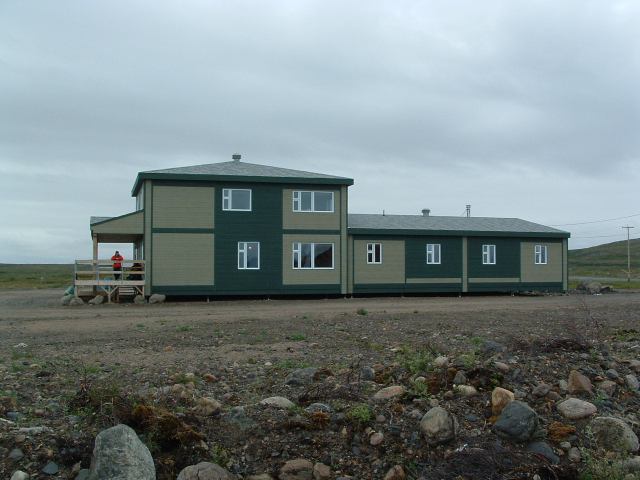
The bedrock under Tasiujaq consists of sedimentary and metamorphic formations, chiefly sandstone, slate, greywacke and argillite. Iron ore, dolomite, and mafic rocks are nearby.
The region is very rich in marine mammals (seal and beluga), fish (Arctic char, Atlantic salmon, trout), ducks (particularly eider ducks) and many seabirds; also, close to 1000 musk-ox roam the surrounding area. Gyrfalcons and peregrine falcons are commonly found nesting on the islands of Leaf Basin and surrounding cliffs.
Tasiujaq has a low tide harbour five kilometres north of the village, on Rowe Island. The Tasiujaq Airport is located a few kilometres south of the village. Tasiujaq is the final destination for the canoeists paddling down Leaf River.
Demographics
In the 2021 Census of Population conducted by Statistics Canada, Tasiujaq had a population of living in of its total private dwellings, a change of from its 2016 population of . With a land area of 65.53 km2, it had a population density of in 2021.
As with many Inuit villages, there is a large youth contingent. In 2021, 34.5% of the population was below the age of fifteen. The median age was 21.2.
As of 2016, unemployment was at 13.9 percent. The median income for the same census was $26,624 (in Canadian dollars). 48 percent of the workforce walked to work.
Population trend:
- Population in 2021: 420 (2016 to 2021 population change: 13.8%)
- Population in 2016: 369 (2011 to 2016 population change: 21.8%)
- Population in 2011: 303
- Population in 2006: 248
- Population in 2001: 228
- Population in 1996: 191
History
The French fur company Révillon Frères and the Hudson's Bay Company each opened trading posts in 1905 and 1907, respectively, on a site located east of today's settlement. This settlement was along a traditional dogsled route used by Inuit to travel between Kuujjuaq and Kangirsuk. However, both posts had been closed by 1935 without any village ever having developed around them.
In the 1950s, when the federal government opened a school in Kuujjuaq and started delivering social services, many Inuit congregated around the emerging village. The wildlife resources of Kuujjuaq, however, were scarce and many Inuit were forced to rely on governmental financial aid. In 1963, the Northern Quebec directorate of the provincial government, hoping to partially remedy this problem, decided to create a new village on the south shore of Leaf Lake where wildlife resources were more plentiful.
In 1966, with the project about to start, the Inuit families which would relocate were divided as to where their future village should be built. A choice had to be made between a site known as Qaamanialuk Paanga and the site of the old trading posts. Qaamanialuk Paanga was finally selected because it was easily accessible by boats used for summer hunting and fishing, nearby Finger River provided the necessary drinking water, and there was room to construct a landing strip. The new village was subsequently given the name Tasiujaq. The main reason the old trading post site was not selected as the site for the new village was its foreshore (tide land) was dotted with large boulders, and access by boat in summer would have been difficult. In 1971, once the community was organized, a cooperative store was established independently by residents, and is now associated with the Federation of Co-operatives of Northern Quebec. Since 1996, the police services, as the other villages in the Kativik region, are provided by the Kativik Regional Police Force (KRPF).
Education

The Kativik School Board operates the Ajagutak School.
References
References
- Nunavik Tourism Association & Tourisme Quebec: Nunavik Official Tourist Guide 2007-2008, page 52
- https://geoscan.nrcan.gc.ca/starweb/geoscan/servlet.starweb?path=geoscan/downloade.web&search1=R=100600 Gross, G.A. Iron deposits near Ungava Bay, Quebec. Geological Survey of Canada, Bulletin 82, 1962
- Lester Kovac: [https://web.archive.org/web/20080421035638/http://www.geocities.com/lester_kovac/leaf2007.htm Charpentier/Lear 2007]
- Tim Kunin: [http://www.pakboats.com/exper6.html Leaf River Trip, August 1998] {{Webarchive. link. (2010-12-12)
- Willem Lange: [http://www.pakboats.com/exper44.html Leaf River, Northern Quebec 2001] {{Webarchive. link. (2010-12-12)
- (February 9, 2022). "Population and dwelling counts: Canada, provinces and territories, and census subdivisions (municipalities), Quebec". [[Statistics Canada]].
- (27 April 2022). "Tasiujaq community profile". [[Statistics Canada]].
- Statistics Canada: [[Canada 1996 Census. 1996]], [[Canada 2001 Census. 2001]], [[Canada 2006 Census. 2006]], [[Canada 2011 Census. 2011]], [[Canada 2016 Census. 2016]], [[Canada 2021 Census. 2021]] census
- KRPF. "General Information".
- "[http://www.kativik.qc.ca/our-schools/ Our Schools] {{Webarchive. link. (2017-09-15 ." [[Kativik School Board]]. Retrieved on September 23, 2017.)
- (9 February 2022). "Profile table, Census Profile, 2021 Census of Population - Tasiujaq, Village nordique (VN) [Census subdivision], Quebec".
- {{mamrot. 99100
- {{toponymie. 97010
This article was imported from Wikipedia and is available under the Creative Commons Attribution-ShareAlike 4.0 License. Content has been adapted to SurfDoc format. Original contributors can be found on the article history page.
Ask Mako anything about Tasiujaq — get instant answers, deeper analysis, and related topics.
Research with MakoFree with your Surf account
Create a free account to save articles, ask Mako questions, and organize your research.
Sign up freeThis content may have been generated or modified by AI. CloudSurf Software LLC is not responsible for the accuracy, completeness, or reliability of AI-generated content. Always verify important information from primary sources.
Report