From Surf Wiki (app.surf) — the open knowledge base
Tarantul-class corvette
Class of Soviet missile corvette

Class of Soviet missile corvette
| Field | Value |
|---|---|
| sclass | 2 |
| section1 | {{Infobox ship/image |
| image | ORP Metalowiec in Gdynia.JPG |
| image_caption | ORP Metalowiec, a Polish Navy Tarantul-I missile corvette in Gdynia |
| section2 | {{Infobox ship/class overview |
| name | Tarantul class |
| builders | Vympel Shipyard |
| operators | * |
| subclasses | * |
| total_ships_completed | ~80 (including ) |
| total_ships_lost | 1 |
| total_ships_preserved | 2 or 3 |
| section3 | {{Infobox ship/characteristics |
| type | Missile corvette |
| displacement | 480 LT standard, 540 LT full load |
| length | 56.0 m |
| beam | 10.5 m |
| draught | 2.5 m |
| propulsion | 2 shaft COGAG turbines at 11000 hp each, plus 2 cruising engines at 4000 hp each (there were diesel and turbine versions of the cruising engines), |
| speed | 42 kn |
| range | 2400 nmi at 12 kn, operational autonomy for 10 days |
| complement | 50 |
| sensors | * Radar: Spin trough, Bass Tilt, Peel pair, Pop group |
| armament | * 4 × P-15 Termit/SS-N-2 Styx or 4 × P-270 Moskit/SS-N-22 Sunburn or 16 × Kh-35 Uran/SS-N-25 Switchblade anti-ship missiles or 4 × BrahMos |
-
1 SA-N-5 SAM (1x4) MANPADS air defence missiles
-
1 × 76 mm AK-176 dual purpose main gun
-
2 × AK-630 30 mm gun or 1 × CADS-N-1 Kashtan CIWS (close-in weapon system) for air defence
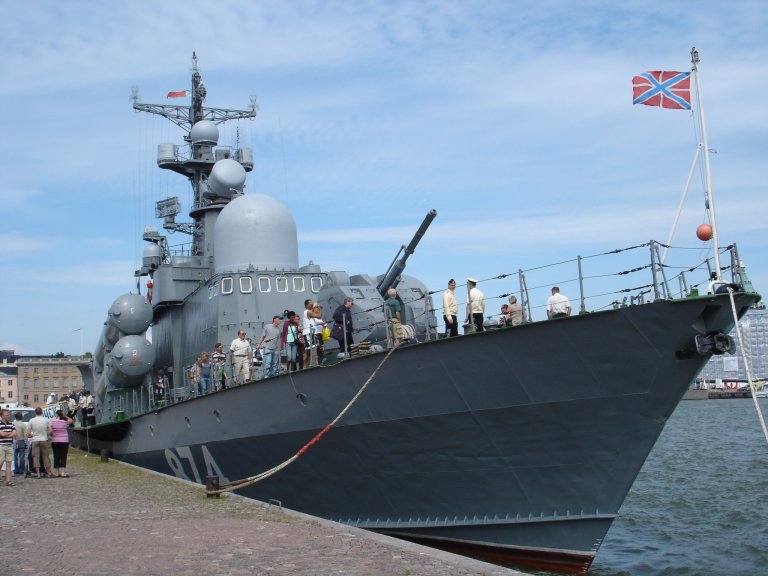
The Tarantul-class corvette, Soviet designation '*Project 1241 *Molniya''''' () are a class of Russian missile corvettes (large missile cutters in Soviet classification).
They have the NATO reporting name Tarantul (not to be confused with the , whose official Soviet name is also Project 205P Tarantul). These ships were designed to replace the Project 205M Tsunami missile cutter (NATO: ).
A new updated variant of the class (Project 12418) was projected to start entering service in 2025.
Development
In the late 1970s, the Soviets realised the need for a larger, more seaworthy craft with better gun armament and higher positioned air search radars. In the Tarantul class, both the single 76 mm main gun and the two 30 mm Gatling-type guns are used for air defence, together with a comprehensive electronic warfare suite. The boats are built by the Petrovsky yard (St. Petersburg), Rybinsk and Ulis yard (Vladivostok). A version of these ships for coastal anti-submarine warfare and patrol was developed as the or Project 1241.2. The Indian Navy paid approximately $30 million each to license-produce Tarantul-I in the early 1990s. With over 30 sales on the export market the Tarantul has been a relative success for the Russian shipbuilding industry.
Versions
Project 1241.1 (NATO: Tarantul-II)
The naming convention for NATO reporting name Tarantul was a special case here. NATO called the first version of the class as Tarantul-II, given that they had a better sensor suite/equipment than the ships of the following class Tarantul-I, which was produced exclusively for export.
A first version was based on the Pauk-class hull, though with significantly increased weight. Equipped with four SS-N-2 'Styx' anti-ship missiles (either the 40 km range P-15 'Termit' missile or the later P-20 variant with 80 km range) and the associated 'Plank Shave' radar targeting system (45 km range in active mode of surveillance, 75 – range in passive mode, with an added air surveillance capability). One AK–176 76.2 mm main gun and two AK-630 30 mm six-barreled Gatling guns, the latter CIWS system supported by the 'Bass Tilt' targeting radar. Furthermore, there is a Fasta-N SA-N-5 quadruple MANPADS launcher and two PK-16 decoy launchers.
Propulsion is a COGOG system (COmbined Gas Or Gas) consisting of two M70 at 12000 hp high power gas turbines with a combined 24200 hp output for full power and two cruise gas turbines type M75 with a combined output of 5000 hp. Top speed is 38 kn.
Between 1979 and 1984, 13 ships of the type were built. Another ship, R-55, was rebuilt after its completion as a test vessel for the 'Kortik' short-range defense system for Project 1241.7.
Project 1241.RE (NATO: Tarantul-I)
To clarify, by NATO's definition, Project 1241.RE (NATO: Tarantul-I) was an export version of Project 1241.1 (NATO: Tarantul-II).
This class of ships could be distinguished by the lack of fire control radar on the roof of the bridge. Instead, the fire control radar, X-band "Garpun-Bal" (NATO: "Plank Shave"), built for the anti-ship missiles, was installed on the top of the mast. Other equipment included a small navigation radar type "Kivach-2" on the bridge roof (or MR-312 "Pechera-1" on the ships of Poland), and the gun-fire control radar MR-123 Vympel (NATO: "Bass Tilt") at the foot of the mast. Two PK-16 decoy launchers were also installed. The model of the missiles in the KT-138 launch containers were P-20 (NATO: SS-N-2B), basically they were P-15 updated with the new guidance system but with the original 40 km range.
Between 1977 and 1979, 22 ships of this class were produced exclusively for export. Only one of these ships, R-26, was retained by the Soviet Navy for training purposes. India bought five of these ships as s, and would later produce eight ships of the same class domestically. Vietnam also bought four Project 1241.RE ships from various sources over the years.
Project 12411 (1241.1M/1241.1MR) (NATO: Tarantul-III/Tarantul-III Mod)
Retaining the main armament and basic hull form of the 1241.RE (NATO: Tarantul-I) class, 1241.1M (NATO: Tarantul-III) received important upgrades. Apart from a modest but useful internal redesign, the Tarantul-III had a new type of propulsion—a CODAG (COmbined Diesel And Gas) system. Two M-70 gas turbines (rated at 12,000 hp each) and two M510 (rated at 4,000 hp each) diesel engines were used, being a big improvement over the earlier COGOG system both in terms of serviceability (the two cruise diesels being almost something of a Soviet 'classic'), fuel efficiency and, most importantly, service life expectancy compared to the older NK-12Ms. The maximum speed reached 42 kn.
The superstructures were redesigned and the angled mast of the previous projects has been replaced by a narrow, straight lattice. The sensor position remained almost the same as the Project 1241.1. The "Pechera" navigation radar was off the roof of the bridge, with the MR-123 "Vympel" fire control radar installed. Two jamming system (NATO: "Wine Glass") were installed on both sides at the foot of the mast. The reason for this was the installation of four SS-N-22 'Sunburn' supersonic ship-to-ship missiles with a range of at least 100 km. The associated radar system is the L-band 'Band Stand' radar, with a 120 km active and 500 km passive range and the capability to track 15 different targets. The missiles can also receive third party guidance through the 'Light Bulb' uplink (from other ships, helicopters or long range patrol aircraft). Cannon armament is retained, as were the PK-16 launchers, although Soviet Navy ships benefited from the improved SA-N-8 quadruple MANPADS launcher. At least one ship had an SA-N-11 Kashtan gun and missile CIWS installed instead of the AK-630s.
The Tarantul-III, built from 1987 on, received an improved electronic countermeasures suite, consisting of two 'Half Hat' and two 'Foot Ball' jamming systems, coupled to four improved PK-10 decoy launchers. At least 24 of these ships were built for the Soviet Navy before production ended in 1992.
Between 1985 and 2001, 34 ships of this class were built. After the construction of first batch of 11 ships, the anti-ship missiles were changed from the P-80 "Moskit" to the more modern model P-270 "Moskit-M", therefore the following 23 boats had a new ID: Project 1241.1MR.
The guided missile corvette R-60 was further modernized in 2005, having the two AK-630M CIWS removed, and replaced with "Palash" CIWS.
Project 1242.1/1241.8 'Molniya'
.jpg)
Project 1242.1 and project 1241.8 Molniya ("Lightning") are further developments of the Tarantul family of ships. The two projects has been modified and rearmed with modern missile systems like the Uran-E and are more capable ships than the Tarantul types. The ships are built by the Russian Vympel Shipyard. Russia received at least one boat for trials in the 1990s and in 1999 Vietnam ordered two vessels. Vietnam is currently the main user of the Molniya class, with two Russian-made ships and six locally built ships. Vietnam started its own production line of 1241.8 Molniya ships with the assistance of Almaz Central Design Bureau in Russia. The first two locally built ships were delivered in July 2014, two more in June 2015, and the last two in October 2017. The Vietnamese warships are armed with a AK-176 76 mm gun, 16 Uran-E anti-ship missiles, four Igla-M air-defence missiles and two AK-630 close-in-weapon systems. The Vietnamese ships are also larger at 56.9 m in length and a maximum displacement of 563 tons. They have a range of 1700 nmi with 44 crew members on board. The Indian Navy ordered four further modified 1241.8 Tarantuls, this order was later reduced to two. These last two ships of the Veer class are armed with 16 SS-N-25 'Switchblade' / URAN E missiles, a OTO Melara 76 mm gun instead of the AK-176, and MR 352 Positiv-E (NATO: Cross Dome) radar. In 2009 Libya ordered three ships, however, the civil war in 2011 put a stop to any acquisitions. Shortly afterwards Turkmenistan acquired three Type 1241.8 vessels, possibly those that had been ordered by Libya but not delivered.
The Russian Navy received two upgraded Molniya-class missile boats in early 2019; they were initially built for a foreign customer, but the contract was cancelled, so the Russian Navy acquired them. The boats replaced the Moskit with eight Kh-35U anti-ship missiles and MANPADS launcher with the Pantsir-M gun/missile system. They also had a modern radar phased antenna array. One boat was expected to operate in the Black Sea and the other in the Caspian Sea.
Russian domestic developments
- 3R-60U fire control system (for Uran SSM)
- 1 76mm AK-176M rapid-fire gun (314 rounds)
- 2 x 6 30mm AK-630М six-barrel light guns (2000 rounds) A new Tarantul design, reportedly begun in the 1990s, resulted in a new variant of the class with the first vessel (Stupinets) being launched in 2024. This variant (also known by Project Number 12418) reportedly incorporates a larger superstructure and new propulsion system (two diesels (CODAD), likely Zwiezda M-507D-1) dropping the top speed to around 29 knots. The main armament is the Uran antiship missile system with 3M24 subsonic missiles and 3R-60U fire control system. The range of the missile is reportedly up to 130 km (up to 260 km with the 3M24U version). The design also incorporates the 76.2mm AK-176MA gun and two six-barrel 30mm AK-630Ms – both in stealth turrets. Decoy launchers are the KT-216/PK-10 Smely system. Two vessels (Stupinets & Strelok) had been launched as of October 2025. The lead vessel has commenced sea trials and both vessels are to be based with the Caspian Flotilla.
Current operators


-
One ship in service – 101 Мълния ("Lightning").
-
One ship in service. In 2014, Egypt showed interest in the acquisition of the P-32 (Project 12421 Molniya) missile boat but the contract was signed in 2015. In July 2015, the missile boat headed to the Mediterranean Sea and arrived at the port of Alexandria at the end of the month. The P-32 was handed over to the Egyptian Navy on 10 August after participating in the inauguration of the New Suez Canal.
-
Seven license-built Indian variants, designated as s, are currently in active service. The last Soviet-built vessel in service, Nishank, was decommissioned on 3 June 2022.
-
Three ships, all in service, homeport Mangalia.
- Zborul, commissioned 1990
- Pescărușul, commissioned 1991
- Lăstunul, commissioned 1991
-
, approx. 16 vessels of project 1241.7 and project 12411/1242.1 (Tarantul IIIs) were in service with the Russian Navy (+ up to 2 new Tarantul IVs likely to enter service with the Caspian Flotilla in due course)
- Pacific Fleet – 10 ships
- Baltic Fleet – 4 ships
- Black Sea Fleet – 2 ships; on 1 February 2024, Ukraine released video purported to show the sinking of the vessel Ivanovets by uncrewed naval drones; all Tarantul IIs (Project 1241.1) reported out of service as of 2024
-
Three ships acquired circa 2011, possibly the three originally ordered by Libya but not delivered.
- 830 Ederman
- 831 Arkadag
- 832 Gayratli
Ensign of Vietnam People's Navy.svg Vietnam People's Navy
-
12 ships in service:
- Four project 1241.RE Tarantul-I missile boats:
- Hull numbers: 371,372, 373 and 374.
- Eight project 1241.8 Molniya missile boats/fast attack crafts:
- Hull numbers: 375, 376, 377, 378, 379, 380, 382 and 383. Six of them were locally built in Ba Son Shipyard under license.
- Four project 1241.RE Tarantul-I missile boats:
-
Two ships in service.
Former operators

-
Four ships built.
- (434), decommissioned and scrapped
- (435), decommissioned and scrapped
- (436), decommissioned and scrapped in April of 2020
- (437), decommissioned and scrapped in April of 2020
-
48 ships built.
-
was briefly in service with U.S. Navy, after it was transferred from the German Navy. The ship was retired in 1996 and became a museum ship in Battleship Cove in Fall River, Massachusetts. She was later scrapped in 2023 due to her hull deteriorating.
-
Four type 1241 ships, all captured by Russia in March 2014 during the invasion of Crimea.
- Prydniprovia (believed hulked as floating barracks)
- Kremenchuk (believed to be in Russian Border Guard service as Kuban)
- Uzhhorod (believed to be in Russian Border Guard service as Novorossisk)
- Khmelnytskyi (believed hulked as floating barracks)
-
Five ships built – all retired
Potential operators
- Two or possibly three ships ordered in 2013. Reports that two or possibly three ships would be donated by Russia in 2016. They may be the former Russian Navy vessels Kuznetsk, Groza and Burya, or vessels captured from Ukraine in 2014.
Surviving ships
Two Tarantul-class corvettes are preserved globally, with a third boat potentially also preserved as of September 2024.
- Hans Beimler (575) is preserved in Peenemünde, Germany. The ship was one of five corvettes of this class built for the Volksmarine, and served between 1986 and 1991.
- INS Nishank (K43) is preserved at the National Maritime Heritage Complex, Lothal, India. Nishank was built as part of the Veer-class for the Indian Navy, a modified variant of the Tarantul design, and served between 1987 and 2022. She was subsequently transferred for preservation in 2023.
- Tambovsky Komsomolets (formerly R-47) has been preserved at Patriot Park in Kronstadt, Russia. She served between 1987 and 2017. She was moored next to the destroyer Bespokoyny (herself a museum), and was seen at the museum as late as May 2022. However, as of August, she is no longer moored at the position.
In addition, another ex-German ship of the class, the ex-Rudolf Egelhofer (772), which served between 1986 and 1991, and was then transferred to the United States as USNS Hiddensee in 1992 for evaluation, serving until 1996, was preserved at Battleship Cove, Massachusetts, United States of America in 1997. However, she fell into disrepair, and due to deteriorating condition, the ship was scrapped in October 2023.
References
Bibliography
- Conway's All the World's Fighting Ships 1947–1995
References
- https://x.com/AdithyaKM_/status/1996426390242205842/photo/1
- "Tarantul Class".
- "Molniya Class – Project 1242.1 / 1241.8".
- (28 September 2015). "ВМС Вьетнама получили вторую пару ракетных корветов проекта 1241.8".
- (10 October 2017). "Во Вьетнаме построены еще два ракетных катера проекта 12418".
- "Veer (Tarantul I) Class". [[Bharat Rakshak]].
- "K91 INS Pralaya". Bharat Rakshak.
- (December 2016). "Project 1241 (Tarantul)".
- (10 July 2018). "Russian Navy to get Two Upgraded Molniya-class Missile Boats".
- "Tarantul Class".
- Litnarovych, Vlad. (1 October 2025). "Russia Turns Back to 1990 Hulls: Strelok Corvette Relaunched With Missile Upgrade".
- Grotnik, Tomasz. (31 July 2024). "Russia launches new variant of Tarantul-class corvette".
- (13 August 2015). "Гвардейский Ракетный Катер "Р-32" Передан Египту".
- (3 June 2022). "INS Nishank and INS Akshay Decommissioned".
- Roblin, Sébastien. (6 February 2024). "Russian ‘Tarantula’ Missile Corvette First Moving Ship at Sea Sunk by Ukraine's Kamikaze Drone Boats".
- Greenall, Robert. (1 February 2024). "Ukraine 'hits Russian missile boat Ivanovets in Black Sea'". BBC News.
- (2024-02-01). "Military intelligence: Russian missile ship sunk off occupied Crimea".
- "Długa agonia ostatnich "Tarantul" - Nasz Bałtyk - morskie czasopismo".
- "Długa agonia ostatnich "Tarantul" - Nasz Bałtyk - morskie czasopismo".
- "Hiddensee".
- (1 May 2024). "Hans Beimler (Tarantul-class), old east-german warship in Peenemünde".
- "Museum ship Hans Beimler".
- (31 March 2023). "Transfer Of Nishank To Lothal And Conversion To Museum".
- (16 September 2023). "INS NISHANK assembly at NMHC Lothal site".
- (1 January 2024). "Missile Boat - Project 12411".

This article was imported from Wikipedia and is available under the Creative Commons Attribution-ShareAlike 4.0 License. Content has been adapted to SurfDoc format. Original contributors can be found on the article history page.
Ask Mako anything about Tarantul-class corvette — get instant answers, deeper analysis, and related topics.
Research with MakoFree with your Surf account
Create a free account to save articles, ask Mako questions, and organize your research.
Sign up freeThis content may have been generated or modified by AI. CloudSurf Software LLC is not responsible for the accuracy, completeness, or reliability of AI-generated content. Always verify important information from primary sources.
Report