From Surf Wiki (app.surf) — the open knowledge base
Tantrum
Type of anger outburst engaged in typically by young children

Type of anger outburst engaged in typically by young children
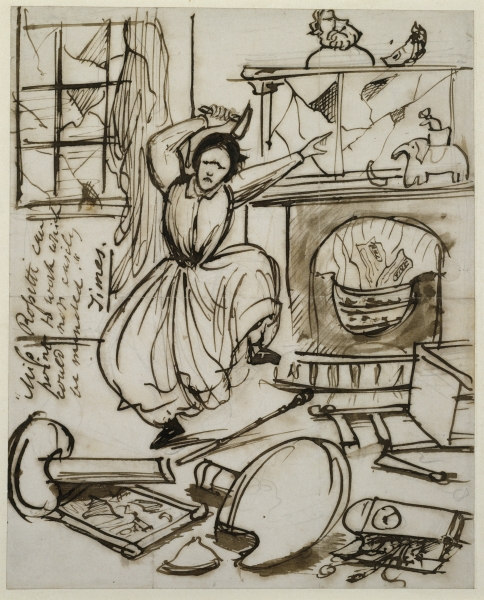
A tantrum, conniption, angry outburst, temper tantrum, lash out, meltdown, fit of anger, or hissy fit is an emotional outburst, usually associated with those in emotional distress. It is typically characterized by stubbornness, crying, screaming, violence, defiance, angry ranting, a resistance to attempts at pacification, and in some cases, hitting or bullying and other physically violent behavior. Physical control may be lost; the person may be unable to remain still; and even if the "goal" of the person is met, they may not be calmed. Throwing a temper tantrum may lead to a child getting detention or being suspended from school for older school age children, and could result in a timeout or grounding, complete with room or corner time, at home. A tantrum may be expressed in a tirade: a protracted, angry speech.
In early childhood
Tantrums are one of the most common forms of problematic behavior in young children but tend to decrease in frequency and intensity as the child gets older. For a toddler, tantrums can be considered as normal, and even as gauges of developing strength of character.
While tantrums are sometimes seen as a predictor of future anti-social behavior, in another sense they are simply an age-appropriate sign of excessive frustration, and will diminish over time given a calm and consistent handling. Parental containment where a child cannot contain themself—rather than what the child is ostensibly demanding—may be what is really required.
Selma Fraiberg warned against "too much pressure or forceful methods of control from the outside" in child-rearing: "if we turn every instance of pants changing, treasure hunting, napping, puddle wading and garbage distribution into a governmental crisis we can easily bring on fierce defiance, tantrums, and all the fireworks of revolt in the nursery".
Intellectual and developmental disorders
Some people who have developmental disorders such as autism, Asperger syndrome, ADHD, and intellectual disability or even a developmental disability, could be more vulnerable to tantrums than others, although anyone experiencing brain damage (temporary or permanent) can suffer from tantrums. Anyone may be prone to tantrums once in a while, regardless of gender or age. However, a meltdown due to sensory overload (which even non-autistic children can experience) is not the same as a temper tantrum.
Aberrations
Freud considered that the Wolf Man's development of temper tantrums was connected with his seduction by his sister: he became "discontented, irritable and violent, took offence on every possible occasion, and then flew into a rage and screamed like a savage". Freud linked the tantrums to an unconscious need for punishment driven by feelings of guilt—something which he thought could be generalised to many other cases of childhood tantrums.
Heinz Kohut contended that tantrums were rages of anger, caused by the thwarting of the infant's grandiose-exhibitionist core. The blow to the inflated self-image, when a child's wishes are (however justifiably) refused, creates fury because it strikes at the feeling of omnipotence.
Jealousy over the birth of a sibling, and resulting aggression, may also provoke negativistic tantrums, as the effort at controlling the feelings overloads the child's system of self-regulation.
In later life
Writer William Makepeace Thackeray claimed that in later life "you may tell a tantrum as far as you can see one, by the distressed and dissatisfied expression of its countenance—'Tantrumical', if we may term it so".
The willingness of the celebrity to throw tantrums whenever thwarted to the least degree is a kind of acquired situational narcissism or tantrumical behavior.
If older people show tantrums, they might often be signs of immaturity or a mental or developmental disability; and often autistic or ADHD meltdowns are incorrectly labelled tantrums. It can also occur in neurotypical people under extreme stress.
References
References
- J.P., Maxwell. (2004). "Anger rumination: An antecedent of athlete aggression?". Psychology of Sport and Exercise.
- (1830). "The Cabinet Album: A Collection of Original and Selected Literature". Hurst Chance and Company.
- Foote, Samuel. (1765). "The Dramatic Works Volume 1". P. Vaillant.
- Payn, James. (1869). "Married Beneath Him. A novel. By the author of "Lost Sir Massingberd" James Payn". The British Library.
- (1886). "Novels [originally Published in Lippincott's Monthly Magazine, 1886-1894]". United States: Lippincott.
- O'Hara, Kane. (1770). "Midas An English Burletta. As it is Performed at the Theatre-Royal, in Covent-Garden". Midas an English Burletta. As It is Performed at the Theatre-Royal, in Covent-Garden.
- GOMBERT, A. J.. (1825). "The French Drama ... with Notes Critical and Explanatory, by A. G. Volume 2 of The French Drama ... with Notes Critical and Explanatory, by A. G". The British Library.
- K.A., Freeman. (2004). "Introduction to Special Issue on Adolescent Conduct Problems.". Behavior Modification.
- Penelope Leach. "What is a tantrum?".
- "Temper Tantrums".
- Karisa Ding. (July 26, 2017). "Tantrums".
- Jan Hunt. "When a Child Has a Tantrum". The Natural Child Project.
- Mullen, J.K.. (1983). "Understanding and managing the temper tantrum". Child Care Quarterly.
- Geelerd, E.R.. (1945). "Observations on temper tantrums in children". American Journal of Orthopsychiatry.
- (2012). "Assessment, management, and prevention of childhood temper tantrums". Journal of the American Academy of Nurse Practitioners.
- Banham Bridges, Katharine M.. (1932). "Emotional Development in Early Infancy". Child Development.
- Robin Skynner. (1993). "Families and how to survive them".
- Isaacs, S.. (1940). "Temper tantrums in early childhood in their relation to internal objects.". The International Journal of Psychoanalysis.
- Solter, A.. (1992). "Understanding Tears and Tantrums". Young Children.
- (June 2003). "Temper Tantrums in Young Children". Journal of Developmental & Behavioral Pediatrics.
- (2011). "Screaming, yelling, whining, and crying: Categorical and intensity differences in vocal expressions of anger and sadness in children's tantrums.". Emotion.
- Roy Benaroch. (2008). "Solving Health and Behavioural Problems from Birth Through Preschool".
- Kopp, C.B.. (1989). "Regulation of distress and negative emotions: A developmental view.". Developmental Psychology.
- Levine, Linda. (1995). "Young Children's Understanding of the Causes of Anger and Sadness". Child Development.
- Patrick Casement. (1990). "Further Learning from the Patient".
- Selma H. Fraiberg. (1987). "The Magic Years".
- (2002). "Providing Instruction from Novel Staff as an Antecedent Intervention for Child Tantrum Behavior in a Public School Classroom". Education and Treatment of Children.
- (1984). "Effects of gross motor activities on the severe self-injurious tantrums of multihandicapped individuals.". Applied Research in Mental Retardation.
- Sandra Ketcham. "Temper Tantrums and Autism". LoveToKnow.
- (April 1, 2010). "A Cross-Sectional Study of Onset, Cessation, Frequency, and Duration of Children's Temper Tantrums in a Nonclinical Sample". Psychological Reports.
- (2 February 2016). "Tantrum vs Autistic Meltdown: What Is The Difference?". Autism Awareness Centre Inc..
- Sigmund Freud. "Case Histories II (PFL 9)".
- Sigmund Freud. "Case Histories II (PFL 9)".
- Sigmund Freud. "Case Histories II (PFL 9)".
- M., R.J, Potegal, Davidson. (1997). "Young children's post tantrum affiliation with their parents". Aggressive Behavior.
- H. Goldenberg. (2007). "Family Therapy".
- [[Edmund Bergler]] in J. Halliday/P. Fuller eds., ''The Psychology of Gambling'' (London 1974) p. 182: With "a child confronted with some refusal ... regardless of its justifications, the refusal automatically provokes fury, since it offends his sense of [[omnipotence]]".
- J., H.A., Kagan, Moss. (1962). "The stability of behavior: II. Aggression. In J. Kagan & H. A. Moss, Birth to maturity: A study in psychological development". John Wiley & Sons, Inc..
- Selma H. Fraiberg. (1987). "The Magic Years".
- Dennis, Tracy A.. (2006). "Emotional self-regulation in preschoolers: The interplay approach reactivity, and control capacities". Developmental Psychology.
- William Makepeace Thackeray. (1848). "The Irish Sketch Book". J. Winchester.
- Cooper Lawrence, ''The Cult of Celebrity'' (2009) p. 72
- Simon Crompton, ''All About Me'' (London 2007) p. 176
- "North Jersey".
This article was imported from Wikipedia and is available under the Creative Commons Attribution-ShareAlike 4.0 License. Content has been adapted to SurfDoc format. Original contributors can be found on the article history page.
Ask Mako anything about Tantrum — get instant answers, deeper analysis, and related topics.
Research with MakoFree with your Surf account
Create a free account to save articles, ask Mako questions, and organize your research.
Sign up freeThis content may have been generated or modified by AI. CloudSurf Software LLC is not responsible for the accuracy, completeness, or reliability of AI-generated content. Always verify important information from primary sources.
Report