From Surf Wiki (app.surf) — the open knowledge base
Tanegashima (gun)
Japanese firearm

Japanese firearm
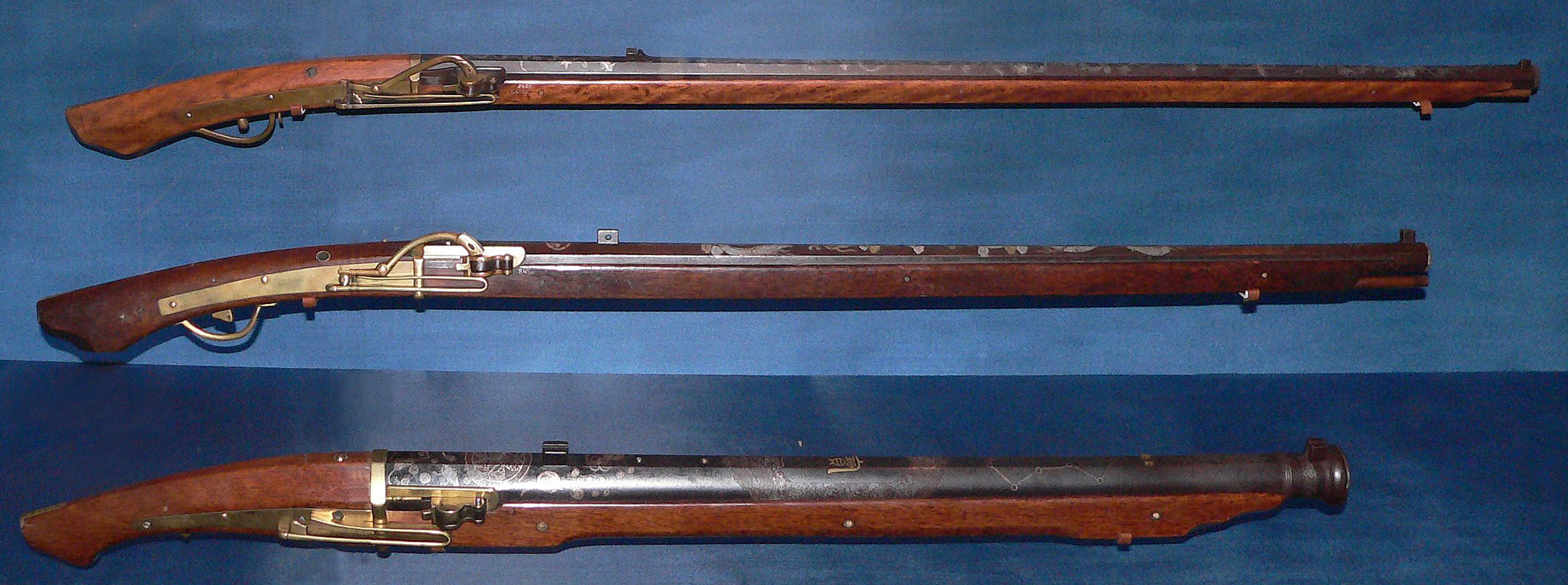
, most often called in Japanese and sometimes in English , was a type of matchlock-configured arquebus firearm introduced to Japan through the Portuguese Empire in 1543. It was used by the samurai class and their ja "foot soldiers", and within a few years its introduction in battle changed the way war was fought in Japan forever. It, however, could not completely replace the ja (longbow). Although the Japanese developed various techniques to improve the gun's shortcomings, specifically its slow rate of fire and inability to fire in the rain, After Tokugawa Ieyasu destroyed the Toyotomi clan in the siege of Osaka and established the Tokugawa shogunate, the relatively peaceful Edo period arrived, and the use of ja declined.
History
Origins
The ja seems to have been based on snap matchlocks that were produced in the armory of Goa in Portuguese India, which was captured by the Portuguese in 1510. The name ja came from the Japanese island (Tanegashima) where a Chinese junk with two Portuguese adventurers on board was driven to anchor by a storm in 1543. The lord of the Japanese island, Tanegashima Tokitaka (1528–1579), purchased two matchlock muskets from the Portuguese and put a swordsmith to work copying the matchlock barrel and firing mechanism. The smith, Yaita Kinbee Kiyosoda, did not have much of a problem with most of the gun but "drilling the barrel helically so that the screw (ja bolt) could be tightly inserted" was a major problem as this "technique did not apparently exist in Japan until this time." The Portuguese fixed their ship and left the island, and only in the next year, when a Portuguese blacksmith was brought back to Japan, was the problem solved.
Sengoku period
.jpg)
Much of Japan was involved with internecine wars during the Sengoku period (1467–1603), as feudal lords vied for supremacy. Matchlock guns were introduced midway through the period and saw extensive use in the later years of the conflict, playing a decisive role on the battlefield. In 1549, Oda Nobunaga ordered 500 guns to be produced for his armies at a time when the benefits of firearms over traditional weapons were still relatively questionable to other ja. However the new firearm had undoubted advantages in range in comparison with traditional bows. In addition, bullets could penetrate almost any armor and shield. Joseon official Yu Sŏngnyong quoted:
The Japanese soon worked on various techniques to improve the effectiveness of their guns. They developed a staggered firing technique to create a continuous rain of bullets on the enemy. They also developed larger caliber barrels and ammunition to increase lethality. Protective boxes in lacquerware were invented to fit over the firing mechanism so it could still fire while it was raining, as were systems to accurately fire weapons at night by keeping fixed angles thanks to measured strings. Another development would be the ja, a bamboo cartridge used to facilitate faster reloading. A hollow tube open at both ends, the ja contained gunpowder, wadding, and a bullet. Upon tearing open the tube's paper seal at the bottom, a soldier could quickly use it to pour the necessary powder into his weapon before placing over the barrel and using his rammer to load both wadding and bullet into the barrel at the same time. After use, the ja could be kept for repacking or discarded.
In 1563 the Amago clan of Izumo Province won a victory over the Kikkawa clan with 33 of their adversaries wounded by ja. In 1567, Takeda Shingen announced that, "Hereafter, the guns will be the most important arms, therefore decrease the number of spears per unit, and have your most capable men carry guns". Oda Nobunaga used tanegashima in the Battle of Anegawa (1570), and again against the powerful Takeda clan in the Battle of Nagashino (1575), 3,000 gunners helped win the battle, firing by volleys of a thousand at a time. They were concealed across a river and used breastworks to effectively stop enemy infantry and cavalry charges while being protected. The defeat of the powerful Takeda clan brought about permanent changes in battle tactics. In the Battle of Numajiri (1584), Satake Yoshishige won against Hojo clan, due in part to the use of over 8600 matchlock rifles by their troops. The soldiers led by Date Masamune were 70% armed with guns.
Japan became so enthusiastic about the new weapons that it possibly overtook every European country in absolute numbers produced. Japan also used the guns in the Japanese invasion of Korea in 1592, in which about a quarter of the invasion force of 160,000 were gunners. They were extremely successful at first and managed to capture Seoul just 18 days after their landing at Busan.
Edo period


The internal war for control of Japan was won by Tokugawa Ieyasu, who defeated his rivals at the Battle of Sekigahara in October 1600. Three years later, he established the Tokugawa shogunate, a powerful entity that would maintain peace, stability, and prosperity in Japan for the following 250 years. This is known as the Edo period (1603–1868). From the mid-17th century, Japan decided to close itself to interaction with the West except for the Dutch Republic through its policy of ja. Contrary to popular belief, this did not lead to Japan "giving up the gun"; if anything, the gun was used less frequently because the Edo period did not have many large-scale conflicts in which a gun would be of use. Often the katana was simply the more practical weapon in the average small-scale conflicts.
Isolation did not eliminate the production of guns in Japan—on the contrary, there is evidence of around 200 gunsmiths in Japan by the end of the Edo period. However, the social life of firearms had changed: as the historian David L. Howell has argued, for many in Japanese society, the gun had become less a weapon than a farm implement for scaring off animals. With no external enemies for over 200 years, ja were mainly used by samurai for hunting and target practice, the majority were relegated to the arms store houses of the ja.
The arrival in Japan of the United States Navy led by Matthew C. Perry in 1854 started a period of rearmament. The ja was an antiquated weapon by the 1800s and various samurai factions acquired advanced firearms including the minié rifle, breech-loading and repeating rifles. The samurai era ended in 1868 with the Meiji period; Japan turned to a national conscription army with modern weapons and uniforms. Some gunsmiths did replace their matchlock-type ja into percussion cap mechanisms while retaining its design as a musket. The last use of samurai armour and traditional weapons in Japan, including ja, was during the Satsuma Rebellion (1877), when the Meiji government's newly established Imperial Japanese Army put an end to the last samurai and their resistance to modernization.
Classifications of different guns
Japanese arquebuses are classified by the location of their native gunsmiths as well as with the weight of the ball by momme.
{{transliteration|ja|Ban-zutsu}} (numbered cylinder)

The most common users of the ja were peasant foot soldiers commanded by the samurai, the ja. Where warfare changed during the Sengoku era exponentially with massed pike, archer, and eventually arquebus formations, large quantities of guns were needed and produced to equip the ja (gun units) of the feudal Japanese armies.
As these guns were primarily used by the ja, they were of low quality and were stored in arsenals where they could be used again.
{{transliteration|ja|Tan-zutsu}} (small cylinder)
ja were generally matchlock pistols that due to their inferior range and firepower compared to the ja, were not best suited in open field battles and were instead used as status symbols for mounted samurai. They were occasionally used for self-defense by high ranking commanders.

{{transliteration|ja|Chu-zutsu}} (middle cylinder)
At the advent of firearms, Japanese armies had to come up with reliable ways of repelling the widespread use of guns; whether it would be the creation of full plated and soon bullet-proof armor, bulletproof bundles of bamboo called taketaba or heavy iron pavises. With the caliber of the ja being too weak to penetrate these protection methods, a new, yet harder to handle and expensive gun with a larger gun caliber was needed to equip the ja formations that encountered these obstacles; the ja was such a solution.
{{transliteration|ja|O-zutsu}} (great cylinder)
Guns of the ja caliber (20 momme (≈ 75 g) and more) were practically portable hand cannons and were used as siege weapons employed to knock down the hinges of gates as well as powerful anti-personnel and anti-cavalry weapons.

A gun of this size was typically hard to operate (though varying on the momme), requiring plentiful amounts of gunpowder and proper training. One of the issues of operating such device was the powerful recoil and the difficulty of transporting, where sometimes larger ja were either rested on rice bales, hung from trees using ropes, or installed on a carriage (similar to European cannons).
Samurai-{{transliteration|ja|zutsu}} (samurai cylinder)
The samurai-ja guns were custom-made for use only by the samurai, whose high social standing and wealth meant they could afford well-crafted and intricately designed guns which were longer and of larger caliber, as opposed to the cruder and inferior quality ja used by the ja.

{{transliteration|ja|Hazama/Zama-zutsu}} (loop hole/hole cylinder)
ja or ja guns were generally longer than most guns and had a smaller caliber than even the ja. These guns were used on castles and ships primarily as long range defensive weapons.

{{transliteration|ja|Bajo-zutsu}} (horse riding cylinder)
As the ja became a status symbol among the ja (cavalry), it eventually made its way into becoming a cavalry gun. These guns were similar in structure to the ja, but had a longer barrel and were fairly easy to reload on horseback.
{{transliteration|ja|Shateki-zutsu}} (target cylinder)
ja were made purely for the purpose of target practice.
Modern use

Today ja are readily available from sellers of antique firearms and dealers of samurai antiques both in Japan and the West. Modern ja gun troops in Japan re-enact the use of ja in battle, and black powder enthusiasts use ja for target practice.
Parts
- ja – Butt protector
- ja – Trigger
- ja – Lock
- ja – Plate
- ja – Trigger guard
- ja – Rivet
- ja – Hole for the matchcord
- ja – Spring
- ja – Stock ring
- ja – Hammer arm
- ja – Barrel protector
- ja – Pancover
- ja – Pantray
- ja – Stock
- ja – Barrel
- ja – Rear sight
- ja – Sling hole
- ja – Middle sight
- ja – Pin hole
- ja – Front sight
- ja – Ramrod
- ja – Muzzle
Gallery
File:Tanegashima.JPG|Edo-period ja firing mechanism File:Antique Japanese (samurai) tamegashima (matchlock) firing mechanism.JPG|The inside of the arquebus's firing mechanism File:Choshu tanegashima 3.JPG|Edo-period ja showing the barrel bolt File:Choshu tanegashima.JPG|Edo-period ja firing mechanism
References
References
- Patricia Ebrey]], Anne Walthall, James Palais, Publisher Cengage Learning, 2008, {{ISBN. 978-0-547-00534-8 P257
- Lidin, Olof G.. (2002). "Tanegashima: the arrival of Europe in Japan". NIAS Press.
- [https://books.google.com/books?id=6WQnNqhDNhAC ''Tanegashima: the arrival of Europe in Japan''], Olof G. Lidin, Nordic Institute of Asian Studies, NIAS Press, 2002 P.1-14
- Noel Perrin. (1979). "Giving up the gun: Japan's reversion to the sword, 1543-1879". David R Godine.
- it remained inferior to the {{transliteration. ja. link. Nagoya Japanese Sword Museum Nagoya Touken World
- link. Nagoya Japanese Sword Museum Nagoya Touken World
- Daehnhardt, Rainer. (1994). "The Bewitched Gun: The Introduction of the Firearm in the Far East by the Portuguese; Espingarda Feiticeira: A Introducao Da Arma De Fogo Pelos Portugueses No Extremo-Oriente". Texto Editora.
- Tanegashima: the Arrival of Europe to Japan (2002) p. 5, 6
- Lidin, Olof G.. (2002). "Tanegashima: The Arrival of Europe in Japan". Taylor & Francis.
- Perrin p.9
- [[Andrade, Tonio]]. (2016) ''The Gunpowder Age'' p. 184: "When [our] soldiers are lined up against the enemy ranks, our arrows do not reach the enemy while their musket balls rain down upon us."
- Firearms: A Global History to 1700 by Kenneth Chase
- Perrin p.17
- Perrin, p.18
- Perrin, p.40
- Wayland, Dean. "TEPPŌ Japanese Matchlock Guns".
- (2010). "War and State Building in Medieval Japan". Stanford University Press.
- Perrin, p.17
- Perrin p.19-20
- name="Satake-Shi at harimaya.com"
- (2023-12-09). "味方の軍にも鉄砲を撃ちまくって全滅させた…伊達政宗が大坂の陣で張り切りすぎて残した"最悪の伝説"". PRESIDENT WOMAN SOCIAL.
- Perrin p.25
- Perrin p.27
- Perrin p.28
- Samurai Archives Podcast EP05 [http://www.samuraipodcast.com/ep05-the-myth-of-samurai-giving-up-the-gun "The Myth of Samurai Giving Up the Gun"]. Retrieved August 13, 2013.
- Howell, David L.. (1 May 2009). "The Social Life of Firearms in Tokugawa Japan". Japanese Studies.
- "Home".
This article was imported from Wikipedia and is available under the Creative Commons Attribution-ShareAlike 4.0 License. Content has been adapted to SurfDoc format. Original contributors can be found on the article history page.
Ask Mako anything about Tanegashima (gun) — get instant answers, deeper analysis, and related topics.
Research with MakoFree with your Surf account
Create a free account to save articles, ask Mako questions, and organize your research.
Sign up freeThis content may have been generated or modified by AI. CloudSurf Software LLC is not responsible for the accuracy, completeness, or reliability of AI-generated content. Always verify important information from primary sources.
Report