From Surf Wiki (app.surf) — the open knowledge base
Tamga
Symbol branding a group of Eurasian nomads

Symbol branding a group of Eurasian nomads
A tamga, or tamgha (from ), was an abstract seal or brand used by Eurasian nomads and cultures influenced by them, initially as a livestock branding. The tamga was used as a livestock branding for a particular tribe, clan or family. They were common among the Eurasian nomads throughout Classical Antiquity and the Middle Ages. As clan and family identifiers, the collection and systematic comparison of tamgas is regarded to provide insights into relations between families, individuals and ethnic groups in the steppe territory.
Similar tamga-like symbols were sometimes adopted by sedentary peoples adjacent to the Pontic–Caspian steppe both in Eastern Europe and Central Asia. Branding of livestock was a common practice across most sedentary populations, as far back as the ancient Egyptians.
It has been speculated that Turkic tamgas represent one of the sources of the Old Turkic script of the 6th–10th centuries, but since the mid-20th century, this hypothesis is widely rejected as being unverifiable.
Tamgas in the steppe tradition
Ancient origins

Tamgas originate in prehistoric times, but their exact usage and development cannot be continuously traced over time. There are, however, symbols represented in rock art that are referred to as tamgas or tamga-like. If they serve to record the presence of individuals at a particular place, they may be functionally equivalent to medieval tamgas.
In the later phases of the Bosporan Kingdom of the Crimea, the ruling dynasty applied personal tamgas, composed of a fragment representing the family and a fragment representing the individual king, apparently in continuation of steppe traditions and in an attempt to consolidate sedentary and nomadic factions within the kingdom.
Turkic peoples
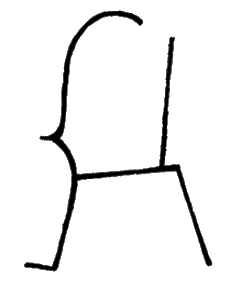

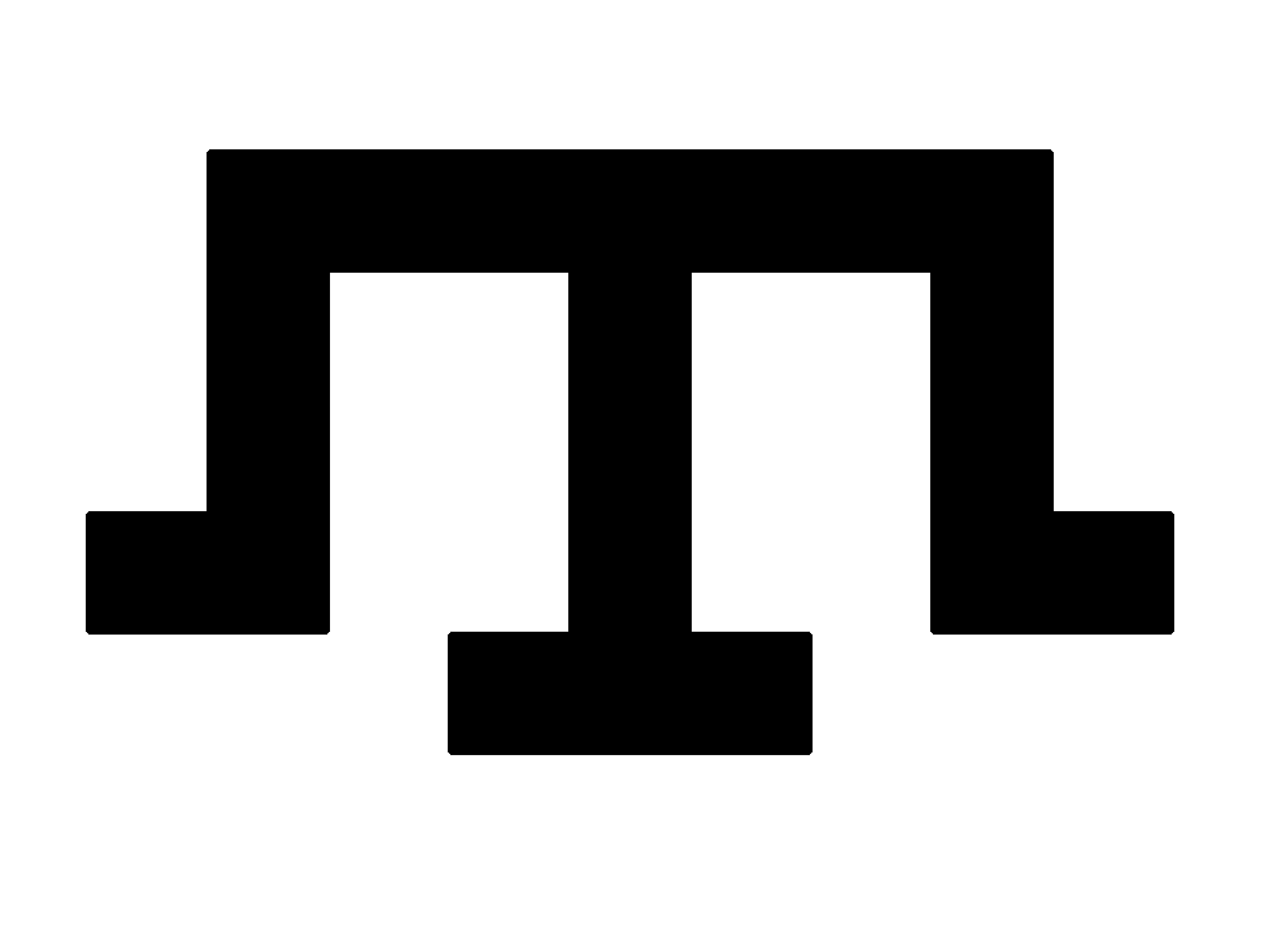
.jpg)
According to Clauson (1972, p.504f.), Common Turkic tamga means "originally a `brand' or mark of ownership placed on horses, cattle, and other livestock; it became at a very early date something like a European coat of arms or crest, and as such appears at the head of several Türkü and many O[ld] Kir[giz] funary monuments".
Among modern Turkic peoples, the tamga is a design identifying property or cattle belonging to a specific Turkic clan, usually as a cattle brand or stamp. In Turkestan, it has remained what it originally was: a cattle brand and clan identifier. The Turks who remained pastoral nomad kings in eastern Anatolia and Iran, continued to use their clan tamgas and in fact, they became high-strung nationalistic imagery. The Aq Qoyunlu and Qara Qoyunlu, like many other royal dynasties in Eurasia, put their tamga on their flags and stamped their coinage with it.
When Turkish clans took over more urban or rural areas, tamgas dropped out of use as pastoral ways of life became forgotten. That is most evident in the Turkish clans that took over western and eastern Anatolia after the Battle of Manzikert. The Turks who took over western Anatolia founded the Sultanate of Rûm and became Roman-style aristocrats. Most of them adopted the then-Muslim symbol of the Seal of Solomon after the Sultanate disintegrated into a mass of feuding ghazi states (see Isfendiyarids, Karamanids). Only the Ottoman ghazi state (later to become the Ottoman Empire) kept its tamga, which was so highly stylized that the bow was stylized down eventually to a crescent moon.
Tamgas of the 21 Oghuz tribes (as Charuklug had none) according to Mahmud al-Kashgari in Dīwān Lughāt al-Turk: File:Kinik.svg|Qiniq File:Kayi.svg|Kayı File:Bayundur.svg|Bayandur File:Yiva.svg|Yiwa File:Salur.svg|Salur File:Avsar.svg|Afshar File:Begdili.svg|Begtili File:Bugduz.svg|Bugduz File:Bayat.svg|Bayat File:Yazir.svg|Yazigir File:Eymur.svg|Eymur File:Karaevli.svg|Karaboluk File:Akevli.svg|Аlkaboluk File:Igdir.svg|Taşburun (Iğdır) File:Yuregir.svg|Uregir (Yüregir) File:Dodurga.svg|Dodurga File:Alayuntlu.svg|Ulayundluğ File:Doger.svg|Döger File:Pecenek.svg|Pechenek File:Cavuldur.svg|Chuvaldar File:Cepni.svg|Chepni
List of Kazakh tamga symbols that were used by [[jüz|clans]]
| Clan | Subclan | Tamga | Senior Jüz | [[File:Kazakh Tamga 46.svg | 30px]] | Middle Jüz | [[File:Kazakh Tamga 18.svg | 30px]] | Junior Jüz | Out of Jüz system | ||
|---|---|---|---|---|---|---|---|---|---|---|---|---|
| Qaŋlı | [[File:Kazakh Tamga 04.svg | 30px]], [[File:Kazakh Tamga 05.svg | 30px]] | |||||||||
| Jalayır | [[File:Kazakh Tamga 03.svg | 30px]] | ||||||||||
| Dulat | [[File:Kazakh Tamga 02.svg | 30px]], [[File:Kazakh Tamga 74.svg | 30px]] | |||||||||
| Siqım | [[File:Kazakh Tamga 04.svg | 30px]], [[File:Kazakh Tamga 63.svg | 30px]], [[File:Kazakh Tamga 64.svg | 30px]] | ||||||||
| Janıs | [[File:Kazakh Tamga 65.svg | 30px]] | ||||||||||
| Botbay | [[File:Kazakh Tamga 64.svg | 30px]] | ||||||||||
| Şımır | [[File:Kazakh Tamga 01.svg | 30px]] | ||||||||||
| Alban | [[File:Kazakh Tamga 01.svg | 30px]] | ||||||||||
| Suwan | [[File:Kazakh Tamga 09.svg | 30px]] | ||||||||||
| Sarı-Üysin | [[File:Kazakh Tamga 08.svg | 30px]] | ||||||||||
| Şapıraştı | [[File:Kazakh Tamga 13.svg | 30px]], [[File:Kazakh Tamga 14.svg | 30px]], [[File:Kazakh Tamga 42.svg | 30px]] | ||||||||
| Oşaqtı | [[File:Kazakh Tamga 07.svg | 30px]] | ||||||||||
| Istı | [[File:Kazakh Tamga 04.svg | 30px]], [[File:Kazakh Tamga 05.svg | 30px]] | |||||||||
| Oyıq | [[File:Kazakh Tamga 04.svg | 30px]], [[File:Kazakh Tamga 17.svg | 30px]] | |||||||||
| Tilik | [[File:Kazakh Tamga 66.svg | 30px]] | ||||||||||
| Sirgeli | [[File:Kazakh Tamga 10.svg | 30px]], [[File:Kazakh Tamga 11.svg | 30px]], [[File:Kazakh Tamga 12.svg | 30px]], [[File:Kazakh Tamga 75.svg | 30px]] | |||||||
| Şanışqılı | [[File:Kazakh Tamga 15.svg | 30px]], [[File:Kazakh Tamga 16.svg | 30px]] | |||||||||
| Arğın | [[File:Kazakh Tamga 17.svg | 30px]] | ||||||||||
| Joğarı şekti | [[File:Kazakh Tamga 76.svg | 30px]] | ||||||||||
| Tömengi şekti | [[File:Kazakh Tamga 77.svg | 30px]] | ||||||||||
| Taraqtı | [[File:Kazakh Tamga 03.svg | 30px]], [[File:Kazakh Tamga 24.svg | 30px]] | |||||||||
| Nayman | [[File:Kazakh Tamga 22.svg | 30px]], [[File:Kazakh Tamga 23.svg | 30px]] | |||||||||
| Baltalı | [[File:Kazakh Tamga 71.svg | 30px]] | ||||||||||
| Bağanalı | [[File:Kazakh Tamga 30.svg | 30px]], [[File:Kazakh Tamga 20.svg | 30px]], [[File:Kazakh Tamga 73.svg | 30px]] | ||||||||
| Buwra | [[File:Kazakh Tamga 81.svg | 30px]] | ||||||||||
| Qarakerey | [[File:Kazakh Tamga 78.svg | 30px]] | ||||||||||
| Matay | [[File:Kazakh Tamga 79.svg | 30px]] | ||||||||||
| Sadır | [[File:Kazakh Tamga 02.svg | 30px]], [[File:Kazakh Tamga 35.svg | 30px]] | |||||||||
| Qıpşaq | [[File:Kazakh Tamga 19.svg | 30px]] | ||||||||||
| Qoŋırat | [[File:Kazakh Tamga 18.svg | 30px]] | ||||||||||
| Saŋğıl | [[File:Kazakh Tamga 18.svg | 30px]] | ||||||||||
| Waq | [[File:Kazakh Tamga 25.svg | 30px]], [[File:Kazakh Tamga 20.svg | 30px]], [[File:Kazakh Tamga 26.svg | 30px]] | ||||||||
| Ergenekti Waq | [[File:Kazakh Tamga 75.svg | 30px]], [[File:Kazakh Tamga 80.svg | 30px]] | |||||||||
| Keraites | [[File:Kazakh Tamga Tortkara.svg | 30px]] | ||||||||||
| Aşamaylı | [[File:Kazakh Tamga 20.svg | 30px]] | ||||||||||
| Abaq | [[File:Kazakh Tamga 21.svg | 30px]] | ||||||||||
| Bayulı | ||||||||||||
| Aday | [[File:Kazakh Tamga 27.svg | 30px]], [[File:Kazakh Tamga 28.svg | 30px]] | |||||||||
| Beriş | [[File:Kazakh Tamga 36.svg | 30px]], [[File:Kazakh Tamga 37.svg | 30px]], [[File:Kazakh Tamga 06.svg | 30px]], [[File:Kazakh Tamga 38.svg | 30px]] | |||||||
| Altın | [[File:Kazakh Tamga 32.svg | 30px]], [[File:Kazakh Tamga 33.svg | 30px]] | |||||||||
| Jappas | [[File:Kazakh Tamga 41.svg | 30px]], [[File:Kazakh Tamga 42.svg | 30px]], [[File:Kazakh Tamga 20.svg | 30px]], [[File:Kazakh Tamga 43.svg | 30px]] | |||||||
| Esentemir | [[File:Kazakh Tamga 44.svg | 30px]], [[File:Kazakh Tamga 45.svg | 30px]] | |||||||||
| Taz | [[File:Kazakh Tamga 55.svg | 30px]], [[File:Kazakh Tamga 56.svg | 30px]] | |||||||||
| Baybaqtı | [[File:Kazakh Tamga 72.svg | 30px]], [[File:Kazakh Tamga 02.svg | 30px]], [[File:Kazakh Tamga 34.svg | 30px]], [[File:Kazakh Tamga 35.svg | 30px]] | |||||||
| Tana | [[File:Kazakh Tamga 04.svg | 30px]] | ||||||||||
| Masqar | ||||||||||||
| Altıbas (Alaşa) | [[File:Kazakh Tamga 29.svg | 30px]], [[File:Kazakh Tamga 30.svg | 30px]], [[File:Kazakh Tamga 31.svg | 30px]] | ||||||||
| Qızılqurıt | [[File:Kazakh Tamga 04.svg | 30px]], [[File:Kazakh Tamga 49.svg | 30px]], [[File:Kazakh Tamga 19.svg | 30px]], [[File:Kazakh Tamga 50.svg | 30px]] | |||||||
| Şerkeş | [[File:Kazakh Tamga 30.svg | 30px]], [[File:Kazakh Tamga 44.svg | 30px]], [[File:Kazakh Tamga 47.svg | 30px]] | ||||||||
| Isıq | [[File:Kazakh Tamga 44.svg | 30px]], [[File:Kazakh Tamga 45.svg | 30px]] | |||||||||
| Älimulı | ||||||||||||
| Qarasaqal | [[File:Kazakh Tamga 47.svg | 30px]], [[File:Kazakh Tamga 40.svg | 30px]], [[File:Kazakh Tamga 48.svg | 30px]] | ||||||||
| Qarakesek | [[File:Kazakh Tamga 18.svg | 30px]], [[File:Kazakh Tamga 46.svg | 30px]] | |||||||||
| Törtqara | ||||||||||||
| Şekti | [[File:Kazakh Tamga 61.svg | 30px]], [[File:Kazakh Tamga 62.svg | 30px]], [[File:Kazakh Tamga 13.svg | 30px]] | ||||||||
| Şömekey | ||||||||||||
| Jetiruw | ||||||||||||
| Tabın | [[File:Kazakh Tamga 54.svg | 30px]], [[File:Kazakh Tamga 57.svg | 30px]], [[File:Kazakh Tamga 58.svg | 30px]] | ||||||||
| Tama | [[File:Kazakh Tamga 19.svg | 30px]], [[File:Kazakh Tamga 59.svg | 30px]], [[File:Kazakh Tamga 05.svg | 30px]] | ||||||||
| Jağabayl | [[File:Kazakh Tamga 39.svg | 30px]] [[File:Kazakh Tamga 40.svg | 30px]] | |||||||||
| Telew | [[File:Kazakh Tamga 60.svg | 30px]], [[File:Kazakh Tamga 20.svg | 30px]] | |||||||||
| Kerderi | [[File:Kazakh Tamga 53.svg | 30px]] | ||||||||||
| Kereyit | [[File:Kazakh Tamga 51.svg | 30px]], [[File:Kazakh Tamga 52.svg | 30px]] | |||||||||
| Ramadan | [[File:Kazakh Tamga 54.svg | 30px]] | ||||||||||
| Töre | [[File:Kazakh Tamga 57.svg | 30px]], [[File:Kazakh Tamga 70.svg | 30px]] | |||||||||
| Qoja | [[File:Kazakh Tamga 04.svg | 30px]], [[File:Kazakh Tamga 69.svg | 30px]] | |||||||||
| Töleñgıt | [[File:Kazakh Tamga 03.svg | 30px]] | ||||||||||
| Noğay-Qazaq | [[File:Kazakh Tamga 39.svg | 30px]] |
Mongolian
"Tamga", or "tamag'a", literally means "stamp" or "seal" in Mongolian and designates emblematic symbols which were historically used by various Mongolic tribes or clans in Central Asia. According to Clauson (1972, p.504), it was originally a Turkic word also "used for a Chinese 'seal' and passed into Mong[olian] in this meaning as tamaga".
In the Mongol Empire, a tamgha was a seal placed on taxed items and, by extension, a tax on commerce (see Eastern Europe below).
Over a hundred different Mongolian tamga are known. Certain tamga were adopted by individual medieval Mongolic and Turkic rulers, and were consequently used on coins and seals issued by these rulers. Tamga are most widely found on Islamic coins issued by the descendants of Chinggis Khan in the various khanates of Central Asia during the 13th and 14th centuries, in particular the Chaghatai Khanate. Tamga are of immense interest to numismatists, and are discussed in many academic works relating to the medieval Islamic coins of Central Asia. However, numismatists and historians currently have limited options for representing tamga symbols in text, and cannot reliably interchange text including tamga symbols because they are either represented as images, or are handdrawn, or use an ad hoc font. Doctor Nyamaa identifies nearly a hundred tamga signs used on coins, although only about half of them can be assigned to a specific ruler, and some of them are variant forms or presentation forms of the same tamga.
File:Naran Tamga.svg|alt=|Naran Tamga or Ongin Tamga File:Chinggis khan tamga.svg|alt=|Tamga of Chinggis khan File:Tului khan tamga.svg|alt=|Tamga of Tului khan File:Ugudei khan tamga.svg|alt=|Tamga of Ögedei Khan File:Tsagadai khan Tamga.svg|alt=|Tamga of Tsagadai khan File:Zuchi khan tamga.svg|alt=|Tamga of Juchi khan File:Guyug khan tamga.svg|alt=|Tamga of Guyug khan

Tamgas are also stamped using hot irons on domesticated animals such as horses in present-day Mongolia and others to identify that the livestock belongs to a certain family, since livestock is allowed to roam during the day. Each family has their own tamga markings for easier identification. Tamga marks are not very elaborate, since they are made from curved pieces of iron by the individual families.
A tamag'a is also used as the "state seal" of Mongolia, which is handed over by the President of Mongolia as part of the transition to a new president. In the presidential case, the tamag'a is a little more elaborate and is contained in a wooden box.
Caucasus
From Turkic, the term "tamga" has also been loaned into Caucasian languages, e.g., ; . Among the Circassians, almost every family has a tamga to this day.
In Ingushetia, members of the aristocracy used tamgas as hereditary emblems, examples of which can be seen on tower complexes in auls such as Erzi, Egikal, Targim, Khamkhi, Yevloy, and Vovnushki.
Secondary usage
Eastern Europe
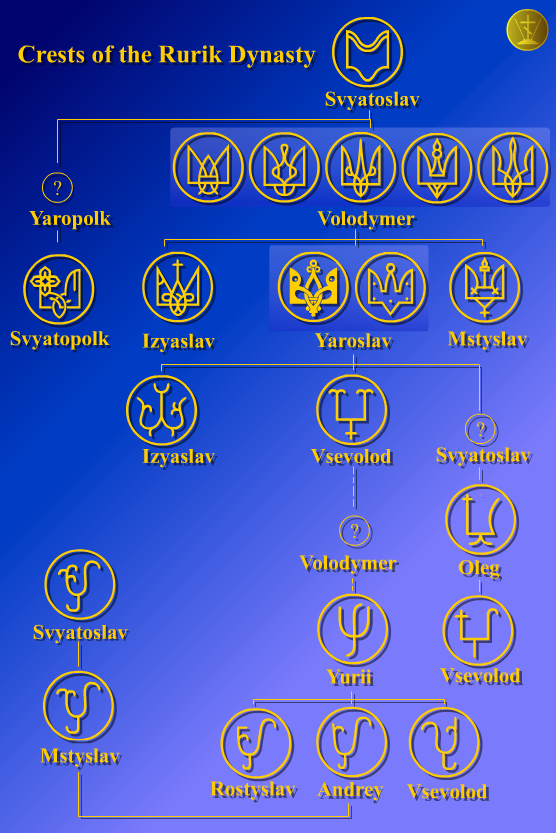
Throughout the early Middle Ages, the Rurikid nobles of Rus' used Tamga-like symbols to denote property rights over various items (Rurikid symbols). Very likely, these are of Khazar (Turkic) origin and have been adopted along with the expansion of the Rus into steppe territory. A similar process of acculturation of steppe elements can also be suspected for (or before) the Second Bulgarian Empire (1185–1396), as its flags closely resemble the Rurikid symbols in taking the shape of a trident.
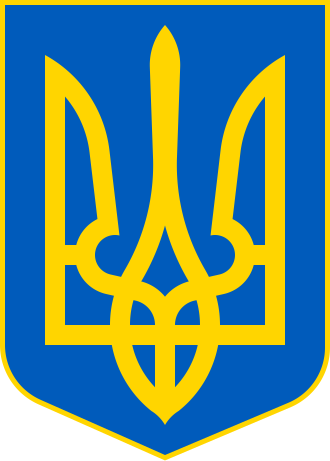
In the 20th century, the Rurikid trident, colloquially called tryzub (тризуб), has been adopted as the national symbol and the coat of arms of Ukraine. The modern version has been designed by Vasyl Krychevsky (1918) and Andriy Grechylo, Oleksii Kokhan, and Ivan Turetskyi (1992).
Islamic empires

In the late medieval Turco-Mongol states, the term tamga was used for any kind of official stamp or seal. This usage persisted in the early modern Islamic Empires (Ottoman Empire, Mughal Empire), and in some of their modern successor states.
In the Urdu language (which absorbed Turkic vocabulary), Tamgha is used as medal. Tamgha-i-Jurat is the fourth highest Military medal of Pakistan. It is admissible to all ranks for gallantry and distinguished services in combat. Tamgha-i-Imtiaz or Tamgha-e-Imtiaz (), which translates as "medal of excellence", is fourth highest honour given by the Government of Pakistan to both the military and civilians. Tamgha-i-Khidmat or Tamgha-e-Khidmat (تمغۂ خدمت), which translates as "medal of services", is seventh highest honour given by the Government of Pakistan to both the military and civilians. It is admissible to non-commissioned officers and other ranks for long meritorious or distinguished services of a non-operational nature.
In Egypt, the term damgha () or tamgha (تمغة) is still used in two contexts. One is a tax or fee when dealing with the government. It is normally in the form of stamps that have to be purchased and affixed to government forms, such as a driver license or a registration deed for a contract. The term is derived from the Ottoman damga resmi. Another is a stamp put on every piece of jewelry made from gold or silver to indicate it is genuine, and not made of baser metals.
Notes
References
References
- Bobir Gayibov (2016). [https://oaji.net/articles/2016/1115-1470132971.pdf "About To the Question of the Main Origin of Sogdian Rulers"]. ''International Journal of Humanities & Social Science Studies'' III(I): 235–242.
- Shnanov, U. R.; Artykbaev, Z. O.; Kazhenova, G. T.; & Abdykulova, G. (2020). [https://dialnet.unirioja.es/descarga/articulo/7643170.pdf "Historical significance of tribal Tamgas and its relation to the runic script"]. ''Opción: Revista de Ciencias Humanas y Sociales'' (91). pp. 833–850.
- Neubecker, Ottfried. (2002). "Heraldik". Orbis.
- Brook, Kevin Alan. (2006). "The Jews of Khazaria". Rowman and Littlefield.
- (1996). "The Emergence of Rus 750–1200". Longman.
- Pritsak, Omeljan. (1998). "The Origins of the Old Rus' Weights and Monetary Systems". [[Harvard Ukrainian Research Institute]].
- Aristov, N. (1896). ''Notes on Ethnic Composition of Turkic Tribes and People and Population Record''. ZhS 3–4, 277–456
- Talat Tekin (1965), [https://www.proquest.com/openview/0ef1aeb9458a313c40ff7232f515673f/1?pq-origsite=gscholar&cbl=18750&diss=y "A Grammar of Orkhon Turkic"], PhD thesis, University of California, Los Angeles for a literature overview
- Rogozhinskiy, A. E. (2011). Rock art sites in Kazakhstan. ''Rock Art in Central Asia'', 9.
- (2013). "Die Krim goldene Insel im Schwarzen Meer; Griechen, Skythen, Goten". Primus-Verl., LVR-LandesMuseum Bonn (Begleitbuch zur Ausstellung; LVR-LandesMuseum Bonn: 4. Juli 2013 - 19. Januar 2014).
- Samashev, S. K. (2021). Horse branding tradition among the Turks. ''Вестник КазНУ. Серия историческая'', ''103''(4), 53-62.
- Mahmûd, Kâşgarlı. "Divânü Lugâti't-Türk". Kabalcı Yayınevi.
- Clauson, Gerard. (1972). "An etymological dictionary of pre-thirteenth-century Turkish". Oxford, Clarendon Press.
- Christian, David. (1999). "A History of Russia, Mongolia and Central Asia". Blackwell.
- Badarch, Nyamaa. (2005). "The Coins of Mongol Empire and Clan Tamgha of Khans (XIII–XIV)".
- Zaytsev, Viacheslav. (2019-01-01). "West, Andrew and Viacheslav Zaytsev 2019. Preliminary proposal to encode a set of 30 Tamga symbols. [Document No. JTC1/SC2/WG2 N5092 = L2/19-216], "The Unicode Consortium: [official site]". 90 pp.". Preliminary Proposal to Encode a Set of 30 Tamga Symbols.
- Цуекъо, Алый. Адыгэ лъэкъуацIэхэмрэ тамыгъэхэмрэ
- Чахкиев, Д. Ю.. (2003). "Древности Горной Ингушетии I-II том".
- Boris Zhivkov. (2015). "Khazaria in the Ninth and Tenth Centuries". Brill.
- Pritsak, Omeljan. (1998). "The Origins of the Old Rus' Weights and Monetary Systems: Two Studies in Western Eurasian Metrology and Numismatics in the Seventh to Eleventh Centuries". Harvard University Press.
- Noonan, T. S. (2001). [https://books.google.com/books?id=-v_RORENFbMC&dq=the+khazar+qaghanate&pg=PA76 The Khazar qaghanate and its impact on the early Rus’ state: The translatio imperii from Itil to Kiev]. In: A.M. Khazanov and A. Wink (eds.), ''Nomads in the Sedentary World'', Routledge, London and New York, p. 76-102.
This article was imported from Wikipedia and is available under the Creative Commons Attribution-ShareAlike 4.0 License. Content has been adapted to SurfDoc format. Original contributors can be found on the article history page.
Ask Mako anything about Tamga — get instant answers, deeper analysis, and related topics.
Research with MakoFree with your Surf account
Create a free account to save articles, ask Mako questions, and organize your research.
Sign up freeThis content may have been generated or modified by AI. CloudSurf Software LLC is not responsible for the accuracy, completeness, or reliability of AI-generated content. Always verify important information from primary sources.
Report