From Surf Wiki (app.surf) — the open knowledge base
Tamanu oil
Oil from the seeds of tamanu plants

Oil from the seeds of tamanu plants
Tamanu oil is pressed from nuts of either Calophyllum inophyllum (usually) or Calophyllum tacamahaca (ati), tropical trees belonging to the Calophyllaceae family. The oil originates in Polynesia, where it continues to play an important cultural role.
Commercial uses of tamanu oil are predominantly for skin care. The oil has value and use as a fuel. Calophyllum inophyllum oil (CIO) is rich in antioxidants and contains UV-absorption properties.
Other names
It is also called beauty leaf oil, calophyllum inophyllum seed oil, calophyllum inophyllum oil,"Da'ok", kamani oil, calophyllum oil, calophyllum inophyllum essential oil, dilo oil, foraha oil, Alexandrian laurel oil, poon oil, nyamplung oil, domba oil, honne oil (Honge is used as biodiesel), undi oil, pinnai oil, fetau oil, punnai oil, daok oil, pinnay oil, kamanu oil, bitaog oil, tamanu nut oil, punna oil, takamaka oil (ambiguous), laurelwood oil (ambiguous), tacamahac oil (ambiguous), punnaga oil, fetaʻu oil, palo maria oil, ballnut tree oil, ballnut oil, btaches oil, beach calophyllum oil, or mù u oil.
- English: beauty leaf, Alexandrian laurel
- Hindi: सुलतान चम्पा sultan champa
- Indonesia: nyamplung
- Japanese: テリハボク terihaboku
- Kannada: ಸುರಹೊನ್ನೆ, surhonne
- Konkani: उंडी undi, उंगम unga
- Malayalam: പുന്ന punna
- Marathi: सुरंगी surangi पुन्नाग punnag, उंड unda, उंडी undi
- Oriya: tungakesara ତୁଙ୍ଗକେଶର Polang ପୋଲାଙ୍ଗ
- Sanskrit: काम्बोज kambojh, कुम्भीक kumbhikh, नाग चम्पा naag champa, नागपुष्प nagapushpah
- Tamil: புன்னை punnai
- Telugu: punnaga, నమేరువు nameruvu, పొన్న ponna
- Tulu: ponne
- Urdu: surpun
- Vietnamese: dầu mù u --
Production
Harvest of fruits
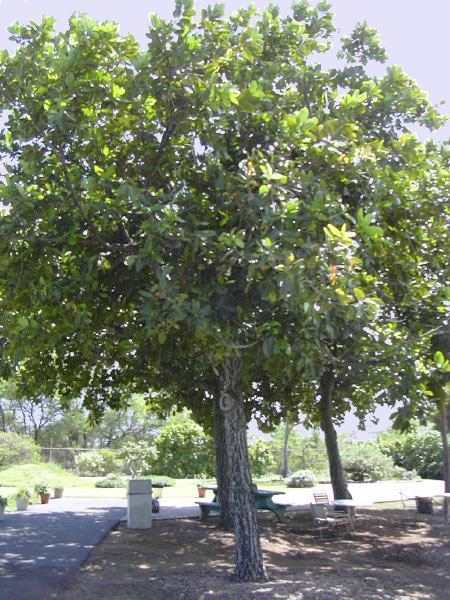
Fruiting takes place twice a year, in May and November. When ripe, the fruit is wrinkled and its color varies from yellow to brownish-red. Ripe and fallen fruits are collected from the bottom of the tree, by beating the limbs with a long hand stick, or hand-picked by climbing the tree.
A tamanu fruit produces a single large seed. The seed consists of a kernel 1.5 cm in diameter and enclosed in a soft- and a hard seed coat. It is 43–52% of the weight of the whole dry fruit, about 4 g. Fresh kernels contain 55–73% oil and 25% moisture; the oil content increases to 70–75% when dry.
Seed processing and extraction
The seeds are decorticated by wooden mallets or by decorticators or by pressing under planks. Usually, the kernels are pressed in wooden and stone* ghani*.
Uses
The first neoflavone isolated in 1951 from natural sources was calophyllolide from C. inophyllum seeds.
The fatty acid methyl esters derived from C. inophyllum seed oil meet the major biodiesel requirements in the United States (ASTM D 6751), and European Union (EN 14214). The average oil yield is 11.7 kg-oil/tree or 4680 kg-oil/hectare. In the northwest coastal areas of Luzon island in the Philippines, the oil was used for night lamps. This widespread use started to decline when kerosene, and later electricity, became available. It was also used as fuel to generate electricity to power radios during World War II. A farmer in Nagappattinam district of Tamil Nadu, India, has successfully used the oil as biodiesel to run his 5-hp pumpset.
In Southern India, the oil may have been useful in waterproofing cloth and is used as a varnish. An extract from the fruit was once used to make a brown dye to colour cloth. The oil can also be used to make soap.
Properties and fatty acids
The oil is bluish-yellow to dark green and very viscous. It has a disagreeable taste and odour as it contains some resinous material that can easily be removed by refining. The concentration of resinous substances in the oil varies from 10 to 30%. The main compounds of the seed oil are oleic-, linoleic-, stearic- and palmitic acids.
Physical characteristics
| Moisture | 0.5%, maximum |
|---|
Fatty acids present in oil
| Erucic acid | 2.5-3.5 |
|---|
| Fatty acid | Content | |
|---|---|---|
| Linoleic acid | 38% | |
| Oleic acid | 34% | |
| Stearic acid | 13% | |
| Palmitic acid | 12% |
Other components include calophyllolide, friedelin, inophyllums B and P, terpenic essences, benzoic and oxibenzoic acids, phospho-amino lipids, glycerides, saturated fatty acids, and 4-phenylcoumarins.
References
References
- (2015-09-25). "The Wound Healing and Antibacterial Activity of Five Ethnomedical Calophyllum inophyllum Oils: An Alternative Therapeutic Strategy to Treat Infected Wounds". PLOS ONE.
- SEAHand Book-2009 by The Solvent Extractors' Association of India
- (1907). "Commercial Utilization of some Philippine Oil-Bearing Seeds; Preliminary Paper". The Philippine Journal of Science.
- (2002). "Tamanu (''Calophyllum inophyllum'') – the African, Asian, Polynesian and Pacific Panacea". International Journal of Cosmetic Science.
- (2003-01-01). "Neoflavones. 1. Natural Distribution and Spectral and Biological Properties". Chemistry of Natural Compounds.
- "Alexandrain Laurel, Undi, Undal, Sultan Champa". Gardentia.
- Prabu, M. J.. (2014-03-26). "Using bio fuel to run an irrigation pump for five acres". The Hindu.
- "Undi".
- (2013-12-11). "Calophyllum inophyllum Species Information".
- (December 2002). "Tamanu (Calophyllum inophyllum) – the African, Asian, Polynesian and Pacific Panacea". International Journal of Cosmetic Science.
This article was imported from Wikipedia and is available under the Creative Commons Attribution-ShareAlike 4.0 License. Content has been adapted to SurfDoc format. Original contributors can be found on the article history page.
Ask Mako anything about Tamanu oil — get instant answers, deeper analysis, and related topics.
Research with MakoFree with your Surf account
Create a free account to save articles, ask Mako questions, and organize your research.
Sign up freeThis content may have been generated or modified by AI. CloudSurf Software LLC is not responsible for the accuracy, completeness, or reliability of AI-generated content. Always verify important information from primary sources.
Report