From Surf Wiki (app.surf) — the open knowledge base
Tai languages
Branch of the Kra–Dai language family

Branch of the Kra–Dai language family
| Field | Value |
|---|---|
| name | Tai |
| altname | Zhuang–Tai, Daic |
| region | Southern China (esp. Guangxi, Guizhou, Yunnan and Guangdong), Southeast Asia, Northeast India |
| familycolor | Tai-Kadai |
| fam2 | Kam–Tai? |
| fam3 | Be–Tai? |
| protoname | Proto-Tai |
| child1 | Northern (NT) |
| child2 | Central (CT) |
| child3 | Southwestern (SWT) |
| child4 | (see also Zhuang languages) |
| iso2 | tai |
| iso5 | tai |
| glotto | daic1237 |
| glottorefname | Daic |
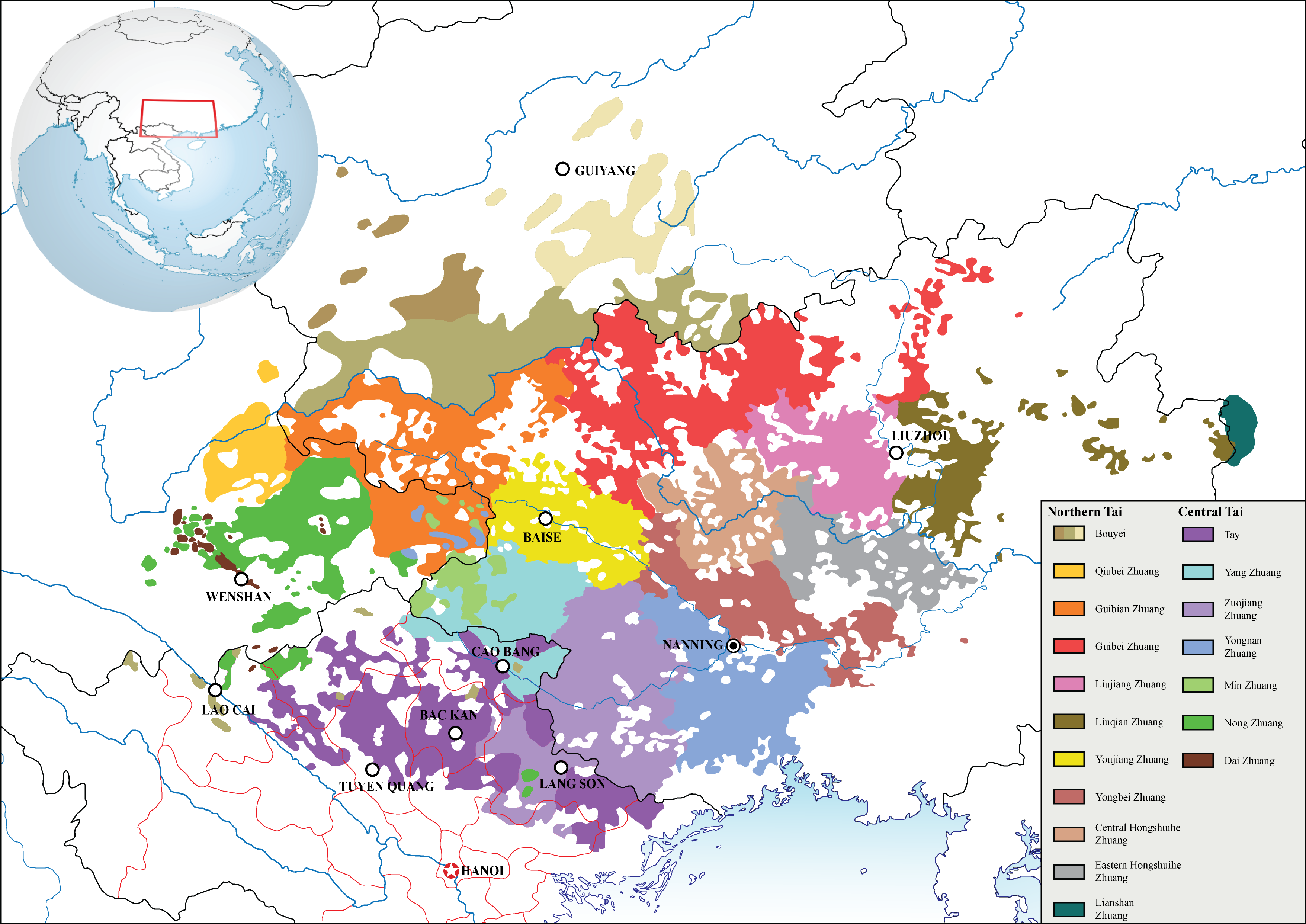
| map | Taikadai-en1.png |
| mapcaption | Distribution of Tai languages: |
The Tai languages ( ), also known as Zhuang–Tai and Daic languages ( ), are a branch of the Kra–Dai language family. The Tai languages include the most widely spoken of the Tai–Kadai languages, including Standard Thai, or Siamese, the national language of Thailand; Lao or Laotian, the national language of Laos; Myanmar's Shan language; and Zhuang, a major language in the Southwestern China's Guangxi Zhuang Autonomous Region, spoken by the Zhuang people (壯), the largest minority ethnic group in China, with a population of 15.55 million, living mainly in Guangxi, the rest scattered across Yunnan, Guangdong, Guizhou, and Hunan provinces.
Name
Cognates with the name Tai (Thai, Dai, etc.) are used by speakers of many Tai languages. The term Tai is now well-established as the generic name in English. In his book* The Tai-Kadai Languages*, Anthony Diller claims that Lao scholars he has met are not pleased with Lao being regarded as a Tai language. For some, Thai should instead be considered a member of the Lao language family. One or more Ancient Chinese characters for 'Lao' may be cited in support of this alternative appellation. Some scholars, including Benedict (1975), have used Thai to refer to a wider (Tai) grouping and one sees designations like proto-Thai and Austro-Thai in earlier works. In the institutional context in Thailand, and occasionally elsewhere, sometimes Tai (and its corresponding Thai-script spelling, without a final -y symbol) is used to indicate varieties in the language family not spoken in Thailand or spoken there only as the result of recent immigration. In this usage, Thai would not then be considered a Tai language. On the other hand, Gedney, Li and others have preferred to call the standard language of Thailand Siamese rather than Thai, perhaps to reduce potential Thai/Tai confusion, especially among English speakers not comfortable with making a word-initial unaspirated voiceless sound for Tai, which in any event might sound artificial or arcane to outsiders.
According to Michel Ferlus, the ethnonyms Tai/Thai (or Tay/Thay) would have evolved from the etymon k(ə)ri: 'human being' through the following chain: kəri: kəli: kədi:/kədaj (-l-* -d- shift in tense sesquisyllables and probable diphthongization of -i: -aj). This in turn changed to di:/daj (presyllabic truncation and probable diphthongization -i: -aj). And then to *dajA (Proto-Southwestern Tai) tʰajA2 (in Siamese and Lao) or tajA2 (in the other Southwestern and Central Tai languages by Li Fangkuei). Michel Ferlus' work is based on some simple rules of phonetic change observable in the Sinosphere and studied for the most part by William H. Baxter (1992).
The Central Tai languages are called Zhuang in China and Tay and Nung in Vietnam.
History
Citing the fact that both the Zhuang and Thai peoples have the same exonym for the Vietnamese, kɛɛuA1, derived from the name of Jiaozhi in Vietnam, and that the indigenous Bai Yue were given family names by their northern rulers during the Northern and Southern dynasties, while the Thai didn't have family names into the 19th century, Jerold A. Edmondson of the University of Texas at Arlington posited that the split between Zhuang (a Central Tai language) and the Southwestern Tai languages happened no earlier than the founding of Jiaozhi in 112 BCE but no later than the 5th–6th century AD. Based on layers of Chinese loanwords in Proto-Southwestern Tai and other historical evidence, Pittayawat Pittayaporn (2014) suggests that the dispersal of Southwestern Tai must have begun sometime between the 8th and 10th centuries AD.
Connection to ancient Yue language(s)
The Tai languages descend from proto-Kra–Dai, which has been hypothesized to originate in the Lower Yangtze valleys. Ancient Chinese texts refer to non-Sinitic languages spoken across this substantial region and their speakers as "Yue". Although those languages are extinct, traces of their existence could be found in unearthed inscriptional materials, ancient Chinese historical texts and non-Han substrata in various Southern Chinese dialects. Thai, as the most-spoken language in the Tai-Kadai language family, has been used extensively in historical-comparative linguistics to identify the origins of language(s) spoken in the ancient region of South China. One of the very few direct records of non-Sinitic speech in pre-Qin and Han times having been preserved so far is the "Song of the Yue Boatman" (Yueren Ge 越人歌), which was transcribed phonetically in Chinese characters in 528 BC, and found in the 善说 Shanshuo chapter of the Shuoyuan 说苑 or 'Garden of Persuasions'. In the early 1980s the Zhuang linguist Wei Qingwen using reconstructed Old Chinese for the characters discovered that the resulting vocabulary showed strong resemblance to modern Zhuang. Later, Zhengzhang Shangfang (1991) followed Wei's insight but used Thai orthography for comparison, since this orthography dates from the 13th century and preserves archaisms vis-à-vis the modern pronunciation.
Internal classification
Haudricourt (1956)
Haudricourt emphasizes the specificity of Dioi (Zhuang) and proposes to make a two-way distinction between the following two sets. The original language names used in Haudricourt's (1956) are provided first; alternative names are given in parentheses.
- Tai
- Dioi group: Yei Zhuang, Yongbei Zhuang, Youjiang Zhuang, Bouyei (Buyi)
- Tai proper: Ahom, Shan, Siamese (Thai), Lao, White Tai (Tai Dón), Black Tai (Tai Dam), Southern Zhuang, Tho (Tày), Nung
Characteristics of the Dioi group pointed out by Haudricourt are
- r- corresponding to the lateral l- in the other Tai languages,
- divergent vowel system characteristics, e.g. 'tail' has an /a/ vowel in Tai proper, as against /ə̄/ in Bo-ai, /iə/ in Tianzhou, and /ɯə/ in Tianzhou and Wuming, and
- the lack of aspirated stops and affricates, which are found everywhere in Tai proper.
Li (1977)
Li Fang-Kuei divided Tai into three sister branches.
- Tai
- Northern Tai
- Central Tai
- Southwestern Tai (Thai)
Li's Northern group corresponds to Haudricourt's Dioi group, while his Central and Southwestern groups correspond to Haudricourt's Tai proper. The three last languages in Haudricourt's list of 'Tai proper' languages are Tho (Tày), Longzhou, and Nung, which Li classifies as 'Central Tai'.
This classification scheme has long been accepted as standard in comparative Tai linguistics. However, Central Tai does not appear to be a monophyletic group.
Gedney (1989)
Gedney (1989) considers Central and Southwestern Tai to form a subgroup, of which Northern Tai is a sister. The top-level branching is in agreement with Haudricourt (1956).
- Tai
- Northern Tai
-
- Central Tai
- Southwestern Tai
Luo (1997)
Luo Yongxian (1997) classifies the Tai languages as follows, introducing a fourth branch called Northwestern Tai that includes Ahom, Shan, Dehong Dai, and Khamti. All branches are considered to be coordinate to each other.
- Tai
- Northern Tai
- Central Tai
- Southwestern Tai
- Northwestern Tai
Pittayaporn (2009)

Overview
Pittayawat Pittayaporn (2009) classifies the Tai languages based on clusters of shared innovations (which, individually, may be associated with more than one branch) (Pittayaporn 2009:298). In Pittayaporn's preliminary classification system of the Tai languages, Central Tai is considered to be paraphyletic and is split up into multiple branches, with the Zhuang varieties of Chongzuo in southwestern Guangxi (especially in the Zuo River valley at the border to Vietnam) having the most internal diversity. The Southwestern Tai and Northern Tai branches remain intact as in Li Fang-Kuei's 1977 classification system, and several of the Southern Zhuang languages allocated ISO codes are considered to be paraphyletic. The classification is as follows.
- Tai
- D: Northern Tai
- I: Qinzhou Zhuang (Yongnan Zhuang of Qinzhou)
- J
- M: Wuming Zhuang, Yongnan Zhuang, Long'an Zhuang, Fusui
- N: Core Northern Tai: Saek, Bouyei, Yay, Youjiang Zhuang and others
- C: Chongzuo Zhuang (Yongnan Zhuang of Chongzuo), Shangsi Zhuang (Yongnan Zhuang of Shangsi), Caolan (Vietnam)
- B: Ningming Zhuang (Zuojiang Zhuang of Ningming)
- A
- F: Lungchow Zhuang, Leiping Zhuang
- E
- H: Lungming Zhuang, Daxin Zhuang
- G
- L (Nung): Yang Zhuang of Debao, Yang Zhuang of Jingxi, (Western) Nung of Mường Khương District, Nong Zhuang of Wenshan City), Nong Zhuang of Yanshan
- K
- P (Tay): Tày of Bảo Yên, Tày of Cao Bằng, Dai Zhuang of Wenma (文麻)
- O
- R: Sapa (Vietnam)
- Q: Southwestern Tai (Laos, Thailand, Burma)
- D: Northern Tai
Standard Zhuang is based on the dialect of Shuangqiao (双桥), Wuming District.

N, M, I, C, B, F, H, L, P ]]
Sound changes
The following phonological shifts occurred in the Q (Southwestern), N (Northern), B (Ningming), and C (Chongzuo) subgroups (Pittayaporn 2009:300–301).
| Proto-Tai | Subgroup Q | Subgroup N | Subgroup B | Subgroup C | ɤj, ɤw, *ɤɰ | ɯj, ɯw | we, wo | *ɟm̩.r- | *k.t- | ɤn, ɤt, *ɤc |
|---|---|---|---|---|---|---|---|---|---|---|
| aj, aw, *aɰ | i:, u:, *ɯ: | i:, u:, *ɯ: | – | |||||||
| iː, uː | aj, aw | iː, uː | – | |||||||
| eː, oː | iː, uː | eː, oː | eː, oː | |||||||
| *br- | *ɟr- | – | *ɟr- | |||||||
| – | *tr- | – | *tr- | |||||||
| – | an, at, *ac | – | – |
Furthermore, the following shifts occurred at various nodes leading up to node Q.
- E: *p.t- *p.r-; *ɯm *ɤm
- G: *k.r- *qr-
- K: *eː, *oː *ɛː, *ɔː
- O: *ɤn *on
- Q: *kr- *ʰr-
Edmondson (2013)
Jerold A. Edmondson's (2013) computational phylogenetic analysis of the Tai languages is shown below. Tay and Nung are both shown to be coherent branches under Central Tai. Northern Tai and Southwestern Tai are also shown to be coherent branches.
- Tai
- Northern Tai: Buyi, Yay, Po-Ai, Wuming Zhuang, Mashan Zhuang
-
- Central Tai
- core Central Tai: Nung Chau, Pingxiang Zhuang, Leiping Zhuang, Ningming Zhuang
- Nung: Western Nung, Nung Yang, Nung An, Thu Lao
- Tay: Tay Bao Lac, Tay Khanh Trung, Cao Lan
- Southwestern Tai: Ahom, Shan, Dehong, Tai Theeng (Nghe An), Black Tai, White Tai, Padi, Lao, Thai
- Central Tai
Reconstruction
Main article: Proto-Tai language
Proto-Tai has been reconstructed in 1977 by Li Fang-Kuei and by Pittayawat Pittayaporn in 2009. Proto-Southwestern Tai has also been reconstructed in 1977 by Li Fang-Kuei and by Nanna L. Jonsson in 1991.
Others have taken up specific area reconstructions, such as David Strecker's 1984 work regarding "Proto-Tai Personal Pronouns." Strecker's proposed system of personal pronouns in Proto-Tai involves "three numbers, three persons, an inclusive/exclusive distinction and an animate/non-animate distinction in the third person non-singular."
| plural | *kʰau | เขา |
|---|
Comparison
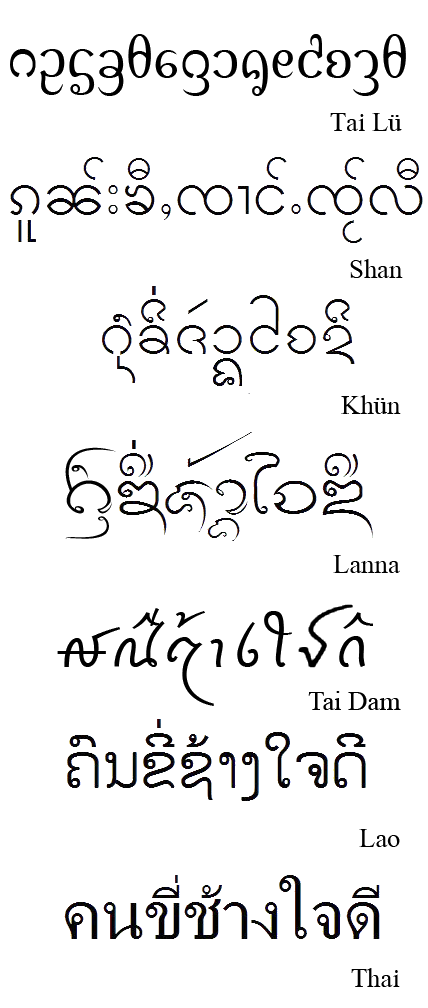
Below is comparative table of Tai languages.
| English | Proto-Tai | Thai | Lao | Northern Thai | Shan | Tai Lü | Standard Zhuang | Ahom |
|---|---|---|---|---|---|---|---|---|
| *wind* | *dluom | lum | ||||||
| *town* | *mɯəŋA | mvng | ||||||
| *earth* | *ɗin | nin | ||||||
| *fire* | *wɤjA | or | phai | |||||
| *heart* | *cɤɰA | chau | ||||||
| *water* | *C.namC | nam |
Writing systems

Many Southwestern Tai languages are written using Brahmi-derived alphabets. Zhuang languages are traditionally written with Chinese characters called Sawndip, and now officially written with a romanized alphabet, though the traditional writing system is still in use to this day.
- Thai script
- Lao script
- Sawndip
- Shan script
- Ahom script
- Tai Viet script
- Tai Le script
- New Tai Lue alphabet
- Tai Tham script
Notes
References
References
- Diller, 2008. ''The Tai–Kadai Languages'', p. 7.
- (2023-07-10). "Glottolog 4.8 - Daic". [[Max Planck Institute for Evolutionary Anthropology]].
- "The Zhuang ethnic minority". [[Ministry of Foreign Affairs of the People's Republic of China]].
- 1135791163.
- [https://hal.inria.fr/halshs-01182596/document Ferlus, Michel (2009). Formation of Ethnonyms in Southeast Asia]. ''42nd International Conference on Sino-Tibetan Languages and Linguistics, Nov 2009, Chiang Mai, Thailand. 2009'', p.3.
- [https://www.jstor.org/stable/25608449?seq=6#page_scan_tab_contents Pain, Frédéric (2008). An Introduction to Thai Ethnonymy: Examples from Shan and Northern Thai]. ''Journal of the American Oriental Society Vol. 128, No. 4 (Oct. – Dec., 2008)'', p.646.
- Edmondson, Jerold A.. (2007). "Studies in Southeast Asian Linguistics". Ekphimthai.
- [http://www.manusya.journals.chula.ac.th/files/essay/Pittayawat%2047-68.pdf Pittayaporn, Pittayawat (2014). Layers of Chinese Loanwords in Proto-Southwestern Tai as Evidence for the Dating of the Spread of Southwestern Tai]. ''MANUSYA: Journal of Humanities,'' Special Issue No 20: 47–64.
- Zhengzhang, Shangfang. (Winter 1991). "Decipherment of Yue-Ren-Ge (Song of the Yue boatman)". Cahiers de Linguistique Asie Orientale.
- Haudricourt, André-Georges. 1956. De la restitution des initiales dans les langues monosyllabiques : le problème du thai commun. Bulletin de la Société de Linguistique de Paris 52. 307–322.
- Luo, Yongxian. (1997). ''[https://www.jstor.org/stable/23887080 The subgroup structure of the Tai Languages: a historical-comparative study]''. Journal of Chinese Linguistics Monograph Series, (12), p. 232.
- Pittayaporn, Pittayawat. 2009. ''The Phonology of Proto-Tai''. PhD dissertation. Department of Linguistics, Cornell University.
- Edmondson, Jerold A. 2013. ''Tai subgrouping using phylogenetic estimation''. Presented at the 46th International Conference on Sino-Tibetan Languages and Linguistics (ICSTLL 46), Dartmouth College, Hanover, New Hampshire, United States, 7–10 August 2013 (Session: Tai-Kadai Workshop).
- Jonsson, Nanna L. (1991) [http://language.psy.auckland.ac.nz/austronesian/language.php?id=698 Proto Southwestern Tai]. PhD dissertation, available from UMI and SEAlang.net on http://sealang.net/crcl/proto/
- "ABVD: Proto-Southwestern Tai".
- (2017). "How Society Shapes Language: Personal Pronouns in the Greater Burma Zone". Asiatische Studien - Études Asiatiques.
- "The phonology of Proto-Tai".
- Pittayaporn, Pittayawat. (August 2009). "THE PHONOLOGY OF PROTO-TAI".
This article was imported from Wikipedia and is available under the Creative Commons Attribution-ShareAlike 4.0 License. Content has been adapted to SurfDoc format. Original contributors can be found on the article history page.
Ask Mako anything about Tai languages — get instant answers, deeper analysis, and related topics.
Research with MakoFree with your Surf account
Create a free account to save articles, ask Mako questions, and organize your research.
Sign up freeThis content may have been generated or modified by AI. CloudSurf Software LLC is not responsible for the accuracy, completeness, or reliability of AI-generated content. Always verify important information from primary sources.
Report