From Surf Wiki (app.surf) — the open knowledge base
Tablighi Jamaat
International Islamic movement
.jpg)
International Islamic movement
| Field | Value |
|---|---|
| group | Tablighi Jamaat |
| image | 2009 Malaysian Tablighi Ijtema.jpg |
| image_caption | 2009 Annual Congregation of Tablighi Jamaat |
| Sepang Selangor, Malaysia | |
| image_size | 300px |
| population | 12 to 80 million |
| founder | Muhammad Ilyas Kandhlawi |
| rels | Deobandi Islam |
| scrips | Quran, and Hadith, Fada'il series, Hayat al-Sahaba |
Deobandi proselytizing movement
Sepang Selangor, Malaysia
Tablighi Jamaat ( , also translated as "propagation party" or "preaching party") is an international Islamic religious movement. It focuses on exhorting Muslims to be more religiously observant and secondarily give dawah (calling) to non-Muslims. "One of the most widespread Sunni" islah (reform) and called "one of the most influential religious movements in 20th-century Islam," the organisation is estimated to have between 12 and 80 million adherents worldwide, spread over 150 countries,
The group encourages its followers to undertake short-term preaching missions (khuruj), lasting from a few days to a few months in groups of usually forty days and four months, to preach to Muslims reminding them of "the core teachings of the Prophet Muhammad" and encourage them to attend mosque prayers and sermons. Members "travel, eat, sleep, wash and pray together in the mosques and often observe strict regimens relating to dress and personal grooming".
Established in 1926 by Muhammad Ilyas Kandhlawi, in the Mewat region of British India, it has roots in the revivalist tradition of the Deobandi school, and developed as a response to the deterioration of moral values and the neglect of aspects of Islam. The movement aims for the spiritual reformation of Islam by working at the grassroots level. The teachings of Tabligh Jamaat are expressed in "Six Principles": Kalimah (Declaration of faith), Salah (Prayer), Ilm-o-Zikr (Reading and Remembrance), Ikraam-e-Muslim (Respect for Muslims), Ikhlas-e-Niyyat (Sincerity of intention), and Dawat-o-Tableegh (Proselytisation).
Tablighi Jamaat denies any political affiliation, involvement in debate over political or Islamic doctrine such as fiqh, let alone terrorism. It maintains its focus on the study of the sacred scriptures of Islam: the Quran and the Hadith, and that the personal spiritual renewal that results will lead to reformation of society. However, the group has been accused of maintaining political links, and being used by members of Islamic terrorist organisations to recruit operatives.
History
The emergence of Tablighi Jamaat also coincided closely with the rise of various Hindu revivalist movements such as Shuddhi (purification) and Sanghatan (consolidation) launched in the early twentieth century to reconvert Hindus who had converted to Islam and Tablighi Jamaat has been called a "missionary offshoot" of the revivalist Deobandi movement of India.
Origin
Muhammad Ilyas Kandhlawi, the founder of Tablighi Jamaat, wanted to create a movement that would enjoin good and forbid evil as the Quran decreed,
Ilyas abandoned his teaching post at Madrasah Mazahir Uloom in Saharanpur and became a missionary for reforming Muslims (but he did not advocate preaching to non-Muslims). He relocated near Dargah Hazrat Nizamuddin in Delhi, where this movement was formally launched in 1926, or 1927. When setting the guidelines for the movement, he sought inspiration from the practices adopted by Muhammad at the dawn of Islam. Muhammad Ilyas put forward the slogan, , "O Muslims, become [true] Muslims!". This expressed the central focus of Tablighi Jamaat: their aim to renew Muslims by socially by trying to unite them in embracing the lifestyle of Muhammad. The movement gained a following in a relatively short period and nearly 25,000 people attended the annual conference in November 1941.
At the time, some Muslim Indian leaders feared that Muslims were losing their religious identity and were heedless of Islamic rituals. The movement was never given any name officially, but Ilyas called it Tahrik-i Imaan. Muhammad Ilyas died in 1945 and he himself is buried in the Nizām Ad-Dīn Mosque.
The Mewat region where Tablighi Jamaat started near Delhi was inhabited by the Meos, an ethnic group native to the region, most of whom had converted to Islam, and then had adopted Hindu traditions and attitudes when Muslim political power declined in the region, lacking the necessary acumen (according to one author, Roger Ballard) required to resist the cultural and religious influence of majority Hindus, prior to the arrival of Tablighi Jamaat.
Expansion
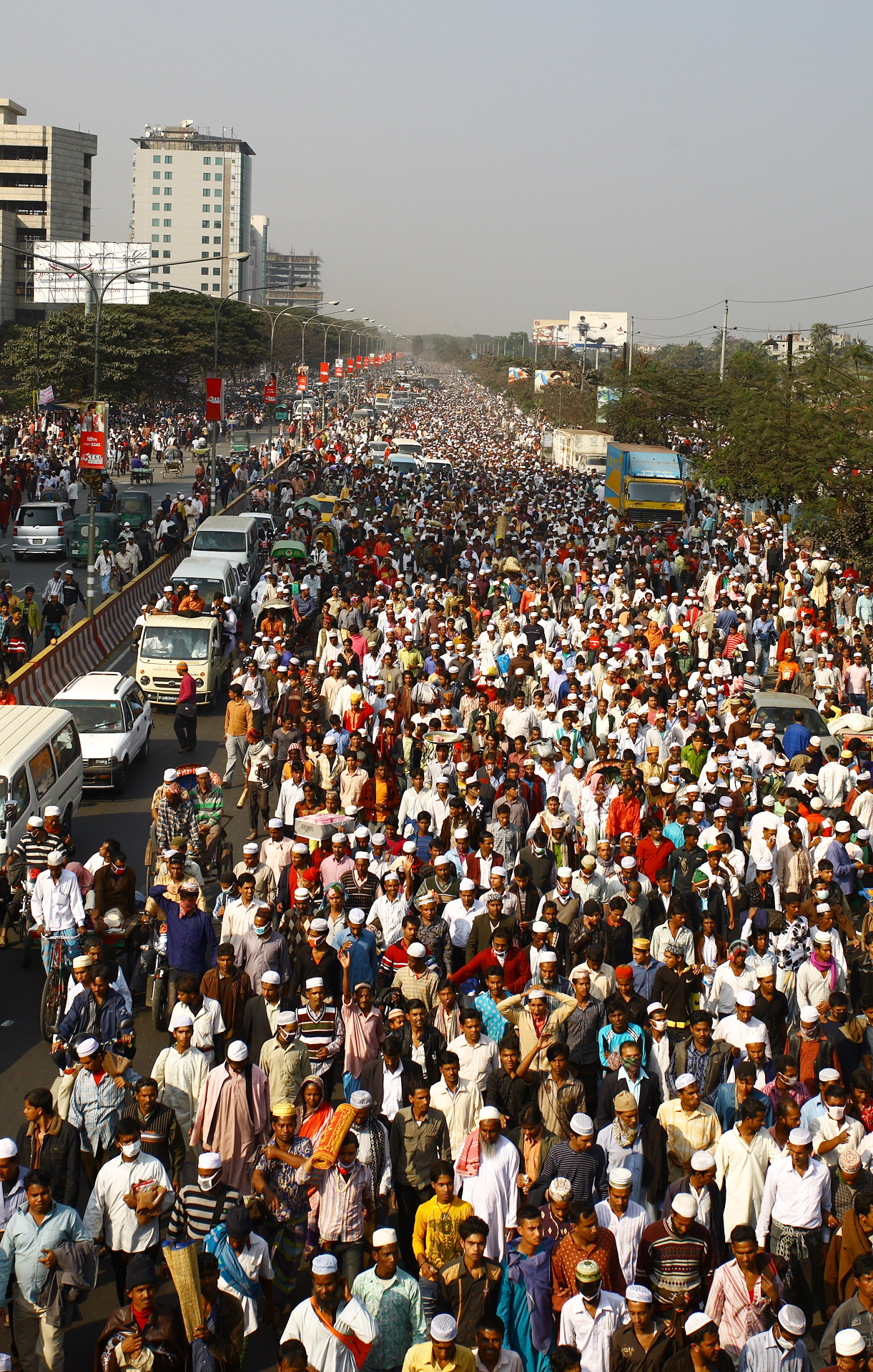
The group began to expand its activities in 1946. The initial expansion within South Asia happened immediately after the partition of India in 1947, when the Pakistan Chapter was established in the hinterlands of Raiwind town near Lahore, Pakistan. The Pakistan Chapter remained the largest until Bangladesh became independent from Pakistan in 1971. Today, the largest Chapter is Bangladesh followed by the second largest in Pakistan. Within two decades of its establishment, the group reached Southwest and Southeast Asia, Africa, Europe, and North America. The Tablighi Jamaat's aversion to politics, and also its lack of any direct and practical economic-political-social viewpoints, helped it enter and operate in societies, especially western countries and societies where politically active religious groups faced restrictions.
Foreign missions
The first foreign missions were sent to the Hejaz (western Saudi Arabia) and Britain in 1946. The United States followed and during the 1970s and 1980s the Tablighi Jamaat also established a large presence in continental Europe. In France it was introduced in the 1960s, and grew significantly in the two decades following 1970.
In France, as of 2004, it was represented on the French Council of the Muslim Faith. During the first half-decade of the 21st century Tablighi Jamaat went through a major revival in France, reaching 100,000 followers by 2006. However, the United Kingdom is the current focus of the movement in Europe, primarily due to the large South Asian population that began to arrive there in the 1960s. By 2007, Tablighi Jamaat members were situated at 600 of Britain's 1,350 mosques.
After the collapse of the Soviet Union in 1991, the movement made inroads into Central Asia. As of 2007, it was estimated that 10,000 Tablighi Jamaat members could be found in Kyrgyzstan.
Pew Research Center estimates there are between 12 and 80 million adherents, spread across more than 150 countries. The majority of the followers of the Tablighi Jamaat live in South Asia. It is estimated that nearly 50,000 members of Tablighi Jamaat are active in the United States.
Beliefs and objectives
Members of Tabligh Jamat are allowed to follow their own fiqh as long as it does not deviate from Sunni Islam. Those two verses are:
Six Attributes (Sifāt)

When Tablighi Jamaat visits a village or neighborhood, it invites the local Muslims to assemble in the mosque to hear their message in the form of "Six Attributes". These six Attributes were derived from the lives of the companions of Muhammad, since Muslims believe Sahabah (companions) are the best human beings after Muhammad—It is stated in one hadith, "My Sahabah (companions) are like [guiding] stars, whosoever follows [any] one of them will be guided." The Six Sifāt are basically a discussion about six special Attributes that when achieved, will just make it easy to follow the entire Dīn. These objectives are:
- Kalimah (ʾImān'i Sifāt) — T.J Believes, to achieve it, One must have to strive. To make his iman into Yaqeen. That, Creation cannot do anything without the will of Allah, but Allah can & Peace-Happiness, Success is lying only in the way that Muhammad shows, not in any other worldly ways.
- Salah (Namaz) — T.J Believes, One must have to try to achieve the sahaba standard salah. in both the inward and outward manners, that the Companions learnt from Muhammad. Have to make a Yaqeen that, by doing so one can become direct recipients from the vast Treasuries of Allah.
- Ilm with Zikr (Knowledge and Remembrance of Allah) — T.J Believes, One must have to try to know what Allah desires from us at any particular time and condition. know to differentiate halal-Haram. so that he can act accordingly in the way Muhammad taught. Try to achieve, the consciousness and remembrance of Allah in every action, at each moment in one's worldly existence. these two are combined because only through the quality of Zikr, A'mal can be done with the full consciousness and remembrance of Allah. T.J Believes, the benefits of ilm should be learned in Taleem programs & ilm Maslaha from Ulama. The knowledge and remembrance of Allah conducted individually and in sessions where the congregation listens to preaching by the emir, performs prayers, recites the Quran and reads Hadith. The congregation will also use these sessions to eat meals together, thus fostering a sense of community and identity.
- Ikram al-Muslim (Honoring Muslims; Ikram Sifāt) — Treating fellow Muslims "with honor and deference". T.J Believes, One must have to try to act Iḥsān (in the best possible way, with excellence and perfection), toward every Creation. One should invariably fulfil the obligations towards other human beings as commanded by Allah, & as taught by Muhammad. One should be prepared to sacrifice one's own rights, for which one will be rewarded in the hereafter. The other aspect of this sifat is, Akhlaq and Haqooq Ul Ibad encompassing rights of the Muslims as well as mankind. It is through these moral values, character building and showing sympathy to Muslims and non Muslims like poor, sick, elderly and other needy Islamic teachings could be practically disseminated.
- Ikhlas-i-Niyyah (Purity, Sincerity of Intention; Ikhlāṣ Sifāt) — T.J Believes, One must have to try to be pure, sincere when making an intention. every action is to be undertaken with no other end in view but to please Allah, & to reform oneself. Any slightest deviation from this set path is bound to generate the wrath, anger of Allah instead as it tantamont to admitting partner in that deed. Whether it be ibadat or mu'amalat, Allah accepts only such deeds which are offered purely with an intention to gain his pleasure only. A small act with purity in intention is great, considered acceptable and fully reward-able by Allah, compared to a big one where a slightest corruption in intention is present.
- Dawah and Tabligh (Invitation and Conveyance, Preach; Dāʿī Sifāt), also Tafrigh-i-Waqt (sparing time in the path of Allah; Missionary tours;) — T.J Believes, As there are no more prophets to come, the responsibility for the effort of Da'wah now falls upon the Ummah. So, One should spent his life, wealth & time in the way of Allah. so that he can learn the proper use of these three, which was actually borrowed from Allah. Should follow the footsteps of Muhammad, by taking His message door to door. He should make an effort so that everyone can gets closer to Allah, & also withdraw himself from worldly engagements to go forth in missionary groups. spend one night a week, one weekend a month, 40 continuous days a year, and ultimately 120 days at least once in their lives. Women would work among other women or travel occasionally, with their men folk on longer tours. Only in an atmosphere free of worldly thoughts can be there a true receptivity to the message concerned.
Activities, traditions, methodology
Man is a ship in trouble in tumultuous sea. It is impossible to repair it without taking it away from the high seas where the waves of ignorance and the temptations of temporal life assail it. Its only chance is to come back to land to be dry-docked. The dry-dock is the mosque of the jamaat. The activism of Tablighi Jamaat can be characterised by the last of the Six Principles. This principle, Tafrigh-i-Waqt (English: sparing of time) justifies the withdrawal from World, though temporarily, for travelling. Travel has been adopted as the most effective method of personal reform and has become an emblematic feature of organisation. They describe the purpose of this retreat as to patch the damages caused by the worldly indulgence and occasionally use the dry-dock parable to explain this.
These individual jamaats, each led by an ameer, are sent from each markaz across the city or country to remind people to persist on the path of God. The duration of the work depends on the discretion of each jamaat. A trip can take an evening, a couple of days or a prolonged duration.
''Khurūj'' (proselytising tour)
Preaching tours hold an important position in the Tablighi Da'wah methodology that they may be referred as 'travelers in faith' Tabligh Jamaat encourages its followers to follow the pattern of spending "one night a week, one weekend a month, 40 continuous days a year, and ultimately 120 days at least once in their lives engaged in tabligh missions". During the course of these tours, members are generally seen dressed in simple, white, loose-clothing, carrying sleeping bags on their backs. These members use mosques as their base during this travel but particular mosques, due to more frequent tablighiyat activities, have come to be specifically associated with this organisation. These mosques generally hold the periodic, smaller scale convocations for neighbourhood members.
During their stay in mosques, these jamaats conduct a daily gasht, which involves visiting local neighbourhoods, preferably with the help of a guide called as rehbar.
Generally, the assumed role of these jamaat members cycle in a way that they may be engaged as a preacher, a cook or as a cleaner at other times. Among Tabligh Jamaat members, this is generally referred to as khidmat which essentially connotes to serving their companions and freeing them for tablighi engagements.
''Ijtema'' (annual gathering)

Main article: Ijtema
An annual gathering of followers, called ijtema, is summoned at headquarters of the respective countries. A typical ijtema continues for three days and ends with an exceptionally long prayer. The second largest Tabligh Jamaat gathering takes place in Raiwind, Pakistan which was attended by approximately 1.5 million people in 2004. In 2011 Pakistan divided the Ijtema into two parts and a total of 1 million people attended each of the two Ijtema.
Methodology
The method adopted by Muhammad Ilyas was to organise units (called jamaats, meaning Assembly) of at least ten persons and send them to various villages or neighborhoods to preach. These outings, Dawah tours (see below), are now organised by Tablighi Jamaat leaders. In these tours, emphasis is laid on "A hadith about virtues of action" (imitating Muhammad). In the ahadith (reported sayings of Muhammad) of fazail (virtues) these has been called Eemaan (faith) and Ihtisab (for the sake of Allah) and Tablighi Jamaat believes this is the most vital deriving force for reward in akhirah (afterlife). The Tablighi Jamaat founder Ilyas preached that knowledge of virtues and A'amalu-Saliha (Good Deeds and Actions) takes precedence over the knowledge of Masa'il (jurisprudence). Knowing jurisprudence detail (Fara'id (mandates) and Sunan (traditions) of Salat) is useful only if a person is ready to perform rituals such as offering Salat. They insist that the best way of learning is teaching and encouraging others, with the books prescribed by Tabligi Jamaat Movement in the light of Quran and Hadith stories of Prophets, Sahaba (Companions of Prophet) and Awlia Allah ("Friends of Allah"). A collection of books, usually referred as Tablighi Nisaab (Tablighi Curriculum), is recommended by Tabligh Jamaat elders for general reading. This set includes four books namely (Hayatus Sahabah, Fazail-e-Amaal, Fazail-e-Sadqaat and Muntakhab Ahadith).
In its early days and in South Asia, the Tabligh movement aimed to return to orthodoxy and "purify" the Muslim religio-cultural identity of heterodox or "borderline" Muslims who still practised customs and religious rites connected with Hinduism. Especially to counteract the efforts of Hindu proselytising movements who targeted these often recently converts from Hinduism. Unlike common proselytising movements, Tablighi Jamaat has mostly focused on making Muslims 'better and purer' and ideally "religiously perfect", rather than preaching to the non-Muslims. This is because (it believes) dawah to non-Muslims will only be effective (or will be much more effective) when a Muslim reaches "perfection".
Organisation

Tablighi Jamaat follows an informal organisational structure and keeps an introverted institutional profile. It has been described as "a free-floating religious movement with minimal dependence on hierarchy, leadership positions, and decision-making procedures." It keeps its distance from the mass media and avoids publishing details about its activities and membership. The group also exercises complete abstinence from expressing opinions on political and controversial issues, mainly to avoid the disputes that would accompany these endorsements. As an organisation, Tabligh Jamaat does not seek donations and is not funded by anyone; in fact, members have to bear their own expenditures. Since there is no formal registration process and no official membership count has ever been taken, the exact membership statistics remain unknown. The movement discourages interviews with its elders and has never officially released texts, although there are publications associated with the movement (usually referred to as Tablighi Nisaab [Tablighi Curriculum]). The emphasis has never been on book learning but rather on first-hand personal communication.
The organisation's activities are coordinated through centers called Markaz. It also has country-wise centers in over 200 countries to coordinate its activities. These centers organise volunteer, self-funding people in groups (called jamaats), averaging ten to twelve people, to remind Muslims to remain steadfast on the path of Allah. These jamaats and preaching missions are self-funded by their respective members.
Ameer is the title of supervisor (doyen) in the Tabligh Jamaat, and the attribute largely sought is the quality of faith rather than the worldly rank.
Since 2016, Tableeghi Jamat has functioned as two groups after a bitter division, one led by Maulana Saad Kandhelvi with headquarters in India, and the other led by a collective Shura with headquarters in Punjab, Pakistan and Bangladesh. There have been at least three violent clashes, one in Delhi, India and two in Bangladesh.
Role of women
In Tablighi Jamaat, women are encouraged to stay at home, and to choose a life of "segregation between female and male". However they also engage in proselytising activities, discussing among themselves in small groups the basics of Tabligh and traveling with their husbands (or another mahram) on proselytising trips. Tabligh inculcates in them that dawah is also important alongside taking care of their spouses or taking care of their children.
According to a 1996 study by Barbara Metcalf, the Tablighi Jamaat has encouraged women to participate since the beginning of the movement. Some scholars objected to the participation of women, but Muhammad Ilyas slowly gained their support and the first jamaat of women was formed in Nizamuddin, Delhi. Accompanied by a close male relative, (mahram), women are encouraged to go out in jamaats and work among other women and family members while following the rules of modesty, seclusion and segregation. They observe hijab by covering their faces and hands. Jamaats of women sometimes participate in large annual meetings; otherwise, they commonly hold neighbourhood meetings.
Tablighi Jamaat tends to blur the boundaries of gender roles and both genders share a common behavioural model and their commitment to tabligh. The emphasis is on a common nature and responsibilities shared by both genders. Just as men redraw the gender roles when they wash and cook during the course of da'wa tours, women undertake the male responsibility of sustaining the household. Women do not play any role in the higher echelons of the movement, but their opinions are taken into due consideration. Women and the family members are told to learn Quran and follow 5 Amaals in everyday life, Taleem of Ahadees, Quran recitation, 6 Points muzakera, and mashwara for daily life work and fikr for the whole world as people from around the world will be coming and they are the ones who have to learn before they can teach.

Criticism and controversy
Lack of political activism
Tablighi Jamaat avoids scrutiny and official ban by maintaining absolute secrecy and neutral stance towards the Political Islam by remaining neutral towards extremist Islamic groups "neither condemning nor supporting their actions" as " any overt connection with these groups is not in the best interest of the Tablighi Jamaat", thus allowing it to coexist even in modern Western world. Many analysts find this neutrality of Tablighi Jamaat towards extremist political Islamist groups sufficient to make Tablighi Jamaat culpable because Islamist militant groups often attend TJ congregations "where they hand out recruitment pamphlets". This allows those radicals to obtain the cover of Tablighi Jamaat to gain visa for overseas travel. "It is thus possible that a [extremist Islamist] flame sparked and fueled by Tabligh could begin to burn out of control."
Tabligh Jamaat has been criticised—especially by the radical islamist groups, The Tablighi Jamaat, in response, states that it is only by avoiding the political debates that the Tablighi Jamaat has been successful in reawakening the spiritual conscience of the followers. The apolitical stance also helped it operate in difficult times, such as during the governments of Ayub Khan (1960s) and Indira Gandhi (1975–77), when other sociopolitical Islamic groups faced restrictions.
The difference of opinion regarding political participation also marks the fundamental difference between the Tablighi Jamaat and Islamist movements. While the Islamists believe that the acquisition of political power is the absolute requirement for the establishment of an Islamic society, the Tablighi Jamaat believes that mere political power is not enough to ensure effective organisation of the Islamic social order. The exclusive focus of the Tablighi Jamaat's attention is the individual, and members believe the reformation of society and institutions will only be effective through education and reform of individuals. It insists that nations and social systems exist by the virtue of the individuals who form them; therefore, the reform must begin at the grass-roots with individuals and not at the higher level of political structure.
Nasiruddin al-Albani in his book "Darsush Shaikhul Albani" talks about Tabligh Jamaat's aloofness from politics,
Ideological opposition
Tablighi Jamaat has received criticism in the Indian subcontinent from the Barelvi movement. One of the main criticisms against them is that the men neglect and ignore their families, especially by going out on da'wa tours. Tablighi Jamaat participants, in response, argue that both genders should be equally engaged in Tabligh. They further say that women, like men, are also urged to carry the responsibility of Tabligh and that men should facilitate women's participation by providing childcare.
Tablighi Jamaat has been criticised for being retrogressive. The women in the movement observe hijab for which the movement has been accused of keeping women "strictly subservient and second string".
Before the rule of Prince Muhammad bin Salman, Salafist and Wahhabi ulema in Saudi Arabia issued rulings "declaring Tablighis to be deviants and forbidding participation in Tablighi activities unless the reason for the participation is to criticise" the alleged deviancy. They also issued fatwa prohibiting Tablighi literature and preaching in that country.
Allegations of extremism
Denials by TJ
Denial
Tablighi Jamaat focuses on religion and generally avoids political activities and debates, claiming that the reformation of society will be achieved through personal spiritual renewal. It has been criticised by some Muslims for being too pacifist/quietist. Its leaders have denied any links with terrorism, denounced Al-Qaeda, but admit to not controlling its membership.
At least three western experts on Islam have testified to its apolitical, quietist and/or peaceful character:
- "peaceful and apolitical preaching-to-the-people movement" (Graham E. Fuller).
- "completely apolitical and law abiding" (Olivier Roy).
- "an apolitical, quietist movement of internal grassroots missionary renewal" (Barbara D. Metcalf). According to the American Foreign Policy Council (AFPC), the Tablighi Jamaat teaches that jihad is "primarily as personal purification rather than as holy warfare". Because of its disavowal of violent jihad, the Tablighi activities have been banned in Saudi Arabia and some Islamist groups have accused the Tabligh of weakening support for jihad amongst Muslims. Interviews with TJ members, based on primary research, indicate that they emphasise self-reform, unity, and adherence to Islamic teachings before considering any broader struggles. Some TJ adherents describe their primary jihad as 'Tabligh'—the act of preaching and reviving faith among Muslims—arguing that external struggles are secondary to internal spiritual development. TJ followers highlight that division and lack of religious adherence within the Muslim community make any form of militant jihad ineffective and premature. Furthermore, some members view controlling one’s 'Nafs' (self) as the greatest form of jihad, placing emphasis on personal piety rather than political activism.
Connection between TJ and jihadism
Terror
Fred Burton, Scott Stewart, Mumtaz Ahmad, and Shireen Khan Burki explain the connection between TJ and jihadism by the opinions that
- TJ shares much with groups that have been accused of breeding jihadis -- Salafis, Wahhabis and other 'revivalist' Islamist movements. They share the same conservative Islamic values and lifestyle, strict Islamic belief system and rejection of secularism; they "share the same core ideology and ultimate objectives (the expansion of Dar al Islam and the establishment of a global Caliphate)". the teachings and beliefs of Tablighi Jamat have been a cornerstone for joining in radical Muslim groups.
- By asking Muslims to "shun politics and public affairs", TJ leaves "a gap" in members' worldview/belief system; since "some people find they cannot ignore what is happening in the world around them, especially when that world includes wars". When jihadist groups "offer religiously sanctioned prescriptions as to how 'good Muslims' should deal with life's injustices", some TJ members listen.
- In addition, Mumtaz Ahmad notes, its "apolitical stance" has helped reassure Muslim and non-Muslim states, governments and others who put severe restrictions on politically activist Islamic groups; it allows TJ to penetrate and operate in these societies.
- Thus TJ provides "a cover, a conduit and a fertile recruiting ground for jihadi organisations such as Al Qaeda and Lashkar-i-Taiba". TJ has been said to enable Al-Qaida "by supporting recruitment in radical madrassas and fundraising at mosques all over Pakistan." Law enforcement officials says that Tablighi Jamaat's presence all around the world and its apolitical stance have been exploited by militant groups. A former homeland security employee described Tablighi Jamaat as a "trans-national Islamist network". According to Alex Alexiev, "perhaps 80% percent of the Islamist extremists have come from Tablighi ranks, prompting French intelligence officers to call Tablighi Jamaat the 'antechamber of fundamentalism.'"
- In addition, some argue Tablighi Jamaat is not as apolitical as it might first appear. According to Patrick Sukhdeo, TJ is an extremely secretive group and the core of the group does not disclose how it operates. Despite claims of being apolitical, it has ties with the political and military sector of countries such as Pakistan and Bangladesh.
The Tablighi Jamaat operates in every sense as a secret society in this country [Britain], as much as elsewhere [...] Its meetings are held behind closed doors. We don't know who attends them. How much money it has. It publishes no minutes or accounts. It doesn't talk about itself. It is extremely difficult to penetrate.quoting TJ scholar, Dr. Patrick Sukhdeo, the director of the Institute for the Study of Islam and Christianity
Some have compared the group's ideology to Khawarij whereas others point out that the Tablighi Jamaat takes a "traditionalist" approach to Islam in contrast to Khawarij's extremist and often heretical approach.
The Tablighi Jamaat tried to expand the Abbey Mills Mosque into the largest mosque in the United Kingdom. The plan attracted controversy, and the Tabligh was denied permission.
Bans on Tablighi Jamaat in several countries
Ban
Tablighi Jamaat has been banned in Russia as well as several Muslim nations such as Iran, Uzbekistan, Tajikistan and Kazakhstan, and Saudi Arabia. Central Asian Muslim countries which banned TJ, such as Uzbekistan, Tajikistan and Kazakhstan, view TJ's puritanical preachings as extremist. In February 2020, a counter-terrorism operation in Russia led to the arrest of seven Tablighis and dismantled the terrorist cell affiliated to the Tablighi Jamaat. According to Russian intelligence, the terrorist cell was involved in dissemination of materials and radicalisation. The Tablighi Jamaat has been banned in Russia since 2009. The Supreme Court of Russia also recommended the Tablighi Jamaat to be included into the list of terrorist groups monitored by the Kremlin. On 10 December 2021, Saudi Arabia further warned against Tablighi Jamaat, calling it a "danger to society" and "one of the gates of terrorism", while all forms of innovated Islamic preaching are already banned in the kingdom. The announcement was made by the country's Minister of Islamic Affairs, Abdullatif Al Al-Sheikh. All other Arab countries specifically Gulf Arabic countries including United Arab Emirates, Qatar, Kuwait, Bahrain and Oman have Tablighi Jamat Maraakez (centres) and many locals are openly involved in Tabligh activity.
| # | Country | Banned since | Note | Reference | |||||||||
|---|---|---|---|---|---|---|---|---|---|---|---|---|---|
| 1 | Iran | last=Refugees | first=United Nations High Commissioner for | title=Refworld The Tablighi Jamaat: A Soft Islamization from the Ferghana Valley to Russia's Turkic Regions? | url=https://www.refworld.org/docid/510672692.html | access-date=2021-12-21 | website=Refworld | language=en | archive-date=27 June 2017 | archive-url=https://web.archive.org/web/20170627115731/http://www.refworld.org/docid/510672692.html | url-status=live}} | ||
| 2 | Uzbekistan | ||||||||||||
| 3 | Turkmenistan | ||||||||||||
| 4 | Tajikistan | 2006 | last=Refugees | first=United Nations High Commissioner for | title=Refworld Tajik Clampdown on Islamic Group Could Backfire | url=https://www.refworld.org/docid/4ac06f581c.html | access-date=2021-12-21 | website=Refworld | language=en | archive-date=21 December 2021 | archive-url=https://web.archive.org/web/20211221060056/https://www.refworld.org/docid/4ac06f581c.html | url-status=live}} | |
| 5 | Kazakhstan | 2013 | Designated as extremist in Kazakhstan and now considered illegal. | ||||||||||
| 6 | Russia | 2009 | Banned by Supreme Court of Russia | ||||||||||
| 7 | Saudi Arabia | 2021 | Warned against by Ministry of Islamic Affairs of Saudi Arabia |
COVID-19 pandemic
Tablighi Jamaat attracted significant public and media attention during the COVID-19 pandemic.
Malaysia
Between 27 February and 1 March 2020, the movement organised an international mass religious gathering at the Masjid Jamek in Sri Petaling, Kuala Lumpur in Malaysia. The Tablighi Jamaat gathering has been linked to more than 620 COVID-19 cases, making it the largest-known centre of transmission of the virus in Southeast Asia. The Sri Petaling event resulted in the biggest increase in COVID-19 cases in Malaysia, with almost two thirds of the 673 confirmed cases in Malaysia linked to this event by 17 March 2020. Most of the COVID-19 cases in Brunei originated here, and other countries including Indonesia, Singapore, Thailand, Cambodia, Vietnam and the Philippines have traced their cases back to this event. By 20 May 2020, Director-General of Health Noor Hisham Abdullah confirmed that 48% of Malaysia's COVID-19 cases (3,347) had been linked to the Sri Petaling tabligh cluster.
Indonesia
Despite the outbreak, Tablighi Jamaat organised a second international mass gathering on 18 March in Gowa Regency near Makassar in South Sulawesi, Indonesia. Though the organisers initially rebuffed official directives to cancel the gathering, they subsequently complied and cancelled the gathering.
Pakistan
Yet another gathering was organised in Pakistan near Lahore at Raiwind, for 250,000 people. The event was "called off" in response to the officials' requests, but the participants had already gathered and communed together. When they returned, the virus travelled with them, including two cases in the Gaza Strip. During testing, around 40 members of the Tablighi Jamaat were found to be COVID-infected. Another 50 people including four Nigerian women, suspected to be the carriers of the virus were quarantined 50 km from Lahore. In Hyderabad, Sindh, 38 members of the organisation were found to be positive for coronavirus. Raiwind, the place where the event was held has been locked down by Pakistani authorities and the police arrested Tablighi Jamaat members from their offices in Sindh and Punjab for violating the law.
Ninety-four more Tableeghi Jamaat members tested positive for the coronavirus on 31 March 2020 in Hyderabad, in the Sindh province.
India
The Tablighi Jamaat wanted to arrange the program somewhere in Vasai, Maharashtra. After the outbreak of COVID-19 in Maharashtra, the Government of Maharashtra and Mumbai Police called off the meeting. After the rejection from the Government of Maharashtra, the Nizamuddin faction the Tablighi Jamaat held the religious congregational program (Ijtema) in Nizamuddin West, Delhi. There were also other violation of rules by foreign speakers including misuse of tourist visa for missionary activities and not taking 14-day home quarantine for travellers from abroad.
The Nizamuddin Markaz Mosque added that the officials there"met the Ld. DM and apprised him of the stranded visitors and once again sought permission for the vehicles arranged by us," to clear the Markaz premises and take the devotees back home.
"Under such compelling circumstances there was no option for Markaz Nizamuddin but to accommodate the stranded visitors with prescribed medical precautions till such time that situation becomes conducive for their movement or arrangements are made by the authorities," the Tablighi Jamaat HQ said.
On 21 March the Markaz directed everyone "not to venture out until 9 PM as desired by the Prime Minister of India, therefore the plans to move back to their native places by way of means other than railways also did not materialise."
At least 24 of the attendees had tested positive for the virus among the 300 who showed symptoms by 31 March 2020. It is believed that the sources of infection were preachers from Indonesia. Many had returned to their states and also housed foreign devotees without the knowledge of local governments. and eventually started local transmissions especially in Tamil Nadu, Telangana, Karnataka, Jammu and Kashmir and Assam. The entire Nizamuddin West area has been cordoned off by the police as of 30 March, and medical camps have been set up. After evacuation from the markaz, of the scores of jamaat attendees, 167 of them were quarantined in a railway facility in south east Delhi amid concerns over their safety and transmission of the virus. The Tablighi Jamaat gathering emerged as one of India's major coronavirus hotspots in India, after 1445 out of 4067 cases were linked to attendees according to the Health Ministry. On 18 April 2020, Central Government said that 4,291 cases (or 29.8% Of the total 14,378 confirmed cases of COVID-19 in India) were linked to the Tablighi Jamaat, and these cases were spread across 23 states and Union Territories.
Questions have been raised as to how the Delhi Police, which under direct control of the Union Home Ministry headed by the Home Minister & the then Bharatiya Janata Party president Amit Shah allowed this event to proceed in the midst of a pandemic, while a similar event was prohibited in Mumbai by the Maharashtra Police. Once the COVID lockdown came into effect in Delhi from 22 March onwards, the missionaries remaining in the Nizamuddin Markaz were trapped, and the functionaries began to seek assistance from the authorities for their evacuation. As of 4 April, more than 1000 cases, representing 30% all confirmed cases in India, were linked to the Nizamuddin event. Some 22,000 people that came in contact with the Tablighi Jamaat missionaries had to be quarantined. On 31 March 2020, an FIR was filed against Muhammad Saad Kandhlawi and others by Delhi Police Crime Branch. On 8 April 2020, the Delhi Police traced Tablighi Jamaat leader Maulana Saad Kandhalvi in Zakirnagar in South-East Delhi, where he claimed to be under self-quarantine.
People associated with the ruling Hindutva-aligned Bharatiya Janata Party called out Indian Hindus to socially boycott Indian Muslims. This drew criticism from Arab leaders and the Organisation of Islamic Cooperation; the Prime Minister Narendra Modi responded: "the virus did not discriminate between people on the basis of faith, community, race or nationality".
On 12 October 2020, Mumbai court discharged the members with the order stating they didn't act negligently to spread COVID and didn't disobey to the orders of the Indian authorities.
Notable members
The Tablighi Jamaat has no membership lists nor formal procedures for membership, which makes it difficult to quantify and verify affiliations. One of the most famous and popular contemporary leaders of the Tablighi Jamaat is the Pakistani preacher Maulana Tariq Jamil who has amassed a huge online social media following.
The former chief minister of the Pakistani province of Punjab, Pervaiz Elahi is also a strong supporter of the Tablighi Jamaat. During his tenure in 2011, 75 kanals of land (75/8 acre, 75/8 acre) were purchased for a Tablighi Jamaat mosque at the Raiwind Markaz.
In India, Munawar Faruqui, an Indian stand-up comedian, and Sana Khan, an ex-Bollywood star, and Arif Khan, an ex-Bollywood actor, are associated with Jamaat.
The Former Pakistan Presidents- Farooq Leghari and Muhammad Rafiq Tarar were believed to be associated with the movement, the Indian president Dr Zakir Hussain was also affiliated with tabligh jammat
Singers, actors and models, including Attaullah Essa Khailwi, Gulzar Alam, Bacha, Alamzeb Mujahid, and Junaid Jamshed are also affiliated with the movement.
Former Lieutenant General and head of Inter-Services Intelligence Javed Nasir and General Mahmud Ahmed of the Pakistan Army both became members of Tablighi Jamaat during their service. The Tablighi Jamaat also has a notable following among Pakistani professional cricketers: Shahid Afridi, Mohammad (formerly "Youhana") Yousuf and the former cricketers Saqlain Mushtaq, Inzamam-ul-Haq, Mushtaq Ahmed, Saeed Anwar and Saeed Ahmed Muhammad Rizwan are active members. Mohammad Yousuf's conversion from Christianity to Islam is widely attributed to the influence of the Tabligh Jamaat.
In Malaysia, prominent actors and singers such as Azmil Mustapha, Nabil Ahmad, Aliff Aziz, Anuar Zain, Amar Asyraf, Dato' Nash and Dr Sam have all been involved with Tablighi Jamaat. One of Malaysia's most prominent actress Neelofa, has also participated in Tablighi Jamaat's Tours with her husband (PU Riz), as a result of which she now dons the Islamic face veil ever since.
References
Notes
Citations
Bibliography
- Islam, Youth, and Modernity in The Gambia
- Resisting Regimes
- Inside the Tablighi Jamaat
- Islam on the Move
- Ali, Jan A. (2012).Islamic Revivalism Encounters the Modern World: A Study of the Tabligh Jama'at. New Delhi: Sterling Publishers. .
- Lone, Rameez Ahmad (2021). Tablighi Jamaat: Ideology and Organisational Structure. https://www.amazon.com/dp/1685862357?lsskpint=erf_DP-MW-AUI-PSO_flf_sdrs_vlr (). Notion Press, India.
References
- (2021). "Handbook of Islamic Sects and Movements". [[Brill Publishers]].
- Burki, Shireen Khan. (2013). "The Tablighi Jama'at: Proselytizing Missionaries or Trojan Horse?". [[Routledge]].
- Kuiper, Matthew J.. (22 February 2018). "Tablighi Jamaʿat - Oxford Islamic Studies Online". [[Oxford University Press]].
- (2 April 2020). "Explained, Who are the Tablighi Jamaat?". The Hindu.
- (9 June 2007). "Fatwa # 15332 from Sri Lanka". Ask Imam, Online Islamic Q & A with Mufti Ebrahim Desai Darul Iftaa.
- (8 September 2009). "What is the Tablighi Jamaat?". The Guardian.
- {{harvp. Ahmad. 1994
- (15 September 2010). "Tablighi Jama'at". [[Pew Research Center]].
- Burton, Fred. (23 January 2008). "Tablighi Jamaat: An Indirect Line to Terrorism". Stratfor Intelligence.
- Howenstein, Nicholas. (12 October 2006). "Islamist Networks: The Case of Tablighi Jamaat". [[United States Institute of Peace]].
- Sameer Arshad. (22 July 2007). "Tabligh, or the enigma of revival". The Times of India.
- Dominic Kennedy and Hannah Devlin. (19 August 2006). "Disbelief and shame in a community of divided faith". [[The Times]].
- (12 October 2006). "Islamic Networks: The case of the Tablighi Jamaat". United States Institute of Peace.
- {{harvnb. Ayoob. 2007
- (2016). "Faith-Based Violence and Deobandi Militancy in Pakistan". [[Palgrave Macmillan]].
- Jenkins, Philip. (2007). "God's continent". [[Oxford University Press]].
- (2015). "Sufis and Salafis in the Contemporary Age". [[Bloomsbury Publishing]].
- {{qref. 3. 104
- Agwani, Mohammad Shafi. (1986). "Islamic Fundamentalism in India". Twenty First Century Indian Society.
- {{harvnb. Ahmad. 1994
- Dietrich Reetz, Sûfî spirituality fires reformist zeal: The Tablîghî Jamâ'at in today's India and Pakistan, [[Archives de sciences sociales des religions]], 135. juillet–septembre 2006, mis en ligne le 01 septembre 2009, consulté le 29 novembre 2014. p. 33.
- {{harvnb. Ballard. 1994
- [[#GKWMM2004. Kepel, ''War for Muslim Minds'', 2004]]: p. 261
- {{harvnb. Roy. Sfeir. 2007
- {{harvnb. Ballard. 1994
- {{harvnb. Ahmad. 1994
- {{harvnb. Masud. 2000
- (29 April 2005). "French Islamic group offers rich soil for militancy". The New York Times.
- Khalid Hasan. (13 August 2006). "Tableeghi Jamaat: all that you know and don't". Daily Times.
- Howenstein, Nicholas. "Islamist Networks: The Case of Tablighi Jamaat".
- Norfolk, Andrew. (10 September 2007). "Muslim group behind 'mega-mosque' seeks to convert all Britain". [[The Times]].
- Rotar, Igor. (23 June 2007). "Pakistani Islamic Missionary Group Establishes a Strong Presence in Central Asia". EurasiaNet.
- (16 September 2013). "Inside the Tablighi Jamaat". Live Mint.
- {{harvnb. Masud. 2000
- Lone, Rameez Ahmad. (2021). "Tablighi Movement of 20th Century: Six Principles". EPRA International Journal of Multidisciplinary Research.
- {{harvnb. Ahmad. 1994
- [(Sahih Muslim 6466; 207-(2531) Darussalam ed.)]
- (2022). "A Sociological Study of the Tabligh Jama'at: Working for Allah". Palgrave Macmillan.
- (2021). "TABLIGHI JAMAAT: IDEOLOGY AND ORGANISATIONAL STRUCTURE". Notion Press.
- Metcalf, Barbara D.. (1 November 2001). ""Traditionalist" Islamic Activism: Deoband, Tablighis, and Talibs".
- {{harvnb. Masud. 2000
- Lone, Rameez Ahmad. (2021). "Religious Tourism: An Insight into the Islamic Tourism of Tablighi Jamaat". EPRA International Journal of Multidisciplinary Research.
- They invite people to attend the ''[[Maghrib (prayer). Maghrib]]'' prayer at their mosque and those who attend are delivered a sermon after the prayers, which essentially outlines the Six Principles. They urge the attendees to spend time in tabligh for self reformation and the propagation of Islam.{{harvnb. Masud. 2000
- Metcalf, Barbara. (27 February 1996). "Islam and women: The case of the Tablighi Jama'at". Stanford University.
- Uddin, Sufia M.. (October 2011}} One of the largest of such annual gatherings is held in Bangladesh. The [[Bengalis). "Constructing Bangladesh: Religion, Ethnicity, and Language in an Islamic Nation". UNC Press.
- (2 February 2007). "Millions of Muslims gather in Bangladesh". Reuters, UK.
- (21 November 2004). "600 couples wedded at Ijtema". Daily Times.
- (20 November 2011). "Raiwind Ijtema: Thousands head home as first session ends". The Express Tribune.
- (28 November 2011). "Religious conference: Second Raiwind Ijtema session ends". The Express Tribune.
- [[#GKWMM2004. Kepel, ''War for Muslim Minds'', 2004]]: p. 83
- "Dawat O Tabligh & Islah: What is and What not in Fazail e Amaal, Haqeeqat Reality of allegation Propaganda discussion". Tablighijamaattruth.blogspot.in.
- Metcalf, Barbara. "Traditionalist" Islamic Activism: Deoband, Tablighis, and Talibs". Social Science Research Council.
- "Tableeghi Jamaat: On the scale of Qur'aan & Sunnah | Civil". Central-mosque.com.
- {{harvnb. Masud. 2000
- {{harvnb. Ahmad. 1994
- {{harvnb. Masud. 2000
- {{harvnb. Ahmad. 1994
- Alexiev, Alex. (Winter 2005). "Tablighi Jamaat: Jihad's Stealthy Legions". [[Middle East Quarterly]].
- Khattak, Inamullah. (27 April 2009). "Tableeghi Jamaat leaders denounce gunpoint Sharia". Dawn.
- {{harvnb. Ahmad. 1994
- (12 October 2018). "Global Leadership Split in Tablighi Jamaat Echoes in San Francisco Bay Area| Countercurrents".
- (19 December 2024). "4 killed in clash over control of Ijtema ground".
- (April 2020). "How Tablighi movement split into two groups two years ago". The Times of India.
- (12 October 2009). "Behind the Veil, In the Ranks of the Tablighi Jamaat". World Religion Watch.
- [https://www.usip.org/publications/2006/10/islamist-networks-case-tablighi-jamaat Islamist Networks: The Case of Tablighi Jamaat], [[United States Institute of Peace]], 12 Oct 2006.
- such as [[Hizb ut-Tahrir]] and [[Jamaat-e-Islami Pakistan. Jamaat-e-Islami]], for its neutral political stance and failure to assist Islamist forces in the fight against secular or non-Islamist opponents. Specifically they criticise the Tabligh Jamaat's neutral position towards issues in South Asia such as the introduction of an [[Constitution of Pakistan of 1956. Islamic constitution in Pakistan]] (1950s), Islam vs socialism (1969–1971), communal riots in India in the 1970s and 1980s, the Khatm-e-Nabuwwat Movement (1974), and [[Tehreek Nizam-e-Mustafa. Ahmad. 1994
- "Growing Islamic State Influence in Pakistan Fuels Sectarian Violence".
- {{harvnb. Ahmad. 1994
- {{harvnb. Ahmad. 1994
- "ص10 - دروس للشيخ الألباني - عدم اهتمامهم بالسياسات - المكتبة الشاملة الحديثة".
- (15 January 2016). "Are Conservative Muslim Tablighi Jamaat Pacifists or Extremists?". VOA News.
- Lewis, Paul. "Inside the Islamic group accused by MI5 and FBI". The Guardian.
- (Winter 2005). "Tablighi Jamaat: Jihad's Stealthy Legions". Middle East Quarterly.
- "The Future of Political Islam". ''[[Foreign Affairs]]''. 2002-03-01. Retrieved 2008-03-28.
- [[Graham E. Fuller]] is a former CIA official and an expert on Islam, and author of ''The Future of Political Islam'')
- "Search for a perfect world of Islam". ''Le Monde diplomatique''. 2002-05. Retrieved 2008-03-28.
- [[Olivier Roy (professor). Olivier Roy]] is a prominent authority on Islam at the [[French National Centre for Scientific Research]]
- [[Barbara D. Metcalf]] is an academic at [[University of Michigan]]
- "Tablighi Jama'at". American Foreign Policy Council.
- "Tablighi Jama'at". American Foreign Policy Council.
- Silber, Mitchell D.. (2011-11-29). "The Al Qaeda Factor: Plots Against the West". University of Pennsylvania Press.
- Pisoiu, Daniela. (2011-07-15). "Islamist Radicalisation in Europe: An Occupational Change Process". Routledge.
- Sachs, Susan. (14 July 2003). "A Muslim Missionary Group Draws New Scrutiny in U.S.".
- (2011). "Al-Qaida After Ten Years of War: A Global Perspective of Successes, Failures, and Prospects". Marine Corps University Press.
- Sachs, Susan. (14 July 2003). "A Muslim Missionary Group Draws New Scrutiny in U.S.".
- Picard, Joe. (16 December 2015). "Administration nixed probe into Southern California jihadists".
- (9 May 2011). "Qaeda used Tablighi Jamaat as cover: WikiLeaks". Zeenews.india.com.
- Nahid Afrose Kabir. (14 March 2012). "Young British Muslims: Identity, Culture, Politics and the Media". [[Edinburgh University Press]].
- Alexiev, Alex. (2005-01-01). "Tablighi Jamaat: Jihad's Stealthy Legions". Middle East Quarterly.
- Burki, Shireen Khan. (2013-01-01). "The Tablighi Jama'at: Proselytizing Missionaries or Trojan Horse?". Journal of Applied Security Research.
- "First Public Debate About The 'Mega' Mosque".
- "Biggest UK mosque: Newham Council rejects plans".
- (2 April 2020). "Explained Who are the Tablighi Jamaat?".
- "Tablighi Jamaat, an 'antechamber of terrorism' in Europe?".
- "Saudi Arabia bans Tablighi Jamaat, calls it 'one of the gates of terrorism'".
- Refugees, United Nations High Commissioner for. "Refworld {{!}} The Tablighi Jamaat: A Soft Islamization from the Ferghana Valley to Russia's Turkic Regions?".
- (2021-12-16). "Saudi Arabia's Tablighi Jamaat ban - JournalsOfIndia".
- Refugees, United Nations High Commissioner for. "Refworld {{!}} Tajik Clampdown on Islamic Group Could Backfire".
- (2021-12-14). "Explained: Saudi Arabia's ban on the Tablighi and Da'wah group".
- (26 February 2013). "Kazakhstan Bans Islamic Group". Radio Free Europe/Radio Liberty.
- (20 March 2020). "None of us have fear of corona".
- "How Tablighi Jamaat event became India's worst coronavirus vector".
- (4 April 2020). "'Largest viral vector' — how Tablighi Jamaat spread coronavirus from Malaysia to India".
- Lone, Rameez Ahmad. (2024). "Navigating Islamophobia, COVID-19 bans, and ideology: a study of Tablighi Jamaat's apolitical movement and jihad in a complex world". Contemporary Islam.
- Beech, Hannah. (20 March 2020). "None of Us Have a Fear of Corona': The Faithful at an Outbreak's Center". [[The New York Times]].
- (18 March 2020). "Despite Covid-19 threat, thousands of Muslim pilgrims gather in Indonesia". [[The Star (Malaysia).
- (17 March 2020). "How Mass Pilgrimage at Malaysian Mosque Became Coronavirus Hotspot". Reuters.
- (17 March 2020). "How Sri Petaling tabligh became Southeast Asia's Covid-19 hotspot". [[New Straits Times]].
- CABRERA, Ferdinandh B.. (23 March 2020). "19 Filipino tablighs positive for COVID-19 quarantined in Malaysia". Minda News.
- (18 March 2020). "Vietnam reports new case of coronavirus linked to tabligh event".
- (19 May 2020). "48% of nation's Covid-19 cases linked to Sri Petaling tabligh event". [[The Sun (Malaysia).
- (19 March 2020). "Istana: Ijtima Ulama Dunia di Gowa Batal, Ribuan Peserta Dipulangkan". [[Kompas]].
- (19 March 2020). "How the coronavirus spread at Malaysia's tabligh Islamic gathering". [[South China Morning Post]].
- (4 April 2020). "Coronavirus: Pakistan quarantines Tablighi Jamaat missionaries". [[Middle East Eye]].
- (1 April 2020). "'God Will Protect Us': Coronavirus Spreads Through an Already Struggling Pakistan". [[The New York Times]].
- (2020-04-02). "Pakistan places Raiwind under complete lockdown after Tablighi Jamaat members tested coronavirus positive".
- (1 April 2020). "94 more members of Tableeghi Jamaat tested corona positive". [[The News International]].
- (1 April 2020). "Covid-19 update: Genesis of India's biggest coronavirus hot spot". Hindustan Times.
- (31 March 2020). "2100 foreigners visited India for Tablighi activities this year: MHA". The Economic Times.
- (1 April 2020). "Coronavirus: State govts race to curb spread as hundreds from Tablighi meet show symptoms". The Times of India.
- (13 March 2020). "IPL, all big events banned in Delhi amid coronavirus outbreak: Manish Sisodia". Hindustan Times.
- "Delhi Man Has Coronavirus. All Staff At His Noida Office Quarantined".
- (31 March 2020). "Home Ministry asked States to identify 824 foreign Tablighi members". [[The Hindu]].
- "Communal Corona? Is It Justified To Blame Tablighi Jamaat For Nizamuddin Outbreak?".
- "24 attendees test positive for COVID-19".
- (31 March 2020). "Coronavirus: Search for hundreds of people after Delhi prayer meeting". BBC.
- (17 March 2020). "Five tourists from Thailand admitted to isolation ward at Erode hospital". [[The Hindu]].
- (30 March 2020). "Coronavirus | 200 people in Nizamuddin develop symptoms; area cordoned off". The Hindu.
- (2 April 2020). "Tablighi Jamaat case: Story behind the Covid hotspot that set cops on a frantic nationwide hunt". The Economic Times.
- (2020-04-06). "1,445 out of 4,067 Covid-19 cases linked to Tablighi Jamaat: Health Ministry".
- (6 April 2020). "1,445 cases linked to Tablighi Jamaat event; total cases rise to 4,281, death toll 111". The Times of India.
- (19 April 2020). "30% of cases across India tied to Jamaat event: Govt".
- (1 April 2020). "Timeline of how Delhi Police, government made Markaz a ticking time bomb". [[India Today]].
- (2 April 2020). "When Maharashtra Police cancelled a parallel, bigger Tablighi Jamaat event to avoid Covid-19 spread". [[India Today]].
- (31 March 2020). "Nizamuddin markaz had sought help from authorities for vacating premises". The Hindu.
- (4 April 2020). "30 Per Cent Of Coronavirus Cases Linked To Delhi Mosque Event: Government". NDTV.
- (30 March 2020). "Nizamuddin congregation: Arvind Kejriwal orders FIR against maulana". Business Standard India.
- (30 March 2020). "Nizamuddin congregation: Arvind Kejriwal orders FIR against maulana".
- (31 March 2020). "Coronavirus in India: Tablighi Jamaat preacher, others booked for violating govt guidelines on religious gatherings".
- (8 April 2020). "Tablighi Jamaat leader Maulana Saad Kandhalvi traced: Delhi Police sources". The Printers (Mysore) Private Ltd..
- (17 April 2020). "In Modi's India, virus fallout inflames divisions between Muslims and Hindus". [[Reuters]].
- (20 April 2020). "PM Modi calls for unity, says virus knows no religion, caste | India News - Times of India".
- "Why Arabs are speaking out against Islamophobia in India".
- Upadhyay, Sparsh. (2020-10-12). "[Tablighi Jamaat] 'They Didn't Act Negligently To Spread COVID; Didn't Disobey Orders Of Authorities', Mumbai Court Discharges 12 Foreign Nationals [Read Order]".
- "Investigative Reports & findings of Saudi Scholars on Tableeghi Jamaat | Civil". Central-mosque.com.
- (2022). "Religious Authority, Popular Preaching and the Dialectic of Structure-Agency in an Islamic Revivalist Movement: The Case of Maulana Tariq Jamil and the Tablighi Jama'at". Religions.
- (28 November 2011). "Pervaiz invited to attend BD congregation". The Nation.
- (2020-04-02). "The group blamed for new Covid-19 outbreak in India". BBC News.
- (18 December 2006). "Top Stories". The News.
- (20 January 2009). "Entertainment industry of Frontier hangs in the balance". The News.
- (28 January 2009). "Pakistan's Pashtu artists flee Taliban repression". Hindustan Times.
- Raman, B. (3 June 2003). "Cambodia meets Islam head on". [[Asia Times]].
- (28 July 2007). "Annual Karachi Tablighi Ijtima". Daily Times.
- (19 September 2005). "Pakistan's Youhana embraces Islam". BBC News.
This article was imported from Wikipedia and is available under the Creative Commons Attribution-ShareAlike 4.0 License. Content has been adapted to SurfDoc format. Original contributors can be found on the article history page.
Ask Mako anything about Tablighi Jamaat — get instant answers, deeper analysis, and related topics.
Research with MakoFree with your Surf account
Create a free account to save articles, ask Mako questions, and organize your research.
Sign up freeThis content may have been generated or modified by AI. CloudSurf Software LLC is not responsible for the accuracy, completeness, or reliability of AI-generated content. Always verify important information from primary sources.
Report