From Surf Wiki (app.surf) — the open knowledge base
Tablet of Shamash
Stele recovered from Sippa
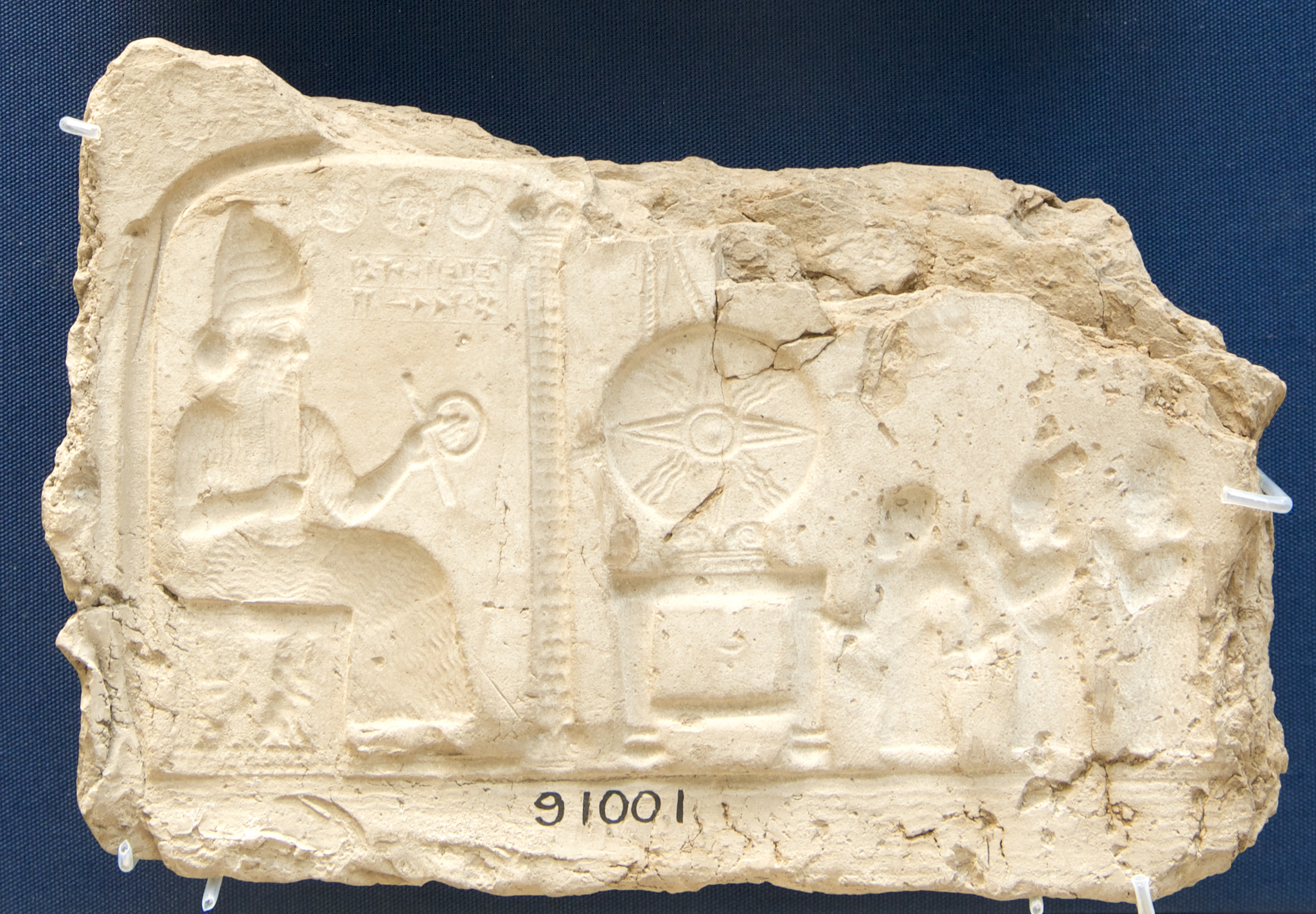
Stele recovered from Sippa
| Field | Value |
|---|---|
| image | Tablet_of_Shamash.jpg |
| image_caption | Tablet of Shamash |
| material | Limestone |
| size | Length: 29.2 cm, Width: 17.8 cm |
| created | 888–855 BC |
| location | British Museum, London. Room 55. |
| registration | ME 91000 |
The Tablet of Shamash (also known as the Sun God Tablet or the Nabuapaliddina Tablet) is a stele recovered from the ancient Babylonian city of Sippar in southern Iraq in 1881; it is now a major piece in the British Museum's ancient Middle East collection and is a visual attestation of Babylonian cosmology. It is dated to the reign of King Nabu-apla-iddina ca. 888 – 855 BC.

Discovery
The tablet was discovered during excavations by Hormuzd Rassam between 1878 and 1883. The tablet was found complete but broken into two large and six small pieces. By the time of King Nabopolassar, between 625 and 605 BC, it had broken into four parts and been repaired. The terracotta coffer also contained two clay impressions of the tablet's presentation scene. The coffer was sealed under an asphalt temple floor. It has been suggested that the coffer also contained a second tablet as well as a third clay impression (now in the Istanbul Archaeology Museums).
Description
It was encased in a clay cast or "squeeze" that created impressions when placed over the face of the stone and protected it. This indicates that the tablet was an item of reverence, possibly stored due to newer traditions. The tablet has serrated edges like a saw. The bas-relief on the top of the obverse (pictured) shows Shamash, the Sun God, beneath symbols of the sun, moon and star. Shamash is depicted in a seated position, wearing a horned headdress, holding the rod-and-ring symbol in his right hand. There is another large sun disk in front of him on an altar, suspended from above by two figures. Of the three figures on the left, the central one is dressed in the same fashion as Shamash and is assumed to be the Babylonian king Nabu-apla-iddina receiving the symbols of deity.
The bas relief can be superimposed with two orders of golden rectangles.
Inscription
The scene contains three inscriptions. The first, at the head of the tablet reads: (1) ṣal-lam (ilu)Šamaš bêlu rabû (2) a-šib E-babbar-ra (3) ša ki-rib Sippar(KI) | (1) Image of Shamash, the great Lord (2) who dwells in Ebabbara, (3) which is in Sippar}}
Above the sun god a second inscription describes the position of the depicted moon, sun, and star as being over against the heavenly ocean, on which the scene sits: (1) (ilu)Sin (ilu)Šamaš u (ilu)Ištar ina pu-ut apsî (2) ina bi-rit ili muš-ti-mi innadû(pl. u) | (1) Sin, Shamash and Ishtar are set over against the heavenly ocean (2) within the divine judge}}
The final inscription in the scene reads: (1)agû (ilu)Šamaš (2) muš-ši do | (1) Headdress of Shamash (2) rod of do.}} The cuneiform text beneath the stele is divided into fifteen passages, blending prose, poetic and rhetorical elements in the fashion typical of Mesopotamian royal inscriptions. It tells how Sippar and the Ebabbar temple of Shamash had fallen into disrepair with the loss of the statue of the god. This cult image is temporarily replaced with the solar disk; it is further described how a new figure of Shamash was found in an eastern part of the Euphrates, from which Nabu-apla-iddina has constructed a new statue of lapis lazuli and gold to restore the cult. Similar iconographic and prosaic parallels have been evidenced from Mesopotamian and later Jewish sources where the king who restores the cult is seen like a deity passing on divine symbols. The remainder of the text records the gifts of the royal grant, similar to a kudurru and discusses the practices of the temple, priestly rules, dress codes and regulations.
References
References
- (1969). "Fifty masterpieces of ancient Near Eastern art in the Department of Western Asiatic Antiquities, the British Museum". British Museum.
- "Cover | British Museum".
- Hormuzd Rassam (1897), 401-402. [https://archive.org/download/asshurlandofnimr00rass/asshurlandofnimr00rass.pdf Asshur and the Land of Nimrod: Being an Account of the Discoveries Made in the Ancient Ruins of Nineveh, Asshur, Sepharvaim, Calah, etc.] Curts & Jennings.
- C. E. Woods, The Sun-God Tablet of Nabû-apla-iddina Revisited, ''Journal of Cuneiform Studies,'' vol. 56, pp. 23 - 103, 2004
- Stefan Zawadzki. (2006). "Garments of the Gods: studies on the textile industry and the Pantheon of Sippar according to the texts from the Ebabbar archive". Saint-Paul.
- Olsen, Scott. (2006). "The Golden Section: Nature's Greatest Secret". Wooden Books.
- [https://www.britishmuseum.org/research/collection_online/collection_object_details.aspx?objectId=282224&partId=1 British Museum Collection]
- L. W. King. (1912). "Babylonian boundary-stones and memorial-tablets in the British Museum: with an atlas of plates".
- Ḥevrah ha-ʻIvrit la-ḥaḳirat Erets-Yiśraʼel ṿe-ʻatiḳoteha. (2003). "Erets-Yiśraʼel: meḥḳarim bi-yediʻat ha-Arets ṿe-ʻatiḳoteha, pp. 91-110". ha-Ḥevrah ha-ʻIvrit la-ḥaḳirat Erets-Yiśraʼel ṿe-ʻatiḳoteha.
This article was imported from Wikipedia and is available under the Creative Commons Attribution-ShareAlike 4.0 License. Content has been adapted to SurfDoc format. Original contributors can be found on the article history page.
Ask Mako anything about Tablet of Shamash — get instant answers, deeper analysis, and related topics.
Research with MakoFree with your Surf account
Create a free account to save articles, ask Mako questions, and organize your research.
Sign up freeThis content may have been generated or modified by AI. CloudSurf Software LLC is not responsible for the accuracy, completeness, or reliability of AI-generated content. Always verify important information from primary sources.
Report