From Surf Wiki (app.surf) — the open knowledge base
T gauge
Model railway scale
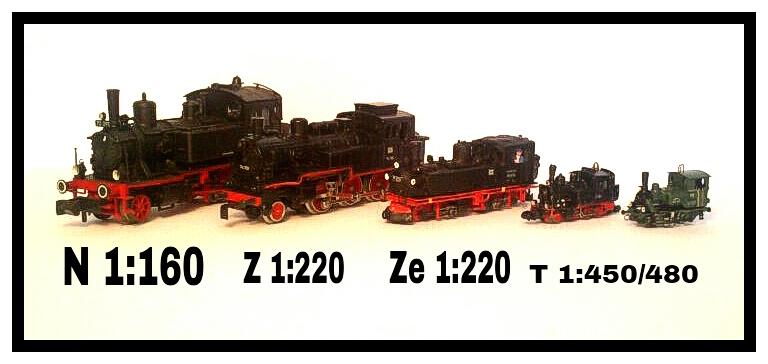
Model railway scale
| Field | Value |
|---|---|
| name | T gauge |
| image_filename | T review 04.jpg |
| scale | 1/40 in to 1 ft |
| 2/75 in to 1 ft | |
| 2 mm to 1 m | |
| ratio | 1:450 (Japanese gauge) |
| 1:480 (Standard gauge) | |
| 1:500 (Standard and broad gauge) | |
| gauge | |
| prototype_gauge | Commercially available models are of gauge. |
2/75 in to 1 ft 2 mm to 1 m 1:480 (Standard gauge) 1:500 (Standard and broad gauge)
T gauge (1:450, 1:480 and 1:500) is a model railway scale with a track gauge of , referred to as "three-millimeter gauge" or "third of N scale." It was introduced at the Tokyo Toy Show in 2006 by KK Eishindo of Japan and went on sale in 2007. It is the smallest commercial model train scale in the world. Since mid-2009, Railway Shop (Hong Kong) has been the exclusive licensed manufacturer.
The first train released was the Japanese 103 series commuter train in different versions. Each standard train set comes with two powered cars, which are located in the middle of the train. The front and rear cars are equipped with directional headlights. The tiny pantographs are made of etched stainless steel. The Hankyu Railway 9000 EMU Series and the Kiha 40 DMU were added to the line of available trainsets in early 2010 and feature improved mechanisms for better performance.
The track is offered as either flexible sections of rail and sleepers at 200 ,, or as rigid sections with roadbed, and a small selection of pieces without roadbed. Rigid curved track is available with four different radii: 120 mm, 132.5 , in 15° and 30° arc lengths; straight tracks are 30 , long. Points (switches or turnouts) are available in a single length, right and left-hand, with manual or electric throw. Diamond crossings are made at 30° and 90° angles in a 60mm length. Several miscellaneous track sections are also sold including power, isolating, and level grade crossing. The standard sectional track is "roadbed" style, with integrated ballast, or without roadbed as "fine scale". The rail is approximately 0.040 in high ("Code 40"). Track pieces are connected with gold-plated metal rail joiners plus plastic clips in the roadbed. Different types of dummy catenary masts can be attached to the track.
One side effect of the magnetic wheels of the powered units is that they can climb acute grades as steep as 45 degrees.
References
http://www.kk-eishindo.co.jp/ The manufacturer and creator of T Gauge
This article was imported from Wikipedia and is available under the Creative Commons Attribution-ShareAlike 4.0 License. Content has been adapted to SurfDoc format. Original contributors can be found on the article history page.
Ask Mako anything about T gauge — get instant answers, deeper analysis, and related topics.
Research with MakoFree with your Surf account
Create a free account to save articles, ask Mako questions, and organize your research.
Sign up freeThis content may have been generated or modified by AI. CloudSurf Software LLC is not responsible for the accuracy, completeness, or reliability of AI-generated content. Always verify important information from primary sources.
Report