From Surf Wiki (app.surf) — the open knowledge base
T. B. Walker
American business magnate (1840–1928)
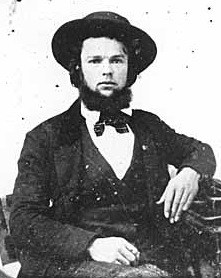
American business magnate (1840–1928)
| Field | Value | |
|---|---|---|
| image | Thomas B Walker-1888.png | alt=cropped shoulder high portrait wearing a suit and tie, mustache and short beard |
| caption | Thomas Barlow Walker in 1888 | |
| image_size | 180px | |
| birth_date | February 1, 1840 | |
| birth_place | Xenia, Ohio, U.S. | |
| death_date | ||
| death_place | Minneapolis, Minnesota, U.S. | |
| resting_place | Lakewood Cemetery | |
| birth_name | Thomas Barlow Walker | |
| known_for | lumber, Minneapolis Public Library, Walker Art Center | |
| occupation | businessperson, art collector | |
| signature | Signature of TB Walker.png | |
| spouse | ||
| children | Gilbert, Julia, Leon, Harriet, Fletcher, Willis, Clinton, and Archie | |
| relatives |
Thomas Barlow Walker (February 1, 1840 – July 28, 1928) was an American business magnate who acquired lumber in Minnesota and California and became an art collector. Walker founded the Minneapolis Public Library. He was among the ten wealthiest men in the world in 1923. He built two company towns, one of which his son sold to become part of what is today known as Sunkist. He is the founder and namesake of the Walker Art Center.
Early life and family
T. B. Walker was the son of Platt Walker and Anstis Keziah (Barlow) Walker (1814–1883), a sister of New York State Senator Thomas Barlow (1805–1896). He was born in Xenia, Ohio, in 1840, where in 1849 he got his first job in a bakery cutting biscuits. He had accompanied his parents and siblings west from New York when his father died of cholera in 1849 at Westport, Missouri, on their way to the California gold fields to seek their fortune.

In 1854, his mother married Oliver Barnes and in 1855 his family moved to Berea, Ohio, where while traveling for Fletcher Hulet, at Baldwin University. When he finished college at age 19, he filled a contract in Paris, Illinois for railroad ties. He then taught school and then became a traveling salesman of grindstones. He is remembered as a man of "strong opinions" who would not eat grapefruit and who slept with a pistol under his pillow. His brother Platt Bayless Walker II founded Mississippi Valley Lumberman, a magazine. He had another brother and two sisters: Oliver W. Barnes, Adelaide B. Walker, and Helen M. Walker.
Walker married his college classmate and boss's daughter Harriet Granger Hulet in 1863. One of Walker's grandsons was Olympic hurdler Walker Smith.
Forestry
From a man in Iowa, Walker heard good things about Minneapolis, Minnesota, and moved there in 1862. He arrived at Saint Paul where he met and sold grindstones, once to James Jerome Hill, then employed as a clerk who carefully sorted them for the buyer. Within one hour of his arrival in Minneapolis, he was hired as a chainman to George B. Wright, who was surveying federal pine lands in the north of the state. He became a deputy surveyor within a few days. His application to become assistant professor in mathematics at the University of Wisconsin had been accepted but he loved his new career and turned it down. Walker worked for twelve years on government surveys and on surveys for the St. Paul and Duluth Railroad. His work took him away from home for long periods, and it gave him intricate knowledge of what property to buy in northern Minnesota. He began to acquire pine land in 1867, but without capital of his own, he partnered at first with Dr. Levi Butler and Howard W. Mills and later with others.
With George A. Camp, in 1877 Walker bought the Pacific Mill,
Red River Lumber Company (RRLC) was founded in 1883 and incorporated the following year. became partners with Walker and the company built more mills in Crookston, Minnesota and at Grand Forks, Dakota Territory.
He was concerned about forest conservation and wrote an article for the National Magazine about what had become the "forestry question". During his lifetime, he gave papers to the Conservation Commission, the U.S. Forestry Department, the U.S. Interior Department and to the U.S. House Ways and Means Committee for their consideration for a tariff on lumber. He gave a presentation on conservation to the Minnesota Academy of Science.
Minneapolis
He had to spend months up north, but finally returned to Minneapolis in 1881 intending to build up the city. Walker said, "St. Paul had the wholesale trade, the retail trade, the railroads and the banks. We tried five years to arrange an amicable interest in building up the industries of both cities." He and others tried to lure a factory from the east but was double-crossed when Saint Paul, at the time a rival, ended up with both the eastern and the Minneapolis factories. He and his friends also invested in the Midway area but the city of Saint Paul annexed it.
Walker built the commercial market in Minneapolis, renowned at the time, into the best produce market in the U.S. Walker was a director and president of the library board from its founding in 1885 until he died in 1928.
Four-fifths He was particularly interested in creating a public art gallery, a museum, and the Minneapolis Art School.
He became president of the Business or Businessman's Union, which formed in 1883 for fifteen years. They chose to build up land west of Minneapolis for their industrial site, to avoid any possibility of Saint Paul annexing the land. According to Walker, "some of the men in the union who liked changes made a social club of it, in the Guaranty Loan Building [known as the Metropolitan Building, since demolished]. This practically closed out the Business Union."
Walker Galleries

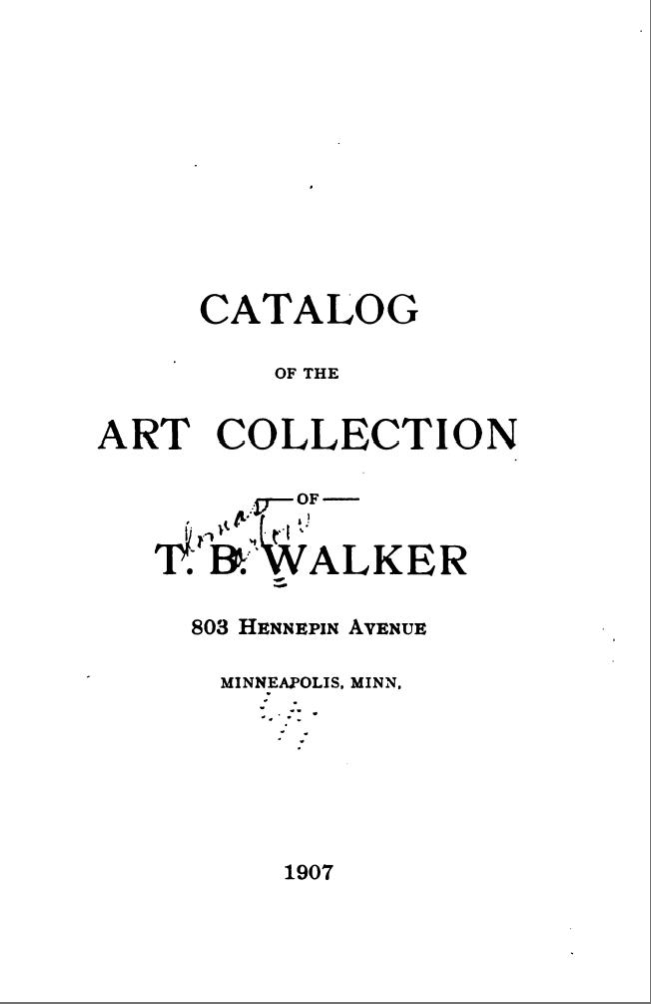
Walker built his first house in Minneapolis in 1870, at Ninth Street and Marquette Avenue. In 1874 he built a mansion at 803 Hennepin Avenue. A gallery was open to the public six days a week beginning in 1879 to display his paintings, porcelain, bronzes, jades, ancient and modern high-grade glass, carved crystals, ancient Chinese carved snuff-boxes and ivory carvings. Visitors had to ring at the front door until the home was expanded. The house and its eight additions covered nearly a city block but were later demolished to build a complex that includes the State Theatre.

His paintings included 15 American landscapes, 103 portraits of Native American chiefs, medicine men and warriors, and 24 portraits of renowned cowboys, scouts and guides, alongside traditional works by Raphael, Rembrandt, Holbein, Ingres, Titian, Bonheur, Turner and Michelangelo and dozens of other artists. Some of these paintings proved to be fakes and some were genuine—certainly, a landscape by Frederic Edwin Church sold for $8.5 million in a 1989 Sotheby's New York auction.
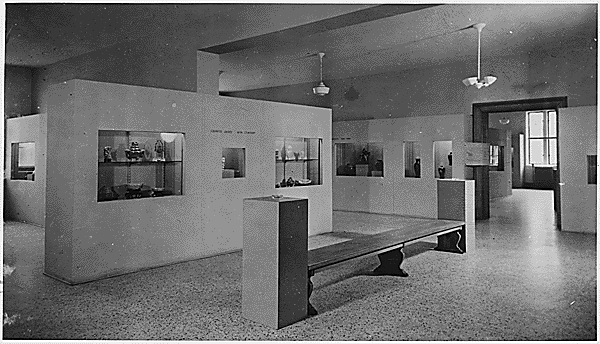
In 1915 Walker purchased the 3.5 acre Thomas Lowry property on Groveland Terrace including the present Walker Art Center. In 1917 Walker moved into the Lowry Mansion but it was demolished in about 1932. By 1915 the Walker Galleries on 803 Hennepin had 14 rooms, and had about 100,000 visitors each year. In 1926, Walker completed building a new gallery next door to the Lowry Mansion on the site of the present Walker Art Center which opened in 1927. Built by local architects, Long and Thorsov, the original Walker Art Center building stayed open until it was demolished in 1969 to make way for a new building by Edward Larrabee Barnes.
Speaking of the 25 to 30 people who founded the Minneapolis Society of Fine Arts, Donald Torbert wrote:
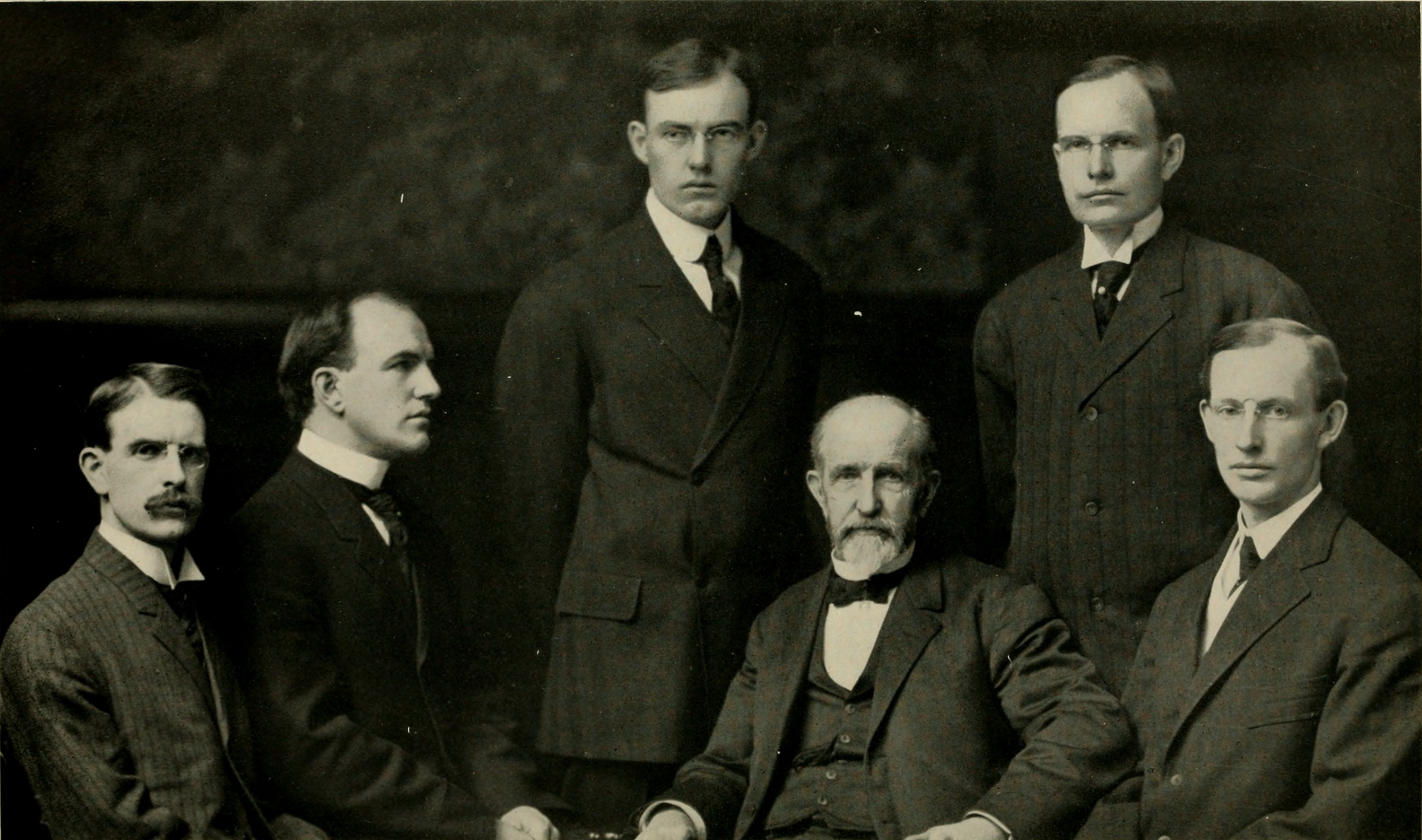
"Today it is impossible to assess, with anything approaching justice, the worth of the individual contributions, because each person was indispensable. But two, by reason of their energy and position in the community, played leading roles and through their accomplishments left a permanent imprint on the art life of the community. They were William Watts Folwell and Thomas Barlow Walker."
During the early 20th century, Walker published catalogs of his art collection which he wanted to give to the city of Minneapolis. According to the Minnesota Historical Society, the city refused the gift.

Walker wanted to build a large public library and an arts and sciences institution but the city failed to provide financial support—the Minnesota legislature authorized bonds for $500,000 but only half of them sold. the city negotiated with Walker but never reached mutual satisfaction, and in 1923 he rescinded the offer. Folwell wrote in his A History of Minnesota, "Walker wisely followed his independent course". Walker Galleries, Inc., was incorporated in 1924, and the T. B. Walker Foundation of today was founded in 1925 to "own and manage the collection and gallery".
Most of his collection was given away or sold to buy modern works. A gallery across the street at Hennepin Avenue United Methodist Church holds several of the works in his collection by 16th- and 19th-century European masters, which Walker donated to decorate the Sunday school.
St. Louis Park, Minnesota
In 1886, with Calvin Goodrich, Jr. and Henry Francis Brown, Walker founded the Minneapolis Land and Investment Company and became its president. Around this time, Walker was the richest man in Minnesota. About 50 of the houses remained in 1999 in the Edgebrook neighborhood.
The Panic of 1893 left Walker owning and paying taxes on many unsold lots the Walker/Syndicate building (still standing), the St. Louis Park Hotel (which the village later demolished), and a streetcar line to Minneapolis. According to the St. Louis Park Historical Society, Walker could be seen "giving out food during the Depression, but people shied away from him and even despised him". The E.H. Shursen Agency sold the last lot during the 1930s.
Death
T. B. Walker died at his home in Minneapolis in 1928. He was buried at Lakewood Cemetery, Minneapolis.
His wife died in 1917 while accompanying Walker on a business trip to New York. Walker was among the 15 or so wealthiest persons in the world when he died.
A portrait of T. B. Walker in 1915 by Carl Boeckman, acquired at some time since 1940, was on display at the Walker Art Center from November 21, 2009 until August 15, 2010. In the Walker's recent collection, Walker appears in Lost Forty (2011), a huge tapestry by Goshka Macuga picturing a tract of unlogged land in the Chippewa National Forest.
Westwood, California
Walker started to acquire northeastern California land in 1894. In 1909 he bought property near Mountain Meadows, California. In 1912 RRLC signed an agreement with the Southern Pacific Railroad giving them the right to build a line (the Fernley and Lassen Railway) and exclusive right to haul lumber. RRLC may have owned 900000 acre of timberland in California, or about 1% of the area of the state, by the time Walker retired .
About 1912 RRLC built a mill and the company town of Westwood, California. Westwood included houses, apartments, dormitories, hotels, a community center, a department store, churches, and a theater. All utilities were company-owned. The men had the "Westwood Club" to themselves but for the first 20 years no liquor was sold.
About this time, Walker retired from RRLC, which his sons Gilbert, Fletcher, Willis, and Archie then ran. Walker grew "increasingly frustrated" that he could not control the business by himself. The Minnesota Historical Society notes that his sons did not always see "eye to eye" with each other or with Walker.
Walker's youngest son Archie Dean Walker was first secretary (1908–1933) and then president (1933–) of RRLC.
List of associations and affiliated businesses
Walker's many business ventures and associations included the Crookston Boom and Water Power Company, the International Lumber Company in Minneapolis, the Metropolitan Trust Company in Minneapolis, the Minneapolis Central City Market Company, the Minneapolis Esterly Harvester Company, the Minnesota and Dakota Elevator Company in Minneapolis, the National Lumber Convention in Washington, D.C., the Northern Minnesota Log Driving & Boom Company, the Northwestern Elevator Company in Minneapolis, Pacific Investment Company, and the Waland Lumber Company. Walker was president of the Flour City National Bank in Minneapolis from 1887 to 1894. He was one of the incorporators of Edison Light & Power Co. He was one of the managers of the State Reform School in Saint Paul. He was involved in the Panama-Pacific International Exposition in San Francisco in 1915.
Walker was a trustee of the Hennepin Avenue Methodist Episcopal Church (now known as the Hennepin Avenue United Methodist Church in Minneapolis), a member of the Executive Committee of the Methodist Episcopal General Conference in Minneapolis, and a president of the Minneapolis Methodist Church Extension Society. He was a member of the executive committee of the See America League, a president of Walker Galleries, Inc., a president and a trustee of the Minneapolis Society of Fine Arts, president of the Minnesota Academy of Natural Sciences and its successor, the Minnesota Academy of Science where he donated boxes of specimens, and a trustee of the Young Men's Christian Association (YMCA) of the City of Minneapolis.
- Butler, Mills & Walker, later L. Butler & Company, reestablished as Butler & Walker, lumber 1869–1872
- Camp & Walker 1877–1887, Pacific Mill 1877–1887
- Walker & Akeley 1887
- Red River Lumber Company (RRLC) 1883–1897, California 1912–1944
- Akeley, Minnesota (developed town), also mill 1899–1915
- Westwood, California (company town) approx. 1912–1913 to retirement
- Walker, Minnesota was named for him
Notes
References
- Wilson, James Grant and Fiske, John (original ed.). "The Cyclopaedia of American biography". New York Press Association Compilers, via Internet Archive.
- Madison, Cathy. (2005). "Walker Art Center". Scala.
- "T. B. Walker". St. Louis Park Historical Society.
- Atwater, Isaac. (1893). "History of the city of Minneapolis, Minnesota". Munsell.
- Abbe, Mary. (9 April 2005). "Art lover T.B. Walker: Where it all began". Avista Capital Partners.
- Walker, Thomas Barlow. (1913). "Announcing the fiftieth anniversary of the marriage of Thomas Barlow Walker".
- Hodak, George A.. (1988). "An Olympian's oral history: Walker Smith, 1920 Olympic Games, Track & Field". LA84 Foundation Digital Library.
- Isaac Atwater. (1893). "History of the city of Minneapolis, Minnesota". Munsell.
- Atwater, Isaac. (1893). "History of the city of Minneapolis, Minnesota".
- Abbe, Mary. (September 11, 2007). "Walker Art Center hires 'rising star' to take helm". Star Tribune.
- Torbert, Donald. (1958). "A Century of Art and Architecture in Minnesota". University of Minnesota Press.
- Walker, Thomas Barlow. (1907). "Catalog of the Art Collection of T. B. Walker". via Internet Archive scan of University of Michigan copy.
- ((Walker Art Center)). (1985). "Walker Art Center: A History". Walker Art Center.
- (2005). "Bits & Pieces Put Together to Present a Semblance of a Whole: Walker Art Center Collections". Walker Art Center.
- Abbe, Mary. (November 19, 2009). "Art: Walker to the max". Star Tribune.
- "A Minnesota Millionaire". Chicago Inter-Ocean, via Internet Archive.
- "T.B. Walker's Methodist Church". St. Louis Park Historical Society.
- "Walker Building". St. Louis Park Historical Society.
- "The Brick Block". St. Louis Park Historical Society.
- "Early Park Hotels". St. Louis Park Historical Society.
- "Benches & Binoculars". Walker Art Center.
- Fong, Kristina. (May 18, 2011). "#IMD2011: Museum, Memory, and "Goshka Macuga: It Broke From Within"". Walker Art Center.
- Isaac Atwater. (1893). "History of the city of Minneapolis, Minnesota". Munsell.
This article was imported from Wikipedia and is available under the Creative Commons Attribution-ShareAlike 4.0 License. Content has been adapted to SurfDoc format. Original contributors can be found on the article history page.
Ask Mako anything about T. B. Walker — get instant answers, deeper analysis, and related topics.
Research with MakoFree with your Surf account
Create a free account to save articles, ask Mako questions, and organize your research.
Sign up freeThis content may have been generated or modified by AI. CloudSurf Software LLC is not responsible for the accuracy, completeness, or reliability of AI-generated content. Always verify important information from primary sources.
Report