From Surf Wiki (app.surf) — the open knowledge base
T-27
| Field | Value | |
|---|---|---|
| name | T-27 | |
| image | T-27 tank.jpg | |
| image_size | 300 | |
| caption | A replica of the T-27 tankette on display in Kyiv, Ukraine | |
| origin | Soviet Union | |
| type | Tankette | |
| <!-- Type selection --> | is_vehicle | yes |
| is_UK | yes | |
| <!-- Service history --> | service | 1931–1941 |
| used_by | Soviet Union | |
| Kingdom of Hungary (1920-1946) Hungary (captured) | ||
| Turkey | ||
| Kingdom of Romania Romania (captured) | ||
| wars | World War II | |
| <!-- Production history --> | designer | Sir John Carden-Vivian Loyd, N. Kozyrev, Factory No. 37, Moscow |
| manufacturer | Bolshevik Factory, GAZ | |
| production_date | 1931–33 | |
| number | 2,540 | |
| variants | T-27A | |
| <!-- General specifications --> | spec_label | T-27A |
| weight | 2.7 tonnes | |
| length | 2.60 m | |
| width | 1.83 m | |
| height | 1.44 m | |
| crew | 2 | |
| traverse | ||
| armour | 6 – | |
| primary_armament | 7.62mm DT machine gun (with 2,520 rounds) | |
| engine | GAZ-AA | |
| engine_power | 40 hp (30 kW) | |
| pw_ratio | 15 hp/tonne | |
| suspension | bogie | |
| fuel_capacity | 46 l | |
| vehicle_range | 120 km | |
| speed | 42 km/h |
Kingdom of Hungary (1920-1946) Hungary (captured) Turkey Kingdom of Romania Romania (captured) The T-27 was a tankette produced in the 1930s by the Soviet Union. It was based on the design of the Carden Loyd tankette, bought under license from the United Kingdom in 1930.
Design
The Soviets were not fully satisfied with the Carden Loyd design and made a number of changes before putting it into mass production under the designation of T-27. Compared with the British original, the hull was larger, the running gear was improved and the weapon mount was modified to take a Soviet 7.62 mm DT machine gun. A number of other changes were made by Chief Engineer N. Kozyrev and Lead Engineer K. Sirken to improve the tankette's ability to cope with the Russian climate and terrain. It lacked any communication devices, as communication between vehicles was intended to be carried out using signal flags.
Service
The tankette was accepted into service on February 13, 1931. It was manufactured in two factories simultaneously, the Bolshevik factory in Leningrad and what would later become the GAZ factory in Nizhni Novgorod.
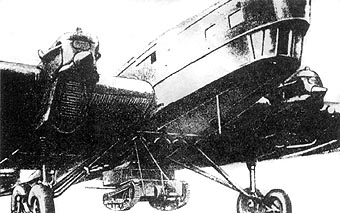
The principal use of the T-27 during its service life was as a reconnaissance vehicle. Initially, 65 tankette battalions were formed by the Red Army, with each having about 50 tankettes. This figure was later reduced to 23 per battalion. The tankette was also intended to be air-mobile. In 1935, the Soviets experimented with transporting T-27s by air, by suspending them under the fuselages of Tupolev TB-3 bombers.
The T-27 saw active service in the Soviet republics of Central Asia during the 1930s, where the tankettes were used in campaigns against basmachis. However, they fairly quickly became obsolete due to the introduction of more advanced tanks. The Red Army found them reliable and simple to operate, but the T-27 coped poorly with swampy and snowy terrain due to the narrowness of its tracks. It was also difficult to find crews, as the tankettes were so small that it was difficult to find crews of sufficiently diminutive stature. By the end of the 1930s the T-27 was relegated primarily to training use, with some being used as tractors to tow field guns.
Ten T-27s were captured by Hungarian forces during the fighting on the Eastern Front.
Five T-27s were ordered by Turkey in 1935, alongside 60 T-26s.
Two T-27 tankettes were captured by Romanian forces as of 1 November 1942.
Variants
References
Sources
References
- Zaloga 1983, p 123.
- (2023-05-04). "Hungary (WW2)".
- Mahé, Yann. (February 2011). "Le Blindorama : La Turquie, 1935 - 1945". Caraktère.
- Mark Axworthy, Cornel I. Scafeș, Cristian Crăciunoiu, ''Third Axis, Fourth Ally: Romanian Armed Forces in the European War, 1941-1945'', p. 220
- Janusz Magnuski. (1994). "Czerwony blitzkrieg (Red Blitzkrieg)". Pelta.
This article was imported from Wikipedia and is available under the Creative Commons Attribution-ShareAlike 4.0 License. Content has been adapted to SurfDoc format. Original contributors can be found on the article history page.
Ask Mako anything about T-27 — get instant answers, deeper analysis, and related topics.
Research with MakoFree with your Surf account
Create a free account to save articles, ask Mako questions, and organize your research.
Sign up freeThis content may have been generated or modified by AI. CloudSurf Software LLC is not responsible for the accuracy, completeness, or reliability of AI-generated content. Always verify important information from primary sources.
Report