From Surf Wiki (app.surf) — the open knowledge base
System on module
Board-level circuit that integrates a system function in a single module
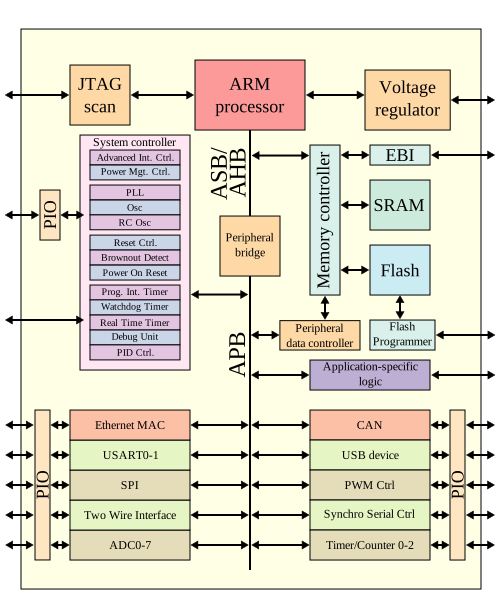
Board-level circuit that integrates a system function in a single module

A system on a module (SoM) is a board-level circuit that integrates a system function in a single module. It may integrate digital and analog functions on a single board. A typical application is in the area of embedded systems. Unlike a single-board computer, a SoM serves a special function like a system on a chip (SoC). The devices integrated in the SoM typically require a high level of interconnection for reasons such as speed, timing, bus width, etc. There are benefits in building a SoM, as for SoC; one notable result is to reduce the cost of the base board or the main PCB. Two other major advantages of SoMs are design-reuse and that they can be integrated into many embedded computer applications.
History
The acronym SoM has its roots in the blade-based modules. In the mid 1980s, when VMEbus blades used M-Modules, these were commonly referred to as system On a module (SoM). These SoMs performed specific functions such as compute functions and data acquisition functions. SoMs were used extensively by Sun Microsystems, Motorola, Xerox, DEC, and IBM in their blade computers.
Design
A typical SoM consists of:
- at least one microcontroller, microprocessor or digital signal processor (DSP) core
- multiprocessor systems-on-chip (MPSoCs) have more than one processor core
- memory blocks including a selection of ROM, RAM, EEPROM and/or flash memory
- timing sources
- industry standard communication interfaces such as USB, FireWire, Ethernet, USART, SPI, I²C
- peripherals including counter-timers, real-time timers and power-on reset generators
- analog interfaces including analog-to-digital converters and digital-to-analog converters
- voltage regulators and power management circuits
References
- ANSI/IEEE Std 1014-1987 and ANSI/VITA 1-1994
- 1386-2001 - IEEE Standard for a Common Mezzanine Card Family: CMC
- Standard ANSI/VITA 46.0-2007
- VITA Technologies Hall of Fame - PCI Mezzanine Cards
References
This article was imported from Wikipedia and is available under the Creative Commons Attribution-ShareAlike 4.0 License. Content has been adapted to SurfDoc format. Original contributors can be found on the article history page.
Ask Mako anything about System on module — get instant answers, deeper analysis, and related topics.
Research with MakoFree with your Surf account
Create a free account to save articles, ask Mako questions, and organize your research.
Sign up freeThis content may have been generated or modified by AI. CloudSurf Software LLC is not responsible for the accuracy, completeness, or reliability of AI-generated content. Always verify important information from primary sources.
Report