From Surf Wiki (app.surf) — the open knowledge base
Syrian pound
Currency of Syria
.jpg)
Currency of Syria
| Field | Value |
|---|---|
| local_name | الليرة السورية |
| local_name_lang | ar |
| image_1 | 200 SYP Front.jpg |
| image_title_1 | 200 pound banknote |
| iso_code | SYP |
| symbol_comment | None official. The abbreviations LS, SP, or ل.س are used. |
| subunit_ratio_1 | |
| subunit_name_1 | piastre (p) |
| used_banknotes | LS 10, LS 25, LS 50, LS 100, LS 200, LS 500 |
| used_coins | - |
| date_of_introduction | 1919 |
| using_countries | |
| issuing_authority | Central Bank of Syria |
| issuing_authority_website | |
| inflation_rate | 28.1% |
| inflation_source_date | The World Factbook, 2017 est. |
| value | US$1 = LS 111.00 |
| €1 = LS 129.73 | |
| (As of January 5, 2026) |
€1 = LS 129.73 (As of January 5, 2026)
The Syrian pound, known locally as the Syrian lira, (; abbreviation: LS or SP in Latin, ل.س in Arabic, historically also £S, and £Syr; ISO code: SYP) is the official currency of Syria. It is issued by the Central Bank of Syria. The pound is nominally divided into 100 piastres (قرش qirsh, plural قروش qurūsh in Arabic, abbreviated to ), although only banknotes are currently issued.
Before 1947, the Arabic inscription of the word "qirsh" was spelled with the initial Arabic letter غ, after which the word began with ق. Until 1958, banknotes were issued with Arabic on the obverse and French on the reverse. Since 1958, English has been used on the reverses, hence the three different names for this currency. Coins used both Arabic and French until independence, then only Arabic.
History
French mandate
Main article: Lebanese-Syrian pound
During the period when Syria was a part of the Ottoman Empire, which lasted about 400 years, the Ottoman pound was its main currency. Following the fall of the Ottoman Empire and the placing of Syria under a mandate (French occupation), the Egyptian pound was used in the territories under French and British mandates, including Lebanon, Transjordan and Palestine. Upon taking Lebanon and Syria under its separate mandate, the French government sought to replace the Egyptian currency and granted a commercial bank, the Banque de Syrie (a French affiliate of the Ottoman Bank), the authority to issue a currency for territories under its new mandate.
The pound (or livre in French) was introduced in 1919 and was set at a value of 20 francs. As the political status of Lebanon evolved, the Banque de Syrie, which was to act as the official bank for Lebanon and Syria, was renamed the Banque de Syrie et du Grand-Liban (BSL). BSL issued the Syro-Lebanese pound for 15 years, starting in 1924. Two years before the expiration of the 15-year period, BSL split the Lebanese-Syrian currency into two separate currencies that could still be used interchangeably in either state. In 1939, the bank was renamed the Banque de Syrie et du Liban.
In 1941, the peg to the French franc was replaced by a peg to sterling of LS 8.83125 = £1, as a consequence of the occupation of Syria by British and Free French forces. This rate was based on the pre-war conversion rate between the franc and sterling. In 1946, following devaluation of the franc, the pound was pegged once again to the franc at a rate of LS 1 = 54.35 F. In 1947, Syria joined the International Monetary Fund (IMF) and pegged its currency to the U.S. dollar at LS 2.19148 = US$1, a rate which was maintained until 1961.
Independence
The Lebanese and Syrian currencies split in 1948. From 1961, a series of official exchange rates were in operation, alongside a parallel, black market rate which reflected the true market rate for Syrian pounds in Jordan and Lebanon where there was a healthy trade in the Syrian currency.
Ba'athist Syria
The Syrian pound had stayed unchanged following the seizure of power by the Ba'athists in 1963. Despite this, the market was allowed to flourish because everybody, including government and public sector companies, needed it. The black market rate diverged dramatically from the official rate in the 1980s. In July 2007, the currency was pegged to the IMF SDR (Special Drawing Rights).

There was a capital flight to nearby countries, including Lebanon, Jordan, Egypt and Turkey, as a result of the Syrian civil war that started in 2011. In addition, Syria has been subject to sanctions imposed by the United States, the European Union and other countries, which shut Syria out of the global financial system. To circumvent the sanctions, Syrians effected foreign transactions through banks in neighbouring countries, especially Lebanon. As a result, the official exchange rate has deteriorated significantly, falling from LS 47 = US$1 in March 2011 to LS 515 = US$1 in July 2017 and 7500 = US$1 in April 2023 (after the Lebanese liquidity crisis)
On 31 October 2019, Syrian President Bashar al-Assad mentioned in an interview that liberating territories had complex economic consequences. While it removed foreign-funded support for terrorists, it also cut off dollar inflows that stabilize local economies:
Post-Assad reforms
Following the fall of the Assad regime at the end of 2024, Ahmed al-Sharaa, president of the Syrian transitional government, stated that he intends to replace the Syrian pound with a new currency once it re-stabilizes.
In August 2025, it was announced that the Syrian government would revalue the currency by removing two zeros and issuing new banknotes by December. Syrian authorities reconfirmed this plan in October but with the date pushed back to 2026.
On 29 December 2025, the Central Bank of Syria unveiled the new Syrian Pound denominations alongside President Ahmed al-Sharaa at the ‘New Syria Banknotes Reveal Event’ in Damascus. Some of the executive instructions related to Decree No. 293 of 2025, which reference the new currency, were released earlier the same day. The new denominations began circulating in the general public on 3 January 2026.
Coins
In 1921, cupro-nickel piastre coins were introduced, followed in 1926 by aluminium bronze 2p and 5p. In 1929, holed, nickel-brass 1p and silver 10p, 25p and 50p were introduced. Nickel-brass p coins were introduced 1935, followed by zinc 1pt and aluminium-bronze p in 1940. During the Second World War, brass 1p and aluminium p emergency coins were issued. These pieces were crudely produced and undated.
A new coinage was introduced between 1947 and 1948 in denominations of p, 5p, 10p, 25p, 50p and LS 1, with the p, 5p and 10p struck in cupro-nickel and the others in silver. Aluminium-bronze replaced cupro-nickel in 1960, with nickel replacing silver in 1968. In 1996, following high inflation, new coins were introduced in denominations of LS 1, LS 2, LS 5, LS 10 and LS 25, with the LS 25 being bimetallic. In 2003, LS 5, LS 10, and LS 25 coins were issued, with latent images. On December 26, 2018, the Central Bank of Syria introduced a LS 50 coin for general circulation to replace the banknote of that denomination. Due to high inflation, only the 50p coin is in circulation. All other coins were worthless by December of 2022.
Banknotes

In 1919, the Banque de Syrie introduced notes for 5p, 25p and 50p, LS 1 and LS 5. These were followed, in 1920, by notes for LS 1, LS 10, LS 25, LS 50 and LS 100. In 1925, the Banque de Syrie et du Grand-Liban began issuing notes and production of denominations below 25p ceased. Notes below LS 1 were not issued from 1930. In 1939, the issuing body again changed its name, to the Banque de Syrie et du Liban.
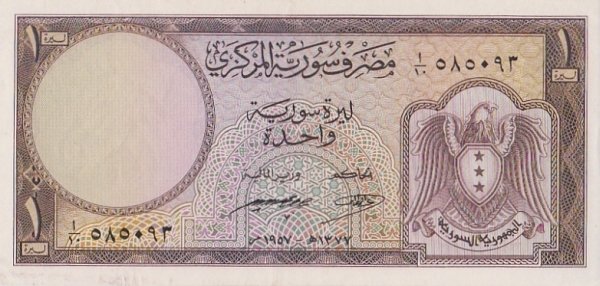
Between 1942 and 1944, the government introduced notes for 5p, 10p, 25p and 50p. In the early 1950s, undated notes were issued by the Institut d'Emission de Syrie in denominations of LS 1, LS 5, LS 10, LS 25, LS 50 and LS 100, followed by notes dated 1955 for LS 10 and LS 25. The Banque Centrale de Syrie took over paper money issuance in 1957, issuing the same denominations as the Institut d'Emission.
In 1958, the French language was removed from banknotes and replaced by English. Notes were issued for LS 1, LS 5, LS 10, LS 25, LS 50, LS 100 and LS 500. In 1966, the design of the LS 25, LS 50, and LS 100 notes were changed. In 1976 and 1977, the designs changed for all the denominations except the LS 500 note.
In 1997 and 1998, a new series of notes was introduced in denominations of LS 50, LS 100, LS 200, LS 500 and LS 1,000, with the lower denominations replaced by coins. In 2009, the LS 50, LS 100, and LS 200 pound notes were changed with an entirely new design. On 2 July 2014, a new LS 500 note was introduced, followed by a LS 1,000 note on 30 July 2015, a LS 2,000 note on 2 July 2017, and a LS 5,000 note on 24 January 2021.
2009–2025 series
On 27 July 2010, the Central Bank of Syria issued a new series of banknotes dated 2009 in denominations of LS 50, LS 100, and LS 200. The notes were designed by Austrian banknote designer Robert Kalina. The Central Bank of Syria issued new LS 500 and LS 1,000 notes in 2013 and 2014, respectively. The reverse of the new LS 1,000 note features an image of a Roman mosaic painting discovered in Deir al-Adas. Then-President Bashar al-Assad was added to the LS 2,000 note in 2017. A LS 5,000 note was released in January 2019.
| Image | Value | Dimensions (millimeters) | Main color | Description | Year of first issue | Obverse | Reverse | Obverse | Reverse | |
|---|---|---|---|---|---|---|---|---|---|---|
| LS 50 | 135 × 65 | Gray | A rectangular Ugarit tablet of first Abjad, and a circular Ebla tablet | National Library and a statue of former President Hafez al-Assad | 2009 | |||||
| [[File:100 Syrian Pound.jpg | frameless]] | LS 100 | 140 x 65 | Red | Basalt stone gate and Bosra amphitheater | The dome of the Treasury of the Umayyad Mosque, Central Bank of Syria, ancient coin of Philip the Arab | 2009 | |||
| LS 200 | 145 x 65 | Orange | Norias of Hama | Ceiling of Temple of Bel (Palmyra) | 2009 | |||||
| LS 500 | 150 x 65 | Blue | Damascus Opera House | "Mosaic of the Musicians" from a Byzantine villa in Maryamin. The clay tablet depicts the Hurrian songs | 2013 | |||||
| LS 1000 | 155 x 65 | Green | Roman Theatre at Bosra | Roman mosaic of a grape harvest in Deir al-Adas | 2014 | |||||
| LS 2000 | 158 x 65 | Purple | Then-president Bashar al-Assad and the Umayyad Mosque | Syrian Parliament | 2017 | |||||
| LS 5000 | 158 x 65 | Brown | Syrian soldier statue and the Ba'athist Syrian flag | Eagle and Yarhibol resco from the Temple of Baalshamin (Palmyra) | 2019 |
2026 series
The new currency was launched on 1 January 2026, and is being issued entirely in paper denominations. In the first phase, six denominations will be launched: LS 500, LS 200, LS 100, LS 50, LS 25, and LS 10. In the second phase, three denominations will be launched: LS 1,000, LS 5, and LS 1.
Under the proposed plan, every 100 Syrian pounds will be exchanged for one unit of the new Syrian Arab Republic pound. Both the old and new currencies will remain in circulation simultaneously for a period of 90 days, with the possibility of an extension.
| Current series (2026) | Image | Value | Dimensions | |||||
|---|---|---|---|---|---|---|---|---|
| (mm) | Main | |||||||
| colour | Description | Issued | ||||||
| from | Obverse | Reverse | ||||||
| LS 1 | 158 × 65 | |||||||
| LS 5 | ||||||||
| LS 10 | Red | Roses; Butterfly | Central bank building; | |||||
| Umayyad Mosque treasury | 1 January 2026 | |||||||
| LS 25 | Blue | Mulberries; House sparrow | ||||||
| LS 50 | Orange | Citrus; Seashell | ||||||
| LS 100 | Purple | Cottons; Gazelle | ||||||
| LS 200 | Green | Olives; Arabian horse | ||||||
| LS 500 | Brown | Wheats; House sparrow | ||||||
| LS 1000 |
Exchange rate

On 5 December 2005, the selling rate quoted by the Commercial Bank of Syria was LS 48.4 = US$1. A rate of about LS 50 to US$1 was usual in the early 2000s, but the rate is subject to fluctuations. Since the start of the civil war in 2011, the pound's unofficial exchange rate has deteriorated significantly. It was LS 47 = US$1 in March 2011 and LS 515 in July 2017. Since July 2007, the Syrian pound has been pegged to the IMF SDR (Special Drawing Rights).
On 29 November 2019, following the Lebanese protests, the black market rate was LS 765 = US$1, a decrease of 30% since the turmoil started in Lebanon a month earlier, as the protests led Lebanese banks to impose tight controls on hard currency withdrawals and transfers abroad, making it hard for Syrians to access funds held by them in those banks.
The black-market rate fell to LS 950 on 2 December 2019, another 25% decrease, while the official rate set by the central bank was LS 434 = US$1.
On 13 January 2020, the currency deteriorated further, as more than LS 1,000 was traded for US$1 in the black market, despite being valued at LS 434 = US$1 by the Syrian Central Bank. During the COVID-19 pandemic in Syria, the Syrian pound continued to fall against the U.S. dollar in the black market, where US$1 equaled more than LS 1,600 in May 2020. A month later, the Syrian pound passed LS 2,000 against the dollar, and a few days later, it passed LS 3,000 against the dollar.
Upon the implementation of the U.S. sanctions related to the Caesar Act, anti-government local authorities in Idlib Governorate adopted the Turkish lira in place of the plummeting Syrian pound. The lira has also replaced the Syrian pound in other Turkish occupied areas of northern Syria, such as Afrin and Jarabulus.
On 31 December 2022, the Syrian pound hit a new record low again on the black market, where each US$1 cost LS 7,150, twice as much as a year before. In 2023, the exchange rate continued deterioration, reaching LS 15,000 per US$1.
During the 2024 Syrian opposition offensives, the exchange rate fell to a record low of LS 25,000 per US$1. After the fall of the Assad regime, the currency was traded between LS 12,500 and 10,000 per US$1.
Links for current rates
Notes
References
References
- "Banknotes of Syria".
- "World Bank Editorial Style Guide 2020 - page 138".
- https://en.numista.com/catalogue/note268783.html
- (1 April 1990). "CIA World Factbook 1990 - page 303".
- (1991). "The Statesman's Yearbook 1990-1991 - page 1177". Springer.
- (January 2, 2026). "App Syria Unveils New Banknotes, Replacing Assad Portraits With Nature Symbols".
- (29 November 2019). "Syria (barely) survived a civil war. Can it weather the latest financial crisis?".
- [http://www.euromoney.com/Article/1451566/Syria-The-businessman-cant-play-his-hand.html Syria: The businessman can't play his hand] Euromoney May 1986.
- (5 June 2007). "Syria ends pound's peg to U.S. dollar". The Globe and Mail.
- (29 November 2019). "Lebanon crisis wreaks havoc on Syria's war-torn economy".
- link. (2011). [[Central Bank of Syria]]
- (31 October 2019). "President al-Assad's interview given to al-Sourya and al-Ikhbarya TVs". Syrian Arab News Agency.
- "أحمد الشرع يحدد أبرز أولوياته الداخلية في سوريا.. ومن بينها قرارات اقتصادية".
- Dalatey, Feras. (2025-08-23). "Exclusive: Syria to revalue currency, dropping two zeros in bid for stability". [[Reuters]].
- (17 October 2025). "Syria to roll out new currency in 2026 to replace collapsed lira". The New Arab.
- "Central bank illuminates building to mark new currency". Syrian Arab News Agency (SANA).
- "Syria begins circulating new post-Assad currency bills".
- Due to fast depreciation, LS 5, and LS 10 coins and 25 pounds coin are practically worthless as of December 2021.[https://en.numista.com/catalogue/pieces148703.html] [https://en.numista.com] Retrieved on 2020-05-20.
- (2013). "The Banknote Book". www.BanknoteNews.com.
- (25 January 2021). "Syria floats new bank note amid soaring inflation".
- Frank Stocker. (21 November 2014). "Dieses Land hilft Syrien beim Gelddrucken aus". Die Welt.
- (June 30, 2015). "Updated-CBS puts into circulation new SYP 1,000 banknotes to replace worn-out currency". Syrian Arab News Agency.
- (29 December 2025). "Syria announces new currency framework, 2-zero redenomination".
- (29 December 2025). "President reveals new currency in Damascus ceremony".
- "Syrian Banknotes". [[Central Bank of Syria]].
- "Coin [10] Syrian Pounds". [[Central Bank of Syria]].
- "Coin [25] Syrian Pounds". [[Central Bank of Syria]].
- "Coin [50] Syrian Pounds". [[Central Bank of Syria]].
- "Coin [100] Syrian Pounds". [[Central Bank of Syria]].
- "Coin [200] Syrian Pounds". [[Central Bank of Syria]].
- "Coin [500] Syrian Pounds". [[Central Bank of Syria]].
- (2 December 2019). "Syrian pound hits record low in panic selling, dealers say".
- (13 January 2020). "Syrian Pound Hits Record Low of 1,000 against the Dollar".
- (17 May 2020). "Syrian pound continues to devaluate against USD".
- (3 June 2020). "Syrian pound passes 2000 against dollar as new policies fail to stop freefall".
- (4 June 2020). "Syrian pound hits record low against dollar in panic trading, dealers say". [[Reuters]].
- (9 June 2020). "Syrian pound hits record low ahead of new U.S. sanctions: dealers".
- (15 June 2020). "Syria's Idlib adopts Turkish lira in place of plummeting pound".
- Ashawi, Khalil. (2018-08-28). "Falling lira hits Syrian enclave backed by Turkey". Reuters.
- al-Issa, Jana. (2023-01-06). "Syrian pound declined 100% in 2022".
- (16 August 2023). "Dollar Approaching 15,000 Syrian Pounds". The Syrian Observer.
- (13 December 2024). "Syrian pound rebounds against dollar". Enab Baladi.
- (14 December 2024). "Syrian currency firms against US dollar after Assad's fall". Reuters.
This article was imported from Wikipedia and is available under the Creative Commons Attribution-ShareAlike 4.0 License. Content has been adapted to SurfDoc format. Original contributors can be found on the article history page.
Ask Mako anything about Syrian pound — get instant answers, deeper analysis, and related topics.
Research with MakoFree with your Surf account
Create a free account to save articles, ask Mako questions, and organize your research.
Sign up freeThis content may have been generated or modified by AI. CloudSurf Software LLC is not responsible for the accuracy, completeness, or reliability of AI-generated content. Always verify important information from primary sources.
Report