From Surf Wiki (app.surf) — the open knowledge base
Synthetism
Art style

Art style
History
Paul Gauguin, Émile Bernard, Louis Anquetin, and others pioneered the style during the late 1880s and early 1890s.
Synthetist artists aimed to synthesize three features:
- The outward appearance of natural forms.
- The artist's feelings about their subject.
- The purity of the aesthetic considerations of line, colour and form.
In 1890, Maurice Denis summarized the goals for synthetism as, :It is well to remember that a picture before being a battle horse, a nude woman, or some anecdote, is essentially a flat surface covered with colours assembled in a certain order.
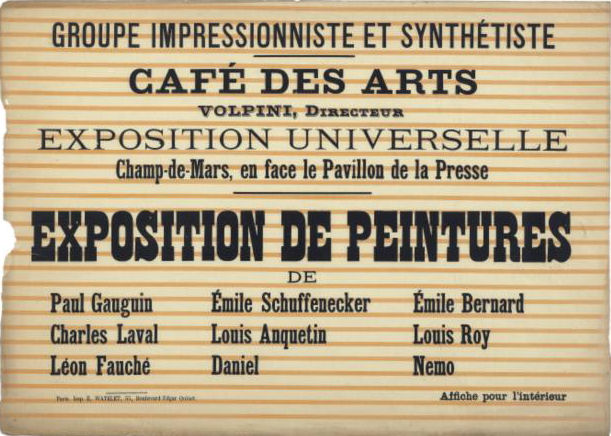
The term was first used in 1877 to distinguish between scientific and naturalistic Impressionism, and in 1889 when Gauguin and Emile Schuffenecker organized an Exposition de peintures du groupe impressioniste et synthétiste in the Café Volpini at the Exposition Universelle in Paris. The confusing title has been mistakenly associated with Impressionism. Synthetism emphasized two-dimensional flat patterns, thus differing from Impressionist art and theory.
Synthetist paintings
- Paul Sérusier - Talisman (Bois d'amour) (1888)
- Paul Gauguin - Vision After The Sermon (1888), La Belle Angele (1889), The Loss of Innocence (1890)
- Émile Bernard - Buckwheat Harvest (1888)
- Charles Laval - Going to Market (1888)
- Cuno Amiet - Breton Spinner (1893)
Gallery
Image:Paul Gauguin 085.jpg|Paul Gauguin, Les Alyscamps, (1888), Musée d'Orsay, Paris File:La vision après le sermon (Paul Gauguin).jpg|Paul Gauguin, Vision after the Sermon, 1888. File:Paul Sérusier 001.jpg|Paul Sérusier, The Talisman (with the forest landscape of love in Pont-Aven) 1888 File:Laval Allant au marché.jpg|Charles Laval, Going to Market, Brittany, 1888, Indianapolis Museum of Art File:Paul Gauguin 028.jpg|Paul Gauguin, The Green Christ, 1889 File:Émile Bernard 1888-08 - Breton Women in the Meadow (Le Pardon de Pont-Aven).jpg|Émile Bernard, Breton Women in the Meadow, August 1888. Bernard exchanged this one with Gauguin who brought it to Arles in autumn 1888 when he joined Van Gogh, who was fond of this style. Van Gogh painted a copy in watercolor to inform his brother Theo about it. File:Breton Women.jpg|Vincent van Gogh, Breton Women and Children, November 1888 (watercolor after Bernard). File:Porträt Paul Ranson.jpg|Portrait of Paul Ranson by Paul Sérusier, 1890, Musée d'Orsay, Paris Image:Louis Anquetin.jpg|Louis Anquetin, Reading Woman, 1890
References
References
- Brettell, Richard R.. (1999). "Modern Art, 1851-1929: Capitalism and Representation". Oxford University Press.
- [http://www.imamuseum.org/art/collections/artwork/going-market-brittany-laval-charles Charles Laval] Retrieved April 6, 2011
This article was imported from Wikipedia and is available under the Creative Commons Attribution-ShareAlike 4.0 License. Content has been adapted to SurfDoc format. Original contributors can be found on the article history page.
Ask Mako anything about Synthetism — get instant answers, deeper analysis, and related topics.
Research with MakoFree with your Surf account
Create a free account to save articles, ask Mako questions, and organize your research.
Sign up freeThis content may have been generated or modified by AI. CloudSurf Software LLC is not responsible for the accuracy, completeness, or reliability of AI-generated content. Always verify important information from primary sources.
Report