From Surf Wiki (app.surf) — the open knowledge base
Synchronized skating
Ice skating discipline

Ice skating discipline
| Field | Value |
|---|---|
| name | Synchronized skating |
| image | 2015 Grand Prix of Figure Skating Final Team Paradise IMG 9903.JPG |
| caption | Team Paradise at the 2015 Grand Prix |
| union | International Skating Union |
| nickname | "precision skating", "synchro" |
| first | |
| firstlabel | First Performed |
| team | * between 8 and 20 figure skaters including 4 alternates |
| olympic | No |
| paralympic | No |
| IWGA | No |
| mgender | Mixed |
| country/region =
- maximum 16 compete on the ice at once
- Discipline of figure skating
- Team sport
- Winter sport
- Figure skates
- Ice rink
- Figure skating rink
Synchronized skating, often called synchro, is an ice skating sport where between 8 and 20 skaters perform together as a team. They move as a flowing unit at high speed over the ice, while performing elements and footwork.
This complex sport originated in 1956 and was initially called "precision skating" due to its emphasis on the maintenance of intricate and precise formations and the requirement of precise timing from all members of the group. Synchronized skating is now well-established as an organized sport in several European countries with several of them having produced teams who frequently win championships at the international level. As of 2022, there are more than 600 synchro teams in United States alone.
Details
Synchronized skating currently uses a judging format similar to singles, pairs and ice dancing. The discipline is primarily judged on skating skills, transitions, performance, composition, interpretation and difficulty of elements.
A synchronized skating free skate program consists of elements that are executed in various shapes and formations both connected and disconnected, such as blocks, triangles, circles, lines, or wheels, done while intersecting, traveling across the ice, and rotating. Teams are required to perform turns and step sequences, ranging in difficulty with each level.
There are many different levels including Aspire 1-4, Pre-Preliminary, Preliminary, Pre-juvenile, Open juvenile, Intermediate, Novice, Junior, Senior, and Adult. In the highest-ranking levels, Junior and Senior division teams are required to perform a short program in addition to the free skate. The short program is more technical in nature, whereas the free skating program is longer and provides an opportunity to showcase expression, emotion and interpretation.
Junior level teams compete in the Junior World Synchronized Skating Championships. At the senior level, teams compete at the World Synchronized Skating Championship. All member nations of the ISU are allocated one entry for each level, countries that placed in the top five of the previous championship are awarded two team entries.
The required elements must be performed in specific ways, as described by published communications by the ISU, unless otherwise specified. The ISU publishes violations and their points values yearly. Situations warranting deductions in synchronized skating include elements where one-quarter of the team or more fails to execute a maneuver in congruence with the majority of the team, falls, interruptions, illegal maneuvers (such as cartwheels), and violations of the rules concerning time, music, and clothing.
History
In 1956, the first synchronized skating team was formed by Dr. Richard Porter. The 'Hockettes' skated out of Ann Arbor, Michigan and entertained spectators during intermissions of the University of Michigan Wolverines hockey team. In the early days, precision skating (as it was then called) resembled a drill team routine, or a precision dance company such as The Rockettes. In 1974, the ISU published the first judges' handbook for synchronized skating.
During the 1970s, the interest for this new sport grew and developed. Teams developed more creative and innovative routines incorporating stronger basic skating skills, new maneuvers and more sophisticated transitions with greater speed, style and agility. Due to the increased interest in the sport in North America, the first official international competition was held between Canadian and American teams in Michigan in March 1976. With the internationalization of the sport, it has evolved, with increasing emphasis on speed and skating skills, and "highlight" elements such as jumps, spirals, spins, and lifts that originally were not permitted in competition.
Elements and formations
Competition programs include a variety of elements utilizing various shapes or formations. Scoring of each element is determined by their base value (BV) and grade of execution (GOE), together this determines the teams technical element score (TES). In competition the technical panel identifies elements as each element is performed, elements are then assigned a level of difficulty ranging from B (basic) to Level 4 (most difficult). Element shapes are a set of distinct configurations that are easily identifiable, these shapes are used as the basis of most synchronized skating elements.
Formations
Certain elements are composed of specific distinctive shapes or formations, occasionally transitioning from one shape to a different shape for a higher level of difficulty.
Block
Identifiable by skaters lined up in at least three separate lines forming a polygonal shape, characterized as block, pyramid or diamond shapes in straight even spaced lines. The shapes can be closed or open formation, with open formations maintaining distinct empty space in the middle of the formation.
Circle
Characterized by rotating around a common center with even distance from the midpoint and spacing from teammates, circles can be connected or disconnected. different circle configurations include multiple circles, circle within a circle, and interlocking. To increase the level of difficulty a circle can include changes of place, or configuration, step sequences, weaving, interlocking, and changes of rotational direction.
Line

Lines are integral to many elements and transitions as they demonstrate the team's collective skating skills and serve as building blocks for both blocks and wheel formations. Lines can be connected and disconnected.
Wheel
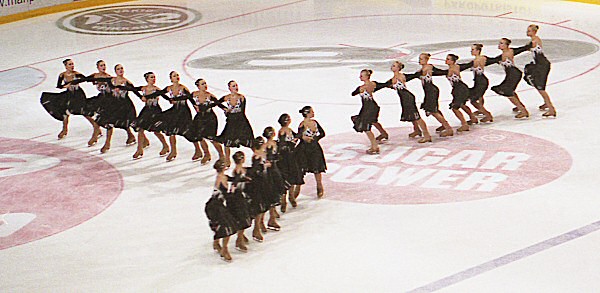
A wheel is characterized by every skater rotating around a common center point in connected lines. Different formations that teams can form including a two to five spoke or a parallel wheel. Each spoke (line) of the wheel should be straight and the team should be leaning into the center of the wheel. The difficulty of the wheel can be increased by adding footwork, changing the rotational direction of the wheel, configuration of the wheel.
Elements
Programs incorporate a set number of specific elements that is announced at the beginning of each season. Currently junior and senior teams both complete 5 elements in the short program, in the free skate junior teams attempt 8 elements, and senior teams attempt 10.
Artistic Element
Done in ether a circle/wheel formation, or a line/block formation, this element should be used to emphasize the music or theme of the program with no requirements for steps or changes of place.
Creative Element
Selected each season, the creative element is intended to be a unique interpretation of the other defined elements or formations (e.g.: creative wheel, creative lift)
Group Lift Element

Incorporating all members of the team, skaters form different groups with each lifted skater supported by two or more teammates at any height. Group lifts can be classified as being ether gliding or rotational, with rotational lifts starting gliding then having the supporting skaters switch between forwards and backwards gliding to rotate the lifted skater.
Intersection Element

An intersection, is when the skaters proceed towards each other in lines and intersect. The intersection can consist of two to four lines, with three and four line intersections forming a triangle or box shape before and after intersecting. The entry to the intersection can be made more difficult by executing various free skating or pair movements while forming the lines, or intersecting from an angle or a whip. The moment when the lines intersect is known as the point of intersection, here skaters do rotational turns or free skating movements to increase the level of difficulty.
Mixed Element
Consisting of at least two separate element formations occurring simultaneously and interacting with each other. Some examples would be a circle within a wheel or line intersecting a block.
Move Element
This element is a sequence of movements that must include free skating moves such as spirals, biellmanns, or 180's. The team can be split into units to execute additional features for levels of difficulty, such as ducking under each other's legs, changing edge, or transitioning from one position to another.
No Hold Element
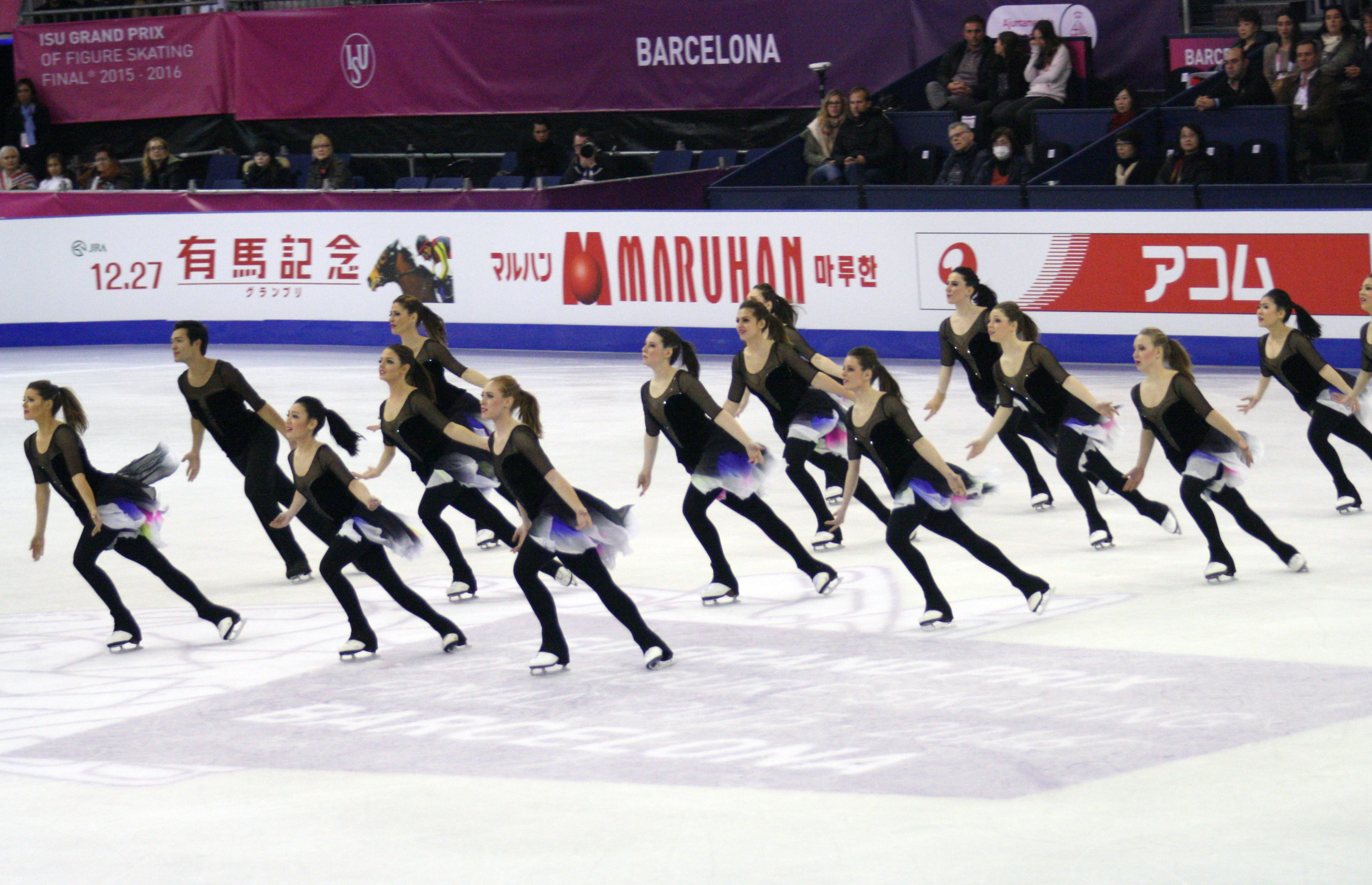
Done in a block formation, the skaters are disconnected but maintain even spacing while executing step sequences and changes of configuration.
Pair Element

Incorporating all members of the team, skaters are paired to execute pairs moves, free skating moves, and or step sequences.
Pivoting and Linear Elements
Done in block, or line formations, programs can include both pivoting and linear elements though they would be done in separate shapes. Pivoting elements rotate around a common center point and must remain connected for the majority of the element while maintaining shape and even spacing. Linear elements need to progress across the ice, and can utilize changes of placement and configuration.
Synchronized Spin Element
Characterized by all members of the team, in ether a solo or pairs spin. Positioned on the ice in any identifiable shape, with all skaters maintaining the same spin position simultaneously, and moving from one position to another as a team.
Traveling and Rotating Elements
Done in circle, or wheel formation, rotation is necessary in both elements. Programs can include both traveling and rotating elements though they would be done in separate shapes, if a program only includes one element both wheel and circle formations can be used as a change of formation for difficulty. Traveling elements are characterized by ice coverage during the element with the circle or wheel required to continually move a certain distance along a set path while rotating. Rotating elements remain stationary. Both elements can utilize changes of position, rotation, and configuration for higher levels of difficulty.
Twizzle Element
Highlighting the twizzle turn, the team executes two to three twizzles, this element can be done in any identifiable formation. The skaters must execute their twizzles while maintaining the chosen shape or transitioning from one configuration to another, and rotating simultaneously. For added levels of difficulty teams can attempt the aforementioned change of place or configuration, different rotational directions for each twizzle, and certain difficult arm and free leg positions.
Competitions
International
There are international synchronized skating competitions at the Senior, Junior, and Novice levels (with Senior being the most elite). The International Skating Union held the first official World Synchronized Skating Championships (WSSC) in 2000 in Minneapolis, Minnesota, USA. The top Junior teams from around the world competed from 2001 to 2012 at the ISU Junior World Challenge Cup (JWCC), held in a different location every year. The JWCC were accompanied in 2013 by the ISU World Junior Synchronized Skating Championships, to be held biannually in odd-numbered years with the JWCC in even-numbered years. Other long-running, major international events attracting elite teams at different levels include the French Cup, Spring Cup, Neuchâtel Trophy, Cup of Berlin, Zagreb Snowflakes Trophy, Leon Lurje Trophy and Prague Cup.
ISU World Synchronized Skating Championships
Main article: ISU World Synchronized Skating Championships
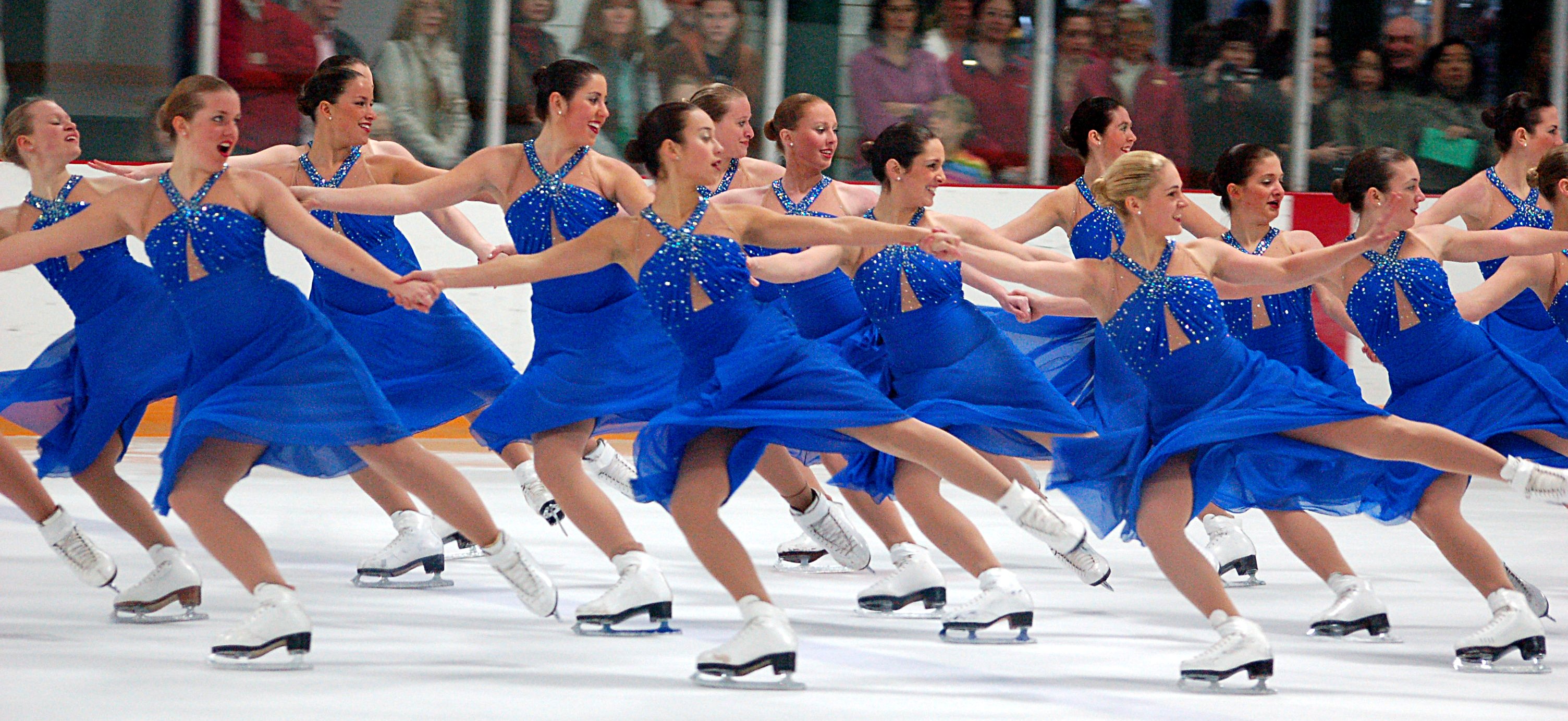
The ISU World Synchronized Skating Championships (WSSC) are the world championships for synchronized skating. Held since 2000, the WSSC is an annual international event organized by the International Skating Union. The top positions have been dominated by Finland, with three different World Champions (Marigold IceUnity, Rockettes and Team Unique) and 19 medals, and Sweden with the team (Team Surprise) with most World titles and medals for a single team (12 medals). Other major countries include Canada with five gold, four silvers and six bronzes (for NEXXICE, Les Suprêmes and the now-discontinued Black Ice), as well as the United States with two silvers and five bronzes (for Miami University and Haydenettes).
| Year | Location | Gold | Silver | Bronze | Source |
|---|---|---|---|---|---|
| 2025 | FIN Helsinki, Finland | FIN Rockettes | FIN Team Unique | USA Haydenettes | |
| 2024 | CRO Zagreb, Croatia | Canada Les Suprêmes | USA Haydenettes | Finland Rockettes | |
| 2023 | USA Lake Placid, USA | Canada Les Suprêmes | Finland Rockettes | Finland Team Unique | |
| 2022 | CAN Hamilton, Canada | Canada Les Suprêmes | Finland Marigold IceUnity | Finland Rockettes | |
| 2021 | CAN Hamilton, Canada | Event cancelled | |||
| 2020 | USA Lake Placid, USA | Event cancelled | |||
| 2019 | FIN Helsinki, Finland | RUS Team Paradise | FIN Marigold IceUnity | FIN Rockettes | |
| 2018 | SWE Stockholm, Sweden | FIN Marigold IceUnity | SWE Team Surprise | RUS Team Paradise | |
| 2017 | USA Colorado Springs, USA | RUS Team Paradise | FIN Marigold IceUnity | CAN NEXXICE | |
| 2016 | HUN Budapest, Hungary | RUS Team Paradise | FIN Rockettes | USA Haydenettes | |
| 2015 | CAN Hamilton, Canada | CAN NEXXICE | FIN Marigold IceUnity | RUS Team Paradise | |
| 2014 | ITA Courmayeur, Italy | FIN Marigold IceUnity | CAN NEXXICE | FIN Rockettes | |
| 2013 | USA Boston, USA | FIN Team Unique | CAN NEXXICE | USA Haydenettes | |
| 2012 | SWE Gothenburg, Sweden | SWE Team Surprise | CAN NEXXICE | USA Haydenettes | |
| 2011 | FIN Helsinki, Finland | FIN Rockettes | FIN Marigold IceUnity | USA Haydenettes | |
| 2010 | USA Colorado Springs, USA | FIN Rockettes | FIN Marigold IceUnity | USA Haydenettes | |
| 2009 | CRO Zagreb, Croatia | CAN NEXXICE | FIN Team Unique | SWE Team Surprise | |
| 2008 | HUN Budapest, Hungary | FIN Rockettes | SWE Team Surprise | CAN NEXXICE | |
| 2007 | CAN London, Canada | SWE Team Surprise | USA Miami University | CAN NEXXICE | |
| 2006 | CZE Prague, Czech Republic | FIN Marigold IceUnity | SWE Team Surprise | FIN Rockettes | |
| 2005 | SWE Gothenburg, Sweden | SWE Team Surprise | FIN Rockettes | FIN Marigold IceUnity | |
| 2004 | CRO Zagreb, Croatia | FIN Marigold IceUnity | SWE Team Surprise | FIN Rockettes | |
| 2003 | CAN Ottawa, Canada | SWE Team Surprise | FIN Marigold IceUnity | CAN Les Suprêmes | |
| 2002 | FRA Rouen, France | FIN Marigold IceUnity | SWE Team Surprise | CAN black ice | |
| 2001 | FIN Helsinki, Finland | SWE Team Surprise | FIN Rockettes | CAN black ice | |
| 2000 | USA Minneapolis, USA | SWE Team Surprise | CAN black ice | FIN Marigold IceUnity |
ISU World Junior Synchronized Skating Championships
Main article: ISU World Junior Synchronized Skating Championships
| Year | Location | Gold | Silver | Bronze | Source | |
|---|---|---|---|---|---|---|
| 2024 | SUINeuchatel, Switzerland | CanadaLes Suprêmes | FinlandTeam Fintastic | USASkyliners | ||
| 2023 | FRAAngers, France | FinlandTeam Fintastic | CanadaNEXXICE | USASkyliners | ||
| 2022 | {{flagicon | AUT | FinlandTeam Fintastic | USASkyliners | USATeams Elite | |
| 2021 | FRALyon, France | Event Cancelled | ||||
| 2020 | GBR Nottingham, United Kingdom | FIN Team Fintastic | RUS Team Junost | RUS Team Crystal Ice | ||
| 2019 | SUI Neuchatel, Switzerland | RUS Team Junost | RUS Team Crystal Ice | USA Team Skyliners | ||
| 2018 | CRO Zagreb, Croatia | RUS Team Junost | USA Team Skyliners | RUS Team Crystal Ice | ||
| 2017 | CAN Mississauga, Canada | RUS Team Junost | FIN Team Fintastic | FIN Musketeers | ||
| 2015 | CRO Zagreb, Croatia | FIN Musketeers | FIN Team Fintastic | CAN Les Suprêmes | ||
| 2013 | FIN Helsinki, Finland | FIN Musketeers | FIN Team Fintastic | RUS Spartak-Junost |
ISU Junior World Challenge Cup
Main article: ISU Junior World Challenge Cup
| Year | Location | Gold | Silver | Bronze | Source(s) |
|---|---|---|---|---|---|
| 2016 | CRO Zagreb, Croatia | CAN Les Suprêmes | FIN Team Fintastic | RUS Team Junost | |
| 2014 | SUI Neuchâtel, Switzerland | FIN Team Fintastic | CAN Les Suprêmes | FIN Musketeers | |
| 2012 | SWE Gothenburg, Sweden | FIN Team Fintastic | FIN Musketeers | CAN Les Suprêmes | |
| 2011 | SUI Neuchâtel, Switzerland | FIN Team Fintastic | FIN Musketeers | USA Team Braemar | |
| 2010 | SWE Gothenburg, Sweden | FIN Team Fintastic | CAN NEXXICE | FIN Musketeers | |
| 2009 | SUI Neuchâtel, Switzerland | FIN Team Fintastic | CAN NEXXICE | FIN Musketeers | |
| 2008 | FRA Rouen, France | FIN Team Fintastic | CAN Gold Ice | FIN Musketeers | |
| 2007 | GBR Nottingham, Great Britain | FIN Team Fintastic | CAN Les Suprêmes | USA Chicago Jazz | |
| 2006 | FIN Helsinki, Finland | FIN Musketeers | FIN Team Fintastic | USA Chicago Jazz | |
| 2005 | SUI Neuchâtel, Switzerland | FIN Musketeers | FIN Team Mystique | CAN Gold Ice | |
| 2004 | ITA Milan, Italy | FIN Musketeers | FIN Team Mystique | CAN Gold Ice | |
| 2003 | SWE Kungsbacka, Sweden | FIN Musketeers | CAN Burlington Ice Image | CAN Les Suprêmes | |
| 2002 | CRO Zagreb, Croatia | CAN Ice Image | RUS Spartak-Leader | FIN Musketeers | |
| 2001 | SUI Neuchâtel, Switzerland | FIN Team Fintastic | CAN Les Suprêmes | USA Superettes |
Finland

The Finnish member of ISU, the Finnish Figure Skating Association, holds the Finnish Synchronized Skating Championships at the Novice, Junior and Senior levels. Also, it holds two Finnish Championships Qualifiers before the nationals. Since the late 1990s, the senior-level battle for the qualifier wins and Finnish Championship—and the ensuing ISU World Synchronized Skating Championships (WSSC) entries—has mainly been fought between three teams from Helsinki, Marigold IceUnity, Rockettes and Team Unique, while a fourth and sometimes a fifth Senior team has competed along in the intervening years.
Finnish Senior Championships medalists
| Year | Location | Gold | Silver | Bronze | Source |
|---|---|---|---|---|---|
| 2022 | Helsinki | Team Unique | Rockettes | Marigold IceUnity | |
| 2022 | Tampere | Rockettes | Marigold IceUnity | Dream Edges | |
| 2021 | Helsinki | Rockettes | Team Unique | Marigold IceUnity | |
| 2020 | Espoo | Rockettes | Team Unique | Marigold IceUnity | |
| 2019 | Turku | Rockettes | Marigold IceUnity | Team Unique | |
| 2018 | Helsinki | Marigold IceUnity | Rockettes | Team Unique | |
| 2017 | Espoo | Team Unique | Marigold IceUnity | Rockettes | |
| 2016 | Helsinki | Team Unique | Marigold IceUnity | Rockettes | |
| 2015 | Tampere | Marigold IceUnity | Rockettes | Team Unique | |
| 2014 | Helsinki | Marigold IceUnity | Rockettes | Team Unique | |
| 2013 | Turku | Team Unique | Marigold IceUnity | Rockettes | |
| 2012 | Espoo | Rockettes | Marigold IceUnity | Team Unique | |
| 2011 | Espoo | Rockettes | Marigold IceUnity | Team Unique | |
| 2010 | Espoo | Rockettes | Marigold IceUnity | Team Unique | |
| 2009 | Helsinki | Marigold IceUnity | Team Unique | Rockettes | |
| 2008 | Helsinki | Rockettes | Marigold IceUnity | Team Unique | |
| 2007 | Helsinki | Marigold IceUnity | Team Unique | Rockettes | |
| 2006 | Helsinki | Marigold IceUnity | Rockettes | Team Unique |
Finnish qualifications for the ISU WSSC
Throughout the years, the Finnish senior teams qualifying for the World Championships have been selected based on their performance at the two qualifiers and the national championships. In the season 2012–13, the teams were selected as follows: the Finnish Champion qualified automatically as Team Finland 1 for the WSSC. Team Finland 2 at the WSSC was the team which earned the fewest points from the first qualifier, the second qualifier and the Finnish Championships. The points equaled the sum of the positions at the three competitions with growing coefficients: the coefficient was 0,3 for the first competition result, 0,5 for the second and 1 for the last.
United States
In the United States, there are several other recognized age and skill levels. Sanctioned by the US Figure Skating Association, the divisions include Aspire 1-4, Pre-Juvenile, Preliminary, Open Juvenile, Open Collegiate, Open Adult, and Open Masters (the non-qualifying divisions/ the divisions that do not go to Nationals) and Juvenile, Intermediate, Novice, Junior, Senior, Collegiate, Adult, and Masters (qualifying levels).
ISI (Ice Skating Institute) is another governing body which focuses on a more recreational form of competition and does not have the same divisions as those of the USFSA. Teams can compete in the Tot Jr. Youth, Youth Sr. Youth, Teen, Collegiate, Adult, or Master age groups, in any of five categories: Formation, Advanced Formation, Skating, Open Skating, and Dance.
While most skaters participating in synchronized skating are female, the rules allow mixed-gender teams.
US Figure Skating Senior Championship
Main article: U.S. Synchronized Skating Championships
The Senior team level consists of 16 skaters. Skaters must be at least 15 years old and have passed the Novice Moves in the Field test.
| Year | Location | Gold | Score | Silver | Score | Bronze | Score | Pewter | Score | Source |
|---|---|---|---|---|---|---|---|---|---|---|
| 2020 | Providence, Rhode Island | Haydenettes | 203.19 | Skyliners | 194.94 | Crystallettes | 193.09 | Miami University | 192.39 | |
| 2019 | Plymouth, Michigan | Haydenettes | 226.37 | Skyliners | 218.14 | Crystallettes | 201.63 | Miami University | 196.95 | |
| 2018 | Portland, Oregon | Haydenettes | 204.05 | Skyliners | 185.86 | Miami University | 182.99 | Crystalettes | 166.89 | |
| 2017 | Rockford, Illinois | Haydenettes | 208.83 | Crystallettes | 189.50 | Skyliners | 172.96 | Miami University | 172.84 | |
| 2016 | Kalamazoo, Michigan | Haydenettes | 202.26 | Miami University | 183.86 | Skyliners | 169.47 | Crystallettes | 166.96 | |
| 2015 | Providence, Rhode Island | Haydenettes | 210.55 | Miami University | 194.70 | Skyliners | 178.99 | Crystallettes | 173.78 | |
| 2014 | Colorado Springs, Colorado | Haydenettes | 205.02 | Crystallettes | 179.77 | Starlights | 154.90 | Miami University | 149.64 | |
| 2013 | Plymouth, Michigan | Haydenettes | 206.33 | Miami University | 191.28 | Crystallettes | 176.96 | Skyliners | 151.56 | |
| 2012 | Worcester, Massachusetts | Haydenettes | 202.92 | Crystallettes | 185.54 | Miami University | 182.64 | ICE'Kateers | 145.15 | |
| 2011 | Ontario, California | Haydenettes | 217.41 | Miami University | 195.50 | Crystallettes | 179.85 | California Gold | ||
| 2010 | Minneapolis, Minnesota | Haydenettes | 231.14 | Crystallettes | 210.35 | Miami University | 202.68 | Starlights | 167.80 | |
| 2009 | Portland, Maine | Miami University | 204.72 | Haydenettes | 203.97 | Crystallettes | 184.10 | California Gold | ||
| 2008 | Providence, Rhode Island | Haydenettes | 213.37 | Miami University | 201.26 | Crystallettes | 184.10 | California Gold | ||
| 2007 | Colorado Springs, Colorado | Haydenettes | 201.04 | Miami University | 199.56 | Crystallettes | 159.65 | California Gold | 158.06 | |
| 2006 | Grand Rapids, Michigan | Miami University | 179.72 | Haydenettes | 161.28 | Crystallettes | 155.12 | Team Elan | 126.96 | |
| 2005 | Lowell, Massachusetts | Haydenettes | * | Miami University | * | Crystallettes | * | Team Elan | * | |
| 2004 | San Diego, California | Haydenettes | * | Crystallettes | * | Team Elan | * | Miami University | * | |
| 2003 | Huntsville, Alabama | Haydenettes | * | Miami University | * | Team Elan | * | Crystallettes | * | |
| 2002 | Lake Placid, New York | Haydenettes | * | Miami University | * | Crystallettes | * | |||
| 2001 | Colorado Springs, Colorado | Haydenettes | * | Miami University | * | Crystallettes | * | |||
| 2000 | Plymouth, Michigan | Haydenettes | * | Team Elan | * | Miami University | * | |||
| 1999 | Tampa, Florida | Miami University | * | Haydenettes | * | Starlets | ||||
| 1998 | San Diego, California | Haydenettes | Miami University | Team Elan | * | |||||
| 1997 | Syracuse, New York | Haydenettes | * | Team Elan | * | Miami University | * | |||
| 1996 | Chicago, Illinois | Haydenettes | * | Miami University | * | Team Elan | * | |||
| 1995 | San Diego, California | Team Elan | * | Haydenettes | * | Miami University | * | |||
| 1994 | Providence, Rhode Island | Haydenettes | * | Team Elan | * | Miami University | * | |||
| 1993 | Detroit, Michigan | Haydenettes | * | Team Elan | * | Crystallettes | * | |||
| 1992 | Portland, Maine | Haydenettes | * | Team Elan | * | Goldenettes | * | |||
| 1991 | Anchorage, Alaska | Haydenettes | * | Goldenettes | * | Fraserettes | * | |||
| 1990 | Houston, Texas | Goldenettes | * | Haydenettes | * | Fraserettes | * | |||
| 1989 | Providence, Rhode Island | Haydenettes | * | Goldenettes | * | Detroit Capets | * | |||
| 1988 | Reno, Nevada | Haydenettes | * | Fraserettes | * | Detroit Capets | * | |||
| 1987 | Tulsa, Oklahoma | Fraserettes | * | Haydenettes | * | Figurettes | * | |||
| 1986 | Boston, Massachusetts | Hot Fudge Sundaes | * | Haydenettes | * | Detroit Capets | * | |||
| 1985 | Lakewood, Ohio | Fraserettes | * | Ice Crystallettes | * | Minneapplettes | * | |||
| 1984 | Bowling Green, Ohio | Fraserettes | * | Ice Crystallettes | * | * |
USFSA Collegiate Championship
The Collegiate team level consists of teams with 12–20 Figure skaters who must be enrolled in a college or degree program as full-time students. Skaters must also have passed the Juvenile Moves in the Field test. It is a Varsity Sport at colleges such as Miami University and Adrian College. Many more have developed club-level collegiate teams without varsity status such as the team at The University of Delaware and the University of Michigan. The Miami University Synchronized Skating Team has been a trailblazer in collegiate synchronized skating, fielding the first completely funded varsity synchronized skating program in the United States, as well as working towards gaining "Synchro" NCAA status in the United States.
| Year | Location | Gold | Score | Silver | Score | Bronze | Score | Pewter | Score | Source |
|---|---|---|---|---|---|---|---|---|---|---|
| 2023 | Peoria, IL | Miami University | 104.61 | Univ of Michigan | 92.61 | Western Michigan | 91.43 | Trine University | 90.58 | |
| 2022 | Colorado Springs, CO | Miami University | 116.95 | Adrian College | 105.74 | Western Michigan | 104.30 | Univ of Michigan | 97.95 | |
| 2020 | Providence, RI | Univ of Michigan | 106.49 | Adrian College | 97.35 | Miami University | 92.81 | University of Delaware | 80.85 | |
| 2019 | Plymouth, MI | Miami University | 104.86 | Western Michigan | 95.92 | Univ of Michigan | 91.67 | Adrian College | 87.44 | |
| 2018 | Portland, OR | Univ of Michigan | 91.48 | Adrian College | 84.84 | Miami University | 83.53 | Michigan State | 70.52 | |
| 2017 | Rockford, IL | Univ of Michigan | 88.22 | Miami University | 86.40 | Michigan State | 75.66 | Metroettes | 75.31 | |
| 2016 | Kalamazoo, MI | Miami University | 90.12 | Univ of Michigan | 86.28 | Metroettes | 82.15 | Western Michigan | 81.76 | |
| 2015 | Providence, RI | Miami University | 94.12 | Univ of Michigan | 85.69 | Metroettes | 84.25 | |||
| 2014 | Colorado Springs, CO | Miami University | 96.80 | Team Excel | 78.77 | Michigan State | 78.60 | Univ of Michigan | ||
| 2013 | Plymouth, MI | Miami University | 92.26 | Univ of Delaware | 84.11 | Univ of Michigan | 77.98 | |||
| 2012 | Worcester, MA | Miami University | 87.80 | Univ of Delaware | 84.29 | Univ of Michigan | 80.83 | |||
| 2011 | Ontario, CA | Miami University | 96.16 | Michigan State | 85.17 | Univ of Michigan | 83.96 | |||
| 2010 | Minneapolis, MN | Miami University | 107.60 | Univ of Michigan | 98.46 | Univ of Delaware | 94.97 | |||
| 2009 | Portland, ME | Miami University | 100.63 | Univ of Illinois | 86.79 | Michigan State | 85.79 | |||
| 2008 | Providence, RI | Miami University | 107.46 | Univ of Delaware | 97.77 | Michigan State | 87.11 | Univ of Michigan | ||
| 2007 | Colorado Springs, CO | Miami University | 102.61 | Michigan State | 92.17 | Univ of Delaware | 88.74 | |||
| 2006 | Grand Rapids, MI | Miami University | Western Michigan | Univ of Delaware | ||||||
| 2005 | Lowell, MA | Miami University | Western Michigan | Michigan State | Univ of Michigan | |||||
| 2004 | San Diego, CA | Western Michigan | Miami University | Univ of Delaware | ||||||
| 2003 | Huntsville, AL | Miami University | Western Michigan | Univ of Michigan | Univ of Michigan | |||||
| 2002 | Lake Placid, NY | Miami University | Michigan State | Western Michigan | Univ of Michigan | |||||
| 2001 | Colorado Springs, CO | Miami University | Western Michigan | Michigan State | ||||||
| 2000 | Plymouth, MI | Miami University | Univ of Delaware | Univ of Michigan | ||||||
| 1999 | Tampa, FL | Univ of Michigan | Miami University | Univ of Delaware | ||||||
| 1998 | San Diego, CA | Miami University | Michigan State | Bowling Green | Univ of Michigan | |||||
| 1997 | Syracuse, NY | Miami University | Bowling Green | Western Michigan |
Canada
The Canadian Synchronized Skating Championships were annual synchronized skating events, sanctioned by the Skate Canada, held to determine the national champions of Canada. They were first held in 1983. Since 2000, it is during these events that the senior teams can qualify for the ISU World Synchronized Skating Championships. Since 2023, the Junior and Senior level teams are competing in the combined synchronized and figure skating championships, held as a single event known as the Canadian National Skating Championships.
Present day
Why not Synchro Petition
Although not currently an Olympic sport, it has already been reviewed for Olympic eligibility. In 2007 synchronized skating was selected to be part of the Universiade or World University Games as a demonstration sport. Teams from several countries competed in Turin, Italy with Sweden, Finland, and Russia coming out on top.
"Why Not Synchro" is an ongoing campaign on social media through the hashtag #whynotsynchro and #whynotsynchro2018 on Facebook, Twitter, and Instagram. This was popularized at the Mozart Cup, held in Austria in January 2014. During the medal ceremonies, teams gathered on the ice and created the shape of the Olympic rings. This image was then shared over social media as skaters petitioned to raise awareness of the sport. A petition to the International Olympic Committee was posted on change.org calling for 15,000 signatures and asking the IOC "Synchronized Figure Skating: Make it an Olympic Event." The petition states "The time has come to add this incredible event to the pinnacle of the sport of figure skating."
Effects of COVID-19
Due to the abrupt appearance of COVID-19, the 2019–2020 season was cut short to ensure safety of all teams. Elite US teams like the Haydenettes, Skyliners and Miami university were not able to compete internationally due to travel restrictions set in place in late March and early April. The US Figure Skating Association is responsible for the health and well-being of the athletes and members.
Judging

International IJS System
The competitive levels of synchronized skating, like those in other disciplines of Figure skating, are now judged using the ISU Judging System that was introduced in 2004. Each element is assigned a difficulty level by the technical panel made up of a technical specialist, assistant technical specialist and a technical controller. Each level of difficulty for a particular element corresponds to a pre-determined base value. The base value is the number of points that are awarded for an executed element before the grade of execution or any deductions are applied. Judges assign a grade of execution from -3 to +3 to each of the elements. Each grade of execution, or GOE, corresponds to a point value. For each element, the highest and lowest GOE values are dropped and the rest are averaged then added to the base value. The sum of all the scores of the elements comprises the Technical Elements score.
Program Component Score
The judges will award points on a scale from 0.25 to 10 (in increments of 0.25) for three program components to grade overall presentation. As with Grade of Execution (GOEs), the highest and lowest scores for each component are thrown out, and the remaining scores are averaged. The final program components scores are then multiplied by a set factor to ensure the technical score and program components score are balanced.
The five program components are:
- Skating Skills - The ability of the skater to execute the skating repertoire of steps, turns and skating movements with blade and body control.
- Performance - The demonstration of engagement, commitment and involvement based on an understanding of the music and composition.
- Composition - The intentional, developed and/or original arrangement of the repertoire and all types of movements into a meaningful whole according to the principles of proportion, unity, space, pattern, and musical structure.
Technical Score
Each element of the program is assigned a base value, which gives skaters credit for every element they perform. Some elements, such as spins and step sequences, have levels of difficulty on which the base values are established. Judges grade the quality of each element using a grade of execution score within a range of −5 to +5, which is added to or deducted from the base value. GOEs are proportional to the base value of each element. The highest and lowest scores for each element are thrown out, and the remaining scores are averaged to determine the final GOE for each element. The GOE is then added to or subtracted from the base value for each element, and the sum of the scores for all elements forms the technical score.
Segment Score
The technical score is added to the program components score to determine the segment score (short program/rhythm dance or free skate/dance). The scores for each segment are then added together to determine the competition score. The skater with the highest competition score is declared the winner. In the event of a tie, the team with the highest free program score wins the competition. The IJS is used at events in the national qualifying structure including the U.S. Championships as well as many local competitions at the juvenile through senior levels, including Excel.
6.0 System
In the United States, the introductory levels of Aspire 1-4, Open Juvenile, Open Collegiate, Open Adult, and Open Masters are still judged under the 6.0 judging system. These levels can compete at the regional level but cannot qualify for the national championships. The basic principle of the 6.0 system is a "majority" system. Each event is judged by an odd number of judges, and the winner of the event is the team placed highest by a majority of these judges.
Differences in Judging Systems
The IJS is based on cumulative points rather than the 6.0 standard of marks and placement. The IJS focuses on the skaters and not the judges. Judges do not have to use their memory to compare all aspects of every skater and figure out where to place them, but simply evaluate the qualities of each performance.
Highest scores at ISU competitions
Short program
| Rank | Team | Score | Event | Source | 1 | 2 | 3 | 4 | 5 | ||||
|---|---|---|---|---|---|---|---|---|---|---|---|---|---|
| SWE Team Surprise | 87.84 | 2004 Neuchâtel Trophy | url=http://events.skating.ch/archiveNT/NT_2004_event/SEG001.HTM | title=Neuchatel Trophy | publisher=Swiss Ice Skating | access-date=2014-04-17}} | |||||||
| FIN Rockettes | 83.46 | 2010 Cup of Berlin | url=http://www.deu-event.de/results/cob2010/SEG004.HTM | title=Cup of Berlin 2010 | publisher=Deutsche Eislauf-Union | date=2010-01-16 | access-date=2014-04-07}} | ||||||
| FIN Team Unique | 82.36 | 2009 Worlds | url=http://www.isuresults.com/results/syswc2009/SEG001.HTM | title=Synchronized Senior - Short Program | publisher=International Skating Union | date=2009-04-03 | access-date=2014-04-07}} | ||||||
| CAN NEXXICE | 80.12 | 2009 Worlds | |||||||||||
| FIN Marigold IceUnity | 78.68 | 2009 Worlds |
Free skating
| Rank | Team | Score | Event | Source | 1 | 2 | 3 | 4 | 5 | |||||||
|---|---|---|---|---|---|---|---|---|---|---|---|---|---|---|---|---|
| SWE Team Surprise | 159.60 | 2004 Neuchâtel Trophy | url=http://events.skating.ch/archiveNT/NT_2004_event/SEG002.HTM | title=Neuchatel Trophy | publisher=Swiss Ice Skating | access-date=2014-04-17}} | ||||||||||
| FIN Marigold IceUnity | 147.31 | 2014 Worlds | url=http://www.isuresults.com/results/wcsys2014/SEG002.HTM | title=Synchronized Skating - Free Skating | publisher=International Skating Union | date=2014-04-04 | access-date=2014-04-07}} | |||||||||
| CAN NEXXICE | 146.03 | 2014 Worlds | ||||||||||||||
| RUS Paradise | 145.84 | 2014 Zagreb Snowflakes Trophy | url=http://zagreb-snowflakes-trophy.org/admin/js/filemanager/files/Rezultati2014/SEG008.HTM | title=12th Zagreb Snowflakes Trophy 2014 | publisher=Croatian Skating Federation | date=2014-03-01 | access-date=2014-04-07 | url-status=dead | archive-url=https://web.archive.org/web/20160303224342/http://zagreb-snowflakes-trophy.org/admin/js/filemanager/files/Rezultati2014/SEG008.HTM | archive-date=2016-03-03}} | ||||||
| FIN Rockettes | 145.68 | 2014 Worlds |
Combined total
| Rank | Team | Score | Event | Source | 1 | 2 | 3 | 4 | 5 | |||||||
|---|---|---|---|---|---|---|---|---|---|---|---|---|---|---|---|---|
| SWE Team Surprise | 247.44 | 2004 Neuchâtel Trophy | url=http://events.skating.ch/archiveNT/NT_2004_event/CAT001RS.HTM | title=Neuchatel Trophy | publisher=Swiss Ice Skating | access-date=2014-04-17}} | ||||||||||
| FIN Rockettes | 223.90 | 2010 Worlds | url=http://www.isuresults.com/results/syswc2010/CAT001RS.HTM | title=Synchronized Senior | publisher=International Skating Union | date=2010-04-10 | access-date=2014-04-07}} | |||||||||
| CAN NEXXICE | 223.58 | 2009 Worlds | url=http://www.isuresults.com/results/syswc2009/CAT001RS.HTM | title=Synchronized Senior | publisher=International Skating Union | date=2009-04-04 | access-date=2014-04-07}} | |||||||||
| FIN Marigold IceUnity | 223.45 | 2014 Worlds | url=http://www.isuresults.com/results/wcsys2014/CAT001RS.HTM | title=Synchronized Senior | publisher=International Skating Union | date=2014-04-05 | access-date=2014-04-07}} | |||||||||
| RUS Paradise | 220.54 | 2014 Zagreb Snowflakes Trophy | url=http://zagreb-snowflakes-trophy.org/admin/js/filemanager/files/Rezultati2014/CAT005RS.HTM | title=12th Zagreb Snowflakes Trophy 2014 | publisher=Croatian Skating Federation | date=2014-03-01 | access-date=2014-04-07 | url-status=dead | archive-url=https://web.archive.org/web/20150927201542/http://zagreb-snowflakes-trophy.org/admin/js/filemanager/files/Rezultati2014/CAT005RS.HTM | archive-date=2015-09-27}} |
References
References
- Butler, Nick. (4 February 2018). "New sports face struggle to be added to Winter Olympic Games programme, IOC warn". Dunsar Media.
- "TEAM DEFINITIONS - usfsa.org".
- (June 2024). "SPECIAL REGULATIONS & TECHNICAL RULES SYNCHRONIZED SKATING 2024".
- "U.S. Figure Skating". Creative.
- "International Skating Union Special Regulations & Technical Rules – Synchronized Skating 2021".
- "Synchronized Skating | U.S. Figure Skating".
- Hines, James R.. (2011). "Historical Dictionary of Figure Skating". Scarecrow Press.
- (2024-03-20). "ISU Synchronized Skating Media Guide".
- (2024-05-27). "Difficulty Groups of Elements, Features and Additional Features Effective for the 2024/25 season".
- (2012-06-18). "ISU OKs vocal music, awards 2015 championships". Ice Network.
- "ISU World Synchronized Skating Championships 2023".
- "ISU World Synchronized Skating Championships 2022".
- "Wayback Machine".
- "ISU World Synchronized Skating Championships 2019 - Synchronized Skating". Isuresults.com.
- "ISU World Synchronized Skating Championships 2018 - Synchronized Skating". Isuresults.com.
- "ISU World Synchronized Skating Championships 2018 - Synchronized Skating". Isuresults.com.
- "ISU World Synchronized Skating Championships 2016 - Synchronized Skating". Isuresults.com.
- Graham, Leslie. (2015-04-11). "Canada's Nexxice takes lead in front of home crowd".
- "Synchronized Skating – Result". International Skating Union.
- "Synchronized Skating – Result". International Skating Union.
- "Synchronized Skating – Result". International Skating Union.
- "Synchronized Skating – Result". International Skating Union.
- "Synchronized Skating – Result". International Skating Union.
- "Synchronized Skating – Result". International Skating Union.
- "Synchronized Skating – Result". International Skating Union.
- "Synchronized Skating – Result". International Skating Union.
- "Synchronized Skating – Result". International Skating Union.
- "Synchronized Skating – Result". International Skating Union.
- "Synchronized Skating – Result". International Skating Union.
- "2001 World Synchronized Skating Championships". International Skating Union.
- "2000 World Synchronized Skating Championships". International Skating Union.
- "ISU World Junior Synchronized Skating Championships 2022".
- "Junior Synchronized Skating". International Skating Union.
- "Junior Synchronized Skating". International Skating Union.
- "Junior Synchronized Skating". International Skating Union.
- "Junior Synchronized Skating". International Skating Union.
- "Junior Synchronized Skating". International Skating Union.
- "Junior Synchronized Skating". International Skating Union.
- (2016-03-12). "Synchronized Skating Junior World Challenge Cup 2016". International Skating Union.
- (2012-03-17). "Junior Synchronized". International Skating Union.
- (2010-03-13). "ISU Synchronized Skating". International Skating Union.
- (2007-03-10). "ISU World Challenge Cup for Juniors". International Skating Union.
- "SM-kilpailut 23.-24.2.2013 – SM-seniorit – Result". Finnish Figure Skating Association.
- "ML SM-kilpailut 24.-26.2.2012 – SM-seniorit – Result". Finnish Figure Skating Association.
- "ML SM-KILPAILUT 4.-6.3.2011 – SM-SENIORIT – Result". Finnish Figure Skating Association.
- "Muodostelmaluistelu SM 26.-28.2.2010 – SM-seniorit – Result". Finnish Figure Skating Association.
- "SM-kilpailut Seniorit ja Juniorit 6.-7.3.2009 – SM-seniorit – Result". Finnish Figure Skating Association.
- "Muodostelmaluistelun SM-kilpailut 22.-24.2.2008 – SM-seniorit – Result". Finnish Figure Skating Association.
- (2007-03-05). "Marigold IceUnitylle Suomen ennätys". Finnish Figure Skating Association.
- (2006-02-27). "Marigold IceUnity ja Musketeers Suomen mestari". Finnish Figure Skating Association.
- "Suomen Taitoluisteluliiton arvokilpailuvalintakriteerit kaudelle 2012-2013". Finnish Figure Skating Association.
- (1990-01-06). "Ice Skating Institute". Skateisi.com.
- "usfigureskating.org".
- "usfigureskating.org".
- "usfigureskating.org". usfigureskating.org.
- "icenetwork.com". Usfigureskating.org.
- "icenetwork.com". Usfigureskating.org.
- "2012 U.S. Synchronized Skating Championships" http://www.usfsa.org/event_details.asp?id=45734.
- "2011 U.S. Synchronized Skating Championships" http://www.usfsa.org/event_details.asp?id=42351.
- "2009 U.S. Synchronized Skating Championships." Icenetwork.com. 7 Mar. 2009. Ice Network. 11 Mar. 2009 <http://www.usfigureskating.org/leaderboard/results/50228/results.html {{Webarchive. link. (2009-09-26 >.)
- link. (2014-03-28)
- link. (2014-03-28)
- link. (2014-03-28)
- link. (2014-01-21)
- link. (2014-03-28)
- "Ann Arbor Hockettes" http://www.hockettes.com.
- "The Figure Skating Sport That's So Wild, It Isn't Even in the Olympics Yet".
- "Synchronized Skating Season Abruptly Ends for U.S. Teams". U.S. Figure Skating Fan Zone.
- (22 May 2020). "Considerations for Competitions and Events | U.S. Figure Skating".
- "Communication No. 2322 SYNCHRONIZED SKATING SCALE OF VALUES". ISU.
- "Scoring System | U.S. Figure Skating".
- "Neuchatel Trophy". Swiss Ice Skating.
- (2010-01-16). "Cup of Berlin 2010". Deutsche Eislauf-Union.
- (2009-04-03). "Synchronized Senior - Short Program". International Skating Union.
- "Neuchatel Trophy". Swiss Ice Skating.
- (2014-04-04). "Synchronized Skating - Free Skating". International Skating Union.
- (2014-03-01). "12th Zagreb Snowflakes Trophy 2014". Croatian Skating Federation.
- "Neuchatel Trophy". Swiss Ice Skating.
- (2010-04-10). "Synchronized Senior". International Skating Union.
- (2009-04-04). "Synchronized Senior". International Skating Union.
- (2014-04-05). "Synchronized Senior". International Skating Union.
- (2014-03-01). "12th Zagreb Snowflakes Trophy 2014". Croatian Skating Federation.
- "Synchronized skating". U.S. Figure Skating.
- "2012 Synchro Media Guide". U.S. Figure Skating.
- "2013 Synchro Media Guide". U.S. Figure Skating.
- Staed Bishop, Becca. (2010-03-06). "Haydenettes blow out competition for senior gold". [[U.S. Figure Skating.
- (2011-11-07). "U.S. awarded 2012 JGP, 2013 synchro worlds". Ice Network.
- "ISU Calendar of Events". International Skating Union.
- (2014-03-08). "Junior World Challenge Cup 2014". International Skating Union.
- (2014-02-23). "ML SM 2014 22.-23.2.2014". Finnish Figure Skating Association.
This article was imported from Wikipedia and is available under the Creative Commons Attribution-ShareAlike 4.0 License. Content has been adapted to SurfDoc format. Original contributors can be found on the article history page.
Ask Mako anything about Synchronized skating — get instant answers, deeper analysis, and related topics.
Research with MakoFree with your Surf account
Create a free account to save articles, ask Mako questions, and organize your research.
Sign up freeThis content may have been generated or modified by AI. CloudSurf Software LLC is not responsible for the accuracy, completeness, or reliability of AI-generated content. Always verify important information from primary sources.
Report