From Surf Wiki (app.surf) — the open knowledge base
Symphytum tuberosum
Species of plant
Species of plant
Symphytum tuberosum, the tuberous comfrey, is a species of Symphytum in the family Boraginaceae.
Species characteristics
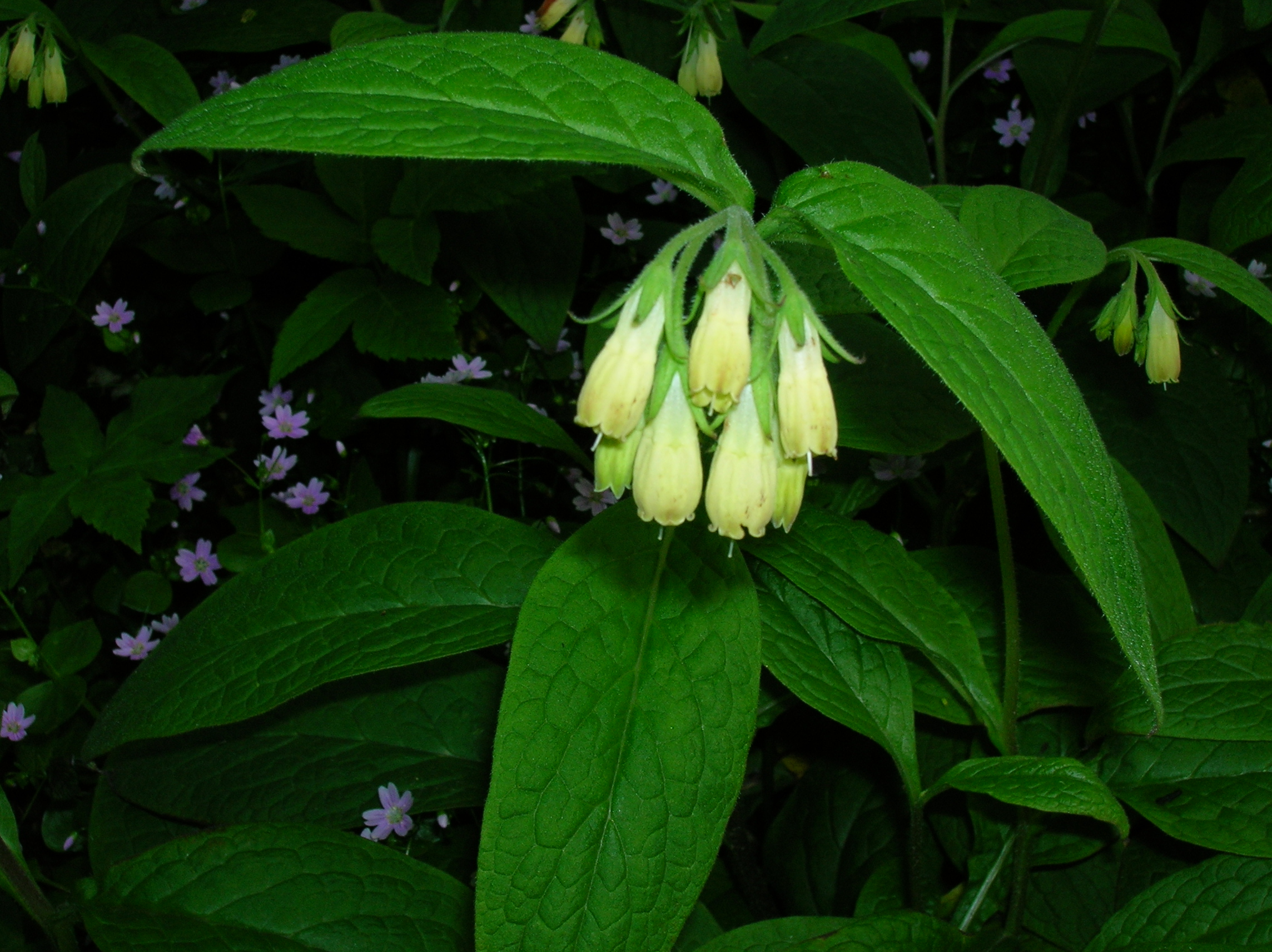
Tuberous comfrey flowers from April to June, however it also reproduces asexually, that is vegetatively, having rhizomes that allow it to spread out from the original site, colonising and competing as it grows. This process continues into the autumn and the young clonal plants can be seen at this time of year, whilst the parent plants leaves are rotting down. Being very hardy, this plant is well able to survive northern winters. Both the stems and leaves are softly hairy, the leaves have deep veining.
The flowers themselves are a subtle pale creamy yellow, a significant characteristic for separating its identity from the purple flowered Russian Comfrey. The usual pollinators are the common carder bumble bee, honey bee, and red mason bee. The stem and leaves are clothed with soft hairs. The stem usually remains unbranched and the leaves are distinctly veined with a clear reduction in size from top to base.
Distribution
Symphytum tuberosum can be found throughout Europe. In Great Britain it is naturally less common in the south, and distribution maps show the species to be common in Scotland and present, but uncommon, throughout much of England and Wales.
On the Isle of Skye now it has a well-established and wide distribution thanks to planting, this has also occurred in Ireland. The North American west coast has a number of introduced S. tuberosum sites.
Medicinal uses
Vernacular common names such as 'knitbone' reveal the healing role that tuberous comfrey and the various hybrid comfreys have played in herbal medicine throughout the ages. In these traditional cures, the recipes make use of the leaves & roots, the former being used to speed up the healing of minor abrasions through their being applied directly to the damaged skin under a compress.
Culinary uses
In spring the fresh young leaves may be used as an herb in cooked recipes, however due to their hairy nature and mildly toxic properties they are not eaten raw. As with dandelion, the root makes a palatable and non-acidic alternative to coffee once prepared, roasted until brown & brittle, and grind it into a powder.
References
References
- {{PLANTS
- {{BSBI 2007
- [http://www.plant-identification.co.uk/skye/boraginaceae/symphytum-tuberosum.htm The Flora of Skye]
- [http://www.paghat.com/borage.html Medicinal uses]
- (29 January 2018). "Symphytum tuberosum & Apis mellifera".
- [http://www.ecoflora.co.uk/search_species2.php?plant_no=1480180040 Ecological Flora of the British Isles.]
- [http://www.plantpress.com/wildlife/o830-tuberouscomfrey.php Natural England] {{Webarchive. link. (2009-05-31)
- [https://data.nbn.org.uk/Taxa/NBNSYS0000003992/Grid_Map NBN Gateway]
- [http://www.habitas.org.uk/flora/species.asp?item=3992 Flora of Ireland]
- [http://193.62.154.38/cgi-bin/nph-readbtree.pl/usedata/maxvals=10/firstval=1?SPECIES_XREF=Symphytum+tuberosum Scottish plant uses]
This article was imported from Wikipedia and is available under the Creative Commons Attribution-ShareAlike 4.0 License. Content has been adapted to SurfDoc format. Original contributors can be found on the article history page.
Ask Mako anything about Symphytum tuberosum — get instant answers, deeper analysis, and related topics.
Research with MakoFree with your Surf account
Create a free account to save articles, ask Mako questions, and organize your research.
Sign up freeThis content may have been generated or modified by AI. CloudSurf Software LLC is not responsible for the accuracy, completeness, or reliability of AI-generated content. Always verify important information from primary sources.
Report